- 256 pages
- English
- ePUB (mobile friendly)
- Available on iOS & Android
eBook - ePub
Understanding the Islamic Scripture
About this book
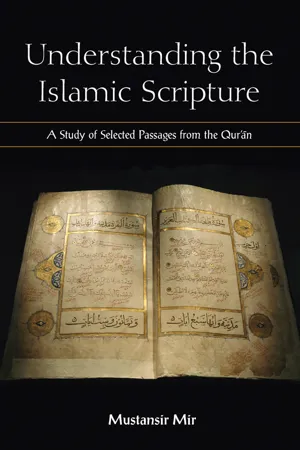
This book makes the Qur'an accessible to the English-speaking student who lacks the linguistic background to read it in the original Arabic by offering accessible translations of, and commentary on, a series of selected passages that are representative of the Islamic scripture. Mustanstir Mir, Director of the Center for Islamic Studies at Youngstown State University, offers clear translations and analysis of 35 selected passages of the Qur'an that will help students understand what kind of book the Qur'an is, what the scripture says, and how it says it.
Information
1 The Essence of the Qurʾān
1 Opening
In the name of God, the Most Compassionate, the Very Merciful.
1Thankful praise is due to God, the Lord of the worlds, 2the Most Compassionate, the Very Merciful, 3the Master of the Day of Recompense!
4You alone do we serve, and You alone do we ask for help. 5Guide us into the Straight Path—6the path of those whom You blessed, who neither became the objects of wrath nor went astray.
________________
Sūrah 1 is Makkan.
I. INTRODUCTION
This is the opening sūrah of the Qurʾān—hence its name, Al-Fātiḥah (literally, “The Opener”). It is generally believed to be one of the first sūrahs revealed to Muhammad. Some consider it to be the very first revelation, making it the first in the chronological as well as in the compilatory order of the sūrahs. On the latter view, a plausible one, the sūrah would be seen as inaugurating, on the one hand, the process of the Qurʾānic revelation and, on the other hand, the Qurʾān in its present arrangement.
One of the best-known sūrahs of the Qurʾān, Al-Fātiḥah is an integral part of the obligatory daily prayers. It is also recited to invoke blessings in a variety of situations—for example, in praying over a deceased person.
The invocation, “In the name of God, the Most Compassionate, the Very Merciful,” occurring at the beginning of this and all the other Qurʾānic sūrahs except sūrah 9, is best regarded as a self-standing verse that is part of the Qurʾān but not part of any sūrah. In other words, the invocation, called basmalah, signals the onset of a sūrah or sets one sūrah apart from another, and, in the case of those passages in this book that are complete sūrahs (chapters 1, 35, 36, and 37), it is given, in italics, at the start of the passages but is not counted as a verse of any of the sūrahs. For an explanation of the phrases “the Most Compassionate” and “the Very Merciful” in the basmalah, see section II, verse 2, below.
II. COMMENTARY
Verse 1: “Thankful praise.” This is a translation of the word ḥamd in the original text. The primary meaning of ḥamd is “gratitude,” though “praise” is part of the Arabic word’s meaning. One may praise a being even if one has not received any favors from it, but one shows gratitude to a being only when one receives some favor from it. Human beings owe gratitude to God because they are the recipients of countless blessings from Him. To offer gratitude is to offer praise as well, hence the rendering “thankful praise.”
“The Lord of the worlds.” “Lord” (Rabb) means “Sustainer” and “Master,” or rather, “Master because Sustainer.” “Worlds” (ʾālamīn) has, basically, the same sense as “kingdoms” in the expression “animal, mineral, and plant kingdoms,” with the qualification that there may be innumerable kingdoms, known and unknown, into which existence, or creation, can be divided. Arabian polytheism recognized God as the Supreme Deity but had set up many “Lords”—that is, beings who were believed to be administering different parts of the universe. This dichotomy between Godhead and Lordship effectively negated the divinity, providence, and other attributes of God. By stating that God is the Lord of all the worlds, the Qurʾān rejects the dichotomy, saying that God is not only the Supreme Deity, but also the caretaking Lord of the entire universe.
Verse 2: The Arabic words for “Most Compassionate” and “Very Merciful” are, respectively, Raḥmān and Raĥīm. The first of these two words denotes intensity; the second, permanence. In other words, God is always merciful, but on some occasions, He is especially compassionate. It is like saying that a certain person, ordinarily generous, is, on some occasions, especially generous. Thus, the two epithets—“the Most Compassionate” and “the Very Merciful”—represent two different but complementary aspects of Divine mercy, the second epithet being more than a simple repetition of the first.
Verse 3: God is the Master of all days—of the days of terrestrial life as well as of the Day of Recompense. But the verse singles out the Day of Recompense because, on that day, not even nominal or symbolic power will belong to anyone else, whereas, during earthly life, a degree of power—even if, in actuality, granted by God Himself—may be possessed by human beings.
Verse 4: The opening verse rejected the division between Godhead and Lordship. This verse now reinforces the idea of the unity of Godhead and Lordship by saying that God alone must be served or worshipped (Godhead) and that He alone must be petitioned for help in all situations (Lordship).
Verse 5: In verse 4, the speaker expresses a general commitment to serve God and decides to seek only God’s help. In verse 5, the speaker seems to have realized, in more specific terms, that possession of right guidance alone will enable one to translate that commitment into action. Having already resolved to seek help only from God, and being convinced that there can be no better source of right guidance than God, the speaker now prays to be guided to the Straight Path.
Verse 6: This verse offers an amplification of “the Straight Path.” The amplification is meant to express the commitment of the human speaker, who, after praying for guidance, now resolves to follow in the footsteps of those people of previous generations who took the Straight Path, earning God’s favor, and to shun the example of those who lived a life full of misdeeds, incurring God’s wrath, and of those who went too far afield in their erroneous belief or doctrine. The verse subtly suggests that, in its essentials, the Straight Path has always been the same and that those who follow this path are, irrespective of whether they belong to ancient times or to modern times, members of a single community.
III. THE QURʾĀN IN MINIATURE
Al-Fātiḥah is often called the Qurʾān in miniature—and appropriately. The principal themes of the Qurʾān are three: monotheism, prophecy, and the afterlife (see also chapter 6, “The Throne Verse,” section III). All those themes are encapsulated in this sūrah, which takes the form of a prayer uttered by a human speaker, who represents humanity In verses 1–2, the speaker acknowledges that there is only one God, who controls and sustains the heavens and the earth. In verse 3, the speaker acknowledges that God will one day judge humanity In verses 4–6, the speaker, having realized that the above-mentioned truths about God must be acknowledged by all human beings, now explicitly speaks on behalf of humanity—hence the use of the first person plural pronoun in this part of the sūrah. After making a commitment to serve only God (verse 4), but not knowing the proper way of serving Him, the speaker asks God Himself for guidance (verse 5). In verse 6, the speaker expresses the determination to join the company of the rightly guided people of the past and to shun the company of those who failed to take the Straight Path. The central verse in the sūrah is the fifth: “Guide us into the Straight Path.” The first four verses lead up to the petition made in this verse, and the last verse elaborates the petition.
To this petition made in Al-Fātiḥah, the rest of the Qurʾān—divine guidance vouchsafed to the Prophet Muḥammad—may be taken as a response. Thus, Al-Fātiḥah is an outline or abstract that finds its elaboration or explication in the rest of the Qurʾān. This understanding of the relationship between Al-Fātiḥah and the rest of the Qurʾān lends some support to the view that Al-Fātiḥah was the very first revelation received by Muḥammad.
IV. THE SŪRAH AS A LOGICAL ARGUMENT
As stated above, Al-Fātiḥah takes the form of a prayer, which, taught by the revelation itself, is made to flow on human lips. The tone of the prayer appears to be exclamatory, expressive of emotion, rather than declarative, expressive of contemplative thought. Underlying the emotion, though, is a certain logical argument, which may be stated as follows:
1. The human speaker observes the universe, noting its order and harmony, reflects on the remarkable system of providence that is attested everywhere in the world, and recognizes and appreciates the blessings of which all of existence is a recipient. The speaker reaches the conclusion that the source of all this providential care is a single being—a sovereign who created everything and sustains everything. Having reached this conclusion, and having realized that God is that being, the speaker exclaims: “Thankful praise is due to God, the Lord of the worlds” (verse 1).
2. The speaker next wonders why God is taking such providential care of the universe. Is He under any obligation to do so? A little reflection yields the conclusion that, being under no such obligation, God is doing so out of sheer mercy and compassion on His part. This realization leads the speaker to say: “The Most Compassionate, the Very Merciful” (verse 2).
3. At this point, a question arises in the speaker’s mind: “Does God’s providential care place any responsibility on me?” The question arises because privilege entails responsibility. Human beings, if they have received divine blessings, must be held accountable for the way they use and respond to those blessings. The thought of accountability leads the speaker to the notion of a day on which all human beings will be called to account, a day on which God will sit in judgment. So, the speaker says: “the Master of the Day of Recompense” (verse 3).
4. If there is going to be a Day of Judgment, then one needs to know exactly what success and failure on that day will consist in. In other words, one feels that one is in need of guidance. But before one can ask God for guidance—and what better source of guidance than God Himself?—one needs to submit to Him and declare one’s subordinate status to Him, and one can do so by acknowledging God as the sole being worthy of being served and the sole source of help and support. Accordingly, the speaker, representing humanity, says: “You alone do we serve, and You alone do we ask for help” (verse 4).
5. Having submitted to God, the speaker, still using the plural pronoun, now asks for direction: “Guide us into the Straight Path” (verse 5).
6. The speaker not only prays for guidance to the Straight Path in a theoretical sense, but also expresses a commitment to follow that path in practice by walking in the footsteps of those who took that path and by shunning the example of those who rejected that path or deviated from it: “The path of those whom You...
Table of contents
- Cover
- Title Page
- Copyright Page
- Dedication
- Table of Contents
- Preface
- Acknowledgements
- General Introduction
- 1 The Essence of the Qurʾān
- 2 The Story of Adam
- 3 Abraham Builds the Kaʿbah and Prays for a Prophet
- 4 True Piety
- 5 A Battle Between the Israelites and the Philistines
- 6 The Throne Verse
- 7 No Compulsion in the Matter of Religion
- 8 Spending in the Way of God
- 9 Making a Loan Transaction
- 10 Creed and Commitment
- 11 Love of Desirable Things
- 12 Jesus: Birth, Miracles, and Mission
- 13 God’s Blessing upon the Arabs
- 14 One God, One Humanity
- 15 Orphans, Justice, and Polygamy
- 16 Structure of Authority in Islam
- 17 Matrimony: Some Issues
- 18 Prophets and Revelation
- 19 Torah, Evangel, and Qurʾān
- 20 Nature as a Repository of Signs
- 21 The Primordial Covenant
- 22 Charity Offerings
- 23 Joseph Interprets the Dreams of His Prison-Mates
- 24 Inviting People to the Faith
- 25 Commandments
- 26 God Makes Moses a Prophet
- 27 War in Self-Defense
- 28 God Is the Light of the Heavens and the Earth
- 29 Qualities of the Servants of God
- 30 Luqmān’s Advice to His Son
- 31 Behavior Unbecoming of a Believer
- 32 Relations with Non-Muslims
- 33 The Hypocrites
- 34 An Argument for the Afterlife
- 35 Muḥammad Consoled
- 36 Judgment Day
- 37 Serving Only God
- Concluding Remarks
- Notes
- Glossary
- Works Consulted
- Index
Trusted by 375,005 students
Access to over 1.5 million titles for a fair monthly price.
Study more efficiently using our study tools.
Frequently asked questions
Yes, you can cancel anytime from the Subscription tab in your account settings on the Perlego website. Your subscription will stay active until the end of your current billing period. Learn how to cancel your subscription
No, books cannot be downloaded as external files, such as PDFs, for use outside of Perlego. However, you can download books within the Perlego app for offline reading on mobile or tablet. Learn how to download books offline
Perlego offers two plans: Essential and Complete
- Essential is ideal for learners and professionals who enjoy exploring a wide range of subjects. Access the Essential Library with 800,000+ trusted titles and best-sellers across business, personal growth, and the humanities. Includes unlimited reading time and Standard Read Aloud voice.
- Complete: Perfect for advanced learners and researchers needing full, unrestricted access. Unlock 1.5M+ books across hundreds of subjects, including academic and specialized titles. The Complete Plan also includes advanced features like Premium Read Aloud and Research Assistant.
We are an online textbook subscription service, where you can get access to an entire online library for less than the price of a single book per month. With over 1.5 million books across 990+ topics, we’ve got you covered! Learn about our mission
Look out for the read-aloud symbol on your next book to see if you can listen to it. The read-aloud tool reads text aloud for you, highlighting the text as it is being read. You can pause it, speed it up and slow it down. Learn more about Read Aloud
Yes! You can use the Perlego app on both iOS and Android devices to read anytime, anywhere — even offline. Perfect for commutes or when you’re on the go.
Please note we cannot support devices running on iOS 13 and Android 7 or earlier. Learn more about using the app
Please note we cannot support devices running on iOS 13 and Android 7 or earlier. Learn more about using the app
Yes, you can access Understanding the Islamic Scripture by Mustansir Mir in PDF and/or ePUB format, as well as other popular books in Theology & Religion & Islamic Theology. We have over 1.5 million books available in our catalogue for you to explore.