Concrete Design covers concrete design fundamentals for architects and engineers, such as tension, flexural, shear, and compression elements, anchorage, lateral design, and footings. As part of the Architect's Guidebooks to Structures Series it provides a comprehensive overview using both imperial and metric units of measurement. Written by experienced professional structural engineers Concrete Design is beautifully illustrated, with more than 170 black and white images, contains clear examples that show all design steps, and provides rules of thumb and simple tables for initial sizing. A refreshing change in textbooks for architectural materials courses, it is an indispensable reference for practicing architects and students alike. As a compact summary of key ideas it is ideal for anyone needing a quick guide to concrete design.
- 338 pages
- English
- ePUB (mobile friendly)
- Available on iOS & Android
eBook - ePub
About this book
Information
Chapter 1
The National Assembly Building, Dhaka, Bangladesh (Sher-e-Bangla Nagar Capital)
The making of the government complex in Dhaka is a story about the brave people of East Pakistan, now Bangladesh. It is also a story about Louis Kahn, the famous architect, his associates, friends, supporters, and the industrious workers who toiled from dawn to dusk, carrying the concrete by hand up bamboo scaffolding. It is a story about genius and generosity and how Kahn helped lift an entire nation through his design and the creation of a capital amidst seemingly insurmountable challenges.
1.1 Introduction
1.1.1 Politics
The genesis of a second capital in Dhaka, East Pakistan, began in 1947 with the British partitioning of India, when national boundaries were cut along religious majority lines. After that tumultuous and bloody event, East and West Pakistan were geographically separated by India, yet they shared a capital in Karachi, West Pakistan.
Heeding a growing tide of resentment, in 1960, President Ayub Khan recommended the construction of a second capital in Dhaka, East Pakistan, to be used on a rotating basis, for six months of the year. The aim was to bridge the economic and cultural divide between East and West Pakistan.1
1.1.2 The Dhaka Commission
Ayub Khan wanted local architect Muzharul Islam to design the capital. Muzharul had earned an engineering degree from the University of Calcutta, an architecture degree from the University of Oregon, and a master’s degree in architecture from Yale. At the time, he was the only Bengali with enough architectural training to successfully design a project of this magnitude but he convinced Ayub Khan to hire an architect with international stature. Three architects were considered: Alvar Aalto, Le Corbusier, and Louis I. Kahn. Le Corbusier was busy and Aalto was ill, therefore, Kahn was selected. Earlier in 1962, Kahn had won the Indian Institute of Management commission; now his hands were full with two major projects halfway around the world.
1.2 Design
1.2.1 The Program
In Kahn’s words:
It is the second capital, which is the legislative capital, and the executive capital is in West Pakistan. I received a program which was in acres. They said “Supreme Court, ten acres. Meeting room, five acres. Hostels, eight acres.” I had no other program, and that was a wonderful program because then I knew that I had to think of what a hostel is … I also realized, by just observing their religious habits, that the assembly room itself had to have a mosque interwoven into it. I knew how dangerous this was but as soon as I realized that some building had to be there or something interwoven, a mosque, some relation to the assembly, I felt I knew the entire program. The complexity meant nothing to me.2
1.2.2 The Design Team
Lou had a talented and loyal group of professionals supporting him in Philadelphia and in Dhaka. Past employees also influenced him; Anne Tyng, a former associate in Kahn’s firm, had conceived the geometry for the Trenton Bath House, which used both modern and classic geometrical forms. Lou claims that project as his architectural epiphany.
Another team member was Henry Wilcots, who was working as an architect for William Perry & Associates in Dhaka, Pakistan, when he met Lou in 1963. Henry’s knowledge of local building customs and his architectural insight appealed to Lou. When Henry returned home to Iowa in 1964, he found a telegram from Kahn saying, “Welcome whenever you are ready.” Henry joined Kahn’s firm in Philadelphia shortly thereafter and made many trips to Dhaka, first with Lou, then alone as his representative and eventually with Kahn’s successor firm—David Wisdom and Associates. Henry saw the Dhaka project through from start to finish and the project would not have been possible without him.3
Also, assisting from Dhaka was Lou’s friend, Muzharul Islam, who was both politician and architect. He helped Kahn interpret local culture and protected him from harsh criticism regarding costs and delays during construction.4 With Muzharul Islam’s help, Khan assimilated and combined the indigenous Mughal architectural forms with his modern Beaux-Arts style and set a new standard for architectural expression.
August Komendant, who had helped Kahn on other projects such as Richards Medical Research building at Penn, would have been the structural engineer for the Dhaka work. When he proposed to the Pakistan Works Department (PWD) that 15 workers could do the same as 500, given mechanization and his brand of Teutonic efficiency, he eliminated himself from the job. Pakistan wanted many people earning wages, not just a few.5
1.2.3 Timeline
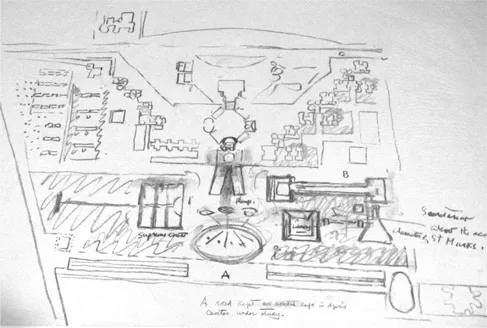
Figure 1.1 Early master plan
Source: University of Pennsylvania, Kahn Archives.
After the award of the contract, Kahn spent six days in January of 1963 touring Pakistan with Muzharul—experiencing the culture and learning how local builders respond to the frequent flooding by simply elevating the site.6 Returning to Philadelphia, he developed a master plan (Figure 1.1) and presented it in March of 1963. Kahn worked on the plans for a year without a formal architect–client agreement. One was eventually drafted and signed in 1964.7
By October of 1964, the structural engineers at Keast & Hood had completed the foundation design drawings and carried the Assembly Building superstructure through Design Development. After that, former Keast & Hood engineer, Harry Palmbaum, took over as structural engineer.8
1.2.4 Presentations
At various intervals during the initial design period, Lou made scale models for President Ayub Khan and the Pakistani Public Works Department (the owner). Delivering these meant carrying them on a plane from Philadelphia to Pakistan. On one occasion, this task fell to Nick Gianopulos of Keast & Hood, the structural engineer. He was challenged when boarding a plane with a plywood box containing a model but justified that it was for the president of Pakistan and that it could not be trusted to the baggage compartment.9
1.2.5 An Uncommon Building
The National Assembly building is the focal point and largest structure of the capital complex. The superstructure is made of cast-in-place concrete (brick was ruled out due to the loads and height). Foundations are on pressure-injected footings (P.I.F, i.e. “Franki type” piles). The main meeting spac...
Table of contents
- Cover
- Title
- Copyright
- Dedication
- Contents
- List of Figures
- List of Tables
- Notes on Contributors
- Acknowledgments
- Note on the Text
- Introduction
- 1 The National Assembly Building, Dhaka, Bangladesh (Sher-e-Bangla Nagar Capital)
- 2 Concrete Fundamentals
- 3 Concrete Tension
- 4 Concrete Bending
- 5 Concrete Shear
- 6 Concrete Compression
- 7 Concrete Lateral Design
- 8 Concrete Foundations
- 9 Concrete Anchorage
- Glossary
- Appendix 1 List of Units
- Appendix 2 List of Symbols
- Appendix 3 Unit Conversion Tables
- Appendix 4 Column Interaction Diagrams
- Bibliography
- Index
Trusted by 375,005 students
Access to over 1.5 million titles for a fair monthly price.
Study more efficiently using our study tools.
Frequently asked questions
Yes, you can cancel anytime from the Subscription tab in your account settings on the Perlego website. Your subscription will stay active until the end of your current billing period. Learn how to cancel your subscription
No, books cannot be downloaded as external files, such as PDFs, for use outside of Perlego. However, you can download books within the Perlego app for offline reading on mobile or tablet. Learn how to download books offline
Perlego offers two plans: Essential and Complete
- Essential is ideal for learners and professionals who enjoy exploring a wide range of subjects. Access the Essential Library with 800,000+ trusted titles and best-sellers across business, personal growth, and the humanities. Includes unlimited reading time and Standard Read Aloud voice.
- Complete: Perfect for advanced learners and researchers needing full, unrestricted access. Unlock 1.5M+ books across hundreds of subjects, including academic and specialized titles. The Complete Plan also includes advanced features like Premium Read Aloud and Research Assistant.
We are an online textbook subscription service, where you can get access to an entire online library for less than the price of a single book per month. With over 1.5 million books across 990+ topics, we’ve got you covered! Learn about our mission
Look out for the read-aloud symbol on your next book to see if you can listen to it. The read-aloud tool reads text aloud for you, highlighting the text as it is being read. You can pause it, speed it up and slow it down. Learn more about Read Aloud
Yes! You can use the Perlego app on both iOS and Android devices to read anytime, anywhere — even offline. Perfect for commutes or when you’re on the go.
Please note we cannot support devices running on iOS 13 and Android 7 or earlier. Learn more about using the app
Please note we cannot support devices running on iOS 13 and Android 7 or earlier. Learn more about using the app
Yes, you can access Concrete Design by Paul McMullin, Jonathan Price, Esra Hasanbas Persellin, Paul McMullin,Jonathan Price,Esra Hasanbas Persellin, Paul W. McMullin, Jonathan S. Price, Esra Hasanbas Persellin in PDF and/or ePUB format, as well as other popular books in Architecture & Architecture General. We have over 1.5 million books available in our catalogue for you to explore.