- 192 pages
- English
- ePUB (mobile friendly)
- Available on iOS & Android
eBook - ePub
On the Sacred
About this book
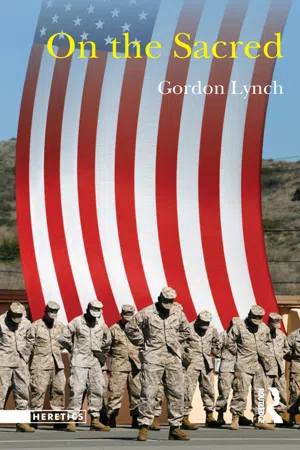
Progressive, modern societies hold the promise of the triumph of reason and the banishing of primitive, religious impulses to a bygone age. If this statement is orthodoxy to much of Western liberal thought, then Gordon Lynch's On the Sacred is heresy. Challenging the myth of the idealized rational society, Lynch argues that emotionally-charged forms of the sacred remain an inevitable foundation of social life. Modernity has not rid us of the sacred, but merely presented us with new sacred forms focused around humanity, nature and the nation. Drawing on examples from the changing status of the British monarchy, the growing influence of humanitarian NGOs and moral justifications for the invasion of Iraq, On the Sacred presents a compelling account of what the sacred is and why it still matters for us today. By the end of the book, Lynch calls us to a new understanding of our moments of deep moral certainty, challenging us to think about the harm we do in the name of what we call sacred.
Information
1
The idea of the sacred
On the morning of Monday 15 October 1894, a trainee officer in the French Artillery, Captain Alfred Dreyfus, reported to a meeting that he had been ordered to attend at the Ministry of War in Paris. Originally told that this was part of an inspection of other trainees, Dreyfus was surprised to be met by another officer and three unknown civilians, who were later revealed to be senior officers in the police and army intelligence service. After obeying a mysterious request to write a letter dictated from a document by the other officer, Dreyfus was then arrested for high treason.
The charge related to the sale of French military secrets to the German military attaché in Paris. A memorandum recording this sensitive information was recovered from a waste bin at the German Embassy by one of the many domestic workers employed as agents by French intelligence, and passed back to the Ministry of War on 26 September. The degree of detail in the memo caused considerable alarm among the French General Staff, and an urgent investigation was set in place to trace its source. With few leads to go on, the investigators decided to narrow their search based on a profile of the kind of officer that would have access to such information (making, as it later turned out, a number of unwarranted assumptions as they did so). The profile they settled on was that of a trainee officer in the Artillery, who had access to a range of sources of information in the Ministry of War as a result of their training programme.
When the names of officers fitting this profile were scrutinized, Dreyfus quickly attracted the investigators’ attention. He was personally known to, and disliked by, some of the investigators. More pertinently, Dreyfus was Jewish. In an increasingly virulent climate of anti-Semitism, it seemed obvious to the investigating team that only a Jew could have been capable of the dishonour that such treason against the French nation required. Throughout the subsequent investigation and Dreyfus’ court martial, however, his prosecutors continually found their progress hampered by lack of evidence. The lack of compelling evidence was, in retrospect, unsurprising as the breach of secrecy had in reality been committed by another French officer, Ferdinand Esterhazy, who was completely unconnected with Dreyfus.
Despite intensive interrogations, Dreyfus continually protested his innocence. The document that Dreyfus had written under dictation at the meeting on 15 October had been extracts from the memorandum recovered from the German Embassy, and a questionable matching of his handwriting to the original formed the only material evidence in the case. In the face of this, senior military and government figures had reservations about the wisdom of proceeding with any prosecution. By 1 November, however, the story of Dreyfus’ arrest had been leaked to the press, with several newspapers hinting that if Dreyfus were not charged or acquitted this would be the result of the influence of other powerful Jews. As Dreyfus became a notorious figure of public hate, so his prosecution became inevitable. His conviction by court martial, on 23 December, was only made possible through a trial dogged by procedural irregularities and the submission of a secret dossier of loosely circumstantial evidence that was passed on to the judges but never made available to Dreyfus’ counsel. Dreyfus was subsequently shamed in a military degradation ceremony, his uniform ceremonially torn to shreds and his sword broken. He was then consigned to a crushing period of solitary confinement in appalling conditions on a remote island off the coast of French Guiana, the only inhabitants of which were Dreyfus himself and the guards stationed to keep watch over him. Forbidden to speak to anyone, apart from occasional visits from the prison physician, Dreyfus’ world was reduced to a small, poorly lit and ventilated cell, and a small exercise yard. Following inaccurate newspaper reports of a failed escape attempt, Dreyfus’ conditions worsened further as he was kept in leg irons during the night and his small cell and exercise yard were encircled by a high wall.
Within two years of his court martial, a growing number of writers, academics and political activists joined Dreyfus’ family in seriously questioning his conviction. Over time, Dreyfus’ case became a cause célèbre, with calls for a proper retrial and acquittal attracting international sympathy from public figures including Queen Victoria and Mark Twain. The Dreyfus Affair was not simply a notorious case of a miscarriage of justice, however, but exposed deeper fault lines in French society. His supporters, the “Dreyfusards”, included writers, intellectuals and activists committed to the principle of individual rights, many of whom became members of the newly formed Ligue des droits de l’homme, a proto-human rights campaign group. Those supporting Dreyfus’ conviction and harsh punishment, the “anti-Dreyfusards”, included a coalition of nationalists and anti-Semites, some of whom believed that even if Dreyfus were innocent it would be better not to expose the injustice committed by the French establishment in order to protect the honour of the nation.
The conflict between these two sides intensified through political action, legal prosecutions and street protests. When Émile Zola wrote his pamphlet J’Accuse in support of Dreyfus, and making various allegations against his investigators, he was soon put on trial for defamation and escaped a prison term only through fleeing the country. Such was the nationalist hostility against Dreyfus that Paul Déroulède, the leader of the populist Ligue des patriotes, sought to channel this into what proved to be a poorly executed coup d’état in 1899. In the same year, the royalist pretender the Duc d’Orléans met with leaders of another popular militia, the Ligue anti-sémitique, and Orleanist funds were directed to the organization on the basis that its fighting power might enable the return of the monarchy to France. As events in Germany were later to demonstrate, the notion that popular anti-Semitism could be used to overturn democratic politics was not that far-fetched. Against this turbulent backdrop, the decision by the French government to give Dreyfus a retrial (which again convicted him in September 1899, this time with “extenuating circumstances”), and then eventually to give a full amnesty to all those involved in the affair in the following year, was not so much an act of conscience as an attempt at damage limitation. Fears of an international boycott of the Paris Exposition of 1900 over the Dreyfus case also forced the government’s hand in this regard. It is a mark of the success of these measures in taking the heat out of the controversy that when Dreyfus was finally exonerated of any crime in 1906, and reappointed to an army commission, public interest barely stirred. He still remained a figure of hate among certain sections of the public, though, and was attacked by a stranger in the street two years later. But the wider public desire to forget the case was such that, when Dreyfus eventually died in 1935, the mainstream press gave virtually no coverage to the internationally notorious controversy that dogged his adult life.
From his post at the University of Bordeaux, the pioneering sociologist Émile Durkheim watched the unfolding events of the Dreyfus Affair with an ever-deepening sense of moral and intellectual clarity. Born in 1858, Durkheim was both the descendent of a line of Jewish rabbis and the product of a French patriotism galvanized by the Franco-Prussian War of 1870–71, and the subsequent Prussian occupation of his home region of Alsace-Lorraine. This background sensitized him to the anti-Semitic currents in society that generated such widespread support for Dreyfus’ conviction. His patriotic commitment to the Third Republic, born out of the horror and shame of the 1870–71 war, also made him acutely aware of what the Dreyfus Affair indicated about what might bind the republic together, and what might tear it apart.
Durkheim had already given considerable attention in his work to the question of the moral foundations of modern society. This was no abstract intellectual interest. The question of how modern societies could hold together had particular significance given the political and social instability of post-Revolutionary France. Throughout the nineteenth century, France was subjected to a succession of struggles between fragmented republican and monarchist groups. In the period following 1792, French society had undergone a bewildering succession of changes, moving from revolution to a republic, then a hereditary empire, a constitutional monarchy, a brief return to Napoleonic rule, a restored monarchy (which veered towards an absolute monarchy before being reined back into a constitutional form), a republic, a brief dictatorship, a republic, an empire, a republic, the short-lived and brutally suppressed revolution of the Paris commune, and then, finally, the restoration of the Third Republic in 1871. Although the Dreyfus Affair came during the longest period of political stability France had seen for a hundred years, it also revealed how fragile loyalties were to the new republic and how easily French society could be split asunder again.
The Dreyfus Affair had two profound effects on Durkheim’s thought. First, it deepened his conviction that a particular kind of moral faith was necessary to hold modern society together. In his earlier book, The Division of Labour in Society, published in 1893, Durkheim had suggested that while modern societies tended to be focused less strongly on a set of common beliefs and values, the rights of the individual was one common focus that might persist. In the wake of the injustice of Dreyfus’ conviction, Durkheim became more deeply convinced of the urgency of such a modern “cult of the individual”:
The human person, whose definition serves as the touchstone according to which good must be distinguished from evil, is considered as sacred, in what one might call the ritual sense of the word. It has something of that transcendental majesty which the churches of all times have given to their Gods. It is conceived as being invested with that mysterious property which creates an empty space around holy objects, which keeps them away from profane contacts … Whoever makes an attempt on a man’s life, on a man’s liberty, on a man’s honour inspires us with a feeling of horror in every way analogous to that which the believer experiences when he sees his idol profaned.
([1898] 1969: 21–2)
Durkheim became less of a detached observer of this faith, and more a passionate devotee, playing a leading role in the formation of Ligue des droits de l’homme and campaigning against the grievous profanation of the sacred rights of the individual manifest in the Dreyfus conviction. Second, in addition to deepening his advocacy of this modern religion, the Dreyfus Affair also made Durkheim increasingly interested in the power of sacred meanings for all societies. At the same time as the Dreyfus Affair deeply polarized French society over the sacred meanings of human rights and the honour of the nation, so Durkheim’s writing gave an increasingly central role to sacred beliefs and rituals in his broader theory of society.
This theory evolved over a number of years, and through what, for a modern sociologist, might seem a rather circuitous route. Increasingly convinced of the power of sacred commitments in social life, Durkheim turned his attention to trying to develop a more general theory of religion. One of the most influential sources for him was William Robertson Smith’s book The Religion of the Semites (1894), which argued that the Semitic religions of the Middle East served important functions in expressing and maintaining the social order from which they arose. Durkheim took up this idea (in probably the only ever instance of a book by a biblical scholar having a profound influence on social theory), and gradually nuanced his understanding of it through his detailed reading of a growing number of ethnographic studies on Australian aboriginal culture. Through this process, Durkheim generated two key claims that were central to his later work. First, the ways in which societies create systems of symbolic classification to make sense of the world was rooted not in abstract rationality, but in an emotional understanding of how the world related to objects that were regarded as sacred in that society. Second, sacred beliefs and rituals played a central role not just in expressing the self-understanding of social groups, but in binding their members into a sense of a shared moral order. Although basing these arguments in the analysis of so-called “primitive” societies, Durkheim argued that the role of the sacred could still be seen in modern societies, even though its effects might be lessened to a certain degree through scientific rationality.
Such arguments about the role of the sacred for human thought and social order might seem like the work of a covert religious sympathizer, trying to smuggle religion into our ways of thinking as the modern world seemed to be turning away from it. But nothing could be further from the truth. Durkheim was an ardent secularist, and one of his most important contributions to the French society of his day was his ideas about the content of secular, moral education, which were widely disseminated through the French school system. What drew Durkheim to the sacred was his growing sense that it was sacred symbols, passions and rituals that provided the best sociological explanation for how societies work. It was not, then, economic structures, demographic shifts or technological change that were the primary drivers of social life but the sacred meanings that societies gave to these things. The figure of Dreyfus, variously pilloried as the profane Jew threatening the purity of the French nation and feted as the tragic hero of a society still struggling to realize the sacred vision of human rights, powerfully demonstrated this point.
Durkheim’s theory of the sacred had significant limitations, not least of applying a theory ostensibly developed in relation to relatively homogenous “primitive” societies to making sense of the complexities of modernity. But it also set down some fundamental markers of how the study of the sacred might proceed on which the argument in this book is built.
The sacred beyond religion
The central aim of Durkheim’s 1912 monograph The Elementary Forms of the Religious Life was to attempt a definition of religion that could uncover the basic role that religious meanings and practices play in structuring social life. What Durkheim uncovered in this study, however, was a phenomenon much broader than our conventional definitions of “religion”. As many undergraduates in religious studies have since discovered, defining “religion” is no simple task. If we think of religions organized around belief in God or other supernatural powers, we can quickly find counter-examples of religions (such as forms of Buddhism) that do not involve this. Attempts to define religion in terms of common phenomena such as sacred texts, priests, institutions and rituals have also been shown to have a Western bias, in which it is assumed that Christianity (with its church-based system of scripture, doctrine and ritual) provides the model for what constitutes a fully developed religion. This not only provides a poor model for describing the highly diverse forms of “religion” that can be found across the world, but it also became a model by which some groups (under Western colonial rule) learned to shape their cultural traditions in ways that appeared more “religious”, and thus more intelligible and acceptable to their colonial rulers. As the definition of “religion” begins to unravel under a critical gaze, some scholars even begin to wonder whether we can even meaningfully speak of “religion” as a distinctive aspect of human culture at all beyond the way it has developed as a category in modern Western discourse.
While some of these critiques of the concept of religion have emerged in recent decades, Durkheim was aware of at least some of the basic problems with the concept of “religion” when he was writing a century ago. To avoid these, he turned to the notion of the sacred, arguing that religion should be understood as “a unified system of beliefs and practices relative to sacred things, that is to say, things set apart and forbidden – beliefs and practices which unite into one single moral community called a Church, all those who adhere to them” (Durkheim [1912] 2001: 44). The language of “Church” here is unhelpfully particularistic, and can simply be dispensed with. If we make that particular edit, though, the other elements of the definition – sacred things, beliefs and practices, moral community – provide the basis for an insightful way of analysing social life.
The first element of this definition worth considering is the concept of “sacred things”. Here Durkheim was not using the sacred simply as a synonym for things that we already conventionally define as “religious”. Nor was he assuming that the sacred simply referred to supernatural beings or God/gods. Rather, he saw sacred objects as being defined by the distinctive ways in which people experienced them and behaved in relation to them. Sacred objects were things “set apart”, radically different from any other aspect of mundane human life. They were to be treated with great care and respect, and preserved from any profanation. The protection of the sacred could take a physical form, such as keeping sacred objects in secret or guarded locations. It could also take an interior, symbolic form, through people learning to think and feel about sacred objects in the right kind of way. But what was common to all of this was a deep sense that the sacred had a different quality to the rest of social life, and that protecting the sacred was an unquestionable moral responsibility for any decent human being.
In this sense, then, to think of Durkheim’s work in The Elementary Forms of the Religious Life as a study in the definition of religion can be misleading. One of his most important insights is that there is no inevitability as to what comes to be regarded as sacred within human societies. Anything can, in principle, acquire the status of a thing “set apart”. Whenever the term “religion” is used, however inclusively, our thoughts naturally tend towards the divine, supernatural beings, heroes and saviours. But Durkheim’s sacred can find a much wider expression than that: in flags, war memorials, bills of rights and child protection procedures. The sacred is not the same as religion. Even to think about the sacred as a broader phenomenon of which “religion” is a subset can be a mistake, as not all religious activity has a sacred significance in Durkheim’s sense. When thinking about the sacred, it may be better for us, for the time being, simply to park our concept of “religion”, and not bring it into our analysis until we have learned much better to see the shapes the sacred takes in the contemporary world.
The sacred is non-contingent
Durkheim’s emphasis on the radically different nature of the sacred is one of the most important ideas to be taken from his work. At one point in The Elementary Forms, he wrote that the sacred and the profane are not equivalent to good and evil, because good and evil are two different points on the scale of human values. By contrast, he argued, the sacred and the profane are not even on the same scale; they are fundamentally different kinds of phenomena. It is possible to have a longer discussion about why Durkheim thought that, as well as challenge his ideas about the relationship between the sacred and profane (as we shall do shortly). But what makes Durkheim’s emphasis on the distinctiveness of the sacred so valuable is that it helps us to avoid some of the blurred thinking that occurs when people talk broadly about the sacred in relation to contemporary life. Often, the sacred is used to describe things that people particularly value in life, sometimes in highly personalized ways: “this place is sacred to me because it’s where I met my wife”. But to define the sacred as that which is highly valued loses the particular value of this concept, and generates misleading ideas about how we study what is sacred in people’s lives.1 It is much more accurate to think about the radically distinct phenomenon of the sacred as being experienced by people as non-contingent. By this, I mean that people regard forms of the sacred as not simply the product of particular cultures, or of the histories of nations or individuals, but as something essential to life itself.
Much of our life is lived in a messy, mundane world of petty negotiations, in which our activities, desires and self-presentation shift depending on what is going on around us. But when we encounter the sacred, we experience this as something that is not contingent on the vagaries of our lives. It is absolute, essential, a bedrock. It is not an essential part of the existence in the sense of a natural law, like the universal boiling point of water or the laws of gravity, but a moral structure. We experience the sacred as exerting an unquestionable claim over the conduct of social life, the breach of which elicits a powerful response. Burning a red poppy at a war memorial or the Stars and Stripes (on any occasion); torturing a child; shooting unarmed civilians who are peacefully protesting for democratic reform; flyin...
Table of contents
- Cover
- Half Title
- Title Page
- Copyright Page
- Table of Contents
- Acknowledgements
- Introduction
- 1. The idea of the sacred
- 2. The transient sacred
- 3. Nation and humanity: sacred forms in the modern age
- 4. The sacred and religion
- 5. Cultivating the sacred
- Further reading
- Bibliography
- Index
Trusted by 375,005 students
Access to over 1.5 million titles for a fair monthly price.
Study more efficiently using our study tools.
Frequently asked questions
Yes, you can cancel anytime from the Subscription tab in your account settings on the Perlego website. Your subscription will stay active until the end of your current billing period. Learn how to cancel your subscription
No, books cannot be downloaded as external files, such as PDFs, for use outside of Perlego. However, you can download books within the Perlego app for offline reading on mobile or tablet. Learn how to download books offline
Perlego offers two plans: Essential and Complete
- Essential is ideal for learners and professionals who enjoy exploring a wide range of subjects. Access the Essential Library with 800,000+ trusted titles and best-sellers across business, personal growth, and the humanities. Includes unlimited reading time and Standard Read Aloud voice.
- Complete: Perfect for advanced learners and researchers needing full, unrestricted access. Unlock 1.5M+ books across hundreds of subjects, including academic and specialized titles. The Complete Plan also includes advanced features like Premium Read Aloud and Research Assistant.
We are an online textbook subscription service, where you can get access to an entire online library for less than the price of a single book per month. With over 1.5 million books across 990+ topics, we’ve got you covered! Learn about our mission
Look out for the read-aloud symbol on your next book to see if you can listen to it. The read-aloud tool reads text aloud for you, highlighting the text as it is being read. You can pause it, speed it up and slow it down. Learn more about Read Aloud
Yes! You can use the Perlego app on both iOS and Android devices to read anytime, anywhere — even offline. Perfect for commutes or when you’re on the go.
Please note we cannot support devices running on iOS 13 and Android 7 or earlier. Learn more about using the app
Please note we cannot support devices running on iOS 13 and Android 7 or earlier. Learn more about using the app
Yes, you can access On the Sacred by Gordon Lynch in PDF and/or ePUB format, as well as other popular books in Social Sciences & Religion. We have over 1.5 million books available in our catalogue for you to explore.