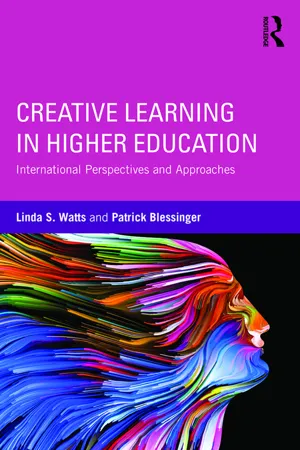
This book provides higher education faculty and administrators a scholarly resource on the most salient aspects and emerging trends in creative learning in higher education today. International contributors explore ways to foster creativity in any student, regardless of academic discipline or demographic characteristics and demonstrate that creativity is a skill all students can and should learn. Chapters analyzes how different countries and cultures implement creative learning, exploring issues of instruction, assessment, and ultimately how these practices are transforming learning. This important book helps higher education professionals understand and cultivate creative learning across disciplines in any college and university setting.
eBook - ePub
Creative Learning in Higher Education
International Perspectives and Approaches
- 246 pages
- English
- ePUB (mobile friendly)
- Available on iOS & Android
eBook - ePub
Creative Learning in Higher Education
International Perspectives and Approaches
About this book
Information
Principles and Concepts
1
History and Nature of Creative Learning
Defining Creativity
As discussed in the preface and as discussed by Csikszentmihalyi, Sawyer et al., creativity includes three key characteristics: (1) it is process and outcome oriented, (2) it is domain and field specific—the knowledge/symbols/rules and the experts/gatekeepers, respectively, and (3) it is connected to and embedded within the culture (i.e., the specific disciplinary culture as well as the broader socio-culture and environment) (Armstrong, 2006; Beghetto & Kaufman, 2010; Blessinger & Carfora, 2014, 2015a, 2015b; Blessinger & Wankel, 2013; Cropley, 2001; Csikszentmihalyi, 1996; Davis & Arend, 2013; Fleith, Bruno-Faria & Alan-car, 2014; Heist, 1967; Jackson, 2008; Jackson, Oliver, Shaw & Wisdom, 2006; Kaufman, Plucker & Baer, 2008; Kaufman & Sternberg, 2010; Kovbasyuk & Blessinger, 2013; Kuh, 2008; McIntosh & Warren, 2013; Nygaard, Courtney & Holtham, 2012; Piirto, 2004; Robinson, 2011; Sawyer, 2012; Sweet & Carpenter, 2013; Treffinger, Young, Selby & Shepardson, 2002; Vartanian, Bristol & Kaufman, 2013).
For the purposes of this book, we are not talking about everyday personal creativity—those simple acts that make us feel creative like creating a new dish for dinner—but rather those major creative achievements that change a domain and are recognized as such by the domain’s experts (the field). Creativity is a key aspect of what makes us human and it, say in the form of innovation, has become vital to economic development and competitiveness in the modern economy. Creative industries now represent an increasingly large part of economic output. According to Gantchev (2011), the creative industries account for over 11% of the gross domestic output in the United States. Increasingly, jobs that don’t require some form of creativity are being outsourced or automated (Sawyer, 2006). As such, it is safe to presume that creativity will continue to grow in importance and that creative learning will start to emerge as a major focus area in all disciplines and at all levels of education.
Brief History of Creativity
The word “create” appeared in English in the 16th century as artists used it to differentiate themselves from craftsmen to denote how their works were different from a craft. This is perhaps why the creative process, even today, is often associated primarily with the artistic fields and with the qualities of inspiration, vision, spontaneity, and imagination. The rationalist view emphasizes that creativity comes from the rational mind by conscious, intentional effort. However, this view was challenged during the Romantic period of the 18th century, where the focus shifted to the imagination and the irrational unconscious as the main source of creativity. During this period, the idea of the creative genius became a popular notion in Europe (Engell, 1981, Taylor, 1989). The word “creative” began to be used in the 18th century. The word “creativity” was invented in the late 19th century when it appeared in 1875 in History of Dramatic Literature, but didn’t appear in English dictionaries until after WWII. The word “creativity” is derived from the English word “create,” which is derived from the Latin word creatio, meaning to make (Weiner, 2000).
Although imagination and creativity are linked, they are fundamentally different. Whereas the mind can imagine virtually anything, no matter how fantastical or implausible in real life, creativity is concerned with how to apply imagination in real life, with all its limitations, constraints, boundaries, and other practical considerations. Thus, another way to view creativity is the meaningful application of imagination (Robinson, 2011).
Creativity not only happens at the individual and micro level but also at the group and macro level. The process of evolution, for example, is a self-perpetuating creative act, and global systems such as the Internet and social networks evolve by the collective creation by many people rather than by a single individual, as well as teams of people collectively working together to come up with a solution to a specific problem. But this book is mainly concerned with creativity that starts with the individual and then flows through, emerges from, and is sanctioned by the respective domain and field. Thus, creativity changes the domain in some meaningful way and may also result in an innovation in the broader society and economy. The great economic, social, and technological revolutions that have occurred over the past several hundred years (e.g., the Printing Revolution, the Industrial Revolution, the Digital Revolution) have been sparked by highly creative discoveries or inventions. Without creativity, progress cannot be made.
Because of the growing importance of creativity in society and education, creativity research continues to grow. Modern research into creativity began in the 1950s. Sawyer (2006) describes four waves of creativity research over the past sixty-five years:
- In the 1950s and ’60s, the first wave of research focused on the study of personalities of highly creative people.
- In the 1970s and ’80s, the second wave focused on cognition and individual mental processes.
- In the 1980s and ’90s, the third wave focused on socio-cultural factors—a social systems approach.
- In the fourth and current wave, creativity research is focused on an interdisciplinary approach to better understanding creativity, examining creativity from multiple points of view and multiple disciplinary domains (e.g., medicine, psychology, biology, social sciences, humanities, arts, philosophy, law, economics).
In addition, creativity can be defined from an individual perspective or from a socio-cultural perspective. The first and second waves of creativity research focused mainly on creativity from an individual perspective. From this perspective, creativity can be defined as a novel cognitive creation that is new to the world. This type of creativity is known as the “little c” of creativity. The individualist notion of creativity is associated with the individual mind and with the psychological study of the mind, with a focus more on the individual mind than on the creation itself (Kasof, 1995). Individualist approaches are reductionist in nature, in that they analyze creativity by breaking it down into its constituent parts of mental processes and behaviors that arise from these processes. The individualist approach tends to study creativity from the bottom up.
The third and fourth waves of creativity research focus mainly on creativity from a socio-cultural perspective. This perspective not only emphasizes individual processes and factors but also socio-cultural processes and factors. From this perspective, creativity can be defined as a creation of a novel and valuable outcome that is new to the world and judged as such by the appropriate experts in the domain. This type of creativity is known as the “Big C” of creativity. Since creativity starts with an individual or team, the “Big C” creativity also includes the “little c” creativity. For the purpose of this book, we focus on those types of creations that change the domain (e.g., creations that solve big problems, so-called wicked problems, creating new knowledge to the domain’s knowledge base, innovations) (Sawyer, 2006). Unlike individualist approaches, socio-cultural approaches focus on real-world creativity and it takes a systems approach, studying the whole creative phenomenon as a system of interrelated and interdependent parts. The socio-cultural approach tends to study creativity from the top down.
Amabile (1988) describes an innovation as an organization’s successful implementation of a new idea. Thus, innovations occur at the industry or macroeconomic level. Creativity may be the result of social creativity or natural creativity if the system is a social (group or community) or a natural (environmental or biological) system. For instance, a major creative solution to a big problem may be the result of the relatively smaller creative works (e.g., discoveries or inventions) of many people who have worked on a problem over centuries. The scientific method, for example, works this way by relying on the community of experts to continually generate new knowledge to expand the domain’s knowledge base. New knowledge is built upon previous discoveries and inventions. The advent of collective learning (e.g., the preservation and dissemination of knowledge from one generation to the next) in human history is perhaps the chief reason for the development of human civilization.
Thus, new knowledge is created directly from the existing knowledge base of the domain (e.g., in the form of books, journals, libraries, and other forms of knowledge preservation and dissemination). The formal learning process, by way of educational institutions at all levels, is the primary way (and the most effective and most efficient way) by which people learn to acquire this knowledge and how knowledge is passed from one generation to another (Blessinger & Carfora, 2014; Blessinger & Stockley, 2016; Kovbasyuk & Blessinger, 2013).
Over the past hundred years, formal learning systems have served as the primary means of social reproduction and continuity. It is no surprise therefore that these systems are now highly developed into a virtuous cycle of knowledge reproduction and that they will continue to grow in importance for human progress and survival. The result of these modern developments, together with the Digital Revolution and other information and communication technologies, has been a rapid increase in how fast new knowledge is created and disseminated around the world. The rate at which the total amount of human knowledge doubles is now measured in months; one day soon it will be measured in weeks, then days, and probably in hours (Blessinger, 2015a, 2015b).
Much has been written about creativity in general and about creativity in primary/secondary education (e.g., gifted programs) but relatively less so about creative learning in higher education. Although much has been written about creativity in terms of innovation and much has been written about critical and analytical thinking, there is a relative dearth (but growing) of literature on creative thinking and creative learning, especially in the context of formal learning environments in higher education. The fact that relatively little has been written about creative learning is especially interesting given the fact that creating as a form of cognitive learning development is at the top of Bloom’s taxonomy of learning objectives. This may suggest that the practical application of creating authentic creative learning environments is more challenging than it may appear.
Some approaches like undergraduate research are inherently focused on producing a learning environment where students must create new knowledge, but undergraduate research is just one means to foster creative learning. Given the relative paucity of academic literature specifically focused on creative learning in higher education, this book attempts to present an analysis supported by empirical data (via case studies and scholarly writing) to explain what creative learning is, how and why it works, and the practical implications of implementing it across disciplines and national cultures.
Assumptions About Creativity
As mentioned in the preface, new creations may be physical in nature such as a book, painting, invention, or other type of tangible product, or they may be mental in nature such as an idea, theory, method, or other type of intangible product. Creativity involves both cognitive (mental) processes (e.g., knowledge of the respective domain, divergent/convergent thinking, imaginative and critical problem-solving thinking, generation of new knowledge) and non-cognitive (affective and behavioral) processes (e.g., interest, motivation, self-efficacy, skill/ability) at the personal level, as well as disciplinary, socio-cultural, and other environmental factors (e.g., value of the creation to the domain, accepted as a new creation by the field). The defining characteristic of creativity is not the type of output but rather that the output is novel and valuable and accepted for inclusion in the domain by the domain’s experts.
Given the right motivation and the right environment to foster creativity, it follows that creativity can be learned, to varying degrees like anything else, by anyone. Therefore, this book starts with the major premise that creative learning is an intentional act. This book serves as a practical resource for educators on how to cultivate and foster creative learning in their classrooms, their disciplines, and the broader educational environment. Because creativity is domain specific and domain dependent, an underlying assumption in this book is that if one learns to be creative in, say art, it will not automatically make her/him more creative in domains outside of art, say science.
Thus, being creative in one domain does not automatically guarantee that one will be creative in other domains, any more than having a high IQ in one domain, say math, will automatically guarantee that one will have a high IQ in another domain, say languages. The major domains involve different modes of inquiry, different rules/symbols, different ways to generate new knowledge, and different disciplinary cultures and historical developments. This suggests that before one can be creative, one must first master the respective discipline. Research strongly suggests that it takes, typically, about 10,000 hours over 10 years of hard work and deliberate practice to master a domain and have the requisite knowledge, skills, and competence to be in a position to make the “Big C” creative contributions (Ericsson, Krampe & Tesch-Romer, 1993; Gardner, 1993; Sawyer, 2012).
However, notwithstanding the fact that each domain must be learned on its own terms, we believe there is value in learning to be creative in multiple domains and learning to make connections across domains which is the essence of multidisciplinary, interdisciplinary and transdisciplinary learning. In fact, some of the greates...
Table of contents
- Cover
- Title
- Copyright
- DEDICATION
- CONTENTS
- Foreword
- Preface
- PART I Principles and Concepts
- PART II Successful Practices in Creative Learning: Cases
- PART III Enhancing Creative Learning: Essays
- PART IV Conclusion
- About the Contributors
- Index
Trusted by 375,005 students
Access to over 1.5 million titles for a fair monthly price.
Study more efficiently using our study tools.
Frequently asked questions
Yes, you can cancel anytime from the Subscription tab in your account settings on the Perlego website. Your subscription will stay active until the end of your current billing period. Learn how to cancel your subscription
No, books cannot be downloaded as external files, such as PDFs, for use outside of Perlego. However, you can download books within the Perlego app for offline reading on mobile or tablet. Learn how to download books offline
We are an online textbook subscription service, where you can get access to an entire online library for less than the price of a single book per month. With over 1.5 million books across 990+ topics, we’ve got you covered! Learn about our mission
Look out for the read-aloud symbol on your next book to see if you can listen to it. The read-aloud tool reads text aloud for you, highlighting the text as it is being read. You can pause it, speed it up and slow it down. Learn more about Read Aloud
Yes! You can use the Perlego app on both iOS and Android devices to read anytime, anywhere — even offline. Perfect for commutes or when you’re on the go.
Please note we cannot support devices running on iOS 13 and Android 7 or earlier. Learn more about using the app
Please note we cannot support devices running on iOS 13 and Android 7 or earlier. Learn more about using the app
Yes, you can access Creative Learning in Higher Education by Linda S. Watts, Patrick Blessinger, Linda S. Watts,Patrick Blessinger in PDF and/or ePUB format, as well as other popular books in Education & Education General. We have over 1.5 million books available in our catalogue for you to explore.