![]() Part A
Part A
Supporting children with a hearing impairment![]()
1
What is deafness?
Hearing impairment, or deafness, is when the hearing is affected by a condition or injury. Some people are born with a hearing loss while others may develop it as they get older. Most commonly, hearing loss happens with age or is caused by loud noises.
In this book, the term ‘deaf’ refers to any level of hearing loss.
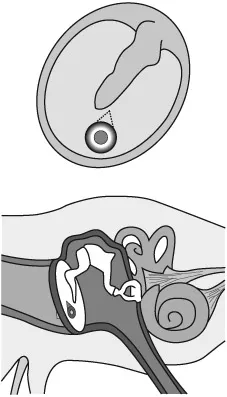
Conductive deafness is when sound cannot pass efficiently through the outer and middle ear to the cochlea and auditory nerve. Conductive deafness in children is often caused by ‘glue ear’. This condition can lead to a fluctuating hearing loss. This affects about one in five children at any time. Glue ear is a build-up of fluid in the middle ear. For most children, the glue ear clears up by itself and does not need any treatment. For some children with continuing or severe glue ear, hearing aids may be offered or the child may need surgery to insert tiny plastic tubes called grommets into the eardrums. They allow air to circulate in the middle ear and help to stop fluid building up.
Further information about glue ear and various treatments is available from the National Deaf Children’s Society (NDCS).
Sensori-neural (or nerve) deafness is when there is a fault in the inner ear usually because the hair cells in the cochlea or auditory (hearing) nerve are not working properly. Sensori-neural deafness is permanent. Children who have a sensori-neural deafness can have conductive problems in addition. This type of loss is known as mixed deafness.
![]()
2
Causes of deafness
There are many reasons why a child can be born deaf or become deaf early in life. It is not always possible to identify the reason, but parents may be offered further tests to try to establish the cause of the deafness.
About half the deaf children born in the UK every year are deaf because of a genetic (inherited) problem. Deafness can occur in families, even though there appears to be no family history of deafness. For some children the gene that caused the deafness may also cause other disabilities or health problems.
Deafness is a feature of certain syndromes, such as Waardenburg, Turner, Down’s, Treacher Collins and Goldenhar syndromes.
Deafness can also be caused by complications during pregnancy. Infections such as rubella, cytomegalovirus (CMV), toxoplasmosis and herpes can lead to a child being born deaf. There is also a range of medicines, known as ototoxic drugs, which can damage a baby’s hearing system before birth.
Being born prematurely can increase the risk of a child being or becoming deaf. Premature babies can be prone to infections that can lead to deafness. Severe jaundice or a lack of oxygen at some point can also cause deafness. Infections during early childhood, such as meningitis, measles and mumps, can be responsible for a child becoming deaf. An injury to the head or exposure to loud noise can also damage the hearing system.
As can be seen above, the causes of hearing loss are numerous. However, for many the cause is unknown. It may be from birth, have a genetic origin or develop later as a result of an illness or accident. There are various degrees of loss, and depending on severity they are classified as mild, moderate, severe or profound.
Where a hearing loss occurs before speech and language have developed, the impact on language acquisition will depend on its severity. Social and emotional development may also be delayed. It is important that there is early diagnosis so that positive, early intervention (such as the use of hearing aids and the support of a teacher of the deaf) can begin.
Where the loss occurs after the acquisition of language, the impact may not be so severe. However, there may still be emotional trauma and the need for social adjustment.
![]()
3
Levels of deafness
Mild hearing loss
Definition
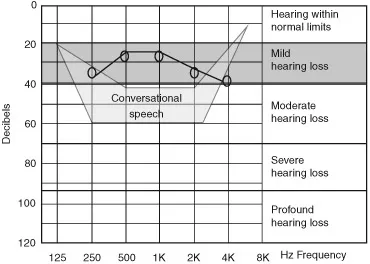
An average loss of no more than 40dB in the better ear. It may be permanent or temporary. A normal voice may be heard as a whisper.
A mild hearing loss as shown in a right ear
Implications
- This loss may go undetected as speech can be heard but it can be muffled.
- There may be difficulties in understanding speech in noisy environments.
- Where speech is misunderstood, this can cause confusion and lead to a breakdown in communication.
Strategies that should help
- A hearing aid may be prescribed but the disadvantages may outweigh the advantages.
- Background noise should be kept to a minimum.
- Advice from a teacher of the deaf.
- The development of appropriate communication skills.
- Deaf awareness training.
- Regular audiological reviews to monitor the hearing loss.
Moderate hearing loss
Definition
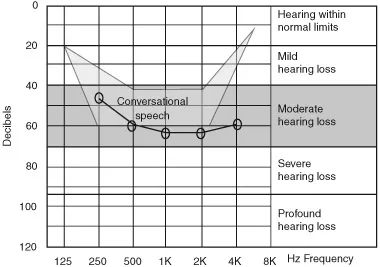
An average loss of between 41dB and 70dB in the better ear. A loud voice may be heard as a whisper.
A moderate hearing loss as shown in a right ear
Implications
- The implications will depend on the age of onset and diagnosis. If it is from birth, there may be delayed language development.
- When listening to speech, all sounds may not be heard.
- Speech may lack clarity because of an inability to hear sounds clearly.
- There may be gaps in vocabulary and general knowledge.
- The loss may go undetected or the implications not fully appreciated if the person has good lip-reading skills and coping strategies.
Strategies that should help
- A hearing aid/s will probably be provided but they will not return hearing to normal.
- Occasionally a radio aid system will be provided for use in a school or learning situation.
- Advice and support from a teacher of the deaf.
- In class, a seating position where children are able to see the teacher’s face clearly whilst at the same time being able to see peers.
- The development of appropriate communication skills.
- Deaf awareness training.
- Speech therapy may be recommended.
- Regular audiological reviews to monitor the hearing loss.
Severe hearing loss
Definition
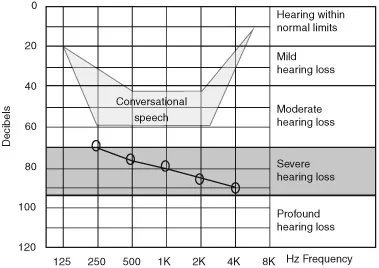
An average loss of between 71dB and 95dB in the better ear. Speech sounds will not be heard without amplification.
A severe hearing loss as shown in a right ear
Implications
- The implications will depend on the age of onset and time of diagnosis. If the loss was from birth and/or late diagnosis, there may be severely delayed language development. There will be little spoken language acquired naturally without intervention.
- Speech may be unclear with omissions and unnatural rhythms.
- There may be difficulties acquiring new language and vocabulary.
- Acquiring early literacy skills may be difficult.
- There may be breakdowns in communication on both sides because of an inability to understand what is being said.
- There may be difficulties understanding situations and what is expected, resulting in frustration and temper tantrums in young children.
- There may be a need to rely on visual clues.
- Sign language may be considered as the method of communication.
Strategies that should help
- Hearing aids will be provided but hearing will not return to normal; they should be worn at all times.
- A cochlear implant may be considered.
- A radio aid system may be provided for use in a school or learning situation.
- Consideration may be given to a placement in a Resource Base for deaf pupils attached to a mainstream school.
- Advice and support from a teacher of the deaf from diagnosis and continuing throughout education.
- Speech therapy is likely to be recommended.
Profound hearing loss
Definition
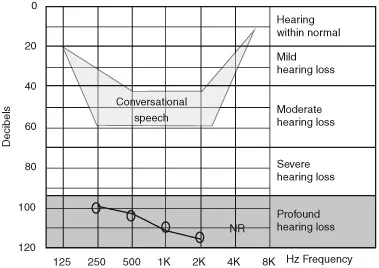
An average loss of greater than 96dB in the better ear. Only the very loudest sound will be heard without amplification.
A profound hearing loss as shown in a right ear
Implications
- The implications will depend on the age of onset and time of diagnosis. If the loss was from birth and/or late diagnosis, there may be severely delayed language development. There will be little spoken language acquired naturally without intervention.
- Speech development will probably be severely delayed and it may be difficult to understand.
- There may be difficulties understanding situations and what is expected resulting in frustration and temper tantrums in young children.
- Vocabulary and general knowledge will be restricted.
- Acquiring early literacy skills will be difficult.
- There may be breakdowns in communication on both sides because of an inability to understand what is being said.
- There are safety implications especially in hazardous situations such as crossing the road.
- There may be difficulties learning socially acceptable behaviour because of problems understanding what is expected.
- Concentrating on oral communication will be very tiring.
- There will be a need to rely on visual clues.
- Sign language may be considered...