Peter Hall and Colin Ward wrote Sociable Cities to celebrate the centenary of publication of Ebenezer Howard's To-morrow: A Peaceful Path to Real Reform in 1998 – an event they then marked by co-editing (with Dennis Hardy) the magnificent annotated facsimile edition of Howard's original, long lost and very scarce, in 2003. In this revised edition of Sociable Cities, sadly now without Colin Ward, Peter Hall writes: 'the sixteen years separating the two editions of this book seem almost like geological time. Revisiting the 1998 edition is like going back deep into ancient history'. The glad confident morning following Tony Blair's election has been followed by political disillusionment, the fiscal crash, widespread austerity and a marked anti-planning stance on the part of the Coalition government.
But – closely following the argument of Good Cities, Better Lives: How Europe discovered the Lost Art of Urbanism (Routledge 2013), to which this book is designed as a companion – Hall argues that the central message is now even stronger: we need more planning, not less. And this planning needs to be driven by broad, high-level strategic visions – national, regional – of the kind of country we want to see.
Above all, Hall shows in the concluding chapters, Britain's escalating housing crisis can be resolved only by a massive programme of planned decentralization from London, at least equal in scale to the great Abercrombie plan seventy years ago. He sets out a picture of great new city clusters at the periphery of South East England, sustainably self-sufficient in their daily patterns of living and working, but linked to the capital by new high-speed rail services.
This is a book that every planner, and every serious student of policy-making, will want to read. Published at a time when the political parties are preparing their policy manifestos, it is designed to make a major contribution to a major national debate.
Here we tell the strange story of how an obscure book by an equally obscure author, published at the end of the nineteenth century, transformed the entire way we think about cities and the way we should plan them. Ebenezer Howard – the ‘Garden City Geezer’ as George Bernard Shaw immortally titled him – offered a credo: the great city and the countryside offered unique bundles of good and bad things, but we could create a new kind of place, town–country, combining the best of both without any of the attendant evils. His garden city, a small town set in open countryside with homes and jobs close together, would be its physical manifestation. But it would not celebrate its success by growing indefinitely; instead, it would spawn a second garden city and then another, thus producing an entire cluster of such places, closely interconnected: the social city.
Howard, always the practical utopian, first founded an Association to promote his views and then started a company to bring the first garden city into being. The Town and Country Planning Association, still flourishing after 115 years, and Letchworth Garden City, vibrant in its 111th year, are his own brainchildren – as is Welwyn Garden City, which he launched in 1920 by buying the land at an auction while almost penniless. But his even larger memorial, started eighteen years after his death, are the twenty-eight British new towns – perhaps the greatest single creation of planned urbanism ever undertaken anywhere. So are their numerous imitations on the European mainland – but there, they became strangely transmuted into something else: the garden suburb or satellite town.
1 Howard's Beginning
DOI: 10.4324/9781315758367-1
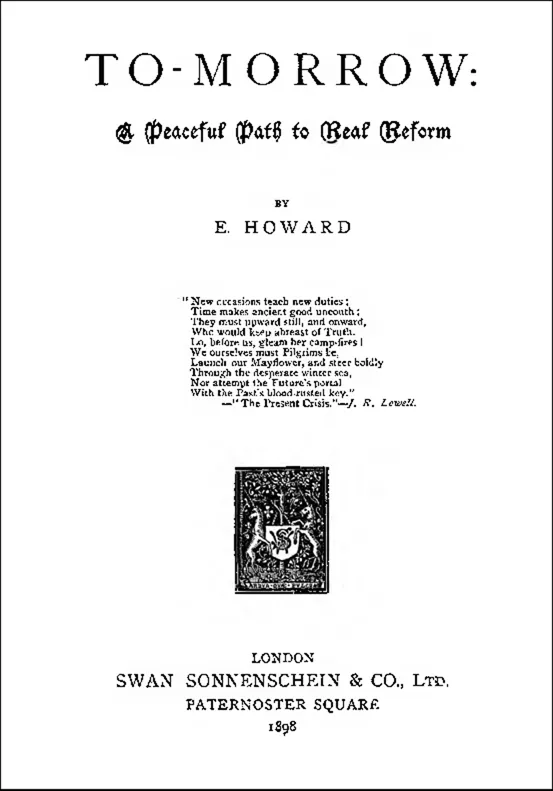
When Ebenezer Howard published To-Morrow: A Peaceful Path to Real Reform, in October 1898, he was an obscure 48-year-old shorthand writer living in genteel poverty with a harassed wife and four children in a modest house in north London. To get the book published, he had to accept a £50 loan from George Dickman, an American who was managing director of the Kodak photographic company in Britain and a fellow-believer in spiritualism. (For years after Howard’s wife died in 1904, he communicated with her through séances.) Howard may well have taken most of the copies himself, for distribution to friends. But it sold well enough to encourage the publishers, Swan Sonnenschein, to issue a cheap paperback issue at a shilling; and soon after 1900 3,000 copies, in both editions, had been sold (Fishman, 1977, p. 54, quoting Howard’s draft of an unfinished draft autobiography; Beevers, 1988, pp. 43, 57, 104).
It was a modest start. But, within a decade, republished as Garden Cities of To-Morrow in 1902, Howard’s book had created an intellectual shock-wave that reverberated around the world: the first Garden City had been launched at Letchworth in Hertfordshire in 1903; German examples were already on the drawing boards, and would soon be realized; translations of the book were appearing in language after language. Half a century after its first publication, and two decades after its author’s death, this modest book had spawned an Act of Parliament and the designation of a score of new towns in his native country. And a century later, the Town and Country Planning Association supported the republication of the entire first edition, with its magnificent colour illustrations – lost in that second and in subsequent editions – together with a detailed academic exegesis by Peter Hall, Dennis Hardy and Colin Ward on each facing page (Howard, 2003[1898]). Seldom in history has a book had such an extraordinary impact.
Howard: The Person
Still, in 1898, it was an inauspicious event. Few, save perhaps Howard himself, could have believed that it would be one of those few books that, unaided, would change the course of history. And Howard categorically lacked the kind of personality that might have qualified him a century later to be described as a media person; he was not exactly built for photo-opportunities. Frederic J. Osborn, his faithful lieutenant and follower, said of him_
Howard’s personality was a continual source of surprise to strangers knowing of his astonishing achievements. He was the mildest and most unassuming of men, unconcerned with his personal appearance, rarely giving evidence of the force within him. Of medium height and sturdy build, and always dressed in a rather shabbily conventional way, he was the sort of man who could easily pass unnoticed in a crowd; Mr. Bernard Shaw, who much admired what he did, only overstates a truth when he says that this ‘amazing man’ seemed an ‘elderly nobody’, ‘whom the Stock Exchange would have dismissed as a negligible crank. (Osborn, 1946, pp. 22–23)
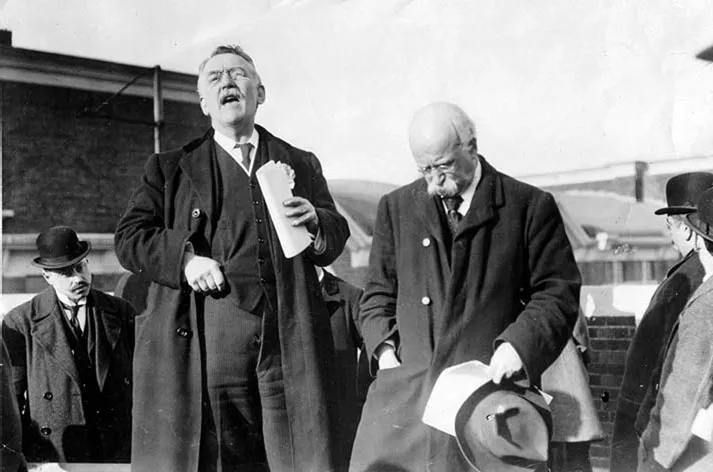
Cecil Harmsworth, brother of Alfred founder of the Daily Mail, who knew him well, described him as ‘our little kind friend, who moved so unassumingly amongst us’ (Thomas, 1983, p. 1). A local Hertfordshire solicitor, whom he met during the purchase of the land for the first garden city at Letchworth, was less kind: ‘an insignificant little man who, to a piercing eye, did not appear to be worth many shillings’ (q. Beevers, 1988, p. 86). And yet: there was something more. He could command a platform, and just possibly he might have commanded a television studio (figure 1.1):
His most distinguished physical characteristics were a clear fresh complexion, a fine aquiline profile, and a really beautiful and powerful speaking voice, and it is not surprising that he was much in demand as an amateur Shakespearean actor in his younger days. (Osborn, 1946, p. 23)
Dr Joseph Parker of the City Temple in London told him he could have been a successful preacher. Though he dominated on the public platform, in private and business life he got ignored, partly because he was too preoccupied and had few concerns with administrative details; this was a product of his power of concentration. But everyone liked him, above all children (Osborn, 1946, p. 23).
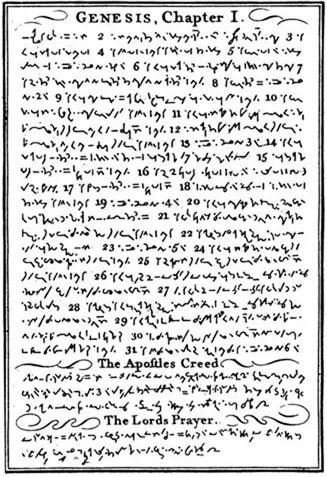
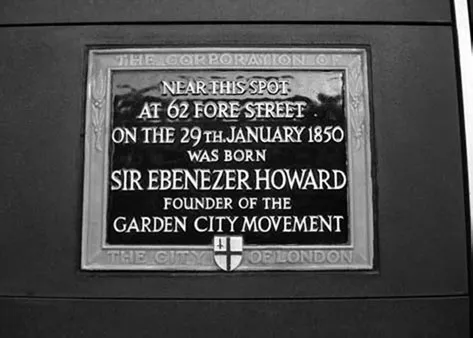
His life until then had been one of hard grind and personal failure. Born to middle-class tradespeople in the City of London on 29 January 1850 (figure 1.2), he spent his childhood in small country towns in southern England: Sudbury, Ipswich, Cheshunt – a fact that may help explain his passionate love of the countryside. He left school at 15, and became a clerk in the City. But at 21, he emigrated to America to become a pioneer farmer in Nebraska. The experience was a disaster, and a year later he found himself a shorthand writer in Chicago, established in the job he was to follow all his life.
Figure1.1 Ebenezer Howard. The great man overcome by embarrassed humility – or is it stupefaction? – by the power of the orator's panegyric. (Source: TCPA)
Figure1.2 Ebenezer Howard Plaque. The birthplace in London's Barbican; but his formative influences were Chicago and the American prairies.
He spent four years in Chicago, 1872–1876, and they must have been formative ones. Howard always denied that he found inspiration in the windy city, but all subsequent chroniclers of his life agree that he must have got the germ for his idea of the garden city here, in his lodgings on Michigan Avenue; Chicago itself had been known by that title before the great fire of 1871, though it would soon lose that character in the rebuilding. He must have been acquainted with the new garden suburb of Riverside on the Des Plaines River 9 miles outside the city, designed by the great landscape architect Frederick Law Olmsted (Osborn, 1950, pp. 226–227; Stern 1986, pp. 133–134; Beevers, 1988, p. 7).
Then, in 1876, he returned to London. He got a position with Gurneys,1 the official Parliamentary reporters, and after one unsuccessful attempt at a private partnership he remained with Gurneys and others in the same business for the rest of his days; ‘His life was always one of hard work and little income’ (Osborn, 1946, p. 19). But there was one advantage, which he must have seen very clearly: he said himself that he was prepared for his work through his profession, which exposed him to argument on the major issues of the day (Beevers, 1988, p. 7). He also had a hobby, which like many hobbies amounted to an obsession: he thought of himself as an inventor, and when obsessed with an idea he would persist with it in defiance of all advice from his friends (Osborn, 1946, p. 19). He thought of garden cities as an invention, just as he did of an improved variable spacing typewriter, which never came to anything (Beevers, 1988, p. 12). And this is an important clue to his character: Osborn, who knew him so well, said, ‘Howard – let me emphasize this – was not a political theorist, not a dreamer, but an inventor’, a man who thought of an idea and then worked out its design on paper (Osborn, 1946, p. 21).
City in Ferment: Howard's Intellectual Education
But for the 30-year-old Howard, London was more than a place to slave at shorthand and dream of a new typewriter. For, as the 1870s gave way to the 1880s, this was a city in social and intellectual turmoil.
The entire city was a hotbed of radical activities and ‘causes’ (Hardy, 1991a, p. 30). William Morris broke with H.M. Hyndman and founded Commonweal for the Socialist League; the anarchists produced Freedom, under the patronage of the great Russian anarchist émigré Prince Peter Kropotkin; another journal, To-Day, was run by Henry Champion and Hubert Bland (MacKenzie and MacKenzie, 1977, pp. 76–77). Everyone in these groups wanted a new social order, but no one quite knew what:
Should one take to the streets like Hyndman, to the stump like Morris, to the anarchist commune, the producer cooperative and the self-improving idealism of the Fellowship of the New Life? (MacKenzie and MacKenzie, 1977, p. 77)
The Fellowship of the New Life, founded by the itinerant visionary Thomas Davidson together with Edward Pease and Percival Chubb in 1883, was essentially a group of people who were trying to achieve an earthly paradise in substitution for a heavenly one. Essentially, its first meeting on 24 October 1883 was the beginning of the Fabian Society (Ibid., pp. 15, 22–24).
A decade later, in 1893, J. Bruce Wallace, subsequently one of the founder-members of the Garden City Association, founded his own Brotherhood Church, and its branches became a magnet for countless alternative causes:
Every kind of ‘crank’ came and aired his views on the open platform, which was provided every Sunday afternoon. Atheists, Spiritualists, Individualists, Communists, Anarchists, ordinary politicians, Vegetarians, Anti-Vivisectionists and Anti-Vaccinationists – in fact, every kind of ‘anti’ had a welcome and a hearing and had to stand a lively criticism in the discussion which followed. (Hardy, 1991a, p. 30, q. Nellie Shaw in Hardy, 1979, p. 177)
Towards the end of 1879 Howard joined a debating society, the Zetetical Society, which mainly attracted freethinkers; it already included George Bernard Shaw and Sidney Webb, with whom he was soon on good terms. During these years Howard read widely, as Osborn testifies; in his book he cited over thirty writers ranging from William Blake to the medical officer of health for Derbyshire; in particular he read newspaper reports, Royal Commission evidence, weighty articles in the Fortnightly Review, the Fabian Essays and the writings of John Stuart Mill and Herbert Spencer, the latter first encountered in Chicago and perhaps the most important influence on him. He was also a regular attender at dissenting chapels, though by now losing his faith; and much of this reading comes from a common non-conformist tradition (Beevers, 1988, pp. 13–14, 19, 23): ‘All the chief contributors to the stock of ideas from which Howard distilled the concept of the garden city – not only Spence but also Richardson, Spencer and even Henry George – were dissenters by upbringing or steeped in its tradition’ (Beevers, 1988, p. 24). Apart from Kropotkin, no continental figure seems to have reached him, not even Marx (Ibid.).
The Great 1880s Debate: The Land Question
By the late 1880s Howard had begun to focus on the land question. And that was no surprise, because land was one of the two or three most intensely-debated topics of the age. The basic reason was that British agriculture was in deep structural crisis. An agricultural depression, product of poor harvests and intense overseas competition following the opening-up of new land in the Americas and Australasia, conspired to reduce cereal acreage in England and Wales by one quarter between 1879 and 1900. Farm rents declined by up to 50 per cent; the Duke of Marlborough said in 1885 that if there were any effective demand, half the land of England would be on the market tomorrow; even by 1902, i...
Table of contents
Cover Page
Half-Title Page
Series Page
Title Page
Copyright Page
Table of Contents
A Note on the Illustrations
Preface
PART ONE: THE FIRST CENTURY
PART TWO: LAND, LIFE AND LIBERTY
PART THREE: THE COMING CENTURY
References
Index
Trusted by 375,005 students
Access to over 1.5 million titles for a fair monthly price.
Study more efficiently using our study tools.
Frequently asked questions
Yes, you can cancel anytime from the Subscription tab in your account settings on the Perlego website. Your subscription will stay active until the end of your current billing period. Learn how to cancel your subscription
No, books cannot be downloaded as external files, such as PDFs, for use outside of Perlego. However, you can download books within the Perlego app for offline reading on mobile or tablet. Learn how to download books offline
Perlego offers two plans: Essential and Complete
Essential is ideal for learners and professionals who enjoy exploring a wide range of subjects. Access the Essential Library with 800,000+ trusted titles and best-sellers across business, personal growth, and the humanities. Includes unlimited reading time and Standard Read Aloud voice.
Complete: Perfect for advanced learners and researchers needing full, unrestricted access. Unlock 1.5M+ books across hundreds of subjects, including academic and specialized titles. The Complete Plan also includes advanced features like Premium Read Aloud and Research Assistant.
Both plans are available with monthly, semester, or annual billing cycles.
We are an online textbook subscription service, where you can get access to an entire online library for less than the price of a single book per month. With over 1.5 million books across 990+ topics, we’ve got you covered! Learn about our mission
Look out for the read-aloud symbol on your next book to see if you can listen to it. The read-aloud tool reads text aloud for you, highlighting the text as it is being read. You can pause it, speed it up and slow it down. Learn more about Read Aloud
Yes! You can use the Perlego app on both iOS and Android devices to read anytime, anywhere — even offline. Perfect for commutes or when you’re on the go. Please note we cannot support devices running on iOS 13 and Android 7 or earlier. Learn more about using the app
Yes, you can access Sociable Cities by Peter Hall,Colin Ward in PDF and/or ePUB format, as well as other popular books in Architecture & Sustainability in Architecture. We have over 1.5 million books available in our catalogue for you to explore.