![]()
Chapter 1
On the table
Crumbs of freedom and fugitivity – A twenty-first century (re)reading of Crumbs from the Table of Joy
Jaye Austin Williams
The bourgeoisie is fearful of the militancy of the Negro woman … [t]he capitalists know, far better than many progressives seem to know, that once Negro women undertake action, the militancy of the whole Negro people … is greatly enhanced.
Claudia Jones, “An End to the Neglect of the Problems of the Negro Woman!”
I never stand for the National Anthem, don’t even know the words. But ya know the tune that git me to my feet every time, that Charlie Parker playing “Salt peanuts, salt peanuts.” Chile, I practically conceded to God when he took his sax on up that scale.
Lily, Act I, Sc. 3, Crumbs from the Table of Joy, Lynn Nottage
Daniel Patrick Moynihan’s celebrated “Report” [published in 1965, depicts] the “Negro Family” [as having] no Father to speak of … [this] is, surprisingly, the fault of the Daughter, or the female line. This stunning reversal of the castration thematic … becomes an aspect of the African-American female’s misnaming.
Hortense J. Spillers, “Mama’s Baby, Papa’s Maybe: An American Grammar Book”
There is a kind of “mathematical” elegance in how these three epigraphs concertize. The first asserts the coalescent power of Black women. The third casts a “black light” to reveal that which rhetorically, legislatively, and historically, which is to say, soci(et)ally, undoes that power. 1 The second moves “fugitively” between the other two, interstitially, articulating an elegant triumvirate: Jones’s wish toward effective militancy, Lily’s love of (and existence betwixt) the jazz notes that sonically exceed the (aesthetic) values that would enslave them, and Spillers’s interrogation of the will to maintain dominion over them all, not least, by laying blame upon the very “matriarchy” that is structurally denied them. 2 The sum of their concerted effort, and more broadly, that of Black women across generations who have labored and died while fighting for “the (civil rights) cause,” equals a violent paradox: a life constituted by a perpetual wish for freedom that continually eludes the wisher.
I offer here a meditation on the ways playwright Lynn Nottage both dramaturgically and theoretically intervenes in that paradox. In so doing, I am mindful of Plato’s precursory imagery of captivity in his Allegory of the Cave, in which he depicts prisoners gazing upon shadows cast on a cave wall. He constructs a cautionary exchange between the prisoners and shadows, deeming it untenable and, more implicitly, dangerous, because of the prisoners’ circumscribed purviews and the shadows’ figurative departure from that upon which a sound, societal apparatus can be constructed and sustained. 3 I posit that the remainder of Plato’s rhetorical invalidation of this confluence between captives and shadows (cited above) manifests in modernity as beings rendered captive within a structure girded by both literal incarceration and abject circumstance; and that it is notable and in no way arbitrary that those so marked and partitioned today are predominantly Black.
A dramatic exemplar of such meditation is Lynn Nottage’s rendering of the “Black family” in post-World War II America, at the intersection of the bebop and McCarthy eras, and the “Great Migrations” north and west by “freed” Blacks. Crumbs from the Table of Joy centers around a young aspiring writer named Ernestine Crump, who recalls the painful aftermath of her mother’s death in Florida in 1950. Ernestine’s bereft father, Godfrey Crump, ventures up north to Brooklyn, New York, with Ernestine and her sister, Ermina in tow, in pursuit of a life unencumbered by grief and Jim Crow.
The play’s title is inspired by poet and dramatist, Langston Hughes’s short poem, Luck:
Sometimes a crumb falls from the table of joy,
Sometimes a bone is flung,
To some people love is given,
To others only heaven.
(Selected 99)
Nottage situates the poem as epigraph to the play, which premiered
Off-Broadway at Second Stage Theatre in New York City in 1995. 4 Her deployment of Hughes as tone-setter is keen, as the poem posits a quadrangle of loci: a crumb, a bone, love, and heaven. Hughes’s quantifier “only” in front of “heaven” paradoxically pinpoints heaven as the locus of death – the place for “others.” It is distinct from the “love” (a presumably greater value here) that “people” get. The “crumbs” that fall suggest a scavenging of the “bone” that is cast to beasts and those presumed to be beasts. The resultant questions and implications surrounding the “table of joy” are vast and anything but joyous, suggesting Nottage’s affinity with Hughes to be savvier than meets the (Platonic) eye, prompting me to read Plato’s rhetorical move as a scandalizing of the captive-shadow relation in order to set soci(et)al practices and political constructs in contradistinction to what he presumes a vacuous exchange. Moreover, this move redacts the “intramural” details of that exchange from historical and epistemological legitimacy across time. 5
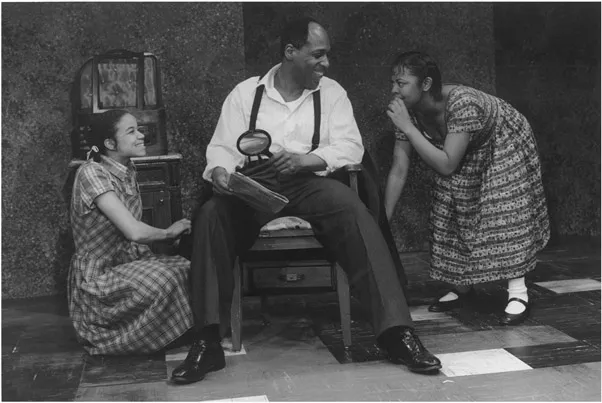
Figure 1.1 Godfrey Crump with daughters Ernestine and Ermina. Daryl Edwards (center) as Godfrey, Kisha Howard (right) as Ernestine, and Nicole Leach (left) as Ermina in the world premiere production at Second Stage. Photo by Susan Cook, ©1995.
One of the most stunning aspects of Nottage’s oeuvre – in addition to her remarkable facility for distilling historical segments into dramatic storytelling – is her apprehension of temporality as a perpetually collapsing, paradoxical vortex for her Black characters. It follows then, that she would look to Hughes’s sensibility. His scathing, prescient 1935 satirical one-act play, Soul Gone Home, for example, anticipates the Moynihan Report that Spillers observes to “misnam[e]” the Black matriarch and her daughters, encumbering them with sole culpability in the failure of the Black “family.” 6 In the following excerpt, Hughes’s grand satire crackles, as the Son lies dead, coins placed over his eyes, in ancient Greek tradition, and the Mother wails with grief. The Son rises from (within) the dead and upbraids her:
| SON: | Mama, you know you ain’t done me right. |
| MOTHER: | What you mean, I ain’t done you right? [She is rooted in horror.] […] |
| SON: | [leaning forward] […] You been a bad mother to me. |
| MOTHER: | Shame! Shame! Shame, talkin’ to your mama that away. […] |
| SON: | You never did feed me good, that’s what I mean! |
(Soul 536)
Hughes is acutely aware that the mother’s inability to care for her son adequately is a matter of her incapacitation rather than her incapability to do so, and his broad, farcical gesture signifies accordingly. Nottage clearly apprehends Hughes’s critique of romanticized tracts about equality and progress and the attendant presumption of racial slavery’s obsolescence, such that the fact of its afterlife slices through the veneer of such violent obfuscation, denial, and displacement of culpability onto the slave-descended. The direct correlation between the Mother’s structural incapacity in Hughes’s play, and father Godfrey’s paralysis in Crumbs, epitomizes the function of the Black feminist and Black radical dramatic. Together, they confront the paradigmatic (structural) condition that so intricately and violently impacts Black existence at every level. In other words, as Hughes sets the suffering wrought of incapacity into deathly satiric relief, so does Nottage situate her characters, with the very first utterance, at the place of death, such that the blur between its literal and figurative contours comes sharply into focus.
The protagonist, Ernestine Crump, remembers: “Death nearly crippled my father, slipping beneath the soles of his feet and taking away his ability to walk at will. Death made him wail like a god-awful banshee. (Godfrey wails like a god-awful banshee.) ” (Nottage 7). Godfrey Crump is grieving his wife’s recent death. However, banshees are said to foretell death with their wailing. 7 In establishing Godfrey as at once already grieving and wailing in anticipation, Nottage, taking her cue from Hughes, uncovers a locus-continuum for death and time, at the fulcrum of which are the illegible pain and paralysis that constitute Black suffering. This is to say, she collapses time through Ernestine’s quip about a banshee, in the “present,” which Godfrey then repeats with the action in the “past.” The dramatic effect resonates almost sonically, resembling a scratch in an old record’s groove that repeatedly trips the needle back to the same spot. Particularly profound here is that Ernestine does not immediately attribute her father’s crippling condition to her mother’s recent death; inferring instead that it is already his condition at the play’s opening. It is not until several lines later that she references her mother’s passing when she recalls, “Death made strangers take hold of our hands and recount endless stories of Mommy” (Nottage 7). With this “subluxated” textual ordering, Godfrey and his daughters become “strangers” to those gathered in mourning; presumably, members of a community to which they and the mother have belonged. 8 This is to say, Ernestine’s remembrance of her first cognition of death might well be read as an adolescent’s experience of adults, particularly in a context as disorienting as a parent’s funeral. Nottage’s labor is far more sophisticated, however. Ernestine’s labeling of the mourners as “strangers” opens a compelling fissure through which the loss of the mother pierces, resonating beyond literal maternal loss, toward the severance from Mother Africa to which Saidiya Hartman refers; a repetition of the cutting through the Atlantic waters by endless slave ship bows, and the subsequent retelling of slave narratives by the slave-descended in the Americas. Its dramatic performance echoes as one slave remembers and the other wails in remembrance … the needle skips and skips, forward, back, back, forward … within the same no-place. 9
Ernestine’s opening incantation continues: “Death made us nauseous with regret. It clipped Daddy’s tongue and put his temper to rest. Made folks shuffle and bow their heads. But it wouldn’t leave us be, tugging at our stomachs and our throats” (Nottage 8). With this opening litany, Nottage enunciates death as a perpetual, unrelenting state of being, and Ernestine, her father, and sister, as its coordinates. This move pinpoints literal death as one of several terms within an overall (relational) condition of what Orlando Patterson terms “social death;” namely, civil society’s refusal of Black being as both a variable within the expression of social life writ large, and a direct outgrowth of Transatlantic (racial) Slavery, to which Patterson applies his analysis. 10 The Crump family indeed experiences death and loss affectively, but Nottage opens a rhetorical space – akin to Suzan-Lori Parks’s formulation of “the great (w)hole in history” – wherein a correlation between the exponential gravity of Black folks performing their response (grief/suffering) to literal (already) death, and an overarching rhetorical expression of symbolic (always) death, can be examined. 11
Ernestine’s soliloquy at the play’s conclusion prompts a theorization of the play by way of her Aunt Lily. Ernestine tells us that she has just arrived in Harlem from Brooklyn, where she had settled some years before with her father and sister. She is searching for her mother’s sister, Lily, who ventured to Harlem immediately after Ernestine’s mother’s death, in fervent quest of a movement that might prove Black people’s salvation. She found Communism, the only apparent political framework that espoused any semblance of “equality for all” in 1950. I posit Lily as the fulcrum of the play precisely because she exemplifies the Black woman of so many “confounded identities,” as Spillers observes, and one whom Ernestine will become (“Mama’s” 65). Ernestine tells us, in both homage and lament:
Years from now I’ll read the Communist Manifesto, The Souls of Black Folk and Black Skin, White Masks and find my dear Lily amongst the pages…. [Y]ears from now I’ll ride the Freedom Bus back down home, enraged and vigilant, years from now I’ll marry a civil servant and argue about the Vietnam war, integration and the Black Panther movement. Years from now I’ll send off one son to college in New England and I’ll lose the other to drugs and sing loudly in the church choir.
(Nottage 88)
Here, Ernestine enters the aporia of years passing yet somehow standing still; marking the “precarious life of the ex-slave” that Hartman memorializes (Venus 4). She exists in perpetual migration, in search of the unfindable, and labors within the railing of political movements that later fall into the impasse of her past. Nottage thus forges a rethinking of “Great” migrations as but fugitive parries in response to the structured violence from and toward which the slave-descended are always running. In so doing, she hurls into urgent question the notion of the Black as a migratory “agent” given, as Spillers and Hartman remind, the literal and symbolic severance from origin and heritage that slavery exacted upon the (née) African 12 (“Mama’s” 67, “Venus” 3). This ruptured relation to life is compounded by the unremittingly rehearsed abjuration of Blacks’ attempts to enter t...