eBook - ePub
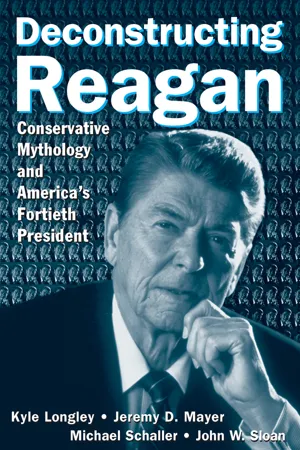
Deconstructing Reagan
Conservative Mythology and America's Fortieth President
- 150 pages
- English
- ePUB (mobile friendly)
- Available on iOS & Android
eBook - ePub
Deconstructing Reagan
Conservative Mythology and America's Fortieth President
About this book
Although he left office nearly 20 years ago, Ronald Reagan remains a potent symbol for the conservative movement. The Bush administration frequently invokes his legacy as it formulates and promotes its fiscal, domestic, and foreign policies. His name is watchword for campus conservatives who regard him in a way that borders on hero worship. Conservative media pundits often equate the term "Reagan-esque" with personal honor, fiscal rectitude, and unqualified success in dealing with foreign threats. But how much of the Reagan legacy is based on fact, how much on idealized myth? And what are the reasons - political and otherwise - behind the mythmaking? "Deconstructing Reagan" is a fascinating study of the interplay of politics and memory concerning our fortieth president. While giving credit where credit is due, the authors scrutinize key aspects of the Reagan legacy and the conservative mythology that surrounds it.
Information
1
Reagan and the Cold War
Popular memories of Ronald Reagan focus on his embrace of free markets at home and strident anticommunism abroad. To many Americans, his unapologetic celebration of patriotism and military fortitude not only made the nation safer, but also in the words of British prime minister Margaret Thatcher, won the Cold War “without firing a shot.” Upon his death in June 2004, Republican leaders such as Texas congressman Tom DeLay praised Reagan in a way few anticipated: as an “intellectual warrior” who “marshaled ideas like troops” and freed the world from the threat of communism. By then, Reagan had nearly passed into mythology. His once ridiculed naiveté was recalled as sincerity; his reputed laziness came to symbolize an inner calm; his well-known disinterest in details merely proved his mastery of the big picture.
Many of those who served the president, along with conservative journalists, praise his record of achievement. Shortly before Reagan left office in 1989, Robert McFarlane, the third of Reagan’s six national security advisers, wrote his former boss that the transformation of the Soviet system represented a “vindication of your seven-year strategy.” Confronted by the “renewal” of American economic, military, and spiritual power, Soviet leaders understood that “they simply had to change their system or face inevitable decline.” One adoring chronicler, Peter Schweizer, argued the point more forcefully. Unlike presidents before him, Reagan made the roll back and defeat of communism a primary goal. Dwight D. Eisenhower and Richard M. Nixon talked a tough game, but valued stability over confrontation and sought to make deals with the Kremlin. Reagan, in contrast, considered communism both a moral evil and an inherent threat to peace. By not only talking but also acting tough, by rearming America and challenging Soviet power globally, the “so-called bumpkin,” as Schweizer put it admiringly, “won the cold war.” Perhaps the shrillest praise of Reagan’s foreign policy accomplishments came from journalist Ann Coulter. Liberals, she wrote, “lie about Reagan’s victory because when Reagan won the Cold War, he proved them wrong on everything they had done and said throughout the Cold War. It is their last defense to fifty years of treason.”1
Without question, Reagan expanded U.S. military power and restored public confidence in presidential leadership. His rhetoric stirred and lifted the spirits of Americans—and many foreigners—who had considered themselves victims in an unfriendly world of hostage taking, nuclear threats, rising oil prices, and third world insurgencies. Yet, as in his domestic policy, a gulf often existed between the idealism, self-assurance, and occasional bluster of Reagan’s calls to action and his administration’s actual accomplishments. To be sure, Reagan oversaw the largest military buildup in peacetime history and played a critical role in transforming the Soviet-American relationship. Whether arms spending and tough talk had much to do with changing Soviet policy remains uncertain. Other Reagan initiatives, such as using covert force in Central America, the Middle East, and Africa, had unintended, sometimes dire, consequences. U.S. intervention did not cause the violence endemic to these regions, but it did little to alleviate it or to further American interests. For example, the extensive program of the Central Intelligence Agency (CIA) from 1982 to 1988 of arming Islamist fighters resisting Soviet forces in Afghanistan ultimately promoted the rise of a fundamentalist terror network led by Osama bin Laden. Reagan’s occasional support for dictatorships, along with a willingness to negotiate secretly with terrorists, marked some of his administration’s worst failures. Reagan’s penchant for unilateral military action still echoes in post–9/11 American foreign policy and is often cited by President George W. Bush and his aides as justification for some of their policies.
Background
Long after he rejected Franklin Roosevelt’s New Deal liberalism, Ronald Reagan continued to admire his childhood idol’s spirit and style. To Reagan, the inspirational Roosevelt remained a “soldier of freedom” who rallied dispirited Americans against the heartbreak of the Depression at home and the threat of Axis aggression abroad. Above all, he led when others faltered. Just as fascism threatened Roosevelt’s America, communism, Reagan believed, had challenged global freedom since 1945.
Like millions of Americans his age, Reagan recalled with special fondness Roosevelt’s use of the radio to communicate his thoughts on everything from banking reform to foreign affairs. In October 1964, when Reagan delivered his first nationally broadcast political speech, on behalf of Republican presidential candidate Barry Goldwater, he lifted verbatim one of Roosevelt’s most famous lines, declaring that Americans “have a rendezvous with destiny.” Reagan believed that God had selected Americans as his chosen people with a special mission.
During the 1970s, as his own ambition turned toward the White House, Reagan broadcast hundreds of short, inspirational radio talks that placed his name and ideas before a national audience. A typical commentary in May 1975 described communism as a “form of insanity” that “will one day disappear from the earth because it is contrary to human nature.” Anticipating his later assertion as president that Soviet leaders would “commit any crime” to advance their cause, Reagan depicted communists as willing to carry out any crime “if it advances the cause of socialism.”2
Once elected president, Reagan revived the lapsed practice of delivering weekly radio commentaries. In August 1984, while he engaged in banter with technicians before delivering a Saturday morning radio talk, Reagan spoke into a microphone that he did not know was activated. “My fellow Americans,” he began, “I am pleased to tell you today that I’ve just signed legislation that will outlaw the Soviet Union forever. We begin bombing in five minutes.” His making a joke of war appalled critics. Soviet officials took the off-the-cuff remark seriously enough to instruct their intelligence agents in Washington to report any signs of war preparation. The president simply laughed off criticism of his joke as if it were something his friend John Wayne might have said in a Hollywood western.
To everyone’s surprise, however, less than eight years later, legislation was signed abolishing the Soviet Union. On Christmas day 1991, Soviet president Mikhail Gorbachev issued a decree dissolving the crumbling communist empire. With this final act, Gorbachev turned over authority to the elected leader of Russia, Boris Yeltsin. Although by then the former president’s mind was clouded by the ravages of Alzheimer’s disease, his many admirers and even some of his critics credited “the Great Communicator,”as journalists dubbed him, with the leadership and determination that culminated in America’s Cold War victory.
Reagan spoke forcefully about the division he saw between the peaceful democratic world of America and its allies and the aggressive web of communist dictatorships controlled by Moscow. As a candidate in 1980 and often thereafter, he remarked that the Soviet Union “underlies all the unrest that is going on” in the world. If “they weren’t engaged in this game of dominos, there wouldn’t be any hotspots in the world.” Reagan also stressed his religious antipathy for communism, as in an address to the National Association of Evangelicals on March 8, 1983. The Soviet Union, he declared, was “the focus of evil in the modern world,” truly an “evil empire.”3
Reagan, his supporters stressed, recognized a simple truth that more sophisticated observers sometimes ignored: the Soviet Union was doomed to fall. In addressing the British Parliament on June 8, 1982, the president dismissed the Soviet Union as a force that “runs against the tide of history.” With its economic, political, and social system all “astounding” failures, he consigned communism to the “ash heap of history.” Although Reagan’s perception of the Soviet Union might be “primitive,” as CIA deputy director Robert Gates described it, it coincided with reality. The president’s clarity of vision, his admirers believed, allowed him to see the future in ways that eluded more nuanced thinkers.4
While campaigning for the White House, Reagan insisted, “there are simple answers to complex questions.” He told a gathering of veterans in August 1980 that under incumbent president Jimmy Carter America suffered from what he called the “Vietnam syndrome,” an unwillingness to use force to resist Soviet pressure or to defend foreign friends and interests. This reluctance explained why American diplomats in 1979 had been seized and held as hostages in Iran while Soviet troops occupied Afghanistan and Moscow-backed insurgents made a play for power in Central America and Africa. Reagan traced the problem to the U.S. failure to win in Vietnam and a guilt complex left over from that war. “It’s time,” he told the cheering veterans, “we recognize that ours, in truth, was a noble cause.” Alexander Haig, whom the newly elected Reagan named secretary of state in 1981, echoed this theme. The American people were ready to “shed their sackcloth and ashes.” Taking a cue from the president’s call in his inaugural address to “dream heroic dreams,” the new administration moved to restore the nation’s military superiority, defend allies, and, in what was later informally called the “Reagan doctrine,” assist anticommunist movements throughout the world. Not by chance, the president’s aides explained, did Iran release its long-held American captives just as Reagan took the presidential oath on January 20, 1981.5
Reagan’s personal as well as his administration’s approach to world affairs rested on a key assumption: since the Nixon administration, the United States had pursued a misguided policy of détente toward the Soviet Union. This effort to reduce superpower rivalry relied on arms control agreements, expanded trade, and an acceptance by each side in the Cold War of the other’s legitimate security interests. At his first press conference, on January 29, 1981, Reagan echoed the complaints of conservative strategists that détente had become a “one-way street,” little more than a smoke screen behind which the Soviets had expanded their strategic nuclear arsenal, cheated on arms control treaties, and supported communist insurgents in the third world. By achieving military superiority, he argued, the Soviet Union was on track to dominate the third world and isolate the United States without fear of retaliation. Reagan saw his historic mission as reversing this flow of power and delegitimizing the Soviet Union.6
Although he never asserted this publicly (and his aides claimed this as a strategy only after he left office), Reagan was said to believe that the inherent weakness of the communist system made the Soviet Union vulnerable to American economic pressure. By blocking access to Western technology and markets, Washington could cripple the inefficient Soviet economy. Simultaneously, rising American defense expenditures would overstress Soviet industry if it tried to match the rapid buildup. According to several high officials who spoke out after 1989, the plan to cripple the Kremlin through an arms race and economic warfare formed a centerpiece of Reagan’s strategy to win the Cold War.7
In addition to bringing military and economic pressure to bear, Reagan, prodded by CIA director, William Casey, confronted Soviet proxies in Poland, Afghanistan, Lebanon, Angola, Mozambique, El Salvador, Grenada, and Nicaragua. By defeating the Soviets in these proxy wars, Casey argued, the United States could undermine the appeal of communism and unravel Soviet self-confidence, creating a sort of Vietnam syndrome in reverse. Ultimately, the Soviet Union would have no choice but to fundamentally alter its foreign and domestic policies. Diplomacy and negotiations with the Soviets would, at most, be an afterthought to certify American supremacy.
During his first five years in office, Reagan justified shunning talks with Moscow for two reasons. The United States, he insisted, must negotiate from strength. Even with record levels of defense spending, it would take several years to restore military superiority. Also, he quipped in response to a journalist’s question, how could he meet his Soviet counterparts when “they keep dying on me.” This reference to the decrepit health of Soviet leaders—and, implicitly, to his own vitality despite age—deflected public criticism. But at a more basic level, well into his second term, Reagan found himself pulled in different directions by advisers who disagreed on fundamentals and disliked each other almost as much as they hated communism.
Administration Infighting
Reagan’s senior foreign policy advisers shared his general antipathy toward the Soviet Union and a determination to build up American military strength; but that was about all they agreed on. Alexander Haig, who served as Reagan’s first secretary of state, described the White House “as mysterious as a ghost ship. You heard the creak of the rigging and the groan of the timbers and sometimes even glimpsed the crew on deck.” But he had no idea “which of the crew was at the helm.” Haig considered the president a “cipher” who virtually never discussed foreign policy with him.8
Many successful presidents, such as Franklin Roosevelt and Dwight Eisenhower, played off contentious aides to achieve a policy consensus. This “hidden hand” approach of allowing subordinates to take the credit —or heat—could provide valuable political cover. But Reagan’s distance from policy details was of a wholly different order. Even his closest aides, like CIA director Casey, were taken aback by their boss’s passivity. With few exceptions, such as missile defense and Iran-contra, Reagan initiated nothing and issued few orders. The president who came across so forcefully in scripted television speeches on the Soviet threat lost focus off camera. At meetings with his foreign policy advisers, the president frequently read from amusing letters or press clippings sent to him by admiring citizens. Then he often fell silent and exhibited what one aide called his “glassy-eyed look.” If his staff reached a consensus, he endorsed it. If not, he deferred deciding. Reagan’s aides kept his attention at meetings by putting on a slide or video show that presented simple, sometimes simplistic, alternatives. After initiating a policy, the president rarely followed up on it.9
Reagan’s three closest aides during his first term, Chief of Staff James Baker, deputy chief Michael Deaver, and counselor Edwin Meese, carefully controlled the president’s domestic and diplomatic agendas. The so-called troika met each morning to review the past day’s events and current day’s plans. One of the three men sat in with Reagan on virtually every meeting.
Baker, Deaver, and Meese wanted to prevent the emergence of a powerful national security adviser, in the mold of Henry Kissinger. Thus, the first four national security advisers, Richard Allen, William Clark, Robert McFarlane, and John Poindexter, were relatively marginal figures in the administration. Secretary of State Haig, who barely knew his boss, also remained outside Reagan’s inner circle. George P. Shultz, who succeeded Haig in June 1982, ultimately emerged as the most influential and respected member of Reagan’s cabinet; but his role remained muted during the first term while his two principal rivals, Defense Secretary Caspar Weinberger and CIA director William Casey, often undercut him.
Broadly speaking, pragmatists and ideologues competed for Reagan’s attention. Pragmatists, including Haig, Shultz, Baker, Deaver, and Nancy Reagan, believed that as the United States adopted a stronger military posture, it should resume arms control and other negotiations with the Soviets from a position of strength. Hardliners, or so-called neoconservatives, within the administration, including Weinberger, Casey, United Nations (UN) ambassador Jeane Kirkpatrick, and Pentagon adviser Richard Perle, rejected entirely the notion of bargaining with the Soviets. Better to rearm and challenge Moscow on all fronts.
James Baker recalled that during Reagan’s first six years his foreign policy structure “was often a witches’ brew of intrigue” and competing agendas. Amid bureaucratic infighting, no one knew exactly what the president wanted. Reagan’s fifth and sixth national security advisers, Frank Carlucci and Colin Powell, were forced to decide on their own a fundamental a...
Table of contents
- Cover
- Half Title
- Title Page
- Copyright Page
- Table of Contents
- Introduction American Conservatism
- 1. Reagan and the Cold War
- 2. The Economic Costs of Reagan Mythology
- 3. Reagan and Race: Prophet of Color Blindness, Baiter of the Backlash
- 4. When Character Was King? Ronald Reagan and the Issues of Ethics and Morality
- Epilogue: Contemporary Politics and the Myths of Reagan
- Notes
- About the Authors
- Index
Trusted by 375,005 students
Access to over 1.5 million titles for a fair monthly price.
Study more efficiently using our study tools.
Frequently asked questions
Yes, you can cancel anytime from the Subscription tab in your account settings on the Perlego website. Your subscription will stay active until the end of your current billing period. Learn how to cancel your subscription
No, books cannot be downloaded as external files, such as PDFs, for use outside of Perlego. However, you can download books within the Perlego app for offline reading on mobile or tablet. Learn how to download books offline
Perlego offers two plans: Essential and Complete
- Essential is ideal for learners and professionals who enjoy exploring a wide range of subjects. Access the Essential Library with 800,000+ trusted titles and best-sellers across business, personal growth, and the humanities. Includes unlimited reading time and Standard Read Aloud voice.
- Complete: Perfect for advanced learners and researchers needing full, unrestricted access. Unlock 1.5M+ books across hundreds of subjects, including academic and specialized titles. The Complete Plan also includes advanced features like Premium Read Aloud and Research Assistant.
We are an online textbook subscription service, where you can get access to an entire online library for less than the price of a single book per month. With over 1.5 million books across 990+ topics, we’ve got you covered! Learn about our mission
Look out for the read-aloud symbol on your next book to see if you can listen to it. The read-aloud tool reads text aloud for you, highlighting the text as it is being read. You can pause it, speed it up and slow it down. Learn more about Read Aloud
Yes! You can use the Perlego app on both iOS and Android devices to read anytime, anywhere — even offline. Perfect for commutes or when you’re on the go.
Please note we cannot support devices running on iOS 13 and Android 7 or earlier. Learn more about using the app
Please note we cannot support devices running on iOS 13 and Android 7 or earlier. Learn more about using the app
Yes, you can access Deconstructing Reagan by Kyle Longley,Jeremy Mayer,Michael Schaller,John W. Sloan in PDF and/or ePUB format, as well as other popular books in Politics & International Relations & Economic Theory. We have over 1.5 million books available in our catalogue for you to explore.