Colonialism has three foundational concerns - violence, territory, and population control - all of which rest on racialist discourse and practice. Placing the Zionist project in Israel/Palestine within the context of settler colonialism reveals strategies and goals behind the region's rules of governance that have included violence, repressive state laws and racialized forms of surveillance.
In Israel's Colonial Project in Palestine: Brutal Pursuit, Elia Zureik revisits and reworks fundamental ideas that informed his first work on colonialism and Palestine three decades ago. Focusing on the means of control that are at the centre of Israel's actions toward Palestine, this book applies Michel Foucault's work on biopolitics to colonialism and to the situation in Israel/Palestine in particular. It reveals how racism plays a central role in colonialism and biopolitics, and how surveillance, in all its forms, becomes the indispensable tool of governance. It goes on to analyse territoriality in light of biopolitics, with the dispossession of indigenous people and population transfer advancing the state's agenda and justified as in the interests of national security. The book incorporates sociological, historical and postcolonial studies into an informed and original examination of the Zionist project in Palestine, from the establishment of Israel through to the actions and decisions of the present-day Israeli government.
Providing new perspectives on settler colonialism informed by Foucault's theory, and with particular focus on the role played by state surveillance in controlling the Palestinian population, this book is a valuable resource for students and scholars interested in the Arab-Israeli Conflict and Colonialism.
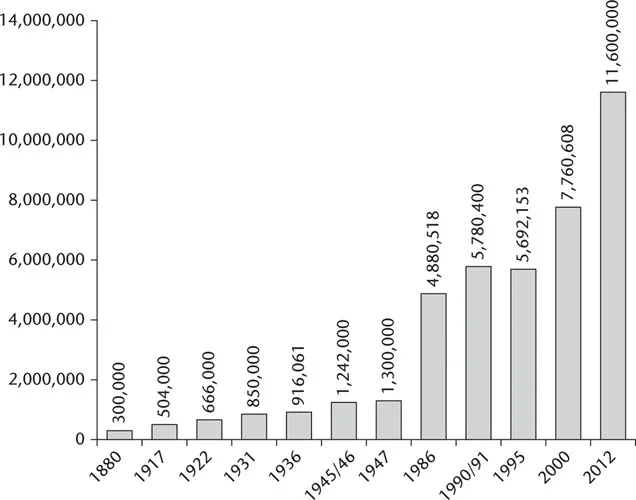
It is estimated that at the end of 2012 the number of Palestinians worldwide was 11.6 million – of whom 4.4 million resided in the West Bank (2.7 million) and Gaza (1.7 million), 1.4 million in Israel, 5.1 million in neighbouring Arab countries, and 655,000 in the rest of the world. By 2020, it is projected that the number of Palestinians in historical Palestine alone, west of the Jordan River, will reach 7.2 million – compared to 6.9 million Jews (PCBS 2011b).1 Of the total number, 5.1 million Palestinians and their descendants are officially classified as refugees, according to the United Nations Relief and Works Agency (PCBS 2012). No doubt, the total number of refugees and their descendants is larger since not every Palestinian who became a refugee in 1947–48 registered with the UN agency.
Figure 1.1 displays the growth of the Palestinian population over more than a century, starting in the 1880s with the first Zionist settler-colonisation of Palestine and ending in 2012. At the time of the Balfour Declaration in 1917, in which the British government promised the Zionists a national home for the Jews, the Palestinians constituted 90 per cent of the population and the Jews a mere 10 per cent (Zureik 2001). On the eve of the United Nations 1947 resolution to partition Palestine, 67 per cent of the population was Arab and 33 per cent Jewish. Following the establishment of Israel in 1948 and the flight and expulsion of the Palestinian population in 1947-48, the remaining Palestinians numbered 160,000, around 20 per cent of the combined Arab and Jewish populations. Now they number 1.3 million people.
For more than a century, which is probably longer than any other national group in recent memory, the Palestinians have struggled for self-determination; they exist largely as a community that is closely administered and monitored by outsiders. Notwithstanding their current attempts at state building, the Palestinians for the most part have lived for two-thirds of a century as refugees, exiles, and minorities – both in their homeland and elsewhere. And prior to that, they lived as an occupied people throughout the modern period, ruled first by the Ottomans, then by the British, Jordanians (in the West Bank), and Egyptians (in Gaza), and finally by the Israelis. It must be said, however, that Ottoman and British rule did not entail loss of Palestinian citizenship, as occurred during Israeli colonisation and occupation. Others prefer to label the Palestinian experience under Israeli rule “denationalisation” (Abu-Zahra and Kay 2013, 5). The 1948 Nakba (Catastrophe), as it is known in Arabic, and the dispersal of the Palestinians as a result of the establishment of Israel brought them under close scrutiny by different administrative regimes belonging to several so-called “host countries,” including the military-administrative apparatus of Israel and the neighbouring Arab states, a UN organisation in charge of refugees, and what is referred to euphemistically as the “international community.” As descendants of minorities and refugees going back five generations, the majority of Palestinians today live under surveillance of one form or another from cradle to grave. Their numbers are contested, their demography is analysed and debated endlessly, their movement across international borders is closely monitored, their activities are routinely scrutinised for political content, and their citizenship status is a perennial topic of discussion. In short, the Palestinians have experienced what sociologists call administrative social sorting of one form or another involving intrusive monitoring, data gathering, and population categorisation. For this reason, surveillance, monitoring, control, and resistance are discussed in this study since they are essential ingredients for understanding Palestinian society – or for that matter, any society (refugee or otherwise) whose existence is controlled and monitored by outsiders. As this study shows, these systems of control are spatial, temporal, local, regional, and global. They include colonial state policies, both past and present, legal impositions to facilitate dispossession and land expropriation, and population containment. Israel, whose establishment contributed directly to the Nakba, occupies a central place throughout this monitoring process and in my analysis of its apparatuses.
Figure1.1 Growth of the Palestinian people, 1880–2012
This chapter highlights the theoretical, methodological, and conceptual issues related to the study of Palestinian society in its dispersal under various statuses. It provides a road map for the macro- and micro-developments at the individual, communal, and institutional levels while highlighting the contribution of this study in light of existing research on the Palestinians. As mentioned above, social sorting via population count and categorisation, spatial arrangements, (im)mobility, and overall monitoring occupy a special place in this study. As pointed out in the coming chapters, social sorting, recordkeeping, and databases are forms of discursive power that aim to constitute the subject. This chapter does not report on empirical findings as such, except by way of examples, but interrogates the relevant theoretical and methodological literature so as to set the stage for understanding Palestinian society in terms of available data to be analysed in subsequent chapters.
This chapter draws upon a variety of disciplines in the social sciences and humanities in order to familiarise the reader with the scope of published and evolvingresearch on Palestine and the Palestinians. To begin with, it provides a thematic overview of this research, with a separate treatment of research on Palestinian refugees. Following this, it proceeds to address six separate theoretical and methodological perspectives: the near absence of the colonialism model in mainstream academic writings about the Zionist project in Palestine and the use of surveillance techniques for the purpose of ruling; the qualitative-quantitative divide in social science, with special reference to ethnography; critical assessment of Michel Foucault’s treatment of power; the utility of constructivist analysis; the problem of order and conflict resolution, and the role of globalisation, networking, electronic communication, and transnationalism in shaping the lives and identities of refugees and migrant communities. Several issues introduced in the next section are taken up again in the subsequent section’s discussion of theoretical and methodical perspectives.
Thematic overview
Academic studies of contemporary Palestine and the Palestinians have come a long way since they first made their debut in the early 1960s – when, generally speaking, social science studies of the Middle East were mostly dominated by functionalism and modernisation theory (Bill and Leiden 1976; Lerner 1958; Zartman 1980), on the one hand, and by their traditional nemeses of Marxist studies and dependency theory (Asad and Owen 1983; Rodinson 1973; Turner 1984), on the other. This does not mean that the modernisation school and its functionalist-theoretical underpinnings have been totally eclipsed (Sa’di 1997); nor does it mean that Marxism has succeeded in laying to rest the once-popular modernisation approach. Rather, alongside the functionalist-Marxist divide, most apparent in sociology, political science, and to some extent, anthropology, we see several additional approaches making headway in our understanding of Palestinian society. These competing schools, espousing different theoretical and methodological orientations, come from a variety of disciplines, including sociology, anthropology, social history, historical studies of colonialism, postcolonial and culture studies, human rights and sociolegal studies, criminology, geography, and more recently, contributions from women’s studies, visual studies, medical sociology, social studies of science, globalisation, Internet and cyberstudies, and transnational research.
Cultural studies
Cultural studies that are anchored in the humanities display a variety of subapproaches encompassing deconstruction, postcolonialism, literary criticism, poststructuralism, postmodernism, and semiotics – all of which have been deployed in one form or another in the study of Palestinians with varying degrees of frequency and sophistication (Harlow 1996; Lavie 1996; Peteet 1994a; Potoc 1998; Said 1985; Sherwell 1996; Tawil-Souri 2011). Notwithstanding its historical roots in functionalism and service to colonialism (Asad 1973), anthropological and ethnographic research on the everyday life, memory construction, and oral history of Palestinian society has made important contributions to its analysis (Ben-Ze’ev 2000, 2011; Farah 1998; Masalha 2012; Sa’di and Abu-Lughod 2007; Sayigh 1979). Ethnographic studies of marginalised communities such as refugees and people living under occupation demonstrate the importance of such research in uncovering everyday experiences, particularly with regard to strategies of coping and resistance among subaltern groups.
Counting Palestinians
The peculiar situation of the dispersal of Palestinians under various political and administrative regimes has made it difficult for researchers to freely access comprehensive and reliable statistical data, thus encouraging the use of ethnography and the case study approach, with a special focus on everyday life. Nevertheless, quantitative data are available on Palestinians in Israel through the publications of the Israel Central Bureau of Statistics (ICBS), and to a limited extent population data are available on Palestinian refugees who are registered with the United Nations Relief and Works Agency (UNRWA), an agency that is responsible for their humanitarian needs. The Oslo agreement of 1993 between Israel and the Palestine Liberation Organization (PLO) and the establishment of the Palestinian National Authority in the West Bank and Gaza ushered in the Palestinian Central Bureau of Statistics (PCBS), which, with financial and scientific assistance from international organisations, has been able to launch its activities and carry out censuses and other specialised surveys of the Palestinian population under its jurisdiction. Today it is considered by academic researchers to be a reliable source of data about the Palestinian population in the West Bank and Gaza.
As noted in Chapter 4’s discussion of demography, in contrast to international estimates and those provided by Palestinian and Israeli experts, right-wing Jewish lobby groups contest these findings and provide lower estimates of the Palestinian population in the occupied territories (Hasson 2013; Ilan 2005; Zimmerman and Seid 2004).
Looking at institutions
The contributions of sociology and political science to the study of Palestinians have included analysing the institutional and psychological bases of alienation and national identity (Ghanem 1998, 2001, 2013; Mi’ari 1998; Rouhana 1997), attempts at state formation (Brynen 2000; Jamal 2001), the emergence of civil society and the role of nongovernmental organisations (Hammami 1995; Muslih 1993; Suleiman 1997; Sullivan 1996), the extent of involvement by Palestinian refugees and exiles in the political affairs of their surroundings (Brand 1988; Zureik 1996), and the study of mobilisation in the form of protest and resistance movements (Khawajah 1994; Sayigh 1979; Swedenburg 1990, 1995). Two events have come to epitomise Palestinian resistance to Israeli occupation and in the process have garnered research interests: the first is the uprising, or Intifada, that lasted from 1987 to 1994 (Zureik, Graff, and Ohan 1990–91), and the second is the Al-Aqsa Intifada, which erupted in October 2000 and lasted until 2005. No fewer than a dozen books had been published by the middle of the 1990s in an attempt to analyse the causes of the First Intifada (Mishal and Aharoni 1994; Nassar and Heacock 1990; Peretz 1990), and the second uprising triggered additional scholarly attention from Palestinian (Ajluni 2003; Hanieh 2002), Israeli (Institute for International Security Studies 2010), and Western writers (G. Robinson 2010).
Human rights, legal rights, and conflict resolution
Related to the causes of violence are research efforts directed at understanding the correlates of suicide bombing. There are those who have sought the causes of Middle Eastern and Palestinian violence in strictly cultural and religious terms (Karsh 2006; Pipes 2002) and those who have challenged these explanations by positing a causal relationship between Israeli state repression and suicide bombing (Brym and Araj 2006, 2008). Working within the tradition of Franz Fanon, Charles Lee (2009) examines Palestinian suicide bombing from a philosophical, collectivist perspective. He argues that current positivist approaches to understanding terrorism posit a lopsided question that seeks the causes of terrorism in the behaviour of the perpetrator of the act. He argues for an approach that examines the behaviour of states toward the disenfranchised and colonised people as a factor that contributes to violent resistance.
The work of the political philosopher Giorgio Agamben (1998) on states of exception, “bare life,” and the homo sacer has prompted scholars to apply his perspective to the study of Palestinian refugees, about whom he had little to say (see Agamben 2000). Maissa Youssef (2007) provides an interesting departure from the legal approach by studying Palestinian refugees in their confrontation with Israel. She argues that although the Palestinians lost diplomatically as a result of the Oslo agreement, where asymmetrical power relations favoured Israel, the “materiality” of Palestinian bodies, exemplified in the biopolitics of the weak (see Chapter 4, and R. Kana’neh 2002), presented Israel with a dilemma that could not be resolved by creating two states or expelling the Palestinians from their homeland. Until the refugee issue is resolved satisfactorily, the existence of the refugees, even outside the state, ultimately unsettles and perforates the undefined borders of Israel, a point that was noted by Agamben (1995) in his passing comments on Palestinian refugees. In an article that resonates with Youssef’s, Ruba Salih (2013) explores the relevance of Hannah Arendt’s claim that refugees constitute the avant-garde of their people and discusses Agamben’s notion of “bare life” as applied to the stateless Palestinian refugees. Salih contends that the refugees’ subaltern voices act to destabilise the nation-state and call for a reconfiguration of the state-society relations in which democratic, rather than territorial, politics predominate.
As a result of the spread of violence and denial of self-determination, issues of human rights, citizenship rights, and international legality have become increasingly salient and are dealt with by international relations experts, lawyers, sociologists, and sociolegal scholars (Akram 2002; Akram and Rempel 2004; Butenschon, Hassassian, and Davis 1997; Be’er and Abdel-Jawad 1994; Jeffries 2012; Kimmerling 2002; Kretzmer 1990; Pacheco 2001; Ron 1997; Shehadeh 1985; Takkenberg 1998).
The study of conflict resolution, a hybrid specialty combining political science, social psychology, and international relations, has frequently used the Middle East conflict, particularly its Israeli-Palestinian dimension, as a site to test ideas about conflict resolution that are primarily advanced by political psychologists and, to a certain extent, by sociobiologists (Burton and Sandole 1986; Collings 1988). In workshops that are organised specifically to facilitate various encounters between Jewish and Arab elites and quasi-official actors, third-party expert intervention is being deployed to test the utility of interventionist research in conflict resolution (Kelman 1998). The results of these simulations have produced mixed results at best, with serious doubt being cast on their efficacy in resolving ethno-national conflicts. They have mostly served to confer legitimacy on the position of the stronger party – in this case, Israel (Abu-Nimer 1999; Rabinowitz 2001a).
Deconstructing Palestine's history
Traditionally, the historical approach has been dominated by linear, chronological studies of Palestine and Palestinian leadership during various phases of the national struggle throughout the past century. The doyen of modern Palestinian historiography and its encounter with Zionism is Walid Khalidi, whose work over a long academic and research career includes three seminal books, From Haven to Conquest (1971), Before Their Diaspora (1984), and All That Remains (1992). The three books were published by the Institute of Palestine Studies, which he co-founded in 1963. The institute, with offices in Beirut, Washington, DC, and Ramallah, has an active book-publishing program, in addition to three journals: the Journal of Palestine Studies, its Arabic-language equivalent publication Majallat al-Dirasat al-Filastiniyah, and Jerusalem Quarterly. It is worth citing Khalidi’s (1988) seminal paper on Plan Dalet of the Haganah, in which he disclosed for the first time the Zionist intentions to expel and depopulate Palestine of its Arab inhabitants as a prelude to establishing the State of Israel.
Historical research on Palestine has benefited from cross-fertilisation with the social sciences and other disciplines in the humanities. A welcome correction to the traditional, linear historical approach has been provided by combining the evolving subaltern research on Palestine (Abu-Manneh 2006; Swedenburg 1995) with studies of social and political history (Farsoun and Zacharia 1997; Kimmerling and Migdal 1993; Tamari 2009), including demography (I. Abu-Lughod 1971; Courbage 1999, 2012; Fargues 2000; Kossaifi 1980; Scholch 1985), population count, land/tenure, and urbanisation (Bisharat 1994; Doumani 1994; Levine 1999), identity formation (R. Khalidi 1997), and social structure of the peasantry (Carmi and Rosenfeld 1974). These works point to significant efforts aimed at deconstructing Palestine’s historical narrative, thus challenging the once-dominant versions of Palestinian history, which were originally contributed by mainstream Western and Israeli scholars. The deconstruction of this history has become a major undertaking of Pale...
Table of contents
Cover
Font Chapter
Half Title Page
Series Page
Title Page
Copyright Page
Dedication
Table of Contents
Preface
Acknowledgements
Introduction
1 Researching Palestine and the Palestinians: a road map
2 Zionism and colonialism
3 Colonialism as surveillance
4 Biopolitics, eugenics, and population discourse
5 From calibrated suffering to necropolitics
6 The Internet and acts of everyday resistance
Conclusion
References
Index
Trusted by 375,005 students
Access to over 1.5 million titles for a fair monthly price.
Study more efficiently using our study tools.
Frequently asked questions
Yes, you can cancel anytime from the Subscription tab in your account settings on the Perlego website. Your subscription will stay active until the end of your current billing period. Learn how to cancel your subscription
No, books cannot be downloaded as external files, such as PDFs, for use outside of Perlego. However, you can download books within the Perlego app for offline reading on mobile or tablet. Learn how to download books offline
Perlego offers two plans: Essential and Complete
Essential is ideal for learners and professionals who enjoy exploring a wide range of subjects. Access the Essential Library with 800,000+ trusted titles and best-sellers across business, personal growth, and the humanities. Includes unlimited reading time and Standard Read Aloud voice.
Complete: Perfect for advanced learners and researchers needing full, unrestricted access. Unlock 1.5M+ books across hundreds of subjects, including academic and specialized titles. The Complete Plan also includes advanced features like Premium Read Aloud and Research Assistant.
Both plans are available with monthly, semester, or annual billing cycles.
We are an online textbook subscription service, where you can get access to an entire online library for less than the price of a single book per month. With over 1.5 million books across 990+ topics, we’ve got you covered! Learn about our mission
Look out for the read-aloud symbol on your next book to see if you can listen to it. The read-aloud tool reads text aloud for you, highlighting the text as it is being read. You can pause it, speed it up and slow it down. Learn more about Read Aloud
Yes! You can use the Perlego app on both iOS and Android devices to read anytime, anywhere — even offline. Perfect for commutes or when you’re on the go. Please note we cannot support devices running on iOS 13 and Android 7 or earlier. Learn more about using the app
Yes, you can access Israel's Colonial Project in Palestine by Elia Zureik in PDF and/or ePUB format, as well as other popular books in Politics & International Relations & Middle Eastern History. We have over 1.5 million books available in our catalogue for you to explore.