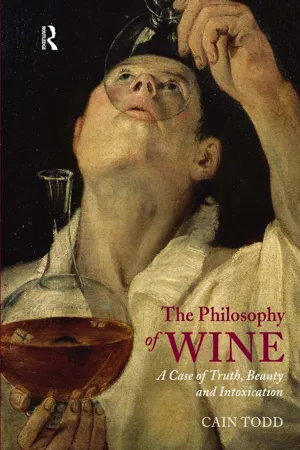
- 224 pages
- English
- ePUB (mobile friendly)
- Available on iOS & Android
eBook - ePub
About this book
Does this Bonnes-Mares really have notes of chocolate, truffle, violets, and merde de cheval? Can wines really be feminine, profound, pretentious, or cheeky? Can they express emotion or terroir? Do the judgements of 'experts' have any objective validity? Is a great wine a work of art? Questions like these will have been entertained by anyone who has ever puzzled over the tasting notes of a wine writer, or been baffled by the response of a sommelier to an innocent question. Only recently, however, have they received the serious philosophical attention they deserve. Touching on issues in metaphysics, epistemology, the philosophy of mind, and aesthetics, this book provides a clear and engaging discussion of the philosophical significance of wine that will be accessible to all wine lovers, specialists and non-specialists alike. The author offers throughout a sustained defence of the objectivity of wine judgements, a demystification of the nature of expertise, and a theory of the aesthetic value of wine and its appreciation.
Information

The Experience of Wine
Tasting, Smelling and Knowing
Common-sense doubts
Philosophical reflection on the nature of wine, our experience of it and pleasure in drinking it has been firmly rooted in the ordinary, everyday observation that, in the hierarchy of importance, our senses of taste and smell seem to lie well below vision, hearing and touch. By “importance” I do not just mean basic survival value, for although we can survive without sight and hearing, and (perhaps with more difficulty) touch, our full engagement with the complex social and cultural world so vital to human flourishing depends on the pre-eminence of these senses. In contrast, although our senses of smell and taste can bring us pleasure, and in certain cases alert us to potential dangers, they can seem much less vital to our existence and well-being, and the pleasures they provide of far less interest and consequence than the objects we contemplate in sight and sound. Hence the scepticism frequently directed, for example, at claims that there can be objective standards of taste, or that food and drink can be genuine or serious objects of aesthetic interest, claims that we shall examine in some detail later.
These purported differences between the different senses and their objects are reflected in the apparent fact that we are, in general, simply much less good at smelling and tasting than we are at seeing, hearing and touching. It is often claimed that we can detect, identify and discriminate a substantially more limited range of tastes and odours than we can colours and sounds, for example. Scientific research appears to confirm this, demonstrating that whereas we are able to see millions of different colours, we can smell merely thousands of different odorants or volatile compounds (between 10,000 and 100,000) and although there is some dispute about the exact number of tastes, these are generally limited to sourness, bitterness, sweetness, saltiness and umami. I shall return to the empirical research on taste and smell below.
But the contrast is not merely quantitative; it is also qualitative. Our taste and smell perception seem less finely tuned, less able to discern the subtle differences between various sensations in our mouths and noses, especially when confronted with complex medleys of tastes and smells – such as we find in wines and perfumes – which all too readily become blended and jumbled together. We easily confuse tastes and smells, and our very ability to detect them seems fragile and fallible, as befits the ephemeral and ethereal quality of the elusive chemical “objects” of our sense perception, which are liable to fade and vanish quickly, and to be easily affected and masked by other tastes and smells. A slight cold can strongly and adversely affect our ability to detect tastes and odours, and you would be well advised not to brush your teeth, drink coffee or eat a spicy curry before a wine tasting.
One needs also to be aware of the ease with which our taste and smell perceptions are influenced by suggestion. Any wine taster will have experienced, at one time or another, their hesitant identification of wine aromas being instantly and irreversibly affected by the loud pronouncements of a more confident voice at the table. This phenomenon goes hand in hand with a common “tip of the tongue” affliction when confronted with even quite familiar smells and tastes, and we frequently struggle to remember and re-identify even the relatively simple mixtures of aromas in not-so-fine wines. How clearly can you remember all the flavours you detected in the last bottle of wine you consumed? This all contrasts quite starkly with the certainty and clarity with which we seem to detect, describe and remember the objects of sight, sound and touch in our environment.
This impoverished status of taste and smell in our perceptual engagement with, and understanding of, the world around us is further clearly reflected, so it has been claimed, in the impoverished vocabulary we have to describe tastes and smells, and our remarkably poor ability to capture our experiences of them in words. We are generally reduced to naming tastes and smells in terms of the substances that reliably cause them, or of which we are reminded – for example, lemony, woody, smoky, and so on – but naming the substances that have tastes and smells is not the same thing as naming or describing the taste or smell itself. And when it comes to describing new and complex aromas, and mixtures of aromas, such as those found in perfumes and wines, we are generally at a loss to know what to say, as any beginner on a wine tasting course can readily testify.
For all of these reasons we trust our taste and smell perceptions and memories less than our visual, auditory and tactile perceptions and memories, and we are wary of sharing and comparing our gustatory experiences. When faced with apparent disagreement over descriptions and evaluations of food and drink we are often inclined to shrug our shoulders and withdraw to the diffident claim “it’s just a matter of taste”, implying that there is really nothing to disagree about, no fact, no truth of the matter. One person’s sweet is another’s bitter, but one person’s square is not another’s circle, and anybody with a minimal ear for music can hear when a singer is out of tune. To introduce a philosophically loaded – and, as we shall see later, extremely slippery – term, tastes and smells appear, for all of these reasons, to be purely subjective; hence the common phrase “De gustibus non est disputandum”: “there is no disputing about taste”.
It should thus be no surprise that these sceptical tendencies surface in yet stronger forms when confronted with the great variety and complexity of tastes and smells that constitute wine, and with the panoply of often baffling social, economic, cultural, linguistic and technological phenomena that surround its production, consumption and appreciation. Mild scepticism may then even blossom into open contempt for what is perceived to be a fraudulent, deceptive, pretentious and elitist façade of expertise and objectivity plastered thinly over mere subjective taste: taste, moreover, that is concerned with objects that simply cannot bear the weight of the complex metaphorical descriptions and evaluations heaped upon them by supposed experts.
How could a mere mixture of chemical odorants, however complex, be accurately or appropriately described as feminine or pretentious? How could it even be meaningful to describe one mixture of smells as “better” than another, unless all that means is that somebody happens to prefer that mixture to the other, that it gives them more sensual enjoyment?
Hopefully this way of putting the matter will seem relatively intuitive and familiar, and common-sense doubts have been echoed in many respects by philosophical reflection. By adding more detailed thoughts and arguments, and some judicious sprinkling of recent evidence from psychology and neuroscience, some philosophers have reached similarly negative conclusions about the status of these neglected senses and the objects constituted by them. “Neglected” here is worth emphasizing, for as I noted in the Introduction, until relatively recently philosophers – and to a lesser, but by no means inconsiderable extent, psychologists, chemists and neuroscientists – have devoted remarkably little attention to taste and smell. Although some interesting historical, cultural and religious reasons can be adduced to explain in part this neglect, these need not detain us now. So let’s turn to the philosophical arguments before examining the relevant empirical data.
Philosophical scepticism
The common-sense intuitions and suspicions just presented have been formulated and defended philosophically by appealing to the metaphysical and epistemological status of tastes and smells,1 and in particular by the privileging of sight as the model for understanding all sense perception.
Philosophers talk about perception being “representational”. That is, when we see the wine bottle in front of us on the table we have a perceptual visual experience that represents the wine bottle. The history of philosophy is awash with disputes about the nature of this representation, particularly with the question of whether it is a thing in the head that we perceive – the “image” of the wine bottle – or whether we directly perceive the “real” wine bottle that exists externally, out there in the world, independently of us and our experiences of it. Mercifully, we can remain relatively aloof from these disputes and focus instead on the idea that visual and auditory perception seem to give us direct access to the world in a way that taste and smell perception do not.
If I smell what seems to be food burning in the kitchen I may infer from my experience that food is burning in the kitchen, but of course I might be wrong about this for I could just be smelling the lingering odour of this burning, which is no longer happening. So my judgement “the food is burning” will in that case be mistaken. The smell was, as it were, only in the head (or the nose). In contrast, if I see the food burning I do not need to make an inference that the food is burning: I simply see that it is. Of course, I can make errors in visual perception, as when I mistake a person for somebody else, or when I see a straight stick in water as bent, but the point is that vision has a certain directness in its relation to the world it represents, which smell and taste seem to lack. Vision, philosophers are wont to say, is essentially veridical; it gets the world right.
Philosophers sometimes characterize this difference by applying the label “distal senses” to sight and hearing, and emphasizing in contrast the chemical nature of our “gustatory senses” of taste and smell, which require a penetration of, and interaction with, our bodies. In visual and auditory representations, it is sometimes claimed, I see through or hear through the perceptual experience to the objects that are the causes of these experiences, whereas taste and smell seem to represent nothing beyond the experiences of taste and smell in our own bodies.
Here is an example of this type of claim from Roger Scruton, who argues that, unlike the sense of sight, taste and smell “do not represent a world independent of themselves”. He says that “visual experience reaches through the ‘look’ of a thing to the thing that looks. I don’t ‘sniff through’ the smell to the thing that smells, for the thing is not represented in its smell in the way that it is represented in its visual appearance” (2007: 4–5).
So, the claim is that the world represented in visual perception is represented to us as a world of separate, independent objects, and the various features of those objects are represented as being the real properties of those objects. The blueness of the cushion is in the cushion; it is not in me, and moreover it seems to us that this is the case in our perception. In contrast, when we smell something, the smell seems to be located in us, in our nose or in our minds, and not in the world in the way that the visual blueness of the cushion seems to be an objective part of the cushion.
In fact, these differences are actually quite difficult to make precise, and it is not obvious that in these respects sounds resemble sights more than tastes and smells. But some philosophers have also contended that our visual and auditory perceptions are informationally richer than our taste and smell perceptions. Whereas sounds have dimensions of pitch, timbre and volume, and colours possess hue, saturation and brightness, it seems that tastes and odours vary only in intensity. This relative simplicity helps explain the marked quantitative and qualitative poverty of the vocabulary we can call on to describe tastes and smells, and our difficulty in capturing our experiences of them in words; they simply lack the dimensional richness and complexity required to do so.
A further, related claim often made is that the information provided by vision and audition is, or can be, spatially and temporally ordered and structured in ways that reflect the nature of the objects perceived, which is beyond the power of taste and smell to represent. Thus, for example, vision allows us to determine the various dimensions of physical objects, offering us multiple perspectives that enable us to determine an object’s identity, while we can hear sounds as temporally successive and bearing certain relations to each other that we characterize, for example, as higher or lower. This is what allows sounds to be ordered as they are in the “movement” we hear in music. In contrast, it has been claimed, smells and tastes intermingle in ways that exhibit no real order or structure. As William Lycan puts it:
a smell seems a modification of our own consciousness rather than a stable property of a perceptual object that would exist unperceived … Vision … offers a multitude of different perspectives that are, to some extent, under the subject’s control … [In contrast we] cannot easily see how one could entirely by smell check and recheck an external object’s identity or character by gaining successively different olfactory perspectives on that object.
(2000: 277)
The metaphysical upshot of these considerations appears to be this: smells and tastes – that is, as “objects”, the things we sense through our taste and smell perceptions in the nose and mouth – are not genuine properties of the objects that are their source, and our experiences of them do not genuinely represent their objects. Rather, they are essentially properties of our experiences. They are subjective rather than objective kinds of things. In this respect they are more like pains and itches than genuine perceptions.
More precisely, tastes and smells are what philosophers sometimes refer to as secondary qualities. Primary qualities, such as shape, weight and texture, are held to properly belong to physical objects independently of us; we detect them primarily by sight and touch, and we perceive them as so belonging. In contrast, secondary qualities depend on our subjective impressions of objects and are thus sometimes labelled response-dependent properties. They spring into existence only through our interaction with the world and hence do not correspond to the way things really are independently of how we experience them. The lemon is not really bitter: the bitterness is simply a property of how we taste it and belongs to our experience and not to the lemon.
The epistemological implication is that our smell and taste perceptions give us no cognitive access to the world; we cannot get genuine knowledge about objects from merely tasting and smelling. It seems to follow straightforwardly that our judgements about taste and smell lack any claim to objective validity. You cannot, as it were, be in error about what you smell, although you might of course be in error about the nature of the object you attribute it to. Why? Because there is no objective correlate to your smell or taste in the object independently of you. One person’s bitter may indeed be another’s sweet.
These claims also have implications for views about the aesthetic value of tastes and smells, which we shall explore later, but for the moment we need to consider what all of this has to do with wine. Given that our appreciation of wine is of an object primarily constituted by tastes and smells, the claims of philosophers outlined above are straightforwardly applicable to it. If tastes and smells are subjective and non-representational in the ways suggested, when we attempt to describe and evaluate wine via these tastes and smells there is reason to think we are not really describing the real way the wine is at all. Rather, what I am describing is merely my own taste and smell experience, and such an experience is a necessarily subjective, private affair that can make no claim on how others do or should experience a particular wine.
So, there seems to be no question of whether the Condrieu really smells of ripe apricots and honey, or whether the Barbaresco really possesses a voluptuous body with hints of violet and raspberries framed by firm but well-integrated tannins. These are merely descriptions of my own taste and smell experiences. Thus, we seem forced to conclude, when appreciating wine we are not really appreciating or describing an independent “wine object”, but merely a range of subjective experiences somehow occasioned by it. Thus, it also seems to follow that there is no point at all to wine criticism, and no real role for “expertise”, other perhaps than to indulge a propensity for elaborate verbal play.
Indeed, one might draw a yet starker sceptical conclusion from these metaphysical and epistemological observations: there simply is no such object as the real wine. This view represents a stronger, more radically subjective view of the nature of our appreciation of wine, for it claims that the glass before us contains merely a bundle of volatile chemical compounds, constantly interacting and changing, and becoming a determinate thing only on their ingestion by a sn...
Table of contents
- Cover
- Half Title
- Title Page
- Copyright Page
- Dedication
- Table of Contents
- Acknowledgements
- Introduction
- 1 The experience of wine: tasting, smelling and knowing
- 2 The language of wine: chemicals, metaphors and imagination
- 3 The case for objectivity I: realism, pluralism and expertise
- 4 The case for objectivity II: relativism, evaluation and disagreement
- 5 The aesthetic value of wine: beauty, art, meaning and expression
- Conclusion: truth, beauty and intoxication
- Bibliography
- Index
Trusted by 375,005 students
Access to over 1.5 million titles for a fair monthly price.
Study more efficiently using our study tools.
Frequently asked questions
Yes, you can cancel anytime from the Subscription tab in your account settings on the Perlego website. Your subscription will stay active until the end of your current billing period. Learn how to cancel your subscription
No, books cannot be downloaded as external files, such as PDFs, for use outside of Perlego. However, you can download books within the Perlego app for offline reading on mobile or tablet. Learn how to download books offline
Perlego offers two plans: Essential and Complete
- Essential is ideal for learners and professionals who enjoy exploring a wide range of subjects. Access the Essential Library with 800,000+ trusted titles and best-sellers across business, personal growth, and the humanities. Includes unlimited reading time and Standard Read Aloud voice.
- Complete: Perfect for advanced learners and researchers needing full, unrestricted access. Unlock 1.5M+ books across hundreds of subjects, including academic and specialized titles. The Complete Plan also includes advanced features like Premium Read Aloud and Research Assistant.
We are an online textbook subscription service, where you can get access to an entire online library for less than the price of a single book per month. With over 1.5 million books across 990+ topics, we’ve got you covered! Learn about our mission
Look out for the read-aloud symbol on your next book to see if you can listen to it. The read-aloud tool reads text aloud for you, highlighting the text as it is being read. You can pause it, speed it up and slow it down. Learn more about Read Aloud
Yes! You can use the Perlego app on both iOS and Android devices to read anytime, anywhere — even offline. Perfect for commutes or when you’re on the go.
Please note we cannot support devices running on iOS 13 and Android 7 or earlier. Learn more about using the app
Please note we cannot support devices running on iOS 13 and Android 7 or earlier. Learn more about using the app
Yes, you can access The Philosophy of Wine by Cain Todd in PDF and/or ePUB format, as well as other popular books in Philosophy & Aesthetics in Philosophy. We have over 1.5 million books available in our catalogue for you to explore.