- 224 pages
- English
- ePUB (mobile friendly)
- Available on iOS & Android
eBook - ePub
About this book
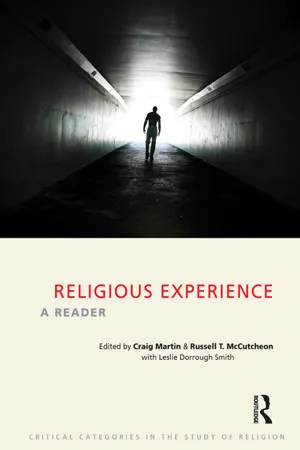
Many regard religious experience as the essence of religion, arguing that narratives might be created and rituals invented but that these are always secondary to the original experience itself. However, the concept of "experience" has come under increasing fire from a range of critics and theorists. This Reader presents writings from both those who assume the existence and possible universality of religious experience and those who question the very rhetoric of "experience". Bringing together both classic and contemporary writings, the Reader showcases differing disciplinary approaches to the study of religious experience: philosophy, literary and cultural theory, history, psychology, anthropology; feminist theory; as well as writings from within religious studies. The essays are structured into pairs, with each essay separately introduced with information on its historical and intellectual context. The ultimate aim of the Reader is to enable students to explore religious experience as rhetoric created to authorize social identities. The book will be an invaluable introduction to the key ideas and approaches for students of Religion, as well as Sociology and Anthropology. CONTRIBUTORS: Robert Desjarlais, Diana Eck, William James, Craig Martin, Russell T. McCutcheon, Wayne Proudfoot, Robert Sharf, Ann Taves, Charles Taylor, Joachim Wach, Joan Wallach Scott, Raymond Williams
Information
1
INTRODUCTION
In the evening, I went very unwillingly to a society in Aldersgate Street, where one was reading Luther’s Preface to the Epistle to the Romans. About a quarter before nine, while he was describing the change which God works in the heart through faith in Christ, I felt my heart strangely warmed. I felt I did trust in Christ, Christ alone for salvation; and an assurance was given me that he had taken away my sins, even mine, and saved me from the law of sin and death.
(Wesley 1988, 249–50)
So wrote John Wesley (1703–91), in what scholars call his conversion narrative, concerning an experience that reportedly took place during a meeting (somewhat like a modern day Bible study) in London on the evening of Wednesday, May 24, 1738. At that time, Wesley, the son of a clergyman, was himself a Church of England minister who had recently returned from a (not altogether successful) three-year assignment as a missionary in Savannah, Georgia (at that time a British colonial possession). Reporting that he had “continual sorrow and heaviness of heart” on the days preceding that evening meeting in late May, Wesley recounts in this famous journal entry how—as that evening’s speaker was addressing Martin Luther’s commentary on Paul’s letter (or, from the Greek, epistle) to the early Christians who were in Rome—he had experienced a “strange warming” of his heart—a phrase that has become famous, especially among historians of Methodism, the originally British but now worldwide Protestant denomination that John and his younger brother Charles (1707–88) went on to establish. According to his journal, this sentiment or feeling—something which, in this tradition, is clearly differentiated from the cognitive (but still no less interior and thus personal) content of knowledge, often termed “belief”—was followed by an awareness of the role that Jesus Christ had played, through his life, death, and resurrection, in guaranteeing Wesley’s own salvation from, as he puts it, “the law of sin and death.”
Although many other examples could be supplied, we have here one of the better known accounts of an interior sentiment or affectation (that is, a feeling or emotion) that, to the person who reports having had it, is said to defy explanation; for it is said to carry with it what they might describe as a fullness or an immediacy of awareness that makes it stand out as unique and thus distinguishable from the other sorts of experiences that people regularly report having—such as the experience of hunger, thirst, joy, boredom, or even fear. Despite what insiders from a variety of cultures may call such exemplary moments in their awareness—if they do in fact possess a framework within which such things not only count as things worth paying attention to but also stand out as worth reporting—in the academic study of religion scholars commonly call such sentiments “religious experiences,” and those who study them have, for some time, been interested in comparing such reports, looking for the various similarities and differences in the content and form of such reported experiences, all in hopes of drawing conclusions about how religion works.
So, with this initial piece of data in hand—our data being Wesley’s journal entry concerning the “strange warming” of his heart—a simple question presents itself: what are we to do with the fact that some people report having had such experiences? Moreover, just what is an experience and what sense does it make to talk, as many scholars do, about such things as unmediated experiences—that is, internal states or dispositions that are said to result from nothing observable in the empirical world (unlike, say, the experience of heat which is presumably mediated by sensory preceptors and neurons as you grab the hot handle on the frying pan)? For that matter, what is a strange warming of the heart? What might cause it? What’s more, what does it mean to have a heavy heart? Was Wesley speaking metaphorically (better put, writing metaphorically, for we cannot forget that all we have is a text and, despite our tendency to hear a human voice behind it, no one is actually speaking here—an important point to which we will return), as in when people commonly associate their heart with emotions, such as claiming to have a broken heart? Or was he speaking literally about sensations taking place in his upper chest, as in when people today talk about experiencing heartburn? Somehow, I suspect that the latter doesn’t quite capture what most people think Wesley was trying to put onto paper—though, could psychological or physiological studies help shed light on what caused his experience? After all, as the noted US neurologist, Oliver Sacks, has phrased it, “with no disrespect to the spiritual, … even the most exalted states of mind—the most extraordinary transformations—must have some physical basis or at least some psychological correlate in neural activity” (2007, 41). But if Wesley was writing metaphorically—a technique we commonly use to place two otherwise unlike things beside each other, to say something about the one by transferring properties of the other—then to what were his metaphors “warming” and “heart” actually referring?
These are the sorts of questions that have occupied the attention of many scholars, and may very well be the questions that many of the readers of this book wish to pursue; but before attempting to answer any of them—and those looking for a start on such answers would do well to read Ann Taves’s important survey of the literature (2005), along with Martin Jay’s detailed survey of various uses of the notion of experience in modern scholarship and literature (2005), as well as Jensine Andresen’s edited collection of essays for a sample of how some cognitive scientists are today approaching the topic (2001)—we ought to step back and consider a few things. For example, is it even correct to assume, as those who try to answer such questions commonly do, that such a thing as language (e.g., whether spoken in words or, as in Wesley’s journal, written in a text) refers to something outside of itself, as in when we assume that “cup” (whether the sound you hear when it is said or the shapes you see when it is read) refers to some property internal to that object on my desk (that is, the very property that makes it a cup and not a bottle or a pen), or when we assume that the quoted words that opened this Introduction correspond to an utterance that came from a historical agent named John Wesley, who lived in England more than a couple hundred years ago. In fact, is it even correct to assume that his words—and perhaps this is why we call them his words—correspond not simply to an utterance that somehow flowed from his lips or, in the case of our quotation, from his pen, but that they also correspond to a meaning that he presumably had in his head (notice how meanings are in the head while emotions are in the heart)? Reading these words—his words—is therefore commonly thought to provide the careful reader with access to a meaning—his meaning—that Wesley had in mind when putting pen and ink to paper; a private meaning only he possessed, akin to his private experience, but that he fortunately exhibited publicly through the medium of language. This is the old “What did Shakespeare mean when he wrote…?” approach to studying meaning—the common approach that we easily find in everyday life (and many high school and college courses). According to this model, writers and speakers express (a key word—words matter!) their meanings in a code (in our case, it is called the English language, which is symbolized in arrangements of characters that we call letters or in combinations of spoken sounds that we call phonemes) that, when heard or read properly, enables a listener or a reader over two hundred and fifty years later to know what someone named Wesley experienced and then meant when he spoke about his heart’s strange warming. Without this assumption that something eternal lurks behind and thereby animates the letters and the sounds, something that links the reader to the writer and the listener to the speaker (what theorists would simply call the sign that links the signifier to the thing being signified), it would make little sense to ask about what either Shakespeare or Wesley meant when he wrote either this or that, for both of them are long gone and all that remains is a text in front of us today—the collection of signs in ink on paper or pictured in shades of light and dark on a computer screen—that has passed through innumerable editorial hands and before countless eyes prior our own.
But is this the way experience, language, and meaning-making actually work? Is experience something inside a person, owned by a person, and is meaning somehow disengaged from the words on a page and the sounds that we hear, such that the sounds and the ink can come and go but the meaning they represented remains forever? If so, then the text of Wesley’s quotation might function like an arrow leading away from his experience, on that fateful evening in May, and to the reader, wherever and whenever he or she may be, efficiently communicating across time something unique about this strange feeling that he had. But if meaning and experience do not work in this fashion, if they are not some inner, pure, and eternal thing, exclusive to the subject and only later symbolized publicly in fallible language, then too quickly moving from reading words on a page, overhearing words spoken orally, or watching people doing things, to concluding that texts, sounds, and behaviors provide direct access to some inner world of timeless significance is a serious error in scholarship.
To rephrase: perhaps we could say that if you follow the common sense model of meaning-making (which is often called the correspondence or the referential theory of meaning), then claims of religious experience will likely be understood as signaling a pre-verbal, pre-linguistic, and thus pre-cultural moment that is later expressed publicly, but done so only to varying degrees of satisfaction (which is none other than the old, “I can’t quite put it into words” approach to how meaning works) by means of those social conventions we call languages. However, if we adopt an alternative theory about how meaning-making takes place, and, by doing so, further complicate meaning’s relation to those internal states or dispositions that we commonly know as either experiences or beliefs—a theory to be discussed below in more detail—then we will have to take seriously that, as phrased by the Austrian philosopher, Ludwig Wittgenstein (1889–1951), “the expression of belief, thought, etc.,” such as Wesley’s journal entry, “is just a sentence;—and the sentence has sense only as a member of a system of language; as one expression within a calculus” (1965, 42). To put it another way, notations on a page or sounds coming from the mouths of people do not necessarily refer to anything outside of themselves; that is, they may simply be notations and sounds that refer to nothing other that the rules of the symbol systems in which they occupy a place (e.g., grammar)—rules that we, as the people who develop and use them, employ to distinguish which markings and which sounds get to count as language and which are seen and heard as mere marks and sounds. If this is the case, then markings and soundings are not neutral collections of signs that re-present (as in the sense of presenting something anew) an otherwise unavailable inner world, thereby making it available, in translated form, to outsiders. And if so, then they do not provide the reader or the listener (no matter how careful they may be in their descriptive and interpretive work) with direct access to any pre-verbal or pre-cultural meanings that were once in someone else’s head. Simply put, there is no way to answer “What did Shakespeare mean when he wrote…?”
If this alternative approach to meaning-making is used, then the question “Do you know what I mean?” may not be about the meaning at all, regardless of what the person asking the question may think it is all about. Instead, such a statement may be an invitation to determine whether speaker and listener share the same set of linguistic rules—what Wittgenstein called a calculus or what we might as well just call a grammar, whether linguistic or perhaps social (as in behaving correctly, as other members of the group do in this or that situation). And thus the common reply, “Yeah, I know what you mean,” may merely establish that that the listener and the speaker do indeed share the same rules. And by sharing the same rules they have established that they are members of the same group, sharing common likes and dislikes.
Case in point: consider the widely parodied “eh?” (pronounced “ay”) which is often used by Canada’s English speakers (a trait picked up from the British, but which is also found, though not as prominently, in US English). Waiting at a bus stop, it would not be unusual to hear someone say, “Nice weather, eh?” But the person saying this is not, in fact, posing a question. For, despite the upward inflection as their sentence ends, one would never expect to find “eh?” used at the end of a sentence that put forward a controversial claim—one that risks the sort of disagreement that marks a break or a gap in social life. That is to say, the linguistic signal “eh?” functions (as opposed to means) for Canadians much as “or what?” functions in American slang, as in “Is this great weather, or what?”: they are both occasions to solicit agreement from the person with whom one is having a conversation—“Yeah, it’s great weather” is therefore the expected, and thus the correct, answer. And by correct I simply mean the answer that signals your participation in the group—the group’s expectations for weather on an autumn morning, perhaps, or the group’s expectations for what sort of behavior can reasonably be expected to take place between strangers waiting at a bus stop. Important to recognize is that this exchange is therefore not about the weather (much like questions such as “How are you doing?” are not about how you are doing but, generally, are simply a way of saying hello; the correct answer, regardless of your disposition, is therefore “Fine”), for the observation on the quality of the weather simply provides an occasion for group affirmation and group building. “Eh?” is therefore a way to invite, perhaps even to force, agreement and thus solidarity by putting forward a claim already known to have the agreement of your conversation partner—it is already known because you each already know the other to be a member of your group, sharing your tastes, your sensibilities, your expectations, and most importantly, your language. Despite being strangers, you are both waiting for the same bus, after all. This agreement therefore is a mark of shared social affinity: “Are we both in the group who thinks that the weather is pleasant today?” to which someone answers, “Yes, we are peers.” “Eh?” questions are therefore simply occasions for massaging the group and your place within it.
If queries about the weather may not actually be about the weather, then could experience talk not actually be about supposedly pristine, internal things called experiences either? For if we follow Wittgenstein, then regardless of what people making claims of having had an experience may think, their claims (like all language) may be nothing more or less than evidence that the writer or the speaker are properly schooled in using their group’s language rules—and using the rules does nothing more or less than use the rules, thereby reproducing and reinforcing them, and in the process reproducing and reinforcing the identity of the group that results from those who collectively use them.
In this model, the sounds of speech and the markings of texts do not refer to anything outside of the fact that the speaker and listener, the writer and reader, are equally competent to put their shared rules into practice—much as readers of this text are doing right now—and doing this so well that the fiction of meaning is created as a result. In this case—recalling an earlier example—if I write “cup” (as I have just done, and which readers have just read) it may tell us nothing about some essential feature of an object on my desk that makes it naturally distinguishable from other objects also on my desk; instead, writing and reading “cup” may tell us everything about our (that is, the writer’s and the reader’s) common place within a rule system which distinguishes “cup” from “cap”—not to mention “cop,” “cot,” “cut,” “cat,” etc—distinctions that we reproduce and teach to newcomers because we find them useful, not only because this system of distinction helps us to find something to drink with but, more importantly perhaps, because they facilitate our cooperative activities with others in our group and allow us to identify those who are not in the group. Participating in such systems is therefore a way in which we continually reinvent ourselves as a specific sort of “we” and mark certain things in the world as significant to us.
Of course, this alternative theory of language will probably frustrate those who employ the common sense view of words as neutral signs that directly correspond either to intangible ideas (e.g., justice) or things (e.g., cups) in the real world. But for others, the fact that users of our language system have so successfully schooled each other in “seeing” a cup when hearing the sounds represented by “cup,” and a cat when hearing the sounds represented by “cat”—sounds and symbols repetitively driven into us from an extremely young age, by those around us, those who made us what we are today—makes language, meaning, experience, and social identity all the more interesting things to study. For despite my assurance that a cow is a cow and that it says moo, I also happen to know (because I’ve seen others do it to their children) that well-meaning (but no less coercive) adults leaned into me, as a very young child, and repeatedly told me, likely with great enthusiasm—“The cow says moo. The cow says moo”—while probably pointing just as repeatedly to a drawing in a child’s story book or to an object outside the car window. Would that sketch in the book, that object on the other side of the farmer’s fence, have naturally been something worth paying attention to without being forced to take notice of it, without being given a name for it, and without repeatedly being told of a whole series of interconnected relationships that it had with other names (“farmer,” “farm,” “horse,” “barn,” “pasture,” “milk,” etc.)? In fact, much like that farmer’s fence, not only creating a set of identities by separating farm from not-farm but, in doing so, helping us to conceptually and physically group together and organize all that falls within it as somehow being inherently related (i.e., the well, the tractor, the chicken coop, the shovel, the bags of corn seed, and the pig sty are now all part of “the farm”), being taught any series of interconnected relationships is a way that an identity is made, inasmuch as one acquires the tools (in other words, the structure, the grammar) to determine what is like what and who is like whom. For example, when placed into the correct framework, a flag, a song, a series of holidays, certain events in the past, and certain institutions can all come to create the impression of a uniform national identity. But without initiation into this or that particular linguistic and social calculus, would I have experienced the cow and its moo? Would I feel French or Greek or Mexican or American? Would I believe that I was or was not a farmer? Or, without initiation into the use of that particular calculus, would the moments that together conspired to create that sense of identity instead be irrelevant, and thus unnoticed, in a hectic world in which I had come to pay attention to yet other things by means of relationships perhaps unimaginable to those intent on “seeing” certain objects as cows and hearing certain sounds as moos?
Apparently, experience is a lot more complicated than was first apparent when reading that quotation from John Wesley, for it now seems that the internalization of a previous calculus, developed long before we arrived on the scene and taught to us by others, ensures that none of my experiences are simply my own; instead, what gets to count as an experience is determined for us by others, by the grids given to us and by means of which we determine what is and is not significant to us. Thus, instead of talking about “his experiences” and “his meanings,” as we did earlier when discussing what Wesley wrote, we might better phrase it as our experience and our meaning, inasmuch as the frameworks that determine what gets to stand out as an experience and what gets to count as meaningful are public and therefore collective (such as the usually unnoticed grid that allows us to pay attention to some long gone social actor named John Wesley, while ignoring countless other people who undoubtedly had rich lives in the eighteenth century). And it is not just that “cup” or “cow” do not necessarily point to something internal to those things we call cups and cows, for everything that has just been said (or, again, should I say written?) equally applies to all of the other words in the preceding paragraphs. For example, whether I used it in my own text, ...
Table of contents
- Cover
- Half Title
- Title Page
- Copyright Page
- Table of Contents
- Preface
- Sources
- 1. Introduction
- Part I: The Background of Experience
- Part II: The Autonomy of Experience
- Part III: The Universality of Experience
- Part IV: The Explanation of Experience
- Part V: The Unraveling of Experience
- Conclusion: The Capital of “Experience”
- Some Afterwords …
- Bibliography
- Index
Trusted by 375,005 students
Access to over 1.5 million titles for a fair monthly price.
Study more efficiently using our study tools.
Frequently asked questions
Yes, you can cancel anytime from the Subscription tab in your account settings on the Perlego website. Your subscription will stay active until the end of your current billing period. Learn how to cancel your subscription
No, books cannot be downloaded as external files, such as PDFs, for use outside of Perlego. However, you can download books within the Perlego app for offline reading on mobile or tablet. Learn how to download books offline
Perlego offers two plans: Essential and Complete
- Essential is ideal for learners and professionals who enjoy exploring a wide range of subjects. Access the Essential Library with 800,000+ trusted titles and best-sellers across business, personal growth, and the humanities. Includes unlimited reading time and Standard Read Aloud voice.
- Complete: Perfect for advanced learners and researchers needing full, unrestricted access. Unlock 1.5M+ books across hundreds of subjects, including academic and specialized titles. The Complete Plan also includes advanced features like Premium Read Aloud and Research Assistant.
We are an online textbook subscription service, where you can get access to an entire online library for less than the price of a single book per month. With over 1.5 million books across 990+ topics, we’ve got you covered! Learn about our mission
Look out for the read-aloud symbol on your next book to see if you can listen to it. The read-aloud tool reads text aloud for you, highlighting the text as it is being read. You can pause it, speed it up and slow it down. Learn more about Read Aloud
Yes! You can use the Perlego app on both iOS and Android devices to read anytime, anywhere — even offline. Perfect for commutes or when you’re on the go.
Please note we cannot support devices running on iOS 13 and Android 7 or earlier. Learn more about using the app
Please note we cannot support devices running on iOS 13 and Android 7 or earlier. Learn more about using the app
Yes, you can access Religious Experience by Craig Martin,Russell T. McCutcheon in PDF and/or ePUB format, as well as other popular books in Social Sciences & Psychology of Religion. We have over 1.5 million books available in our catalogue for you to explore.