- 448 pages
- English
- ePUB (mobile friendly)
- Available on iOS & Android
eBook - ePub
About this book
Over the past several years, a number of Levantine archaeologists working on the Iron Age (ca. 1200 - 586 BCE) have begun to employ high precision radiocarbon dating to solve a wide range of chronological, historical and social issues. The incorporation of high precision radiocarbon dating methods and statistical modelling into the archaeological 'tool box' of the 'Biblical archaeologist' is revolutionizing the field. In fact, Biblical archaeology is leading the field of world archaeology in how archaeologists must deal with history, historical texts, and material culture. A great deal of debate has been generated by this new research direction in southern Levantine (Israel, Jordan, Palestinian territories, southern Lebanon & Syria, the Sinai) archaeology. This book takes the pulse of how archaeology, science-based research methods and the Bible interface at the beginning of the 21st century and brings together a leading team of archaeologists, Egyptologists, Biblical scholars, radiocarbon dating specialists and other researchers who have embraced radiocarbon dating as a significant tool to test hypotheses concerning the historicity of aspects of the Old Testament or Hebrew Bible. As this book "raises the bar" in how archaeologists tackle historical issues as manifest in the interplay between the archaeological record and text, its interest will go well beyond the 'Holy Land.'
Information
V.
ISRAEL IN THE IRON AGE
13 Ladder of Time at Tel Reḥov
Stratigraphy, archaeological context, pottery and radiocarbon dates
Amihai Mazar, Hendrik J. Bruins, Nava Panitz-Cohen and Johannes van der Plicht
Abstract
Six excavation seasons conducted between 1997–2003 at Tel Reḥov south of Beth Shean revealed rich data related to the 12th–8th centuries BCE. In Area D, six stratigraphic phases (D-7 to D-3) relate to the Iron Age I. Occupation layers of the Iron Age IIA were explored in Areas B, C, D, E, F and G. In each of these areas, three to four stratigraphic phases from this period were found. The correlation between the various areas is not an easy task, yet we suggested strata numbers which, though tentative, provide a general stratigraphic framework for the entire site. All three strata, VI–IV, produced typical pottery assemblages. The pottery of Stratum VI differs from the later two later in details, yet all three belong to the Iron IIA horizon. The rich assemblages from Strata V–IV are identical to those found in Strata VB and VB–IVA at Megiddo and related sites and thus the correct dating of Tel Reḥov strata is crucial for the ongoing debate over the chronology of the Iron Age in the Southern Levant.14C dates of samples from Tel Reḥov were measured at three laboratories. Altogether, 70 dates are now available: 15 at the Weizmann Institute, 9 at the University of Arizona (both published in Radiocarbon 2001), 34 at Groningen laboratories (published in the journal Science [April 2004]) and 30 additional dates from Groningen. An additional five are being prepared at the Weizmann Institute. This paper will present the nature and contexts of the samples and discuss the various questions raised in this research. Some major points are:1. The dates measured at the Weizmann Institute during the late 1990s are consistently too low by 50–100 years when compared to those from Arizona and Groningen.2. The stratigraphic sequence and 14C dates from Area D are in accord with the conventional chronology of the Iron Age I in Israel. The uppermost phase in this sequence (concentration of pits from level D-3) yielded a limited pottery assemblage which appears to belong to the end of this period. The 14C dates and other archaeological considerations call for the termination of the Iron Age I somewhere in the first quarter of the 10th century BCE.3. The few dates from Stratum VI and many from the destruction of Stratum V fall in the last quarter of the 10th century BCE. Wiggle matching enables to date Stratum VI close to the mid-10th century and Stratum V to the later half of that century. The 14C dates from Stratum IV indicate that its violent destruction occurred during the 9th century, not later than ca. 830 BCE, yet a more precise date within this time depends on archaeological and historical considerations. These dates at Tel Reḥov fit the ‘extended conventional chronology’ for the Iron IIA in Israel (ca. 980–840/830 BCE).4. Historical events like the raid of Shoshenq I and the Aramean wars may be taken into consideration as causing some of the destruction layers at Tel Reḥov, though such identifications remain tentative.5. The dates measured at Tel Reḥov are important for substantiating the chronology of Phoenicia, Cyprus and Greece, since imported pottery from all three regions was found at Tel Reḥov in stratigraphic contexts.
Introduction
Tel Reḥov is a large site, covering 10 hectares, situated at an important geographic junction in the Jordan Valley, 5 km south of Beth Shean (Figs. 13.1–3).
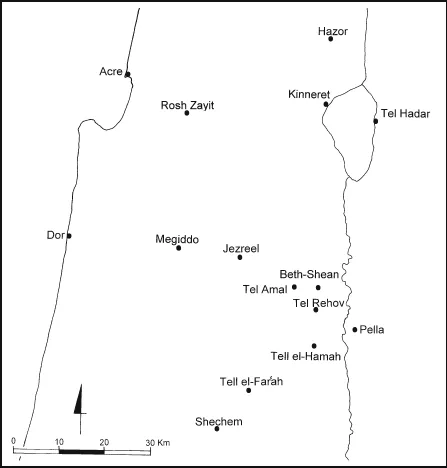
Figure 13.1 Location map of Tel Reḥov
Six excavation seasons between the years 1997 to 2003 revealed complex stratigraphic sequences in seven excavation areas, yielding rich material assemblages from the end of the Late Bronze to the end of the Iron Age IIB. The most widely exposed and explored period is the Iron Age IIA (10th-9th centuries BCE),1 which was excavated in six excavation areas (Mazar 1999, 2003b, in press a, in press b).2 The rich material culture assemblages from Tel Reḥov provide a major contribution to many aspects of material culture relating to northern Israel in the 12th–8th centuries BCE. Large well stratified and restorable pottery assemblages and a large number of 14C dates based on shortlived organic samples from a sequence of well stratified loci provide important data for the currently debated subject of Iron Age chronology. The main results were already published earlier (Bruins, van der Plicht and Mazar 2003a; Mazar and Carmi 2001) and raised controversy (Bruins, van der Plicht and Mazar 2003b; Finkelstein and Piaseztky 2003a, 2003b; Gilboa and Sharon 2003; Mazar 2004).
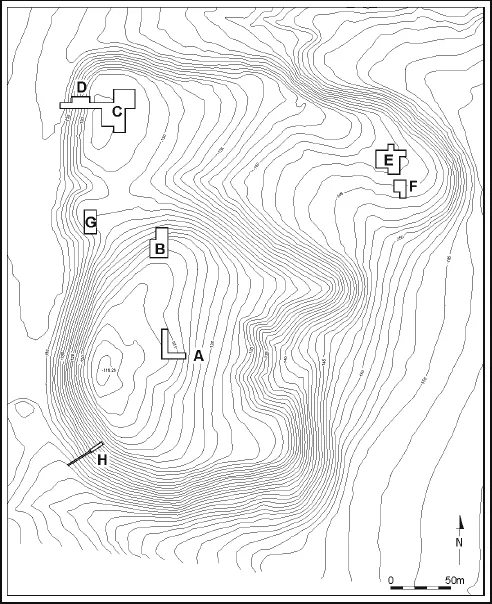
Figure 13.2 Tel Reḥov: topographic map and areas of excavation
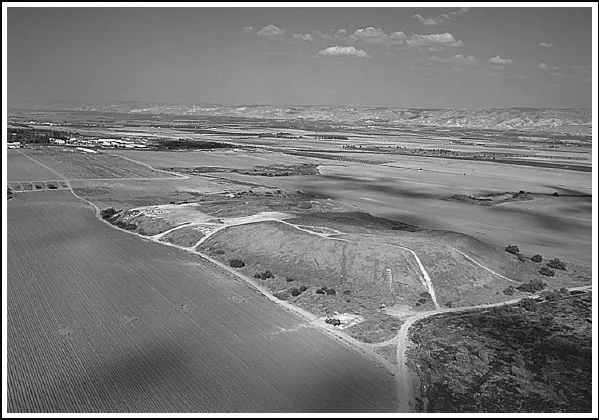
Figure 13.3 Tel Reḥov (looking to the north-east)
In the current paper, we present in considerable detail the major features of the architecture, stratigraphy and pottery assemblages in Areas D, C and B, from which 14C dates were obtained. We explain the context of each sample used for 14C dating and present the large Groningen radiocarbon series of 64 dates. Moreover, a comparison is made with published dates obtained from two other radiocarbon laboratories—Reḥovot and Arizona. Finally, the implications of the results are discussed with respect to the Iron Age chronology in the Southern Levant.
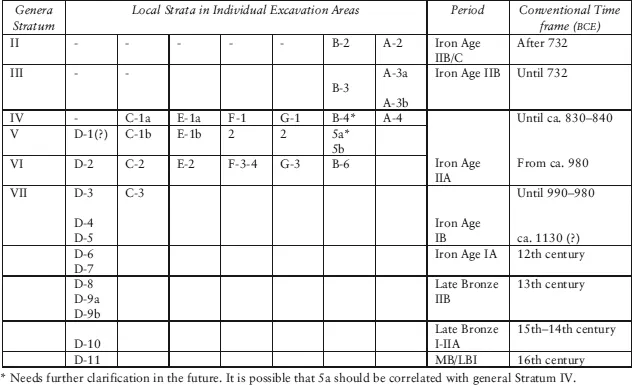
The stratigraphic phases (termed here ‘strata’) in each excavation area at Tel Reḥov were numbered separately; thus Stratum D-1 is the uppermost stratum in Area D, and so on (Table 13.1). Since layers of the Iron Age IIA were excavated in six different excavation areas, we attempted to correlate these local stratigraphic phases into a comprehensive overall framework. These final strata numbers are marked in Roman numerals in Table 13.1. Yet it should be pointed out that this correlation is tentative and insecure in several cases, and its details might be changed or refined in the future. In view of local stratigraphic developments in each of the excavation areas and the correlation uncertainty between areas C, B and E with respect to Iron IIA, we use final Roman numeral strata mainly in relation to Area C, but maintain the local phase stratigraphy in most other cases.
Table 13.1. Stratigraphic table of Tel Reḥov, showing the correlation between the different excavation areas
14C Dates from Tel Reḥov: An Overview3
The following groups of 14C dates from Tel Reḥov were published previously:
(a) A total of 15 dates from seven loci, measured during the years 1998–99 in the 14C Laboratory of the Weizmann Institute in Reḥovot (hereafter: Reḥovot, laboratory code RT) measured conventionally by Liquid Scintillation Counting (LSC) (Mazar and Carmi 2001; cited in the present paper, Tables 13.2 and 13.4). Nine of these were charred grain samples from Locus 2425 of Area C; three were samples of olive stones from various phases in Area D, and an additional three samples consisted of charred timber used for construction in Areas C and E. Also included is one date from Stratum D-3 prepared at Reḥovot and measured at Tucson (RTT-3805).
(b) Nine dates of charred grain from Locus 2425 were measured in the AMS laboratory of the University of Arizona (hereafter: Arizona, laboratory code AA; Mazar and Carmi 2001: 1338; cited in the present paper, Table 13.4).
(c) A series of 34 dates of charred grains and olive stones from 14 loci, measured during 20012002 at the Radiocarbon Laboratories of the University of Groningen were published in 2003 (Bruins, van der Plicht and Mazar 2003a, 2003b; Tables 13.2 and 13.3 in the present paper). The two Groningen 14C labs, situated at the Centre for Isotope Research (hereafter Groningen), have separate pre-treatment and different measurement procedures: (1) conventional radiometry by Proportional Gas Counting (PGC); (2) AMS. The laboratory radiocarbon date codes are GrN and GrA, respectively (see van der Plicht and Bruins [Chapter 14, this volume] for a more extensive treatment of laboratory procedures).
Table 13.2. Radiocarbon dating results from Iron Age I Strata in Area D at Tel Reḥov
GrN: Groningen PGC method.; GrA: Groningen, AMS method; RT: Reḥovot LSC method (cited from Mazar and Carmi 2001); RTT: Reḥovot, AMS (see footnote 9).
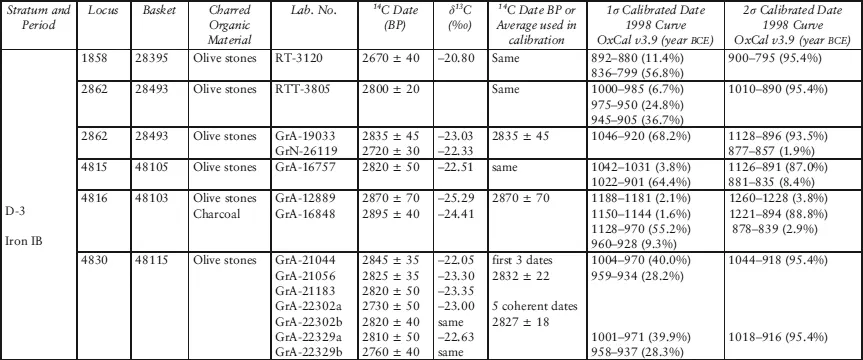
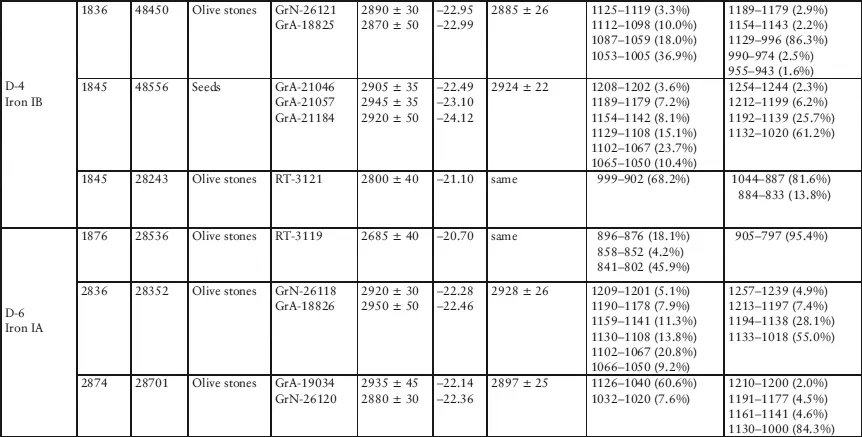
Table 13.3 Calibrated Groningen radiocarbon dates from Iron IIA Strata of Tel Reḥov
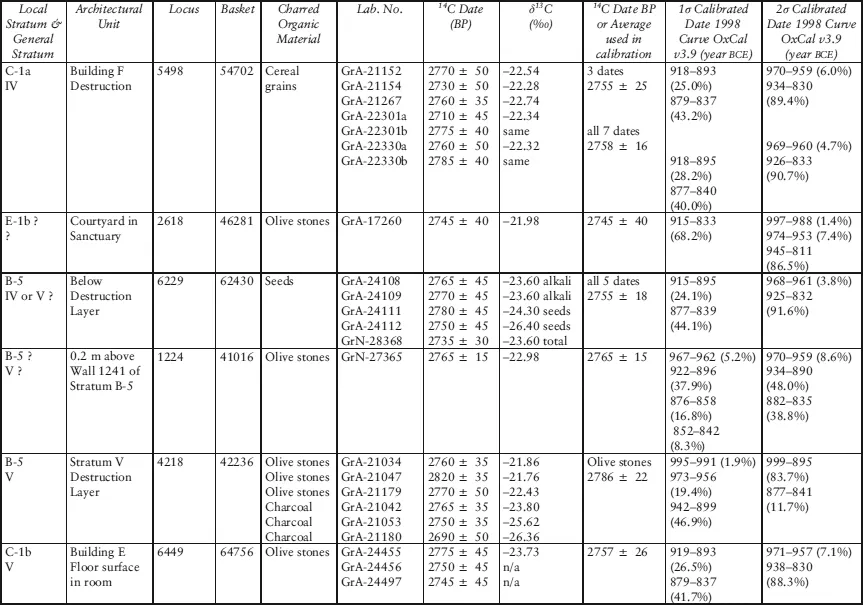
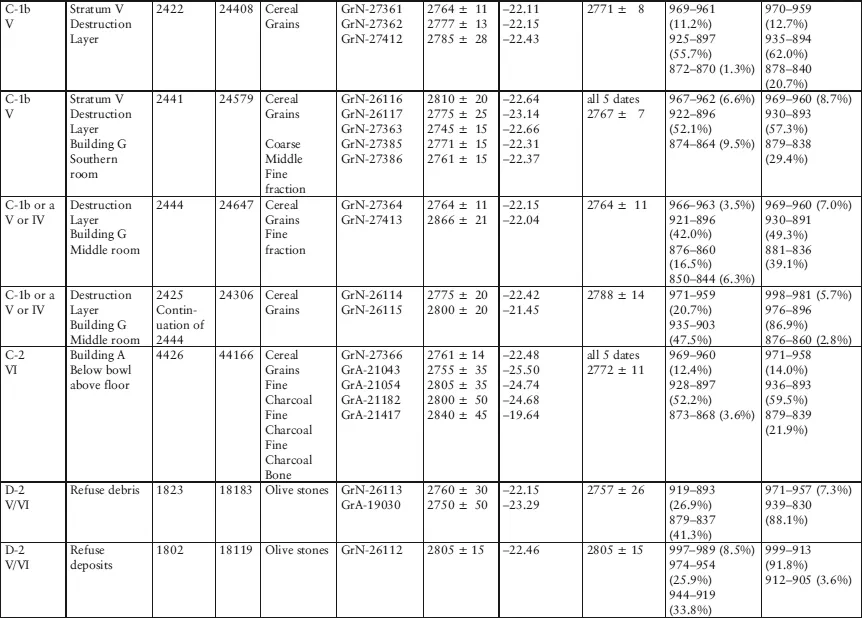
Moreover, 30 additional Groningen dates from Tel Reḥov are presented in this paper (included in Tables 13.2 and 13.3). Therefore, the entire Groningen series of Tel Reḥov totals an impressive 64 radiocarbon dates, the largest lab series available for a single Iron Age site in the Levant (see also van der Plicht and Brui...
Table of contents
- Cover
- Half Title
- Title Page
- Copyright Page
- Table of Contents
- Preface
- Abbreviations
- I. Introduction to the Problems
- II. Some Methodological Issues
- III. Around the Eastern Mediterranean in the Iron Age
- IV. Jordan in the Iron Age
- V. Israel in the Iron Age
- VI. Historical Considerations
- VII. Conclusion
- Index
Trusted by 375,005 students
Access to over 1.5 million titles for a fair monthly price.
Study more efficiently using our study tools.
Frequently asked questions
Yes, you can cancel anytime from the Subscription tab in your account settings on the Perlego website. Your subscription will stay active until the end of your current billing period. Learn how to cancel your subscription
No, books cannot be downloaded as external files, such as PDFs, for use outside of Perlego. However, you can download books within the Perlego app for offline reading on mobile or tablet. Learn how to download books offline
Perlego offers two plans: Essential and Complete
- Essential is ideal for learners and professionals who enjoy exploring a wide range of subjects. Access the Essential Library with 800,000+ trusted titles and best-sellers across business, personal growth, and the humanities. Includes unlimited reading time and Standard Read Aloud voice.
- Complete: Perfect for advanced learners and researchers needing full, unrestricted access. Unlock 1.5M+ books across hundreds of subjects, including academic and specialized titles. The Complete Plan also includes advanced features like Premium Read Aloud and Research Assistant.
We are an online textbook subscription service, where you can get access to an entire online library for less than the price of a single book per month. With over 1.5 million books across 990+ topics, we’ve got you covered! Learn about our mission
Look out for the read-aloud symbol on your next book to see if you can listen to it. The read-aloud tool reads text aloud for you, highlighting the text as it is being read. You can pause it, speed it up and slow it down. Learn more about Read Aloud
Yes! You can use the Perlego app on both iOS and Android devices to read anytime, anywhere — even offline. Perfect for commutes or when you’re on the go.
Please note we cannot support devices running on iOS 13 and Android 7 or earlier. Learn more about using the app
Please note we cannot support devices running on iOS 13 and Android 7 or earlier. Learn more about using the app
Yes, you can access The Bible and Radiocarbon Dating by Thomas Levy,Thomas Higham in PDF and/or ePUB format, as well as other popular books in Social Sciences & Biblical Studies. We have over 1.5 million books available in our catalogue for you to explore.