- 160 pages
- English
- ePUB (mobile friendly)
- Available on iOS & Android
eBook - ePub
About this book
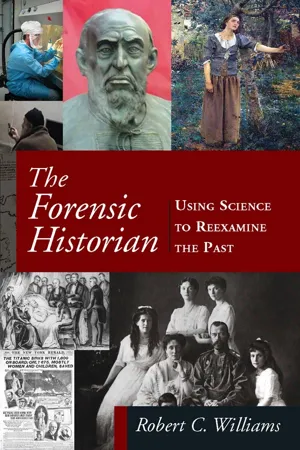
Modern forensic science has significantly affected historical debate over some well-known past crimes or mysteries, utilizing modern DNA, nuclear, and chemical analyses to reexamine the past. This book takes an in-depth look at 20 significant cases where investigators have applied new forensic techniques to confirm, dispute, or revise accepted historical accounts. Among the cases included are the murder of King Tut, the validity of the Vinland Map, the authenticity of the Hitler diaries, Joan of Arc's ashes, the bones of Anastasia, arsenic and the death of Napoleon, and the dating of the Shroud of Turin, plus 13 more.
Information

Introduction
Scope of Evidence
History, as Edward Gibbon once pointed out, is in part the “register of the crimes, follies, and misfortunes of mankind.” History is often a crime scene investigation in which the historian plays the role of a detective, perhaps even a medical examiner. Historians tell a story, and make an argument, that may be confirmed or altered by modern science and forensics, as well as by new evidence and interpretation. The forensic historian investigating past crimes engages in discovery and construction, science and art, the examination of evidence and the creation of narrative.
For historians, the scope of evidence has always been broad. Historians tend to utilize whatever evidence is at hand and whatever analytic approaches they believe could shed more light on that evidence.
Forensic historians examine cases that are relevant in a court of law or in public discussion and debate. (The wordforensic derives from the Latin forum, the public square.) Forensics means the application of science to legal problems, in our case, problems from the past. Forensic historians apply science to questions of historical interest, debate, or argument that may also have legal implications. They may be trained historians utilizing forensic expertise and evidence, or trained forensic scientists examining cold cases from the past. There is as yet no real field of forensic history.
This book examines some famous historical criminal cases where modern forensic science investigators have tried to solve a mystery or revised accepted historical wisdom. It focuses on investigators who utilized analytic chemistry, neutron activation, carbon-14 dating, light and electron microscopy, ballistics, facial reconstruction, DNA fingerprinting, computer autopsies, and ultraviolet light fluorescence. Most cases examined by forensic historians involve:
• a reasonable suspicion that a crime or misdemeanor was committed
• a well-known historical figure or event that attracted media attention
• modern forensic techniques utilized to conduct historical research
• a probable cause to indict someone for committing a crime
• a historiographical debate—an argument without end—that has continued despite, or because of, new scientific results regarding the case.
Forensics, as we shall discover, does not necessarily close a case from the past, but may open new areas for debate and discussion. Forensic science provides new tools for the historian’s toolbox, new ways of examining and investigating the grave evidence of the past. Documents and photographs, skulls and bones, hair and teeth, paint flakes and hard drives, ballistics and DNAanalysis all may be brought to bear on a case. Since World War II, forensic pathology and anthropology have slowly given way to genetics and DNA “fingerprinting,” along with computer hardware and software, as scientific evidence that can stand up in court. This book highlights that transition through specific case studies showing how modern forensic historians and scientists do their work and what kinds of evidence they must obtain.
These historical cases are organized around the forensic work of the scientists who investigated them, often long after the fact. The book begins with the man who reconstructed the face of Ivan the Terrible in 1953 and ends with the team that confirmed the death of Osama bin Laden by DNA analysis in 2011. During that period— and especially after the invention of DNA fingerprinting in 1985—a small group of men and women traveled the globe seeking to apply forensics to history. Initially forensic pathologists and anthropologists working on bones, they became specialists in extracting DNA from old, even ancient, bodies in order to answer questions of paternity, identity, and genealogy.
Case open or case closed, modern forensics provides crucial tools, evidence, and perspectives on the past. Forensics broadens the scope of evidence for the historian. As forensic pathologist William Maples pointed out, dead men do tell tales. History reaches us not simply through the dead hand of the past, but through the living hands and eyes of modern scientists. And science less often closes cases than it adds a valuable and exciting new dimension to historical debate. Although the media tend to exaggerate the novelty in these cases and to oversimplify scientific research, they indicate just how fascinated the public is with forensic approaches to history.
Or as forensic anthropologist Clyde Snow put it, “Bones make good witnesses. They may speak softly, but they don’t lie and they never forget.” So it is with DNA fingerprints.
1.1 Mikhail Gerasimov: Making Ivan the Terrible’s Face
Forensic historians are both artists and scientists. We begin with the work of Soviet forensic anthropologist Mikhail Gerasimov (1907–1970) because his forensic history involved both art and science, the reconstruction of faces from skulls and the measurement of skulls and bones necessary to the task. He used science to investigate the past and art to re-create it.
In 1953 the Soviets buried one criminal and exhumed another. Joseph Stalin, a native of Georgia and the totalitarian dictator of the Soviet Union, died in March, having been responsible for the imprisonment, torture, and murder of millions of people over several decades through his policies of collectivization of the peasantry, purges of the Communist Party and the army, slave labor camps, and forced industrialization of the USSR. World War II slaughtered millions more Soviet citizens. How many people did Stalin murder? No one really knows the exact number, but 30 million people is not a bad guess.
A few weeks after Stalin’s death, on April 23, 1953, a special commission of the Ministry of Culture opened the sarcophagus of Ivan the Terrible—Tsar Ivan IV (1530–1584), or John the Dread, as British historians dubbed him—to conduct a scientific, historical, and forensic analysis of his remains in the Archangel Cathedral of the Kremlin in Moscow. Like the nearby tombs of his two sons, Fedor and Ivan, Ivan the Terrible’s tomb was constructed of brick, covered with plaster, and then overlaid with bronze. The three graves had never previously been disturbed. Ivan’s victims numbered in the thousands, not millions, but everyone knew him as a ruler who enjoyed torturing and murdering his recalcitrant subjects, especially the landed nobility, known as boyars.
Why open the tomb of Ivan the Terrible, Stalin’s hero among Russian rulers? Ivan had been a cult figure under Stalin, who considered Ivan his teacher, a “great and wise ruler” surrounded by hostile foreigners and wealthy boyars. Ivan was the subject of one of movie director Sergei Eisenstein’s greatest films. In 1947 Stalin told Eisenstein that Ivan’s only mistake was not to liquidate everyone who opposed him. Stalin had come close to doing just that. Now Stalin was dead, and curiosity could at last be satisfied by forensics. Perhaps the scientists opened Ivan’s tomb simply because they finally could do so without fear for their careers—and their lives. Or perhaps they were carrying out Stalin’s own orders—posthumously.
A key member of the team exhuming the body of Ivan was Mikhail Gerasimov, a well-known forensic anthropologist, archaeologist, and pioneer of facial reconstruction based on skulls and skeletons. Born in St. Petersburg in 1907, Gerasimov had studied forensic medicine and anthropology at Irkutsk and Moscow in the 1920s. He measured skulls, bones, and the soft tissue in corpses to attempt to reconstruct the faces of individuals. Since the average thickness of soft tissue and muscle was known for types of individuals, pegs of varying lengths (now called tissue-thickness markers) were placed around the skull at various points and covered with rubber sheeting to begin facial reconstruction.
Gerasimov had worked as a scientific technical assistant at the Irkutsk Museum in the 1920s, reconstructing faces from Neanderthal and Pithecanthropus fossils, and became a “doctor of facial science.” He took on a number of criminal cases for Stalin’s police, the dreaded NKVD, and began reconstructing the faces of famous historical figures, including Dostoevsky’s mother, Alexander the Great, and early Kievan ruler Andrei Bogoliubsky. In the 1890s, Swiss-born anatomist Wilhelm His had created models of faces from skulls (notably composer Johann Sebastian Bach), and in the 1930s the FBI tried some facial reconstruction in the United States. But Gerasimov took this early work to another level.
In June 1941, Gerasimov helped excavate the Mongol emperor Tamerlane’s tomb and began to reconstruct Tamerlane’s face from skull fragments found. Tamerlane’s name meant “Timur the Lame,” and his bones confirmed his disability. Opening Tamerlane’s tomb, the local residents believed, would bring down a curse upon those responsible. Indeed, on June 22—the day Gerasimov opened the tomb—Hitler’s armies invaded the Soviet Union. Many local residents believe to this day that World War II was in part the consequence of Tamerlane’s curse.
During the rest of the war, Gerasimov worked at the medical hospital in Tashkent on war victims. Like Mildred Trotter, he had ample opportunity to measure precisely the costs of combat on the human body.
In 1953 the bones of Ivan the Terrible showed a man wracked by pain who relieved his own torment by tormenting others. What did the Soviet Union’s Research Institute of Forensic Medicine add to what historians already knew about Ivan?
Ivan’s skeleton was covered with the torn pieces of a monk’s robe, confirming that immediately after his death Ivan was tonsured as the monk Jonah. His bones were well preserved but brittle, showing traces of quicksilver and arsenic. The arsenic was within the normal range, but the mercury content was unusually high. Ivan was taller than believed at six feet. He was also heavier than believed, weighing 210 pounds when he died. Ivan’s bones showed osteophytes, indicating that he had polyarthritis and was in constant and severe pain. His cartilages and ligaments had ossified, indicating that he had used mercury ointment to alleviate his pain.
Ivan’s bones showed what contemporary records did not: that he was indeed terrible (or awful, or dreaded, as implied by the Russian word groznyi) not only because of his acts of terror, sadism, and cruelty, but because of his unusual height. They also indicated a man wracked by physical pain and subject to the ministrations of doctors. They did not suggest that Ivan was poisoned or otherwise murdered.
In his 1572 last will and testament, Ivan confessed to a corrupt spirit and a “liking for unworthy things.” He had indulged in “murder, lewdness and other bad acts,” along with self-praise, pride, and arrogance. He also admitted to “theft and assassination,” not to mention “shame-lessness, debauchery and drinking.” And he had a “readiness to commit all sorts of evil.” Ivan’s own last will and testament painted quite a self-portrait of a man terrible indeed. Gerasimov’s facial reconstruction from the skull matched contemporary descriptions of Ivan. But until Gerasimov’s reconstruction, historians had no idea what Ivan actually looked like except from the marvelous but speculative portraits by later Russian painters. (Gerasimov deserved the extra month’s salary he received for his work.)
Gerasimov’s techniques became high tech. A skull was set on a turntable, exposed to a low-power laser beam, the contours recorded by a video camera and the results fed into a computer for manipulation. Computer information was then fed into a milling machine that produced a three-dimensional portrait of the individual in hard foam. Today facial reconstruction amounts to three-dimensional modeling by computer, using CT scanners to reconstruct the axial sections of a skull target on film. The results are fed into a computer and sometimes compared with another photograph. The resultant pictures amount to a virtual autopsy.
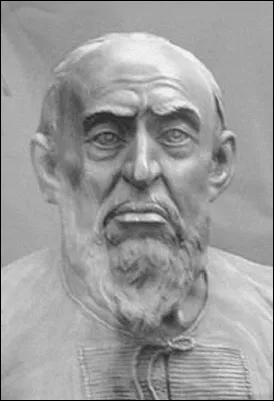
Ivan the Terrible was Gerasimov’s most famous facial reconstruction, based on his exhumed body.
Illustration 1.1 Tsar Ivan the Terrible
The art of facial reconstruction is now standard procedure, used by fil...
Table of contents
- Cover
- Half Title
- Title Page
- Copyright Page
- Dedication
- Table of Contents
- List of Illustrations and Table
- Preface: Mildred Trotter and the Boneyard of War
- 1. Introduction: Scope of Evidence
- 2. Faking It: Chemistry and Forgery
- 3. Atomic Evidence
- 4. A Question of Identity: From Bones to DNA Fingerprinting
- 5. Not-So-Cold Cases
- 6. Conclusion: Modern Forensics and Historical Revision
- Glossary
- Bibliography
- Index
- About the Author
Trusted by 375,005 students
Access to over 1.5 million titles for a fair monthly price.
Study more efficiently using our study tools.
Frequently asked questions
Yes, you can cancel anytime from the Subscription tab in your account settings on the Perlego website. Your subscription will stay active until the end of your current billing period. Learn how to cancel your subscription
No, books cannot be downloaded as external files, such as PDFs, for use outside of Perlego. However, you can download books within the Perlego app for offline reading on mobile or tablet. Learn how to download books offline
Perlego offers two plans: Essential and Complete
- Essential is ideal for learners and professionals who enjoy exploring a wide range of subjects. Access the Essential Library with 800,000+ trusted titles and best-sellers across business, personal growth, and the humanities. Includes unlimited reading time and Standard Read Aloud voice.
- Complete: Perfect for advanced learners and researchers needing full, unrestricted access. Unlock 1.5M+ books across hundreds of subjects, including academic and specialized titles. The Complete Plan also includes advanced features like Premium Read Aloud and Research Assistant.
We are an online textbook subscription service, where you can get access to an entire online library for less than the price of a single book per month. With over 1.5 million books across 990+ topics, we’ve got you covered! Learn about our mission
Look out for the read-aloud symbol on your next book to see if you can listen to it. The read-aloud tool reads text aloud for you, highlighting the text as it is being read. You can pause it, speed it up and slow it down. Learn more about Read Aloud
Yes! You can use the Perlego app on both iOS and Android devices to read anytime, anywhere — even offline. Perfect for commutes or when you’re on the go.
Please note we cannot support devices running on iOS 13 and Android 7 or earlier. Learn more about using the app
Please note we cannot support devices running on iOS 13 and Android 7 or earlier. Learn more about using the app
Yes, you can access The Forensic Historian by Robert C Williams in PDF and/or ePUB format, as well as other popular books in Storia & Storia mondiale. We have over 1.5 million books available in our catalogue for you to explore.