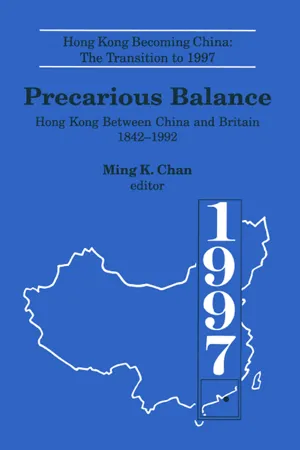
eBook - ePub
Precarious Balance
Hong Kong Between China and Britain, 1842-1992
- 272 pages
- English
- ePUB (mobile friendly)
- Available on iOS & Android
eBook - ePub
1
Introduction: Hong Kong’s Precarious Balance—150 Years in an Historic Triangle
After exactly 150 years of British colonial rule, in the autumn of 1992 Hong Kong found itself in the crux of a new crisis in the uneasy relationship between China and Britain. On July 3, 1992, Governor David Wilson retired and left Hong Kong. Although Wilson’s involuntary early departure at age fifty-seven was announced by Downing Street on New Year’s Eve 1991, no successor was named until late April 1992 after the British general election, which kept the Conservatives in power. British Prime Minister John Major appointed Christopher Patten the next governor of Hong Kong. Patten, a close ally of Major and British Foreign Secretary Douglas Hurd, managed the Tory’s electoral victory as Conservative party chairman but lost his own House of Commons seat in Bath. In becoming the first British politician of senior cabinet rank to assume the governorship of Hong Kong, which until then had always been filled by career colonial administrators or China hands from the Foreign Office, Patten broke this bureaucratic tradition; more significantly, however, his appointment signaled a possible reorientation of British policy toward Beijing in regard to Hong Kong issues.
Amid the Western democracies’ reappraisal of their relations with the People’s Republic of China (PRC) in the aftermath of the 1989 Tiananmen events, London’s continuous appeasement of Beijing regarding Hong Kong affairs, especially local democratization, during the transition to the 1997 resumption of sovereignty by China became increasingly untenable. At the microlevel, the decisive turn in London’s China–Hong Kong policy came after continuous British frustration over Beijing’s obstruction of Hong Kong’s new airport project, despite the September 1991 Sino-British Memorandum of Understanding. It was against such a shift in British policy that on October 7, 1992, barely three months after his arrival, Governor Patten unveiled his blueprint for the sunset years of British rule, Our Next Five Years—Agenda for Hong Kong.
Patten proposed a host of constitutional reforms paving the way for the 1995 legislative elections. This would be the last such electoral exercise to be conducted under British rule, and elected legislators would supposedly serve until 1999, two years into Hong Kong’s new status as a Special Administrative Region (SAR) of the PRC according to the Hong Kong Basic Law. Thus, Patten’s proposal amounts to the last major British input into Hong Kong’s decolonization–democratization process before 1997.
As the 1995 electoral outcome extends past 1997, even setting a precedent for future SAR practice, the PRC was naturally concerned and expected to be fully consulted by the British. However, both the manner of Patten’s direct appeal to the people of Hong Kong for popular support, without advanced clearance from Beijing, and the contents of his reform proposal, which exploited the gray areas and loopholes of the Basic Law, profoundly alarmed the Beijing leadership. Beijing saw this latest British attempt at enlarging popular electoral participation as a dangerous reversal of the 1985–91 British acquiescence of China’s increasing intrusion into Hong Kong affairs, and Beijing’s opposition to Patten’s proposed reforms soon escalated into a full-scale Sino-British confrontation. The bone of contention is much more than the electoral design for Hong Kong’s 1995 elections; rather it is the more crucial problem of Sino-British cooperation on all major transition issues and, by extension, the ultimate question of who rules Hong Kong in the countdown to 1997?
Based on a long repertoire of Sino-British contradictions over Hong Kong and reinforced by an increasingly deep mutual mistrust since the Tiananmen events, the PRC’s campaign condemning the Patten reforms soon galvanized into an all-out nationalistic outburst against perceived British aggression, past and present. In the autumn of 1992, Beijing attempted to arouse patriotic sentiment among Hong Kong Chinese in an anti-Patten united front mobilization. Direct verbal assaults by Beijing not only identified the British proposals as a serious infringement on Chinese national sovereignty but also linked Patten’s reforms to the mid-nineteenth century Opium Wars (which resulted in China’s humiliating defeats and the ceding of Hong Kong Island and Kowloon Peninsula to the British in 1842 and 1860). The British eleventh-hour democratization efforts were also interpreted as part of an international conspiracy orchestrated by the Anglo-American capitalist bloc to use Hong Kong as the Trojan horse to destroy communism in China. Thus, the Patten reforms were perceived as an attempt at neo-imperialist aggression comparable to the 1900 eight-nation expedition into Beijing to crush the Boxer Uprising. In the spring of 1993, Patten himself was denounced as the “sinner of a millenium” by the PRC officialdom, which had threatened to set up its own “kitchen” (shadow government) in Hong Kong before 1997.
The final resolution to this Sino-British crisis has yet to emerge, but the heated rhetoric of Beijing’s anti-Patten propaganda reveals not only the unquestioned significance of Hong Kong in China’s external affairs but also the current policy relevance of the historical consciousness of Hong Kong’s colonial past. In the happier days of Sino-Western rapprochement before the shattering tragedy of the June 4, 1989 events, the 1984 Sino-British Joint Declaration on the Future of Hong Kong was often hailed by Beijing as a peaceful and successful solution to a problem bequeathed by the dark history of imperialism in China. The latest Sino-British hostility in the last four years of British rule suggests the still heavy burden of its bitter colonial legacy in the shaping of Hong Kong’s future under Chinese sovereignty. Beijing’s deep suspicion of democratization as a scheme to entrench post-1997 pro-British (hence anti-PRC) influence and its strong objection to allowing the Hong Kong legislature to make the final decision on Patten’s reforms (as constituting the third leg in a “three-legged stool,” which would infringe on bilateral Sino-British prerogatives [the other two legs]) reflect the PRC’s mistrust of both British colonialists and the Hong Kong democratic advocates.
Indeed, the likelihood of another bilateral secret deal emerging from the current Sino-British negotiations (which started on April 22, 1993, and concluded their twelfth round on September 27, 1993) to settle this crisis without the participation of the people of Hong Kong cannot be ruled out. In fact, the 1982–84 negotiations leading to the Joint Declaration, the spring 1990 confidential diplomatic exchanges on the pre-1997 electoral arrangements, and the summer 1991 clandestine liaison to conclude the airport memorandum were all Beijing-London bilateral maneuvers deliberately excluding the participation of the people of Hong Kong. As such, the unfolding drama of Hong Kong’s transition to 1997 is not unlike the 150-year record of Sino-British antagonism and limited collaboration in which Hong Kong’s people have often found themselves in an untenable position, squeezed between the two powers. Yet Hong Kong as a British colony populated by Chinese thrived in a spectacularly creative mode by maintaining a precarious balance between China and Britain.
Perhaps any realistic portrayal of the historical and geostrategic predicament of Hong Kong’s embarrassing position as a British territory linked closely to Western economic development but dependent on mainland China for both its political survival and its economic well-being must incorporate the all-important factor of Hong Kong’s people. They are, according to the criteria set by London and Beijing, neither true British subjects nor genuine Chinese. To Richard Hughe’s well-known description of Hong Kong’s development under rather unique circumstances as “a borrowed place on borrowed time,” one should add “with borrowed people.”1
Hong Kong has been more than a significant outpost of the British colonial empire, and the heroic record of the Hong Kong Chinese’s popular mobilization from the First Opium War in 1839 to the roaring 1920s, as delineated in chapter 2, by Jung-fang Tsai, and chapter 3, by Ming K. Chan, turned Hong Kong into a front line of Chinese nationalism vis-à-vis Western imperialism. As such, the patriotic identity of the Hong Kong Chinese rallying to the defense of Chinese national interests against foreign encroachment should more than validate their claim to genuine “Chineseness.” The current Chinese Communist leadership’s stern opposition to the democratization of Hong Kong (especially direct election of the legislature) contrasts most sharply with Zhou Enlai’s June 1925 call for universal direct election to the local legislature at the outbreak of the 1925–26 Canton–Hong Kong General Strike–Boycott.
The recent emergence of a “Greater China” (encompassing Guangdong, Hong Kong, Macao, and Taiwan—the economically most developed corner of China despite the problems of multiple political jurisdiction) brings to mind the very crucial regional ties between Canton and Hong Kong that shaped Sino-British relations in the prewar era. This London-Hong Kong-Canton-Nanjing quadrilateral link is vividly analyzed by Norman Miners in chapter 4, which also highlights the sharp difference between the policy objectives of the Hong Kong colonial regime and those of the London Foreign Office. This gap in policy orientation between the high-level British approach to China and the Realpolitik requirements in the more local Hong Kong-China relations, now obvious to the people of Hong Kong, actually has deep historical roots, as pointed out by Kit-ching Lau Chan in chapter 5. Based on her examination of formal Sino-British diplomatic relations from the mid-1920s to the end of the Pacific War, she concludes that there remains a very fluid state of unpredictability in the China–Britain–Hong Kong triangle.
The maintenance of Hong Kong’s independent judiciary and common-law legal system has often been regarded as a vital pillar for the post-1997 “high degree of local autonomy” and an indispensable safeguard for the freedoms Hong Kong’s people now enjoy. However, one should not overlook the dark legacy of legal discrimination and blatantly anti-Chinese legislation that poisoned local Chinese perception of and relations with the British colonial regime. Chapter 6, by Peter Wesley-Smith, on this under-studied but crucial dimension of Sino-British relations is a most timely reminder of the local Chinese’s deep mistrust, which stems from an indefensible record of British colonial unfairness in prewar Hong Kong. Chapter 6 also serves as a useful historical reference to the equally damaging recent record of serious personal misdeeds, criminal conduct, and administrative blunders in both the Hong Kong Legal Department and the judicial bench, which make it imperative that substantial reform be taken to improve Hong Kong’s legal system. As such, any advocacy for the full preservation of the existing unreformed Hong Kong judicial system, including its personnel, for transition to the post-1997 SAR is simply misguided and ignorant of both past and current flaws in the British colonial legal heritage.
The international political power realignment, affecting Hong Kong within the rapidly changing context of Sino-British relations as shaped by the Second World War, the Chinese Communist Revolution, and the cold war, in some sense parallels the recent post–cold war deterioration in Sino-Western rapport, with profound impact on Hong Kong’s transition. In chapter 7, James T.H. Tang provides an insightful survey of the Hong Kong question from the Pacific War (when the Japanese occupation of 1941–45 caused the colony’s status to become highly problematic) to the consolidation of Communist rule in China in 1955 (right after the Geneva Conference on Indochina and at the start of the Bandung era). The Chinese Communist tolerance of Hong Kong’s continued status under British rule since 1949 has been the result of key considerations in cold war politics, while the decline of British power in global politics has enabled China to be increasingly assertive in its Hong Kong presence. The Communist Chinese shadow over Hong Kong’s remarkable domestic development during the height of the cold war is vividly reflected in chapter 8, by John Young, on the period 1950–71. Young also delineates a historic turning point in the emergence of an increasingly strong local identity of the Hong Kong Chinese, as displayed in their support of the British colonial regime against the pro-Beijing leftist riots in 1967, which were a spillover of the PRC’s Cultural Revolution. Indeed, it was a very significant reversal of Hong Kong’s traditional grass-roots defense of the mainland’s interest against British colonial might.
The highly unstable triangular linkage among London, Hong Kong, and Beijing, despite the 1972 normalization of Sino-British diplomatic relations and the 1984 settlement of Hong Kong’s future status, is delineated in chapter 9, by James Tang and Frank Ching. The helplessness of Hong Kong’s people in the Sino-British secret deals, which sealed their fate without their participation and consent, did not give much weight to Hong Kong’s wish to be an equal partner in any “three-legged stool” political arrangement. By the mid-1980s, London’s retreat on the Hong Kong issue had permanently unbalanced any residual stability of the China–Britain–Hong Kong three-legged stool. The regrettable and even tragic experience of transitional Hong Kong under the governorship of David Wilson is succinctly chronicled by Frank Ching in chapter 10.
The British retreat under PRC pressure from an earlier, commitment to pre-1997 democratization postponed the introduction of legislative direct election from 1988 to 1991. The finalization of the Hong Kong Basic Law in the spring of 1990 following Sino-British secret deals on the “convergence” between the pre-and post-1997 electoral arrangements, which became the bone of contention in the recent Patten crisis, reinforced the gridlock stalling Hong Kong’s already limited democratization. Popular mobilization in support of the Tiananmen demonstrators led to a rebound of the Hong Kong democratic lobby, which achieved a landslide victory in the September 1991 legislative direct election, only to be neutralized by Wilson’s appointment of conservative elites who later turned pro-Beijing opportunists. A politically dictated rush decision for a new airport project without adequate customary public consultation or local support provoked Beijing’s stern obstruction, culminating in the 1991 airport memorandum, which did not resolve the original problem but rather legitimized PRC interference in pre-1997 local developments. These are some of the still painful bequests from the Wilson regime highlighted by Ching in chapter 10.
In retrospect, the current Sino-British crisis over transitional Hong Kong can be regarded as the latest round in a very long and infamous repertoire of perceived imperialistic aggression and aroused nationalistic response involving Hong Kong and its Chinese populace as vanguards and victims. These chapters collectively provide some keen observations and cogent analysis for a more informed understanding of the historical roots and the contemporary dramas of Hong Kong’s uneasy passage from Chinese frontier village to British Crown Colony and finally to Socialist China’s Special Administrative Region in 155 years. The life and work, hope and fear, of the people of Hong Kong, forever living with the uncertain prospect of a precarious balance between China and Britain, are reflected in various parts of this volume. As the colonial sunset disappears fast over the horizon, the true legacy of one and a half centuries of British rule in Hong Kong may well be its inability to transform this cosmopolitan Chinese community, which it helped to foster into a shining example of economic success, into a genuine democracy serving the true interests of the Chinese nation at the threshold of the twenty-first century.
Note
1. Hughes, Hong Kong.
2
From Antiforeignism to Popular Nationalism: Hong Kong between China and Britain, 1839–1911
This chapter does not attempt to provide a comprehensive political history of Hong Kong’s early relations with China and Britain. Rather, it focuses on one theme in the triangular relationship—namely, the origins of popular nationalism among the Chinese in the British colony in the formative period of its history. Limited space allows only brief discussion of selected historical events that occurred during the seven decades from 1839 to 1911.
Ever since the British occupation of the island of Hong Kong in 1839 during the Opium War, the Chinese in the neighboring districts have time and again been forced by poverty, hunger, and political disturbances on the mainland to take refuge on the island, which provides relative safety and opportunities for employment. Consequently, it has often been maintained that “most residents [of Hong Kong] … see themselves … as willing subjects of a foreign government rather than involuntary slaves of a conquering colonial regime.”1 This assertion tells only part of the story, though. In fact, there was a long series of tensions and crises in which the Chinese people in Hong Kong expressed their displeasure with and hostility toward the British colonial authorities. This is an important aspect of the colony’s history that has been much neglected by scholars, who have often overstated the prevalence of stability, growth, and development.
In this chapter, the term Chinese nationalism is defined as a sense of collective identity with and loyalty to China as a sovereign nation-state. Nationalism is used interchangeably with the word patriotism. It is a reflection of political consciousness, which may turn into popular action. To assert that the Chinese in Hong Kong have been politically active seems to contradict another common belief—that they have been passive, apolitical, and pragmatic, concerned merely with the pursuit of wealth, comfort, order, and security. In reality, however, they, no less than their brethren on the mainland, could be provoked to action, as in the recent political mobilization protesting the Tiananmen Square massacre in Beijing. Politicization of th...
Table of contents
- Cover
- Half Title
- Title Page
- Copyright Page
- Table of Contents
- Contributors
- Series General Editor’s Foreword
- Acknowledgments
- 1. Introduction: Hong Kong’s Precarious Balance— 150 Years in an Historic Triangle
- 2. From Antiforeignism to Popular Nationalism: Hong Kong between China and Britain, 1839–1911
- 3. Hong Kong in Sino-British Conflict: Mass Mobilization and the Crisis of Legitimacy, 1912–26
- 4. From Nationalistic Confrontation to Regional Collaboration: China-Hong Kong-Britain, 1926–41
- 5. Hong Kong in Sino-British Diplomacy, 1926–45
- 6. Anti-Chinese Legislation in Hong Kong
- 7. World War to Cold War: Hong Kong’s Future and Anglo-Chinese Interactions, 1941–55
- 8. The Building Years: Maintaining a Chinar-Hong Kong-Britain Equilibrium, 1950–71
- 9. The MacLehose-Youde Years: Balancing the “Three-Legged Stool,” 1971–S6
- 10. Toward Colonial Sunset: The Wilson Regime, 1987–92
- Chronology of Major Events
- Bibliography
- Index
Trusted by 375,005 students
Access to over 1.5 million titles for a fair monthly price.
Study more efficiently using our study tools.
Frequently asked questions
Yes, you can cancel anytime from the Subscription tab in your account settings on the Perlego website. Your subscription will stay active until the end of your current billing period. Learn how to cancel your subscription
No, books cannot be downloaded as external files, such as PDFs, for use outside of Perlego. However, you can download books within the Perlego app for offline reading on mobile or tablet. Learn how to download books offline
Perlego offers two plans: Essential and Complete
- Essential is ideal for learners and professionals who enjoy exploring a wide range of subjects. Access the Essential Library with 800,000+ trusted titles and best-sellers across business, personal growth, and the humanities. Includes unlimited reading time and Standard Read Aloud voice.
- Complete: Perfect for advanced learners and researchers needing full, unrestricted access. Unlock 1.5M+ books across hundreds of subjects, including academic and specialized titles. The Complete Plan also includes advanced features like Premium Read Aloud and Research Assistant.
We are an online textbook subscription service, where you can get access to an entire online library for less than the price of a single book per month. With over 1.5 million books across 990+ topics, we’ve got you covered! Learn about our mission
Look out for the read-aloud symbol on your next book to see if you can listen to it. The read-aloud tool reads text aloud for you, highlighting the text as it is being read. You can pause it, speed it up and slow it down. Learn more about Read Aloud
Yes! You can use the Perlego app on both iOS and Android devices to read anytime, anywhere — even offline. Perfect for commutes or when you’re on the go.
Please note we cannot support devices running on iOS 13 and Android 7 or earlier. Learn more about using the app
Please note we cannot support devices running on iOS 13 and Android 7 or earlier. Learn more about using the app
Yes, you can access Precarious Balance by Ming K. Chan,John D. Young in PDF and/or ePUB format, as well as other popular books in History & Chinese History. We have over 1.5 million books available in our catalogue for you to explore.