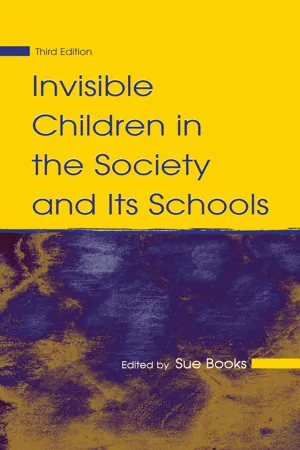
The authors in this book use the metaphors of invisibility and visibility to explore the social and school lives of many children and young people in North America whose complexity, strengths, and vulnerabilities are largely unseen in the society and its schools. These "invisible children" are socially devalued in the sense that alleviating the difficult conditions of their lives is not a priority—children who are subjected to derogatory stereotypes, who are educationally neglected in schools that respond inadequately if at all to their needs, and who receive relatively little attention from scholars in the field of education or writers in the popular press.
The chapter authors, some of the most passionate and insightful scholars in the field of education today, detail oversights and assaults, visible and invisible, but also affirm the capacity of many of these young people to survive, flourish, and often educate others, despite the painful and even desperate circumstances of their lives. By sharing their voices, providing basic information about them, and offering thoughtful analysis of their social situation, this volume combines education and advocacy in an accessible volume responsive to some of the most pressing issues of our time. Although their research methodologies differ, all of the contributors aim to get the facts straight and to set them in a meaningful context.
New in the Third Edition: Chapters retained from the previous edition have been thoroughly revised and updated, and five totally new chapters have been added on the topics of:
*young people pushed into the "school-to-prison" pipeline;
*the "environmental landscape" of two out-of-school Mexican migrant teens in the rural Midwest;
*the perceptions and practices, in and outside schools, that construct African American boys as school failures;
*negative portrayals of blackness in the context of understanding the "collateral damage of continued white privilege"; and
*working-class pregnant and parenting teens' efforts to create positive identities for themselves.
Of interest to a broad range of researchers, students, and practitioners across the field of education, this compelling book is accessible to all readers. It is particularly appropriate as a text for courses that address the social context of education, cultural and political change, and public policy, including social foundations of education, sociology of education, multicultural education, curriculum studies, and educational policy.
- 328 pages
- English
- ePUB (mobile friendly)
- Available on iOS & Android
eBook - ePub
Invisible Children in the Society and Its Schools
About this book
Information
1
Devastation and Disregard: Reflections on Katrina, Child Poverty, and Educational Opportunity
Sue Books
SUNY New Paltz
SUNY New Paltz
The most terrible price of Katrina—veryone can see this—was not the destruction of lives and property, terrible though this was. The worst of it was the damage done to the ties that bind Americans together.
—Michael Ignatieff (2005)
I started writing this introduction the week after Hurricane Katrina hit the Gulf Coast, tore through parts of Mississippi, Louisiana, and Alabama, and broke the levee system designed to protect New Orleans. Floodwaters from Lake Pontchartrain submerged 80 percent of the city in as much as 20 feet of water, stranded tens of thousands of people for days, and created “the largest population of internally displaced people since the Civil War” (Ignatieff, 2005, p. 16). A thousand people died and 100,000 were left without homes in this natural disaster, made much worse by human failings.
Tens of thousands of people did not escape the flood, most because they had no place to go and no way to leave. The “drive yourself out” evacuation plan apparently had not taken into account that in 27 percent of the households in the city no one owned a car (Ignatieff, 2005). As the water rose, some people hammered their way onto scorching rooftops or climbed onto bridge overpasses where they waited up to five days for help, starving and dehydrated. Others fended for themselves in the streets of New Orleans. A group of about 200—“people in wheelchairs . . . people in strollers . . . people on crutches”—tried to flee across a bridge onto the dry lands of the city’s predominantly white suburban west bank. At the nearby town of Gretna they were met with attack dogs and city officials who turned them back at gunpoint (Russell, 2005).
Perhaps worst of all, 30,000 people were trapped in the New Orleans Superdome and 10,000 to 20,000 more in the convention center where conditions quickly deteriorated. People died in plain view, in some cases gruesome deaths, mostly the old and the sick. “A full three days after the hurricane struck Louisiana, Washington’s top officials were asserting they had only just learned that in the convention center were thousands of exhausted fellow citizens in the dark, at the ends of their tethers, awaiting an evacuation that might not come” (Ignatieff, 2005, p. 15).
Almost immediately, demands for some accountability rang out. How could this occur in the United States? As the facts began to surface, it became clear that government officials at all levels had ignored repeated warnings about the vulnerability of the levee system. Despite President Bush’s assertion that no one could have predicted the disaster, it had in fact been forecast with shocking accuracy. Since the mid-1990s, engineering professors at Louisiana State University had been publicizing computer models that showed a major storm could flood New Orleans and kill tens of thousands of people (Drew & Revkin, 2005). In 2001, the Federal Emergency Management Agency (FEMA) itself designated a major hurricane hitting New Orleans as one of the three “like-liest, most catastrophic disasters facing this country” (Berger, 2001). In 2002 the New Orleans Times Picayune published a five-part series predicting that a major hurricane could strand 100,000 people unable to evacuate, kill thousands, and decimate the region. “It’s only a matter of time. . . . We grow more vulnerable everyday,” the newspaper warned (Washing Away, 2002). In July 2004 more than 40 federal, state, and local volunteer organizations participated in a five-day simulated response to an imaginary storm—code-named “Hurricane Pam”—that forced the evacuation of a million people from New Orleans.
The August 2005 disaster had been not only predicted but in some senses invited. Government financing for flood prevention in New Orleans had not kept pace with growing concerns about New Orleans.1 As The New York Times observed, “The broken walls . . . are testament to 40 years of fiscal and political compromises made by elected officials, from local levee boards to Congress and several presidential administrations.” Trumped by other federal budget priorities, the levees “were never tested for their ability to withstand the cascades of lake water that rushed up to, or over, their tops” (Drew & Revkin, 2005, p. A1).
When, as predicted, the floodwaters poured into New Orleans and the surrounding area, state and local rescue systems were overwhelmed, and FEMA stumbled badly. This too should have come as no surprise. Placed within the Department of Homeland Security, the agency had been systematically downsized and defunded, staffed with inexperienced “cronies and political hacks” (Krugman, 2005), and stripped of much of its power—a casualty of the War on Terror to which funds were redirected and of the Bush Administration’s determination to unravel a whole host of social supports and public protections. When the storm struck, half of the National Guard in Mississippi and more than a third in Louisiana were in Iraq. Guard equipment had also been sent to Iraq. Hundreds of high-water trucks, fuel trucks, and satellite phones were therefore unavailable to residents in the area (Shane & Shanker, 2005).
Pictures broadcast across the U.S. and beyond made clear not only that a million people had been let down by those who should have protected them and come to their aid much quicker, but also that those left to fend for themselves were the usual victims of social disregard. “The white people got out. Most of them anyway . . . [I]t was mostly black people who were left behind. Poor black people, growing more hungry, sick and frightened by the hour as faraway officials counseled patience and warned that rescues take time” (DeParle, 2005). Commentators struggled to find meaning in the catastrophe. “Just as it ripped through levees to send water pouring through New Orleans, the storm cleaved a harsh chasm among the region’s refugees, providing a stark portrait of the vast divide between America’s haves and have-nots,” New York Times reporter Jodi Wilgoren (2005) observed. “Is there any silver lining in this unspeakable disgrace and tragedy that is unfolding in the richest country on earth?” Mary Gorman (2005) wondered. “The only thing I can say is that at least for now, the invisible face of poverty is finally being revealed.”
New Orleans, like major cities across the nation, was home to poor Blacks, in wildly disproportionately numbers. Almost a quarter of the population (23.2 percent) lived below the official poverty line in 2004, a rate almost 77 percent higher than the national average (DeParle, 2005), and 38 percent of the children were poor, a percentage that is more than double that in the U.S. overall (National Center for Children in Poverty, 2005). More than two-thirds of the residents of New Orleans (67.9 percent) were African American.2 Among the poor, 84 percent were black (DeParle, 2005). Whereas the median earnings for white people 16 years old and older in New Orleans was $31,479 a year, the comparable figure for Black workers was $18,939—or just 60 percent of what white workers earned (Center for American Progress, 2005). Both Mississippi and Louisiana have higher infant mortality rates than Costa Rica. For Black babies, the odds of living a year are worse than in Sri Lanka (Kristof, 2005).
However, what was most shocking to many people about the flooding and the disastrous response to it was the fore-fronting not of poverty and inequality per se—surely, these social realities are not news—but rather the depth of institutionalized disregard for the vulnerable. As Ignatieff(2005) put it:
People involved in municipal, state and federal government simply did not care enough about their own professional morality to find out the true facts. Public officials simply didn’t bother to cross the social distances that divided them from the truth of the New Orleans population. These social distances between rich and poor, between black and white are stubborn and are likely to endure, but the most basic duty of public leadership is always to know how the other half lives—and dies. (p. 17)
The need for massive rebuilding in the wake first of Katrina and then of Hurricane Rita provided an opportunity to give local people jobs paying a living wage. Sadly, tragically, the Bush Administration had other priorities. The Administration acted quickly to ensure that “politically connected companies like Fluor Corp. and Bechtel National Inc.” would profit handsomely from the reconstruction effort, estimated as a $100 billion to $200 billion project (Dreazen, 2005). A subsidiary of Halliburton, which Dick Cheney ran before he became vice president, did the repair work at three U.S. Navy facilities in Mississippi as part of a pre-existing contract. As in Iraq, the first big contracts for rebuilding on the Gulf Coast were awarded without bidding or with limited competition (Lipton and Nixon, 2005). Many of these were open-ended contracts with “cost plus provisions,” which guarantee contractors a fixed profit regardless of their own costs. At the same time, President Bush suspended the Davis-Bacon Act, which requires contractors on federally funded projects to pay workers at least the locally prevailing wage. Offthat hook, contractors could opt for the most desperate workers willing to work for the lowest pay. When FEMA bought 450 portable classrooms for Mississippi through a $40 million no-bid contract to an Alaskan-owned business with political connections, a small Mississippi business that had wanted the job sued. Adams Hardware and Home Center, based in Yazoo City, Mississippi, was dropped from the deal even though it offered to supply the trailers for 60 percent less. “We set out to do this project not only, of course, to make a profit but to create jobs within our community,” explained the owner’s son who manages the business (Lipton, 2005).
Although aware that bankruptcy filings rise about 50 percent faster in states affected by hurricanes than in others, Congress opted not to suspend a new bankruptcy law that threatened to leave Gulf Coast residents without this recourse should they be unable to start over, build new lives, and pay off old debts quickly (Congress and Katrina, 2005). The law went into effect in October 2005. Meanwhile, conservative senators blocked a bill that would have provided all low-income victims of Katrina with health coverage through Medicaid (Krugman, 2005) and the administration opted for public housing in the form of trailer parks, which some feared would create “long-term refugee ghettoes.” An alternative would have been to expand the Section 8 Housing Program, which would have enabled displaced families with low incomes to live in a variety of communities (Krugman, 2005).
If there is a “silver lining” to this horror, both the disaster and its aftermath, it is the chance it offers to take stock and learn something about who we have become as a nation and a people. As I think about the scope and depth of child poverty in this country, about the ghettoization that isolates poor blacks and immigrants in central cities, about the persistent disparities in school funding across and within states and school districts, about the highly publicized “achievement gap” between white students and their black and Latino peers across the socioeconomic spectrum, about declining wages among all but the highest paid workers, and about the growing number of people coping with untreated sickness and injury because they cannot afford health insurance, I wonder, how many others have been left behind, pushed to the wrong side of the nation’s “vast divide between [the] haves and have-nots” and rendered invisible by a political gaze directed elsewhere (Wilgoren, 2005)? They might not have been stranded on rooftops or traumatized in hellish convention centers, but many others also live from one day to the next with no assurance of food, shelter, clothing, medical care, or help in times of need.
If millions of poor children are invisible in the sense that their lives and insights have received little attention from either the educational establishment or the broader society, this is largely because their families and neighborhoods are also invisible. Whole communities have been left behind, forgotten, overlooked, or rendered economically superfluous in a global reshuffling of production as corporations seek to maximize profits by minimizing wages; by tax policies that support this practice and push much of the national wealth upward;3 by a stunning nonchalance on the part of legislators and political leaders in the face of decades of research documenting the physical, emotional, and academic consequences of growing up in poverty (Anyon, 2005; Books, 2004; Rothstein, 2004; see also Valerie Polakow’s chapter in this book); and by a health-care system that throws millions of people—20 million to 60 million “depending on how one asks the question”—onto a patchwork of overtaxed hospital emergency rooms and under-funded clinics staffed with a few volunteers.4
A national commitment to rebuilding not just New Orleans, but all of our major cities could and should have been the outcome of an extraordinarily costly lesson learned. Sadly, a few months after the disaster, it was clear that a Republican-dominated congress wanted to pay for the damage caused by the hurricane—as well as $70 billion in new tax breaks—largely by cutting programs that help the poor directly or indirectly (Sleight of budgeting, 2005; Keyssar, 2005). Months after the storm, anxious residents still had no assurance that adequate protections against another flood would be put in place, and only one public school, a charter, had reopened. At the same time, fueled by $20 million in federal money offered for charter schools in Louisiana and with no comparable push to reopen district-run schools, New Orleans was poised to become an “impromptu lab for school choice.” “It’s like we’re experimenting with kids who’ve already been traumatized,” said Cynthia Hedge-Morrell, a city councilwoman and former school principal (quoted in Saulny, 2005).
The institutionalized disregard for the vulnerable, dramatized so blatantly in the stage-setting and then response to Katrina, can be seen all around us. This introductory chapter provides a broad-brush sketch of such disregard as it pertains to children and youth in the 21st century, largely in the United States. More specifically, the chapter focuses on two policies of particular social significance: the welfare legislation of 1996, which has unfolded in the context of a frightening concentration of poverty as...
Table of contents
- Cover
- Half Title
- Title
- Copyright
- Dedication
- Contents
- Foreword
- Preface
- 1 Devastation and disregard: Reflections on Katrina, child poverty, and educational opportunity
- 2 Out of sight: The journey through the school-to-prison pipeline
- 3 In the shadows of the ownership society: Homeless children and their families
- 4 It takes more than two villages to bring migrant teens to school: From Chiapas to the rural Midwest
- 5 An Islamic school responds to September 11
- 6 Korean American high school dropouts: A case study of their experiences and negotiations of schooling, family, and communities
- 7 Immigrant children: Art as a second language
- 8 How schools fail African American boys
- 9 Constructions of blackness: A white woman's study of whiteness and schooling
- 10 Thanksgiving and serial killers: Representations of American Indians in schools
- 11 "Does this mean I can't be your daughter?": Troubling representations of white working-class teen mothers
- 12 Queer In/visibility: The case of Ellen, Michel, and Oscar
- 13 Children and young people affected by AIDS
- 14 Hoping for the best: "Inclusion" and stigmatization in a middle school
- Author Index
- Subject Index
- About the Authors
Trusted by 375,005 students
Access to over 1.5 million titles for a fair monthly price.
Study more efficiently using our study tools.
Frequently asked questions
Yes, you can cancel anytime from the Subscription tab in your account settings on the Perlego website. Your subscription will stay active until the end of your current billing period. Learn how to cancel your subscription
No, books cannot be downloaded as external files, such as PDFs, for use outside of Perlego. However, you can download books within the Perlego app for offline reading on mobile or tablet. Learn how to download books offline
Perlego offers two plans: Essential and Complete
- Essential is ideal for learners and professionals who enjoy exploring a wide range of subjects. Access the Essential Library with 800,000+ trusted titles and best-sellers across business, personal growth, and the humanities. Includes unlimited reading time and Standard Read Aloud voice.
- Complete: Perfect for advanced learners and researchers needing full, unrestricted access. Unlock 1.5M+ books across hundreds of subjects, including academic and specialized titles. The Complete Plan also includes advanced features like Premium Read Aloud and Research Assistant.
We are an online textbook subscription service, where you can get access to an entire online library for less than the price of a single book per month. With over 1.5 million books across 990+ topics, we’ve got you covered! Learn about our mission
Look out for the read-aloud symbol on your next book to see if you can listen to it. The read-aloud tool reads text aloud for you, highlighting the text as it is being read. You can pause it, speed it up and slow it down. Learn more about Read Aloud
Yes! You can use the Perlego app on both iOS and Android devices to read anytime, anywhere — even offline. Perfect for commutes or when you’re on the go.
Please note we cannot support devices running on iOS 13 and Android 7 or earlier. Learn more about using the app
Please note we cannot support devices running on iOS 13 and Android 7 or earlier. Learn more about using the app
Yes, you can access Invisible Children in the Society and Its Schools by Sue Books in PDF and/or ePUB format, as well as other popular books in Education & Education General. We have over 1.5 million books available in our catalogue for you to explore.