- 387 pages
- English
- ePUB (mobile friendly)
- Available on iOS & Android
eBook - ePub
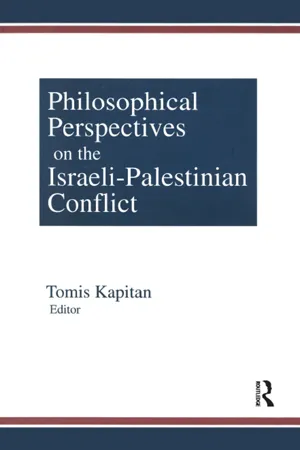
Philosophical Perspectives on the Israeli-Palestinian Conflict
About this book
This volume addresses a number of philosophical problems that arise in consideration of the century-old conflict between Israeli Jews and Palestinian Arabs. Consisting of essays by fifteen contributors (including both Israeli and Palestinian philosophers) and a lengthy introduction by the editor, it deals with rights to land, sovereignity, self-determination, the existence and legitimacy of states, cultural prejudice, national identity, intercommunal violence, and religious intransigence.
Information
1
The Right to National Self-Determination
I have seen, in my times, Frenchmen, Italians, and Russians: I even know, thanks to Montesquieu, that one may be a Persian; but as for Man, I declare I have never met him in my life; if he exists, it is without my knowledge.
—De Maistre
The right to national self-determination has often been at the crux of the modern political debate, but theoretical analyses of this right are few and far between. Most of this analysis has been the work of international lawyers and is therefore highly influenced by legal and political precedents. Political philosophers have also tended to infer the content of this right from past and present political arrangements, and have therefore suggested that the core content of national self-determination is the right to determine whether “a certain territory shall become, or remain, a separate state.”1 The thrust of this right, in the interpretation which has become prevalent in the postcolonial era, is that “a people—if it so wills—is entitled to independence from foreign domination, i.e. it may establish a sovereign state in the territory in which it lives and where it constitutes a majority.”2
I shall take issue with this approach and argue that, at the core of the right to national self-determination, lies a cultural rather than a political claim. The right to national self-determination is the right of a nation to preserve its existence as a unique social group. This right is distinct from the right of individuals to govern their lives and to participate in a free and domestic political process.
The cultural interpretation of the right to self-determination has two main advantages: (1) it allows us to understand this right in the context of similar rights granted to other cultural groups such as ethnic minorities and indigenous people; (2) it is better suited to a world in which the sovereignty of separate nation-states is declining while the importance of federal and regional political arrangements is growing.
The view that the right to national self-determination is, first and foremost, a cultural claim is heavily dependent on a perception of nations as particular types of cultural communities. My first step, therefore, will be to substantiate this perception.
Nations, States, and Cultural Communities
Nation is a very elusive concept, and it might therefore be advisable to begin by determining what a nation is not: a nation is not a state. This statement might seem to be obvious, but it is not. A report on nationalism, written by a study group at the Royal Institute of International Affairs, defines nation as “used synonymously with ‘state’ or ‘country’ to mean a society united under one government.” This sense of the term does not merely reflect the prevalent common speech usage, but appears in such official expressions as “law of nations” or “League of Nations.”3
This identification between state and nation is endorsed by Weil, who claims that “there is no other way of defining the word nation than as a territorial aggregate whose various parts recognize the authority of the same State.”4 Complementary claims are made by Deutsch, who defines a nation as “a people who have hold of a state,”5 and by Hertz, who asserts that the identification of a nation with a people constituted as a state is very widespread and that, according to this view, “every state forms a nation and every citizen is a member of the nation.”6 Thus there is no adjective in English derived from the noun state, and the term national is employed for designating “anything run or controlled by the state, such as the national debt or national health insurance.”7 These definitions might lead to the conclusion that state and nation are identical concepts or, at least, two aspects of the same concept—one relating to the institutional sphere and the other to the individuals who participate in the formation and activities of these institutions. We would therefore expect the definition of state, reciprocatively, to include parameters found in the definition of nation. However, this is not the case: the concept nation, if at all mentioned when defining state, appears in the combination nation-state as one of various possible forms of a state. The Encyclopedia Britannica defines state as the political organization of society. The term is used in two ways, one more general, to refer to a body of people who are politically organized, and the other more specific, meaning the institutions of government. It is distinguished from other associations by its goals, by the methods it employs in accomplishing these goals, by the marking of territorial limits, and by its sovereignty. Sovereignty distinguishes the state from other kinds of human associations: it entails the monopoly of power as well as the creation and control of law.
According to Dyson, the main characteristics of the state are: the specific quality of its authority (its sovereignty), its extraordinary and growing resources of physical power, and its well-defined territory.8 None of these features is considered an essential characteristic of the concept “nation.”9
In his concluding remarks on the development of the concept state in the Dictionary of the History of Ideas, D’Entreves predicts that the nation-state will be replaced by “a new supranational state.” He follows this hypothesis with an interesting question:
But will this [the disappearance of the nation-state] mean the disappearance of the state, its “withering away”—to use the familiar Marxist phrase? So long as there will be an organization capable of controlling force, regulating power and securing allegiances, one thing seems certain … that organization will still be a state.10
For D’Entreves, then, the link between states and nations is a historical coincidence which should not blur the conceptual distinction between them. As Seton-Watson rightly emphasizes, a state is “a legal and political organization with the power to require obedience and loyalty from its citizens,” while a nation is “a community of people, whose members are bound together by a sense of solidarity, a common culture, a national consciousness.”11
How then did the conceptual confusion between nation and state arise? One explanation would see it as part of a deliberate attempt to obscure the difference between the claim that every nation ought to have a state—or, rather, that every state ought to derive its legitimacy from a nation—and the claim that a nation as a state. The attempt to present the nationalist slogan “one people, one country, one language” as descriptive rather than normative illustrates well the tendency to identify state and nation.12 Yet the wide prevalence of this false identification is due not only to the conscious attempts of nationalists; rather, it resulted from the historical processes that accompanied the emergence of the modern nation-state.
Let us look back at this formative period—the end of the eighteenth century. Following Rousseau’s philosophy and its influence on the ideology of both the American and French revolutions, the state has been identified with its subjects rather than with its rulers. This belief, that the state should he the “institutional representation of the people’s will,”13 lies at the heart of the American and French revolutions. These revolutions thus mark a substantial shift in the type of legitimacy sought and claimed by political institutions—from divine or dynastic rulers to popular voluntary consent. This shift has placed the democratic ideal of self-determination, perceived as the right of the citizens to rule themselves, at the core of modern political thought.
The history of self-determination is bound up with the history of the doctrine of popular sovereignty proclaimed by the French Revolution. Government should, according to this view, be based on the will of the people. In the context of the French Revolution, self-determination is therefore seen as “a democratic ideal valid for all mankind.”14
This fit between the democratic universalistic ideal and the emerging national ideology was contingent on the political realities of the period, since the body of citizens empowered to participate in political matters was identical with the nation. This identification emerged in the course of the revolutionary processes. The American Revolution created a new nation, including all the individuals who had been entitled to political participation before the Declaration of Independence and excluding all those who had lacked political rights. Thus there was a complete overlap between the citizens of the state and the members of the nation. The right to national self-determination became equivalent to the right of the people to self-rule. So strong was this identification between state and nation that it still holds today, and in the United States the term nation refers to the federal state.
A different process, though with similar results, unfolded in France. While in America the new state had created a new nation, in France the nation had established a state and identified it as the fatherland. As Abbe Volfius put it in 1790:
The true fatherland is the political community where all citizens protected by the same laws, united by the same interests, enjoy the natural rights of man and participate in the common cause.15
Hence at this particular historical stage, the question of who constitutes the people—the members of the state or the members of the nation—seemed irrelevant: in the French case, because the nation had created the state, and in the American case, because the state (the union) had created the nation.
Consequently, the nation—now equated with the body of citizens—came to be understood as the “body of persons who could claim to represent, or to elect representatives for, a particular territory at councils, diets or estates.”16 It therefore became widely accepted that “the principle of sovereignty resides essentially in the nation; no body of men, no individual, can exercise authority that does not emanate from it.” Accordingly, the Third Estate proclaimed itself to be the true representative of the nation and thus the rightful holder of state power.
The nation became the unique symbol of fellowship among all members of the political framework, as well as the tie between the rulers and the ruled. A new political norm ensued, fostering the belief that “the legitimating principle of politics and state-making is nationalism; no other principle commands mankind’s allegiance.”17 The shift from a justification relying on democratic principles to one based on national ones, from a belief in the right of citizens to self-rule to support for the right of nations to self-determination, was completed. The transition was smooth and the internal contradictions between the democratic version and the national one were not apparent.
In contemporary political discourse, the right of individuals to determine their government remains a basic tenet of both liberal and nationalist doctrines. Yet, since the end of the eighteenth century, history has been marked by a series of social, economic, and political changes caused by immigration, the establishment of new states inhabited by more than one nation, and the inclusion of groups which had previously been excluded from the political process. All these have marred the identification between the citizens of the state and the members of the nation—collapsing together the democratic ideal of self-rule and the belief in the right of nations to self-determination no longer seems plausible.
Today, there are hardly any states that are nationally homogeneous but, surprisingly, our political discourse has not adapted itself to these developments. As late as 1960, when the Covenant on Human Rights was drafted, it was clear that neither people nor nation had ever been adequately defined, and a disquieting confusion reigned between these two concepts and the concept of majorities.
The norm that the only valid source of state legitimacy is the nation still prevails. As a result, every group of individuals who consider themselves a nation desire to establish their own independent state, and members of each state desire to transform themselves from a population into a nation. Governments which are pressured to prove that they represent nations rather than mere gatherings of individuals develop an interest in homogenizing their populations—they intervene in the populations’ languages, in their interpretations of history, myths, and symbols or, to put it more broadly, in their cultures. Thus the modern state becomes an agent for cultural, linguistic, and sometimes religious unification—it attempts to build a nation. However, we should remember our starting point; though nations may attempt to establish states and each state may prefer to present itself as representing a nation, these two concepts are mutually independent.
The above discussion has clarified what a nation is not. I will now seek to take on the much more difficult task of elucidating what it is.
What Is a Nation?
The modern concept of nation-building, namely, the intentional creation of a nation, might help to shed light on this question. Osterud defines nation-building as the sum of politics designed to promote national integration:18 “Nation-building is an architectural metaphor for the process induced within a state to integrate the country and tie the inhabitants together in a national fellowship.”19 The ideal of national fellowship symbolizes a belief in the existence of special ties and obligations among members of the nation that nationalists wish to see as a natural outcome of a shared faith and a common history. However, there appears to be a contradiction between the concept of a nation as a natural community and the idea of nation-building. This tension has evoked a compulsive tendency to “go back” to the ancestral origins of new nations, clinging to even the faintest evidence of historical continuity and supporting blatantly false claims in order to “prove” that the nation’s roots lie in a distant past rather than in the bureaucratic decision of some foreign office or in some international agreement:
Nationalism teaches that all nations have a past by definition, those movements which could not fall back upon a community with long and rich cultural heritage sought to imitate those which could do so by, if necessary, “inventing” or rather “rediscovering” and annexing history and cultures for their communities, in order to provide that cultural base without which no nationalism can attain widespread legitimation.20
The histories of nation-states are saturated with invented traditions.21 Invented tradition is defined by Hobsbawm as “a set of practices, normally governed by overtly or tacitly accepted rules of a ritual of a symbolic nature, which seek to inculcate certain values and norms of behaviour by repetition, which automatically implies continuity with the past.”22 Invented traditions are the result of this urge for continuity, of a desire to present at least some parts of social life as unchanging and invaria...
Table of contents
- Cover
- Half Title
- Title Page
- Copyright Page
- Table of Contents
- Preface
- Acknowledgments
- Map of Israel/Palestine
- Historical Introduction to the Philosophical Issues Tomis Kapitan
- 1. The Right to National Self-Determination
- 2. Formulating the Right of National Self-Determination
- 3. The Moral Status of Israel
- 4. State Terrorism and Its Sponsors
- 5. Jus in Bello and the Intifada
- 6. Targeting Children: Rights versus Realpolitik
- 7. Land, Property, and Occupation: A Question of Political Philosophy
- 8. Personal and National Identity: A Tale of Two Wills
- 9. The State of Palestine: The Question of Existence
- 10. The Ethical Dimension of the Jewish-Arab Conflict
- 11. Philosophical Reflections on Religious Claims and Religious Intransigence in Relation to the Conflict
- 12. In Search of the Emperor’s New Clothes: Reflections on Rights in the Palestine Conflict
- 13. Beyond Justice and Rights: Competing Israeli and Palestinian Claims
- 14. Zionism, Liberalism, and the State
- 15. Tragic Justice
- References
- Contributors
- Index
Trusted by 375,005 students
Access to over 1.5 million titles for a fair monthly price.
Study more efficiently using our study tools.
Frequently asked questions
Yes, you can cancel anytime from the Subscription tab in your account settings on the Perlego website. Your subscription will stay active until the end of your current billing period. Learn how to cancel your subscription
No, books cannot be downloaded as external files, such as PDFs, for use outside of Perlego. However, you can download books within the Perlego app for offline reading on mobile or tablet. Learn how to download books offline
Perlego offers two plans: Essential and Complete
- Essential is ideal for learners and professionals who enjoy exploring a wide range of subjects. Access the Essential Library with 800,000+ trusted titles and best-sellers across business, personal growth, and the humanities. Includes unlimited reading time and Standard Read Aloud voice.
- Complete: Perfect for advanced learners and researchers needing full, unrestricted access. Unlock 1.5M+ books across hundreds of subjects, including academic and specialized titles. The Complete Plan also includes advanced features like Premium Read Aloud and Research Assistant.
We are an online textbook subscription service, where you can get access to an entire online library for less than the price of a single book per month. With over 1.5 million books across 990+ topics, we’ve got you covered! Learn about our mission
Look out for the read-aloud symbol on your next book to see if you can listen to it. The read-aloud tool reads text aloud for you, highlighting the text as it is being read. You can pause it, speed it up and slow it down. Learn more about Read Aloud
Yes! You can use the Perlego app on both iOS and Android devices to read anytime, anywhere — even offline. Perfect for commutes or when you’re on the go.
Please note we cannot support devices running on iOS 13 and Android 7 or earlier. Learn more about using the app
Please note we cannot support devices running on iOS 13 and Android 7 or earlier. Learn more about using the app
Yes, you can access Philosophical Perspectives on the Israeli-Palestinian Conflict by Tomis Kapitan in PDF and/or ePUB format, as well as other popular books in Philosophy & Political Philosophy. We have over 1.5 million books available in our catalogue for you to explore.