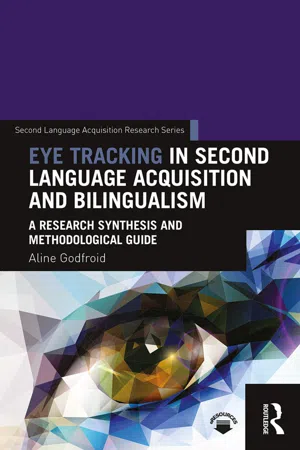
Eye Tracking in Second Language Acquisition and Bilingualism provides foundational knowledge and hands-on advice for designing, conducting, and analysing eye-tracking research in applied linguistics. Godfroid's research synthesis and methodological guide introduces the reader to fundamental facts about eye movements, eye-tracking paradigms for language scientists, data analysis, and the practicalities of building a lab. This indispensable book will appeal to undergraduate students learning principles of experimental design, graduate students developing their theoretical and statistical repertoires, experienced scholars looking to expand their own research, and eye-tracking professionals.
eBook - ePub
Eye Tracking in Second Language Acquisition and Bilingualism
A Research Synthesis and Methodological Guide
- 415 pages
- English
- ePUB (mobile friendly)
- Available on iOS & Android
eBook - ePub
Eye Tracking in Second Language Acquisition and Bilingualism
A Research Synthesis and Methodological Guide
About this book
Information
1
Introducing Eye Tracking
In a fast-changing and multilingual world, the study of how children and adults learn languages other than their native tongue is an important endeavor. Questions about second language (L2) learning are at the heart of the sister disciplines of second language acquisition (SLA) and bilingualism, and researchers who work in these areas have an increasingly diverse and sophisticated methodological toolkit at their disposal (Sanz, Morales-Front, Zalbidea, & Zárate-Sández, 2016; Spivey & Cardon, 2015). In addition, it seems that in the 21st century, the preferred way to investigate questions of language processing and representation is online—that is, as processes unfold in real time—because the data obtained in this way offer a more fine-grained representation of the learning process than any offline measurements could (Frenck-Mestre, 2005; Godfroid & Schmidtke, 2013; Hama & Leow, 2010). This book is about one online methodology that is well suited for studying both visual and auditory language processing, namely eye-movement registration, commonly referred to as eye tracking.
Eye tracking is the real-time registration of an individual’s eye movements, typically as he or she views information on a computer screen. Within the Routledge Series on Second Language Research Methods, this guide on eye-tracking methodology is the third to be devoted to an online data collection method, following Bowles’s (2010) meta-analysis of reactivity research regarding think-alouds, and Jiang’s (2012) overview of reaction time methodologies. This shows how eye tracking is part of a collection of online techniques that have been gaining momentum in SLA and bilingualism (also see Conklin, Pellicer-Sánchez, & Carrol, 2018). Across the language sciences, linguists, applied linguists, language acquisitionists, bilingualism researchers, psychologists, education researchers, and communication scientists have similarly embraced the recording of eye movements in their research programs. Although the research reviewed in this book is primarily from SLA and bilingualism, the principles for researching language with eye tracking generalize to other domains that use similar materials as well, which gives the methodological part of this book a broad, interdisciplinary reach.
To understand where eye tracking fits within the larger movement toward online research methodologies, and to appreciate some of its strengths and weaknesses, I introduce eye tracking along with three other concurrent methodologies—think-aloud protocols, self-paced reading (SPR) and event-related potentials (ERPs)—which present themselves as complements and sometimes competitors to the eye-tracking method.
1.1 Online Methodologies in Language Processing Research
Online (real-time, concurrent) methodologies are a class of data collection methods that provide information about a participant’s receptive or productive language processing as it happens. Online methods stand in contrast with offline methods, which are temporally disconnected from the task processes under investigation. Almost everything budding applied linguists learned about SLA until the 1990s was based on offline methods, such as grammaticality judgments, picture description tasks, sentence-picture matching tasks, comprehension tests, and many more (see Mackey & Gass, 2016, for a review). Any method providing accuracy data as its main output, often as a part of a pretest-posttest design, can be considered offline.
Although offline measures remain important in understanding SLA, these measures are now frequently supplemented by concurrent or online data collection methods. Thus, we may find researchers record ERPs (Morgan-Short, Sanz, Steinhauer, & Ullman, 2010; Morgan-Short, Steinhauer, Sanz, & Ullman, Michael, 2012) or reading time data (Godfroid, Loewen, Jung, Park, Gass, & Ellis, 2015; Leeser, Brandl, & Weissglass, 2011) during grammaticality judgments, collect think-alouds in addition to comprehension pre- and posttest data (Leow, 1997, 2000) or gather reaction times during sentence-picture matching (e.g., Godfroid, 2016; Leung & Williams, 2011). In general, the addition of an online data collection method provides the researcher with a richer and time-sensitive account of ongoing processing (e.g., Clahsen, 2008; ,2005, ; Godfroid & Schmidtke, 2013; Hama & Leow, 2010). Some questions (for instance, about the neural basis of language) can be investigated only through online methodologies. Mitchell (2004) drove this point home when he noted in regard to sentence processing that “any method based on probing events after a delay … may have ‘missed the show’” (p. 16).
1.1.1 Think-Aloud Protocols
Thinking aloud is when a participant says out loud his or her thoughts while carrying out a particular task, such as solving a math problem, reading, or taking a test. That particular task, known as the primary task, is the one researchers want to study, and thinking aloud is sometimes referred to as the secondary task (e.g., Ericsson & Simon, 1993; Fox, Ericsson, & Best, 2011; Godfroid & Spino, 2015; Goo, 2010; Leow, Grey, Marijuan, & Moorman, 2014), which is used to shed light on the main task of interest. Thus, think alouds are a tool researchers use to study cognitive processes as they unfold during some type of human activity, such as language processing.
Think-aloud protocols stand out among the family of concurrent or online data collection methods because they yield qualitative, rather than quantitative, data as their primary outcome. This makes them an interesting supplement for other online methods, which produce quantitative data, even though it is also possible to analyze think-alouds quantitatively after data coding (e.g., Bowles, 2010; Ericsson & Simon, 1993; Leow et al., 2014). An ingenious study that triangulated think alouds and eye tracking was Kaakinen and Hyönä (2005). Kaakinen and Hyönä manipulated L1 Finnish participants’ purpose for reading, by asking them to learn more about one of two rare diseases that a friend had supposedly contracted. Using the eye-tracking data, the authors showed that sentences that were relevant to their participants’ reading perspective (i.e., their friend’s disease) generated longer first-pass reading times than sentences that dealt with the other disease also discussed in the text. In addition, participants more often showed evidence of deeper levels of processing in the think alouds they produced after the longer first-pass reading times. 1 An interesting secondary finding was that verbal evidence of deeper processing coincided with elevated reading times, but not with the presence of task-relevant information per se (i.e., not all sentences about the target disease elicited deep processing). This would seem to suggest that the longer eye fixation durations were the factor that mediated between text information and the participants’ depth of processing.
Think-alouds are a versatile research methodology (see Fox et al., 2011, for a recent review and meta-analysis). Within SLA research, think alouds have been collected to study questions pertaining to noticing and awareness (Alanen, 1995; Godfroid & Spino, 2015; Leow, 1997, 2000; Rosa & Leow, 2004; Rosa & O’Neill, 1999) the processing of feedback during writing, including “noticing the gap” (Qi & Lapkin, 2001; Sachs & Polio, 2007; Sachs & Suh, 2007; Swain & Lapkin, 1995); depth of processing (Leow, Hsieh, & Moreno, 2008; Morgan-Short, Heil, Botero-Moriarty, & Ebert, 2012); strategy use in vocabulary acquisition (De Bot, Paribakht, & Wesche, 1997; Fraser, 1999; Fukkink, 2005; Nassaji, 2003) and test taking behavior (Cohen, 2006; Green, 1998). The prevalent view is that think-aloud protocols reflect the contents of the speaker’s short-term memory, which are believed to ...
Table of contents
- Cover
- Half-Title
- Series
- Title
- Copyright
- Dedication
- CONTENTS
- List of figures
- List of tables
- Preface
- Acknowledgments
- 1 Introducing Eye Tracking
- 2 What Do I Need to Know about Eye Movements?
- 3 What Topics Can Be Studied Using Text-Based Eye Tracking? A Synthetic Review
- 4 What Topics Can Be Studied Using the Visual World Paradigm? A Synthetic Review
- 5 General Principles of Experimental Design
- 6 Designing an eye-tracking study
- 7 Eye-Tracking Measures
- 8 Data Cleaning and Analysis
- 9 Setting up an Eye-Tracking Lab
- References
- Index of Names
- Index
Trusted by 375,005 students
Access to over 1.5 million titles for a fair monthly price.
Study more efficiently using our study tools.
Frequently asked questions
Yes, you can cancel anytime from the Subscription tab in your account settings on the Perlego website. Your subscription will stay active until the end of your current billing period. Learn how to cancel your subscription
No, books cannot be downloaded as external files, such as PDFs, for use outside of Perlego. However, you can download books within the Perlego app for offline reading on mobile or tablet. Learn how to download books offline
Perlego offers two plans: Essential and Complete
- Essential is ideal for learners and professionals who enjoy exploring a wide range of subjects. Access the Essential Library with 800,000+ trusted titles and best-sellers across business, personal growth, and the humanities. Includes unlimited reading time and Standard Read Aloud voice.
- Complete: Perfect for advanced learners and researchers needing full, unrestricted access. Unlock 1.5M+ books across hundreds of subjects, including academic and specialized titles. The Complete Plan also includes advanced features like Premium Read Aloud and Research Assistant.
We are an online textbook subscription service, where you can get access to an entire online library for less than the price of a single book per month. With over 1.5 million books across 990+ topics, we’ve got you covered! Learn about our mission
Look out for the read-aloud symbol on your next book to see if you can listen to it. The read-aloud tool reads text aloud for you, highlighting the text as it is being read. You can pause it, speed it up and slow it down. Learn more about Read Aloud
Yes! You can use the Perlego app on both iOS and Android devices to read anytime, anywhere — even offline. Perfect for commutes or when you’re on the go.
Please note we cannot support devices running on iOS 13 and Android 7 or earlier. Learn more about using the app
Please note we cannot support devices running on iOS 13 and Android 7 or earlier. Learn more about using the app
Yes, you can access Eye Tracking in Second Language Acquisition and Bilingualism by Aline Godfroid in PDF and/or ePUB format, as well as other popular books in Languages & Linguistics & Library & Information Science. We have over 1.5 million books available in our catalogue for you to explore.