The Really Useful Book of Science Experiments contains 100 simple-to-do science experiments that can be confidently carried out by any teacher in a primary school classroom with minimal (or no!) specialist equipment needed.
The experiments in this book are broken down into easily manageable sections including:
It's alive: experiments that explore our living world, including the human body, plants, ecology and disease
A material world: experiments that explore the materials that make up our world and their properties, including metals, acids and alkalis, water and elements
Let's get physical: experiments that explore physics concepts and their applications in our world, including electricity, space, engineering and construction
Something a bit different: experiments that explore interesting and unusual science areas, including forensic science, marine biology and volcanology.
Each experiment is accompanied by a 'subject knowledge guide', filling you in on the key science concepts behind the experiment. There are also suggestions for how to adapt each experiment to increase or decrease the challenge.
The text does not assume a scientific background, making it incredibly accessible, and links to the new National Curriculum programme of study allow easy connections to be made to relevant learning goals. This book is an essential text for any primary school teacher, training teacher or classroom assistant looking to bring the exciting world of science alive in the classroom.
Frequently asked questions
Yes, you can cancel anytime from the Subscription tab in your account settings on the Perlego website. Your subscription will stay active until the end of your current billing period. Learn how to cancel your subscription.
At the moment all of our mobile-responsive ePub books are available to download via the app. Most of our PDFs are also available to download and we're working on making the final remaining ones downloadable now. Learn more here.
Perlego offers two plans: Essential and Complete
Essential is ideal for learners and professionals who enjoy exploring a wide range of subjects. Access the Essential Library with 800,000+ trusted titles and best-sellers across business, personal growth, and the humanities. Includes unlimited reading time and Standard Read Aloud voice.
Complete: Perfect for advanced learners and researchers needing full, unrestricted access. Unlock 1.4M+ books across hundreds of subjects, including academic and specialized titles. The Complete Plan also includes advanced features like Premium Read Aloud and Research Assistant.
Both plans are available with monthly, semester, or annual billing cycles.
We are an online textbook subscription service, where you can get access to an entire online library for less than the price of a single book per month. With over 1 million books across 1000+ topics, we’ve got you covered! Learn more here.
Look out for the read-aloud symbol on your next book to see if you can listen to it. The read-aloud tool reads text aloud for you, highlighting the text as it is being read. You can pause it, speed it up and slow it down. Learn more here.
Yes! You can use the Perlego app on both iOS or Android devices to read anytime, anywhere — even offline. Perfect for commutes or when you’re on the go. Please note we cannot support devices running on iOS 13 and Android 7 or earlier. Learn more about using the app.
Yes, you can access The Really Useful Book of Science Experiments by Tracy-ann Aston in PDF and/or ePUB format, as well as other popular books in Education & Education General. We have over one million books available in our catalogue for you to explore.
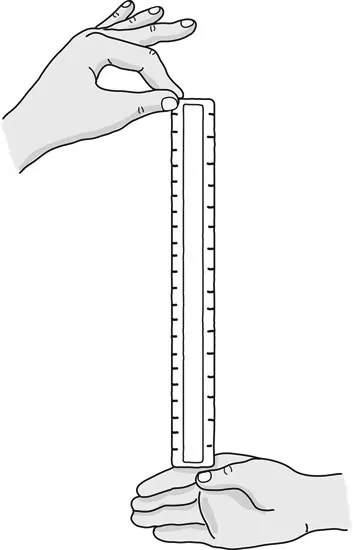
The children investigate their reaction times by catching a ruler as another person drops it. The distance at which it is caught can then be converted into a ‘reaction time’.
Useful Prior Work:
The children do not need to have any particular prior knowledge before completing this investigation.
Background Science:
A reaction time is how long an organism takes to respond to a particular stimulus. This is made up of both ‘thinking time’ (how long it takes your brain to realise that something has happened that it needs to respond to) and the speed of the nervous system in responding to the stimulus. In humans, the nervous system is made up of the brain and neurones (nerve cells). Nervous impulses travel very fast around the body, meaning that we can react to stimuli quickly. This is important for survival, for example moving your hand away when you touch something hot. However your body does not react instantly to stimuli. There is usually some delay between the stimulus and your body’s reaction. This delay is the reaction time. Certain factors can increase or decrease your reaction times. Alcohol, for instance, is a depressant drug that slows down your nervous system, therefore increasing your reaction times. Certain diseases of the nervous system such as multiple sclerosis can also increase reaction times.
National Curriculum Links:
Year 3 programme of study: Animals, including humans
– Identify that humans and some other animals have skele - tons and muscles for support, protection and movement.
Materials Needed:
Rulers: 30cm or metre rulers
Safety And Technical Notes:
Use smaller rulers, for example 30cm long, if doing this investigation with younger children. Older children could use metre rulers.
It is worth demonstrating the technique of dropping and catching the ruler with the children. The child dropping the ruler should not tell the child catching the ruler when they will drop it. The children should try to catch the ruler using just their dominant hand.
Method:
To Be Done In Advance By The Teacher:
Have the ‘calculating your reaction time table’ prepared, either on a worksheet or on a whiteboard.
Children:
Stand facing each other.
Have your partner hold the ruler out at arm’s length with the number ‘0’ at the bottom end of the ruler.
Hold your arm out so that your dominant hand is just below the ruler (but not touching the ruler!)
Have your partner let go of the ruler when they are ready. Try to catch it as quickly as you can.
When you have caught the ruler, write down the number on the ruler closest to your thumb.
Repeat the experiment five times before swapping roles with your partner.
Data Collection Ideas:
[Name]
[Name]
Length (cm)
Time (s)
Length (cm)
Time (s)
Trial 1
Trial 2
Trial 3
Trial 4
Trial 5
Average
Differentiation:
Decrease the challenge: The children can be helped when reading off where they have caught the ruler.
Increase the challenge: The children could repeat the investigation with their non-dominant hand and compare the results.
Useful Questions To Ask The Children:
Do you think there is anything we could do to improve our reaction times?
Can you think of anything that might slow down our reaction times?
What jobs need people to have fast reaction times?
Further Work:
The investigation could be repeated regularly over a few weeks to see if the children’s reaction times improve. This could be related to athletes who need to improve their reaction times – for example, runners who need to start as soon as the starting pistol is fired. They usually achieve this by regular practice in order to improve their reaction times.
Experiment 2 Decomposing
Learning Objectives:
Investigating which materials will decompose and how they decompose.
Introduction:
Children investigate which materials decompose and the rate of decay by burying different materials in the ground. The materials will be observed over a period of time to see the changes that occur.
Useful Prior Work:
The children should know what the word ‘decay’ o...
Table of contents
Cover
Title
Copyright
Contents
Introduction
How to use this book
1 Reaction times: Measuring our reaction times!
2 Decomposing: Investigating which materials decompose
3 Keeping warm: Which materials are best at keeping us warm?
4 Heartbeats: How does our heart rate change when we exercise?
5 Big feet, big hands? The relationship between different parts of our body
6 Taste vs. smell: Using just our sense of taste
7 Catch the ball! The effects of having just one eye instead of two!
8 How sensitive are you? How sensitive is our skin to touch?
9 Time to get sweaty: Investigating how sweat helps us to stay cool
10 Food testing: Which foods contain starch and fats?
11 All about yeast: What temperature of water does yeast prefer?
12 What do plants need to grow? Investigating what plants need in order to grow healthily
13 What’s growing where? The plants growing round our school
14 Brushing our teeth: What works best?
15 Design a seed! Understanding seed dispersal
16 Find the stomata: Observing the stomata on leaves
17 Chewing food: What effect does it have?
18 Green worms! Investigating camouflage
19 How varied are we? Investigating variation in our class
20 Colourful carnations: Investigating how water travels in plants
21 Moving water: How does water ‘move’ in and out of vegetables?
22 Bird beaks: Investigating how birds’ beaks are adapted to eat their food
23 Mouldy bread! What are the best conditions for mould to grow?
24 Germinating seeds: Which surface is best?
25 Fertilisers: The effects of fertilisers on plants
26 Making an indicator: Using red cabbage to make an indicator!
27 M&M chromatography: Which dyes are used to colour M&Ms?
28 Time to separate! How to separate different mixtures
29 Dissolving sugars: Which dissolves fastest?
30 Find the solvent! The right solvent for the right solute
31 Let’s get saturated! Investigating the saturation point of water
32 Cleaning water: Can we clean dirty water?
33 Diffusion rates: Investigating the diffusion rate of water
34 The best straw: Investigating capillary action
35 Let’s make an emulsion: Making our own emulsion
36 Salty water: Can we make objects float?
37 Observing melting: How do different substances melt?
38 Observing burning: Investigating what happens when different substances burn
39 A rusty problem: What are the conditions needed for rusting to happen?
40 Conductor or insulator? Testing electrical conductivity
41 The strongest thread: Investigating the strength of different fibres
42 Design a bag: What’s the best material?
43 Keep it dry! Investigating whether materials are waterproof
44 Drying the washing: What conditions are best?
45 Comparing soils: Investigating the characterstics of different soil samples
46 Testing rocks: Similarities and differences
47 Acid rain! Investigating the effect of acid rain
48 Ice cube challenge: Exploring melting
49 Where did the water go? Investigating evaporation
50 Make a fossil: How are organisms preserved?
51 How strong is your magnet? Investigating the strength of different magnets
52 Making an electromagnet: Making a simple electromagnet and investigating its strength
53 Let’s make a switch: Investigating the best design for a switch
54 Fruit circuits! Can we use fruits as batteries?
55 Brighter bulbs: Investigating bulbs in circuits
56 Floating and sinking: Which objects float and which sink?
57 Density, density: Investigating layers of liquids
58 Friction: Investigating how far a car travels along different surfaces
59 How much force? Lifting and moving different objects
60 Bouncy balls! Investigating how well different balls bounce
61 Speedy cars: Factors that affect the speed of a car
62 Let’s make a helicopter: Investigating gravity
63 Let’s make a parachute: Investigating friction
64 Taking the heat: Which material is best at conducting heat?
65 Swinging time! Investigating the swing of a pendulum
66 Stretching springs: Exploring the effect of weight on a spring
67 Making a rainbow: The colours of the spectrum
68 Colourful light: Using coloured filters
69 Designing curtains: Investigating the best materials for blocking out light
70 Mirror, mirror on the wall: How is light reflected?
71 In the shadows: Investigating changing the size of a shadow
72 Musical water: Making music with bottles of water
73 Making an ear trumpet: What’s the best design?
74 Soundproofing: Which materials soundproof best?
75 Build a steady hand game: Investigating circuits
76 Testing urine! Analysing (fake!) urine for glucose and protein
77 Volcanic eruption! Creating a volcano using baking soda and vinegar
78 Which is the best washing-up liquid? Investigating detergents
79 Making a hovercraft: Testing forces
80 Conker science: Investigating how to strengthen conkers
81 Protect an egg! Investigating forces and properties of materials
82 CSI: Crime scene investigation: Learning how to make fingerprints
83 Measuring photosynthesis: Observing pondweed
84 Fussy woodlice: Investigating habitats
85 Gummy bear science: Examining different solutions
86 Making waves: Making a beach and seeing how waves are formed
87 Call the surgeon! Performing a simple heart dissection
88 Making a bouncy ball: Investigating properties of different materials
89 Make a mini-rocket: Designing and making a rocket that takes off!
90 Extracting DNA: Exploring evolution
91 Making lemonade: Investigating substances that dissolve in water
92 Making a lava lamp: Investigating densities
93 Making slime: Non-Newtonian fluids
94 Extracting ‘plastic’ from milk: Investigating polymers
95 Cleaning pennies: Can we clean dirty pennies with vinegar and salt?
96 Colourful milk: Investigating surface tension
97 Homemade ice cream: Making ice cream without a freezer!
98 Eating iron for breakfast! Investigating which cereals contain iron
99 Compost in a cup: Investigating how plants grow
100 Growing crystals: Using Epsom salts to make our own crystals
Appendix 1: National Curriculum grid: How the Really Useful Science Experiments link to the 2014 National Curriculum