- 714 pages
- English
- ePUB (mobile friendly)
- Available on iOS & Android
eBook - ePub
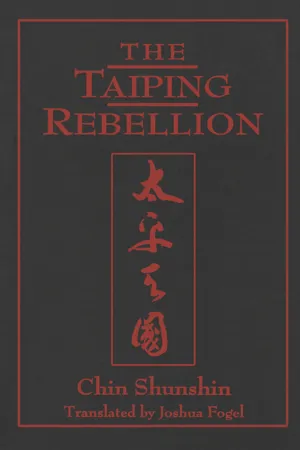
The Taiping Rebellion
About this book
Written by one of Japan' most popular modern authors, this is a lively, readable, and immensely entertaining fictional portrayal of one of the epochal events of the nineteenth century.
1
An Evening in Nagasaki
—1—
Waves were breaking in the shadows cast on the water by the circular moon. Undulating, flickering . . . it was as if light and water were at play with one another.
"So, this is good-bye. Take care," urged the voice of a young man.
"How can I ever thank you?" Lian Liwen said slowly in a faltering, unsteady Japanese. The paper lantern held by the young man beside him illuminated a small boat by the shore.
"I really didn't do anything worthy of thanks," said the young man as he lowered his head.
"Masasuke, you're so young and already so busy. That's remarkable."
"Well, Mr. Lian, your Japanese certainly has improved, but so has your ability at flattery." Lian laughed. "Not even a year has passed, has it?"
"Perhaps we shall meet again," said Lian Liwen as he stepped on board the boat. The black shadow of a Chinese vessel floated over the open sea. The boatman silently rowed, and soon the small craft was far from shore. The young man looking on from the shore held the lantern high. He had a long, thin face, that of someone still in his youth. Ōkubo Masasuke was in fact only twenty years old, by Japanese reckoning.
As the boat carrying Lian Liwen approached the Chinese ship, he removed the hood covering his head. The pigtail stuffed into the hood came dangling loosely down his back. Now he could see before him a rope ladder hanging from the ship's deck. There, in the open sea before Bōnotsu in the domain of Satsuma, Lian boarded his vessel bound for Nagasaki.
The year was 1849, second year of the Kaei reign in Japan. In that year, the Qing government in China sent eight trading ships to Nagasaki, though Number Seven had been shipwrecked at Amakusa. Lian was now boarding Number Four in Satsuma bay.
During the years the Tokugawa regime enforced its exclusion policy, trading ships from China had to carry a special piece of identification known as a shinpai, or license. The license for vessel Number Four of 1849 was issued in the name of one Li Yisheng, and the shipowner named on it was one Niu Xinyuan. The real owner, though, was Lian Weicai, proprietor of an establishment known as the Jinshunji, which had its main office in Xiamen (Amoy), Fujian province, in China.
At the conclusion of the Opium War seven years earlier, the Treaty of Nanjing had compelled the Chinese to open five ports to foreign trade. Until then the Qing government had allowed only Guangzhou (Canton) as a trading site, much as Japan at that time had made Nagasaki its only window to the outside world.
Following the Opium War, the Jinshunji had spread its commercial ventures principally to Hong Kong and Shanghai, while the main office in Fujian remained in name only. Lian Weicai's fourth son, Liwen, had been in Shanghai, but the previous year he had asked to be allowed to sail to the Ryūkyū Islands.
"I'll take about a year. That should do it," he had said, and his father agreed without hesitation. Liwen wanted to go somewhere unfamiliar and forget about everything. He had been married just over a year when his young bride suddenly died, and her death had painfully wounded him.
The Ryūkyūs were a difficult place to work, and that was precisely what Liwen was looking forward to. The Shimazu domain of Satsuma, located on the island of Kyūshū in southern Japan, held control over the Ryūkyū Islands and engaged in trade with China through them. This "trade" was conducted in a form whereby the Ryūkyūs received a kind of enfeoffment by imperial edict from China, and as a subordinate state they bore tribute to the superior Qing regime in China. The Japanese shogunate in Edo officially authorized this arrangement.
As a matter of principle, the shogunate only permitted the Chinese and the Dutch to trade at Nagasaki. The monopoly agency that saw to this trade for the shogunal authorities was known as the Nagasaki Hall. Shimazu domain was now muscling in on its terrain. Of all the domains throughout Japan, though, only Shimazu was engaging in foreign trade on its own, and only in Chinese goods. In 1810 the shogunate was compelled to permit the sale of these imports at Nagasaki. Although at first restricted to a specified list of articles for sale, Shimazu forcibly expanded the list at will. Shimazu's influence over the shogunate was exceptionally strong because it held a trump card: it supported and preserved the Ryūkyūs, without which the island chain would have ceased to remain part of Japan.
Thus the shogunate had no choice but to be conciliatory. Shimazu, for its part, made full use of the privileges accruing to official authorization to participate in commerce at the Nagasaki Hall—indeed, more than full use.
Recognition of Shimazu's special rights was solely so it could dispose of the items acquired in the Qing—Ryūkyūan "tribute trade" and lay items in stock. Yet Shimazu secretly carried on foreign trade beyond the scope of the tribute trade. The very presence of a large volume of Chinese artifacts in the case of the other domains would have been sufficient to cast suspicion on them, for the disposal of such items would have been exceedingly difficult. Secret trade itself necessitated the elimination of a domain's ruling family.
Shimazu domain, however, got away with calling its private trade "Ryūkyūan tribute trade." That provided the perfect cloak of invisibility. It ensured the legality of the origination points for the commercial products being exchanged and made it possible for the Nagasaki Hall to become an officially recognized sales site.
Because of the secret nature of this trade, there were no official records kept. In the Ryūkyū Islands, however, every staff person knew that trade was being implemented outside the structure of the tribute trade. Chinese vessels came to the Ryūkyūs to sell Chinese products; they purchased marine produce and returned to China. Unlike the trade in Nagasaki, though, no bothersome license was required of the Chinese here.
Soon these Chinese vessels also began appearing in the waters off Satsuma, and Shimazu domain transacted business with them under conditions favorable to the Chinese. Thus even vessels carrying official licenses disposed of a part of their cargoes in the coastal islands off Satsuma before continuing on to Nagasaki. There were, as a result, occasions when Chinese vessels called at Nagasaki with almost nothing left to sell on board.
The principal partner in the secret trade, including that of Shimazu domain, was the Jinshunji. Lian Liwen had gone to the Ryūkyūs to carry on business related to this trade, and to engage in work-related negotiations in Satsuma as well. One of the parties with whom he had contact was Ōkubo Toshiyo, Shimazu's overseer for the Ryūkyū Islands, and Liwen had become close friends with his son, Masasuke.
Ship Number Four, carrying a license, as always, unloaded its cargo bound for Shimazu at Bōnotsu, and from there it headed for Nagasaki. Having business to attend to in Nagasaki, Liwen had taken advantage of the ship's scheduled route and boarded it in the waters off Satsuma. The young Masasuke, who saw Liwen off by the harbor, was later to become known as Ōkubo Toshimichi (1830-78), a major political figure in Japanese history. At this time, Masasuke was listed in the domainal register as an official scribe.
—2—
The clamorous peals of gongs and drums continued for a time on the deck of Chinese vessel Number Four. This animated ceremony had become customary in celebration of a safe arrival. Once the ship dropped anchor outside the harbor, it awaited the appropriate measures to be taken by the office of the Nagasaki Administrator. In due time, several dozen small crafts rowed out from the shore, attached a tow line to the Chinese ship, and drew it into the harbor. Once inside the harbor, it again lowered the anchor it had just raised. The gongs clanged and the drums beat to signal this whole event.
When the instruments of celebration quieted down, an inspector and the interpreters from the office of the Nagasaki Administrator boarded the Chinese vessel. They carried a placard enumerating forbidden items, which they hung from the ship's mast. It was, of course, written in Japanese, and was translated into Chinese by the interpreters for the men on board the ship. The main objects banned were Christian items. When the inspection was completed, immigration procedures commenced. The license was checked, and presentation of the cargo list and the ship's manifest was requested.
Lian Liwen's name appeared on the manifest as someone who had boarded in China, and the cargo list, written before the ship had set sail, excluded the portion of items delivered to Satsuma. Because of this, they had to make arrangements in advance for the quantity of business to be conducted with the domainal authorities in Shimazu. In fact, this had been one of Liwen's tasks.
Once the proper documents were presented, the famous loyalty test known as fumie was exacted: to come ashore, the men on board ship had to "step on an image" of Jesus or Mary (the meaning of the term fumie) as a visible act of blasphemy against Christianity. This completed, the Chinese were allowed to disembark. Once on shore, they were not permitted to roam at leisure through the city. Like the Dutch, who were confined to Dejima, the Chinese were placed in a "Chinese Compound."
Prior to the Genroku reign, which began in 1688, Chinese mixed with Japanese and lodged within the city of Nagasaki, probably because the authorities felt safe in assuming that there was little chance any Christians were among them. There was always, however, the fear that mixed residence might enable individuals to partake of secret trading. In addition, reports were transmitted to the shogunate to the effect that the Kangxi Emperor (r. 1662—1722) of the Qing dynasty had appointed a Jesuit to head his Directorate of Astronomy and that he had allowed the return of missionaries who had been chased to Macao. Thus the Japanese authorities had become attentive to the possibility of Christian connections among the Chinese.
The Chinese Official Residence was completed in 1689. It was located on the grounds of the shogunate's garden of medicinal plants at Jūzen Temple. It covered an area of 9,373 tsubo (over 337,000 square feet), much larger than Dejima, which was not even 4,000 tsubo (roughly 144,000 square feet). The Dutch were not allowed one step outside of Dejima, which they referred to as their "Far Eastern Prison." The Chinese, by contrast, were permitted outside their Official Residence at certain specified times for temple visits and the like, if accompanied by Japanese officials.
In compensation for being confined to single spots, both groups were allowed to call in prostitutes to relieve their boredom while away from home. Certain prostitutes, from the Maruyama district of Nagasaki, were picked for Dejima and others for the Chinese Official Residence. After the hard labors aboard ship, this provided the men with an opportunity for some enjoyment. Once they had tread upon the image, merchants and seamen alike turned to more cheerful pursuits. Those who had made the voyage a number of times had their own particular favorites among the women. Higher-ups, like the shipowners, had women who may as well have been called their "Nagasaki wives."
Lian Liwen also headed in a lighthearted step toward the Chinese compound. Since this was his first time in Nagasaki, he had no favorite prostitute picked out. He was elated because he knew that his elder brother Zhewen was already in the compound. Two years Liwen's senior, Zhewen had quietly left the family business to devote his energies to painting. Zhewen had come to Nagasaki from the Chinese port city Ningbo about six months earlier aboard a Chinese vessel licensed in the name of Zheng Langbo. It was the Chinese vessel Number One of the present year.
Though unofficial, there were also Chinese who came to Japan on the invitation from the Nagasaki Administrator. As a rule, since merchants, shipowners, and seamen returned on the ships that had brought them, their stays in Nagasaki lasted only a few months. Invited guests, on the other hand, were allowed longer stays and did not necessarily return to China aboard their ship of arrival. This category included doctors, artists, writers, and Buddhist priests.
Lian Zhewen apparently developed an interest in traveling to Japan after a fellow painter had put the idea in his head. He was endowed with the wanderlust of an artist. Although Zhewen had been in Suzhou for a time, even when Liwen was in nearby Shanghai, he had not been able to contact his peripatetic brother. Now, three years had passed since they had seen one another.
Aboard ship, bound for Nagasaki, Liwen counted the length of time that had transpired and was again appalled at how long it had been. Zhewen was already thirty-one. "And I'm going to be thirty next year," he thought, pondering their respective ages. At that point, the visage of his late wife floated into his mind, her face and figure slender, youthful until the day she died. The contours of her face seemed to resemble Masasuke's, and Liwen realized, as he was about to enter the Chinese compound, that this was one reason he had such positive feelings about Ōkubo Masasuke. In Kagoshima, capital of Shimazu domain, Liwen had known Masasuke's acquaintances, who included a wide assortment of young people. There were, for example, the imposingly heroic types, such as a young fellow by the name of Saigō Kichinosuke (later, the famous Saigō Takamori, 1828-1877). He seemed like a brilliant young man, but Liwen felt no particular fondness for him as he did for Masasuke.
When they had parted company, Liwen presented Masasuke with the gift of a well-known Chinese text of that time, the Haiguo tuzhi (Illustrated Gazetteer of the Sea Kingdoms) by the Chinese scholar and official, Wei Yuan (1794-1856). "I'd like Lord Kichinosuke to read this book," he muttered. The Haiguo tuzhi was a work written on the basis of documents given Wei Yuan by Lin Zexu (1785—1850), the Chinese commissioner whose actions against Great Britain were said to have elicited the attacks on China that were later known as the Opium War. It described conditions in the world in the immediate aftermath of the Opium War and advocated the need for China to modernize. It was just the sort of book he wanted a young man like Saigō to read, but Liwen was unable to give it directly to him, using Ōkubo rather as a conduit.
The region in Nagasaki where the Chinese Official Residence was located is now named for that structure. It was surrounded by a brick wall over seven feet in height, beyond which had been dug a concentric moat six feet deep and six feet wide. Upon passing through the front gate, one found various buildings, such as a station for officials and a business exchange. Only after passing through the inner gate did one enter the actual residential quarters of the Chinese.
"Hey, over here. Liwen, why are you so absent-minded?" Hearing himself addressed, Liwen looked toward the inner gate.
Three Chinese vessels had already docked in Nagasaki, and between four hundred and five hundred Chinese were then staying at the compound. Maybe an acquaintance was trying to welcome him over by the gate, where some twenty of his fellow countrymen were gathered. Thinking his brother...
Table of contents
- Cover
- Title
- Copyright
- Contents
- Translator’s Note
- 1. An Evening in Nagasaki
- 2. Men of Many Dreams
- 3. A Hero in the Setting Sun
- 4. Season of Thieves
- 5. Assemble at Jintian Village!
- 6. Objective: Penghua Mountain
- 7. The Men with Long Hair
- 8. Hoist the Flag!
- 9. Advances and Retreats
- 10. Correspondence from the Ryūkyūs
- 11. Escape from the Jaws of Death
- 12. Attack the Rivers and the Mountains
- 13. Escape from Yongan
- 14. The Battle at Guilin
- 15. Aftermath of a Massacre
- 16. Movement North and South
- 17. Changsha Summer
- 18. Departure on a Rainswept Night
- 19. Birth of a Navy
- 20. Razing the Yellow Crane Tower
- 21. Hillock of the Nine Women
- 22. Jingkou Communiqué
- 23. Early Spring in Jinling
- 24. The Yangzi River Flows to the East
- 25. Traffic on the Yangzi
- 26. Love and Hate in the City of Shanghai
- 27. East and West of the Heavenly Capital
- 28. Red Spots on the Yellow Earth
- 29. Secret Messenger of the Heavenly King
- 30. The Arrow Is in the Bow
- 31. The Collapse of the Finest Pagoda in the Realm
- 32. Victory and Defeat
- 33. Elegy for the Heavenly Capital
Trusted by 375,005 students
Access to over 1.5 million titles for a fair monthly price.
Study more efficiently using our study tools.
Frequently asked questions
Yes, you can cancel anytime from the Subscription tab in your account settings on the Perlego website. Your subscription will stay active until the end of your current billing period. Learn how to cancel your subscription
No, books cannot be downloaded as external files, such as PDFs, for use outside of Perlego. However, you can download books within the Perlego app for offline reading on mobile or tablet. Learn how to download books offline
Perlego offers two plans: Essential and Complete
- Essential is ideal for learners and professionals who enjoy exploring a wide range of subjects. Access the Essential Library with 800,000+ trusted titles and best-sellers across business, personal growth, and the humanities. Includes unlimited reading time and Standard Read Aloud voice.
- Complete: Perfect for advanced learners and researchers needing full, unrestricted access. Unlock 1.5M+ books across hundreds of subjects, including academic and specialized titles. The Complete Plan also includes advanced features like Premium Read Aloud and Research Assistant.
We are an online textbook subscription service, where you can get access to an entire online library for less than the price of a single book per month. With over 1.5 million books across 990+ topics, we’ve got you covered! Learn about our mission
Look out for the read-aloud symbol on your next book to see if you can listen to it. The read-aloud tool reads text aloud for you, highlighting the text as it is being read. You can pause it, speed it up and slow it down. Learn more about Read Aloud
Yes! You can use the Perlego app on both iOS and Android devices to read anytime, anywhere — even offline. Perfect for commutes or when you’re on the go.
Please note we cannot support devices running on iOS 13 and Android 7 or earlier. Learn more about using the app
Please note we cannot support devices running on iOS 13 and Android 7 or earlier. Learn more about using the app
Yes, you can access The Taiping Rebellion by Shunshin Chin,Joshua A. Fogel in PDF and/or ePUB format, as well as other popular books in History & 19th Century History. We have over 1.5 million books available in our catalogue for you to explore.