![]()
PART 1:
LEARNING PRACTICE
If you can’t explain it simply, then you haven’t understood
it well enough.
A. Einstein
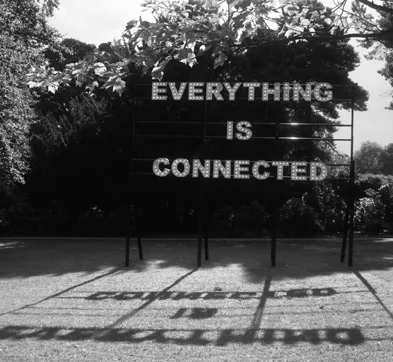
Source: Peter Liversidge, 2012, Yorkshire Sculpture Park
![]()
DECIDING ON PURPOSE:
IN SEARCH OF BEGINNINGS
On 27 July 2012, after completing my presentation at a conference I was attending in Glasgow, I was asked a question from the floor that I had thought that by now I was well practiced to answer: what is a development practitioner?
My strapline response should have been in two parts: first, my take on the ideals of development, which are: to release the potential for human endeavours latent in the everyday; to build new futures, reminding ourselves that all too often, poverty ‘annihilates the future,’1 and that the loss of hope adds fuel to the flames of social disruption and political extremism.2 Dealing with poverty in all its multifaceted dimensions and all the inequalities in both the distribution of opportunity and the distribution of gain – however they are achieved – is therefore central to development work – central to the wellbeing of all.
Second, on what I have come to expect of development practitioners in skills, competencies and ambitions: a development practitioner is someone who can deliver practical solutions now, and sometimes in crisis or otherwise urgent settings, and at the same time makes space for progressive and sustained social economic development over the longer term. In this sense, they are the spacemakers to whom I refer in the title of this book, whether they be planners, artists, architects, engineers, health workers, social scientists, teachers or others involved in humanitarian work. You need prudence, a good measure of practical wisdom, entrepreneurship, flexibility and respect. You need the skills and competencies to be able to work within that ‘sliver of sanity’ in between formal and informal organizations, top-down or bottom-up, equity and efficiency. Most of all, you need the moral high ground from which to argue your cause and guide your decisions – which liberate you to work with the bad guys, the troublemakers, the power-holders – at all levels.
I might have gone on to suggest that the practitioner’s art in development is analogous to the art of ‘ready made.’ It seeks to reposition and more, transform the ordinary in a way that makes it special, gives it dignity – a reincarnation of familiarity, making significant the seemingly insignificant, finding opportunity in the chaos and often oppressive conditions of poverty. Instead, my response was first to sketch out some of the big issues that define our purpose and give context to our work, nourished with some of those blinding statistics designed to provoke and engage. I started by outlining the inequities of globalization, fueled often by the contradictions in development objectives, between the moral obligation for equity and the economic imperative to attract investment and enhance productivity. I pointed to the 2 billion or more people from around the world who are poor or otherwise vulnerable, earn less than US$2 a day, stuck at the bottom of the development pile, suffering exclusion from the mainstream for political, ethnic, economic or other reasons. Their identity and sense of belonging to anywhere has long been undermined by the processes of urbanization and by the progressive and ongoing threat of eviction of the hundred of thousands who get in the way of development.
Then there are the impacts of conflict and climate change, in particular on the displaced – all the biases among aid agencies, some who allocate aid according to need (which might wind up financing the military) and some according to effectiveness to promote growth, ‘which ends up (often) going to those with less need.’3
I found myself sketching out a world of problems that would be impossible to engage with effectively, given their scope and complexity, inducing as much guilt and hopelessness in knowing how to decide how to respond. And yet, oddly enough, the bigger and more complex the issues, the more blinding the statistics, the more worthy I felt my cause. By the time I was ready to answer the question, most had turned off or nodded off.
In my presentation, I had done what I thought I had learnt not to do in professional work. First, I had distanced most in the room from things that matter to them, starting as I did with my own agenda of issues, with what you should do, irrespective of who you are, rather than what you can or want to do. I was implying the kind of convergence between who you are and the world out there, which often ‘causes the inner self to atrophy.’ As Michael Foley notes in his book Embracing the Ordinary, ‘it is as easy to lose the self in the world as it is to lose the world in the self.’ What we need is to carefully balance involvement and detachment – ‘the necessity of being both in and out of the game,’ with careful attention to context.4
Second, and as a result, I had distanced myself from my public and in the manner and sequence of my presentation. I had sketched out the context before giving my answer, instead of giving my answer first, then giving context to how it was derived. I had assumed a certainty about the facts and about by my own convictions as to the order and disorder of the world I was encouraging my audience to engage with. ‘But no one knows less than those who are certain of knowing everything. And no one is more dangerous than those who are convinced of knowing it all…Preaching and lecturing are usually futile because something in the listener always rebels against coercion.’5
Finally, I had devoted most of my response to profiling all the negatives of development, all the problems and disorder that give the professions the legitimacy to intervene and at a level and intensity that often suits outsiders more than insiders. We were in denial of the extraordinary resourcefulness that people bring while coping with, even solving, their own problems.
There have been times amid the hopelessness of it all when one stands back in search of something tangible, doable and immediately useful. Drop the big purpose and let’s get the water running, the kids to school safely, the garbage picked up. And then you come to realize that these practical, more detailed interventions can be first steps to meeting bigger aspirations, because you come to realize as a development practitioner that you suspend rather than abandon your big purpose in order to get something going. Giving bigger context to the detail enables the detail to contribute to the bigger context, to help shape the big purpose. If we have to fix the water, how can we do it to generate enterprise, empower minorities, improve accessibility, conserve supply, build community, save the environment? We look for catalysts, the least we need to do to get things going – the bus stop, the pickle jar, the school bus. We work backwards, asking progressively, what if? In so doing we distinguish ourselves as development practitioners, whatever our disciplinary backgrounds. We reach out for better futures, without losing the specificity of now.
I had come to this same conclusion some years ago when attending a community workshop in Peru. It was entitled ‘Building Civil Society.’ Its purpose was worthy and commendable, to give voice to local residents in processes that would enhance their wellbeing and build their resilience. The speaker was espousing his intent, and that of his organization, to empower civil society to engage with government to deliver better education, health services, housing – to democratize decision making and give people a say, as partners no less, in his schema of good governance.
Amid all the abstraction and good intent, one woman in the crowd spoke out. ‘My roof is leaking, and like so many others who live here, we have no money or help to fix it.’ But leaking roofs featured low on the speaker’s priority list of issues, given his bigger purpose. He was there, after all, to promote the latest in World Bank strategy for poverty reduction at the time – expanding opportunity, empowerment, security. His response was polite, perfunctory and somewhat patronizing. We need first to conclude our discussions on empowerment, on democratizing decision making and on the importance of giving voice to an effective civil society, he said. We need a matrix of issues and actions with which to decide our respective responsibilities. We need a big plan. This will be the basis for deciding where to start, who can do what, who can help, when and how. It will be the basis for exploring new partnerships as we work toward our model of good governance. He had it all worked out. His reasoning was as if a light which had made him see things as they were not.6
The woman, who by now had even less idea what he was talking about, insisted on finishing her story. It was familiar to many and typical. She didn’t want voice, she said, she wanted money and help, and wanted it now. With the absence of furniture in their house, they sit, sleep and cook on the floor, which is constantly damp during the rainy season. The kids get ill and miss out on school. The local clinic is usually crowded with people seeking help – it sometimes takes days to be seen and treated. They themselves get ill, miss out on work and struggle to meet their basic needs, paid as they are on a daily ad hoc basis. In the heavy rains last summer, a section of her roof collapsed, and the family moved in for a while with neighbours – the family was dispersed. Their insecurity is a constant stress on family life – because the roof always leaked.
As I listened to the dialogue and banter, I couldn’t help but think: suspend your big purpose and fix the roof because by doing so, ‘…we learn about the structure of a problem by the process of solving it.’7 Then do it in a way ...