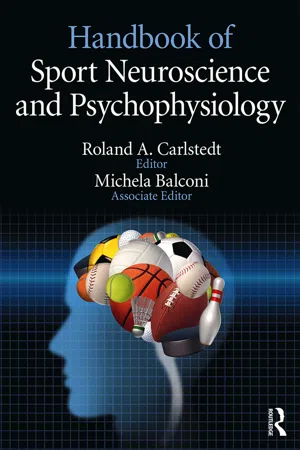
Out of the broad arena of sport science and sport psychology, Roland A. Carlstedt presents a comprehensive collection on the neuroscience and associated psychophysiology that underlies and drives sport performance. Featuring sections ranging from the basics and foundations (anatomy and physiology) to the applied (assessment during competition, training, and mental training), Handbook of Sport Neuroscience and Psychophysiology is the first volume to provide students, researchers, practitioners, and coaches the latest knowledge on the brain, mind-body processes, and psychophysiological responding in the context of sport performance.
- 414 pages
- English
- ePUB (mobile friendly)
- Available on iOS & Android
eBook - ePub
Handbook of Sport Neuroscience and Psychophysiology
About this book
Information
1
Applied, Integrative and Ecological Biomarker-Guided Sport Neuroscience and Psychophysiology
Fundamentals, Research, Procedures, Methods and Analytics: An Overview of Chapters
Roland A. Carlstedt
The Handbook of Sport Neuroscience and Psychophysiology was conceptualized about three years ago. Producing an expansive book that covered the broad fields of neuroscience and psychophysiology was both ambitious and challenging, especially in the context of athletes and sport. In the end, I believe we have succeeded in producing a work that has sufficient depth and breadth to satisfy potentially critical peers and colleagues as well as researchers, practitioners/clinicians, instructors and students. While the book is technical, it is also accessible and importantly, it presents critical perspectives that are crucial to the advancement of evidence-based applied sport neuroscience and psychophysiology. In this introduction, synopses of the book’s chapters are presented.
The book is divided into four sections: (1) SECTION I, Fundamentals and Research in Sport Neuroscience and Psychophysiology; (2) SECTION II, Applied Sport Neuroscience and Psychophysiology: Intervention and Mental Training; (3) SECTION III, Clinical Sport Neuroscience and Psychophysiology; and (4) SECTION IV, Technology and Products in Sport Neuroscience and Psychophysiology. Section I was designed to introduce readers to the basics, frameworks and conceptual models of sport neuroscience and psychophysiology and the foundational research that is informing researchers, practitioners and students as well as coaches and athletes. Authors were selected on the basis of not only their stature in the field, research and publications, but importantly their commitment to critical analysis of their own research findings and others’. Chapter 2, The Neural Pathway of Sport Actions: From Seeing and Hearing to Doing: Perception-Action Relationships by Cesari and Urgesi, and the first chapter in Section I, was a “wish” chapter of mine. I wanted neuroscientists to describe a sport-specific action from the perspective of the brain-mind-body-motor response system (imagine being inside the body in a traveling capsule as in the cult movie of the 70s, the Fantastic Voyage) as it happens. What brain areas activate during a sport action? What happens to the mind and body from the beginning to the end of such an action?
This chapter fills the bill in helping illuminate the complex chain of from seeing and hearing to doing.
Chapter 3 by Balconi and Crivelli, Fundamentals of Electroencephalography and Optical Imaging for Sport and Exercise Science: From the Laboratory to On-the-Playing-Field Acquired Evidence, focuses on the use of electroencephalography (EEG) and cerebral optical imaging (functional Near-Infrared Spectroscopy, [fNIRS]) techniques within the domain of sport and exercise sciences. After a brief introduction on brain functioning and how it is mirrored by electrophysiological and hemodynamic responses, examples of research using EEG and fNIRS are presented in the context sport activity and physical exercise, with a focus on both clinical and non-pathological domains. The chapter also presents a technical-methodological primer for the use of EEG and fNIRS.
Chapter 4 is Sport-Related EEG Activity: What Have We Learned from a Quarter-Century’s Worth of Research? by Kubitz. This survey review of twenty-five years of EEG research in sports asks the following important questions and provides answers to them, including: Based on the aforementioned reviews of the sport-related EEG research studies over the past quarter-century, this chapter focuses on eight questions, including: How does EEG activity change across the pre-performance period? How is EEG activity different during good and poor performances? How is EEG activity different in experts and novices? How is EEG activity different in competitive athletes and nonathletes? How is EEG activity different in disabled and nondisabled athletes? How does practice/learning change EEG activity? Is EEG activity during a sport task different from EEG activity during other tasks (e.g., balancing on a stabilometer)? Is sport-related EEG activity changed by socio-environmental manipulations (e.g., adding competition)?
Chapter 5, Neuroimaging: Techniques and Applications in Sports by Mayo and Gawryluk, helps us understand which regions and networks of the brain are involved in the complex set of behaviors required in sports. They also address the following questions: Are the brains of some athletes bigger than others? Are there differences at a microstructural level? Are different regions recruited during a task given an athlete’s training in sport? One of the key methodologies that has been employed to date to address questions like these is magnetic resonance imaging. It compliments Chapter 2, extending on the illumination of brain activation, neural pathways and motor output using action in basketball as an example.
Chapter 6, titled fMRI in Sport and Performance Research: A Synthesis of Research Findings by Bishop and Wright, delivers a critical overview of the body of literature that has been devoted to the use of fMRI in attempts to elucidate the neural processes that underpin performance in sport and related areas. Contextual examples include anticipation and prediction tasks, motor preparation, motor imagery, action observation, manipulation of affective state and investigation of brain injury. Limitations of fMRI, potential alternatives or complementary techniques, methodological considerations and future research directions are discussed.
Chapter 7, by the author team Balconi, Pala, Crivelli and Milone and titled From Investigation to Intervention: Biofeedback and Neurofeedback Biomarkers in Sport, investigates and discusses psychophysiological and electrophysiological techniques, including biofeedback and neurofeedback, in sports. They expound on and describe principles and techniques in BF/NF.
Chapter 8. Understanding Neural Mechanisms of Memory in Rapid Recognition of Football Formations by Morgan, Tucker and Luu, addresses the neural mechanisms of the cognitive processes that take place when a new quarterback is taught how to analyze defensive formations to make play decisions. Through the training process, this information must be consolidated to the point where the athlete is game-ready in the fall. The authors focus on the stages of learning, the brain mechanisms involved in each and the human neuroscience technologies that allow us to study these brain mechanisms. Important challenges, including the effects of stress and the lack of sleep, that must be considered to maximize health and performance are highlighted.
Chapter 9 Psychologically Mediated Heart Rate Variability During Official Competition: Ecological Investigations of the Heart Rate Deceleration Response with Implications for Quantifying Flow, by Carlstedt, presents two case-study investigations of heart rate deceleration and HRV on the basis of data derived during official tennis tournament matches. It advances the perspective that HRD is the most revealing and predictive biomarker of psychological performance, especially as pressure increases during competition. A case is made, using a novel analytics, for why HRD is the ideal measure for quantifying “Flow,” “Mental Toughness” and psychological performance.
An HRV/HRD primer and literature review of seminal HRD research is presented.
Section II is devoted to neuroscience and psychophysiology guided athlete assessment and intervention (mental training). Novel approaches to ecologically based and biomarker-guided assessment during on-the-playing field training and official competition are presented in this section along with intervention efficiency and efficacy testing. Neurofeedback and biofeedback methods and procedures are also covered in the context of critical perspectives, extant and previous research and future directions.
Chapter 10, Ecological, Volitional Inducement of Heart Rate Deceleration in Athletes During Competition: A Mental Training Protocol, a follow-up to Chapter 9, also by Carlstedt, starts the Applied Sport Neuroscience & Psychophysiology section with another HRD/HRV-centric elucidation of an HRD-biofeedback protocol along with an efficiency and efficacy testing case study.
The author contends that the volitional inducement of HRD through sport-specific, pre-action timed inhalation-exhalation cycles that must be established in a training phase is the key to setting off a cascade of performance facilitative brain-heart-mind-body-motor responses mechanistically and eventually subliminally. HRD is also advanced as mental training biomarker efficacy metric that is central to evidence-based mental training efficacy testing.
Chapter 11, The Use of Gaze Training to Expedite Motor Skill Acquisition by Wilson and Vine, elucidates an emerging mental training procedure involving the control of eye movements and focus.
The chapter centers primarily on research examining novice motor skill acquisition, where consistent findings reveal that gaze training is more effective than traditional instructions focusing on movement control. The premise behind gaze training interventions (e.g., quiet eye training) is that if a performer can learn to optimize the information they receive from their eyes, then they can optimize movement without having to explicitly focus on the control of this movement. As such, by adopting the gaze strategies of experienced performers, novices can “cheat” the learning process where effective sensorimotor mapping must be established. This chapter also outlines the process that is followed in order to develop a practical gaze training program (using examples from laparoscopic surgery, sport and clinical populations) and highlights some of the caveats to consider.
Chapter 12, titled Cognitive Strategies to Enhance Motor Performance: Examples of Applying Action Observation, Motor Imagery and Psyching-Up Techniques and written by Bisio and Bove, focuses on different aspects of motor cognition and on the possibility of stimulating the motor system and improving motor performance by acting at the central level (CNS). Studies on healthy subjects, with particular emphasis on athletes and sport science, are presented. Motor resonance and its role in movement planning and execution is discussed along with a motor imagery technique and why it might be considered an “offline operation” of the motor system. The possibility of learning new motor abilities by means of motor resonance, in particular via action observation and motor imagery, is also addressed. Recent findings on the application of these techniques in sport science are reviewed, as well as cognitive strategies, known as psyching-up techniques, and their application in sport domains.
Chapter 13, Neurofeedback Research in Sport: A Critical Review of the Field by Cooke Bellomo, Gallicchio and Ring, is one of two chapters on neurofeedback (NF) in the book. It reviews the available evidence and considers some of the reasons why neurofeedback training remains only a minor player in applied sport science. The authors especially focus on exploring some key methodological shortcomings and interpretational caveats that pervade much of the extant neurofeedback research. In doing so, this chapter provides a concise introduction to neurofeedback training, and a critical and balanced view of the current state of knowledge regarding neurofeedback and sport performance. The chapter also offers some guidelines for future research, which the authors hope will stimulate more high-quality neurofeedback experiments to further interrogate and unearth its putative performance-enhancing qualities in the years and decades to come. This is a much needed chapter in light of the eclectic and non-standardized/validated approaches to NF.
Chapter 14, Neurofeedback in Sport: Theory, Methods, Research and Efficacy by Hung and Cheng, the second chapter on NF, covers relevant information regarding the application of NF in attempts to enhance sports performance. The aims of this chapter are three-fold: first, to provide both the theoretical and methodological basis of NF in sport performance; and second, to evaluate the quality of studies regarding this line of research, with particular focus on methodological regarding how to evaluate the effects of NF on sports performance; and finally, the authors conclude with several recommendations for future research.
Chapter 15, Social Neuroscience: We Think, Therefore We Exist: Team Dynamics, Hyper-brains, and Hyper-minds by Filho and Tennenbaum, introduces the “notion” of “collective mind” an integral part of many team processes described in the Sport, Exercise and Performance Psychology literature. Most recently, the growth of social neuroscience has ushered new approaches to the study of team dynamics, particularly those focused on capturing the reflective and formative indicators of team processes through peripheral and central psychophysiological methods. The purpose of this chapter is to present the theories and methodologies that lay the foundation for the study of hyper-brains and hyper-minds in interactive motor tasks at large, and the sports domain in particular. The authors advance applied implications stemming from the research conducted thus far, and conclude by discussing future research avenues in this realm.
Section III focuses on Clinical Sport Neuroscience and Psychophysiology. In addition to two chapters relating to sport-induced brain concussions, one on the neuroanatomy and the other the clinical neuropsychology and cellular mechanisms of concussion, emerging explanatory models of exercise-mediated brain mechanisms and cognitive functioning and emotions are presented.
Chapter 16 Neuroanatomy and Cellular Mechanisms of Sports-Related Concussion and Traumatic Brain Injury by Perrine, Zuckerman, and Stieg, reviews the latest definitions of concussions and traumatic brain injury, the mechanisms underlying each and how they differ between sports. The discussion incorporates recent research on the gross anatomy and cellular changes that occur in these injuries, how they vary between sports, the controversial syndrome of Chronic Traumatic Encephalopathy, neuroimaging of brain injury, a brief hypothetical case study incorporating each of these subjects and directions for future research.
Chapter 17, The Neuropsychology of Concussion, by Temple, extends and compliments Chapter 16.
Chapter 18, Beyond Physical Exercise: Designing Physical Activities for Cognitive Enhancement by Moreau, advocates for incorporating additional cognitive tasks/demands within physical training to possibly maximize intervention outcomes. The author reviews research exploring such dual exercise-cognition training and presents an approach that he used within his own line of work – “a blend of physical and cognitive demands integrated within complex environments.” The rationale for such along with recent experimental findings are presented. He concludes with prospective trends and recommendations for future research.
Chapter 19, The Reticular-Activating Hypofrontality (RAH) Model by Dietrich, Dirani and Yaghi, summarizes the key points of a neurocognitive model of the effects of acute exercise on the brain. This model, which is known as the reticular-activating hypofrontality or RAH model, proposes a set of neural mechanisms for the cognitive and emotional changes that occur during exercise. To make sense of the varied data in the field, any attempt to provide a brain mechanism for the psychological effects of exercise has to make two categorical distinctions: (1) between chronic and acute exercise and (2) between executive functions and all other kinds of cognitive processes. While chronic exercise refers to exercise over long periods of time (e.g., weeks or months), acute exercise refers to exercise that is currently ongoing. As we will see, whether cognitive and emotional processes are facilitated or impaired with exercise depends on both factors, that is, what kind of mental process is measured and at what time point (during or after exercise) it is measured. Because the effects are orthogonal, any global statement about exercise and cognition is likely to be meaningless.
Section IV focuses on technology. Chapter 20, Technology Product Options in Sport Neuroscience and Psychophysiology by Jain and Atak, is the final chapter. It presents an overview of select data acquisition and monitoring instrumentation for sport neuroscience and psychophysiology research and practice.
Section I
Fundamentals and research in sport neuroscience and Psychophysiology
2
The Neural Pathway of Sport Actions
From Seeing and Hearing to Doing: Perception-Action Relationships
Paola Cesari and Cosimo Urgesi
The Functional Organization of Perception and Action
Our body is a beautiful machine able to receive different sources of information from the environment and to produce actions that in turn transform the environment. We perceive our body in each instant of the day; the body represents the present through our perceptual and motor experience, the past through the memory of our perceptual and motor experience, and the future through the anticipation of perceptual and motor experience. We perceive the bodies of o...
Table of contents
- Cover
- Half Title
- Title Page
- Copyright Page
- Table of Contents
- List of Contributors
- About the Editors
- Acknowledgements
- 1 Applied, Integrative and Ecological Biomarker-Guided Sport Neuroscience and Psychophysiology: Fundamentals, Research, Procedures, Methods and Analytics: An Overview of Chapters
- Section I Fundamentals and Research in Sport Neuroscience and Psychophysiology
- Section II Applied Sport Neuroscience and Psychophysiology: Intervention and Mental Training
- Section III Clinical Sport Neuroscience and Psychophysiology
- Section IV Equipment, Instrumentation and Technology in Sport Neuroscience and Psychophysiology
- Index
Trusted by 375,005 students
Access to over 1.5 million titles for a fair monthly price.
Study more efficiently using our study tools.
Frequently asked questions
Yes, you can cancel anytime from the Subscription tab in your account settings on the Perlego website. Your subscription will stay active until the end of your current billing period. Learn how to cancel your subscription
No, books cannot be downloaded as external files, such as PDFs, for use outside of Perlego. However, you can download books within the Perlego app for offline reading on mobile or tablet. Learn how to download books offline
We are an online textbook subscription service, where you can get access to an entire online library for less than the price of a single book per month. With over 1.5 million books across 990+ topics, we’ve got you covered! Learn about our mission
Look out for the read-aloud symbol on your next book to see if you can listen to it. The read-aloud tool reads text aloud for you, highlighting the text as it is being read. You can pause it, speed it up and slow it down. Learn more about Read Aloud
Yes! You can use the Perlego app on both iOS and Android devices to read anytime, anywhere — even offline. Perfect for commutes or when you’re on the go.
Please note we cannot support devices running on iOS 13 and Android 7 or earlier. Learn more about using the app
Please note we cannot support devices running on iOS 13 and Android 7 or earlier. Learn more about using the app
Yes, you can access Handbook of Sport Neuroscience and Psychophysiology by Roland Carlstedt in PDF and/or ePUB format, as well as other popular books in Psychology & Applied Psychology. We have over 1.5 million books available in our catalogue for you to explore.