![]()
PART I
Presentation
![]()
1
EXPOSURES
Herzog & de Meuron and photography
Philip Ursprung
It is commonplace that architecture lends itself particularly well as a photographic motif, because buildings cannot run away. If we do not, however, conceive architecture as something static but rather as an event, as something that is subject to the passage of time, something that is ephemeral, fragile and mutable, then photography is also a particularly suitable medium to capture it. During the nineteenth and twentieth centuries, the encounter between the camera and architecture repeatedly generated images that have shaped the perception of buildings more profoundly than the experience of the building itself. This includes photographic shots of buildings under construction, be it the Eiffel Tower, or the Centre Pompidou; buildings in destruction, be it the collapsing Campanile in St. Mark’s Square in 1902, or the burning National University Library of Bosnia and Herzegovina in Sarajevo in 1992. And this especially includes buildings and neighbourhoods that are in danger of disappearing altogether.
A prominent example of this phenomenon is one of the first photographs ever to be taken, Louis Daguerre’s daguerreotype Boulevard du Temple (c. 1838), depicting a highly popular street in Paris, which disappeared soon after in the course of the modernisation of Paris by Baron Haussmann. Equally well known are the countless images that Eugène Atget made in the late nineteenth century, portraying the winding streets and backyards of the old Paris that was falling prey to urban renewal at that time. From the late 1950s to the early 1990s, Bernd and Hilla Becher captured regions troubled by de-industrialisation, depicting coal mines, blast furnaces, factories and workers’ housing in Europe and the United States – witnesses of a vanishing age of heavy industry.
Another example of instances where architectural images had a more profound effect than the architecture itself is buildings constructed for Universal Exhibitions. Ephemeral by nature, and the majority exist only for a short time. Most of these find their way into architectural history through countless albums, stereoscopic photographs, daguerreotypes and photographs. They were built, photographed and then dismantled, so to speak. Among the many examples are the Crystal Palace of the Great Exhibition in 1851, Ludwig Mies van der Rohe’s Barcelona Pavilion for the Universal Exhibition in Barcelona 1929, as well as contemporary examples such as the Blur Building by Diller + Scofidio at the Swiss National Exhibition, Expo.02 in 2002.
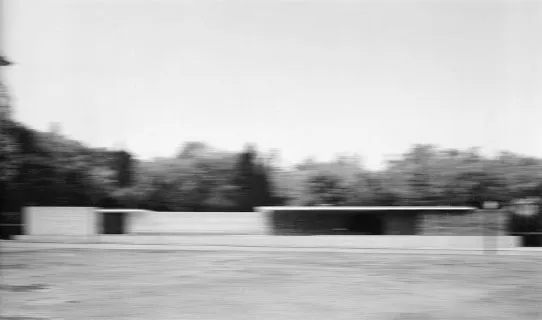
The German artist Thomas Ruff, a student of Bernd and Hilla Becher at the Kunstakademie Düsseldorf, has pointed at this phenomenon in a montage entitled lmvdr., Project 1999–2001. d.p.b. 02 (1999) (Figure 1.1). The title of the work of art is deliberately reduced to acronyms and the famous Barcelona Pavilion is difficult to recognise on the image. Apart from being rendered in colour, the pavilion also appears blurred and distorted as if seen from a passing racecar – a visual effect that can only partially be captured by photography. Ruff’s montage does not only reveal his interest in the historical conditions of photography, it also exemplifies the changes in the relationship between space and time that occurred in the late twentieth century. Following the theories of Fredric Jameson, David Harvey, Michael Hardt, Antonio Negri and others, this historical phase can be characterised as a transition from the predominance of temporal linearity to the ascendance of spatial juxtaposition.1 Regardless of whether this change is interpreted as a phase “after” history, as an indication of a “rupture” between Modernism and Postmodernism, or as a sort of time–space compression and the beginning of an “eternal present,” it poses a challenge for photography – because if the flow of time is seemingly slowed down or brought to a halt, it can no longer be the merit of the camera to capture moments that would otherwise be lost forever. Its purpose can no longer be to fixate a singular moment in the course of time. Rather, it must locate events in their spatial context. It must find ways to depict their simultaneity in space, rather than as a succession of moments in time. After having successfully mastered its task for over 150 years, the camera – mounted on a tripod, fastened as rigidly as possible in order to capture “movement” – must now, so to speak, be as mobile as possible in order to represent the “standstill” that is taking place.
FIGURE 1.1 Thomas Ruff, d.p.b. 02, 1999
A particularly fruitful period for the encounter between architecture and photography was the period between the mid-1980s and the mid-1990s. During this time, both genres were open to change. Architecture aspired to find a new place in the centre of visual culture and sought a way out of the isolation, into which it had fallen in the wake of its homogenisation by the International Style and the recession of the 1970s. Photography strove to join the cultural mainstream and get away from its marginal position as an applied art in the shadow of painting, sculpture and performance.
Herzog & de Meuron, and Thomas Ruff: exposing difference
Besides Peter Zumthor’s commissioning of Swiss artist and photographer Hans Danuser to photograph the Sogn Benedetg chapel, it was mainly Herzog & de Meuron’s encounter with the artist Thomas Ruff that influenced the conventions of architectural photography.2 Soon after the establishment of their studio in 1978, Herzog & de Meuron began to make references to artists or to collaborate with them. Their Blue House (1980) for instance, is an explicit allusion to the Yves Klein Blue invented around 1960 by Yves Klein and valued for its ability to seemingly dematerialise space, thus allowing the viewers to immerse themselves into an illusory depth. Furthermore, the architects had close affinities with the oeuvre of Joseph Beuys, Gerhard Richter, Andy Warhol and Donald Judd. Early on, actual collaborations took place with the Basel-based artist Rémy Zaugg, who was sometimes considered a “fifth partner” in their office, along with subsequent collaborators Michael Craig Martin, Rosemarie Trockel, and Ai Weiwei. Herzog & de Meuron’s association with Ruff, however, is the only one that specifically evolves around the theme of photography – an area that had formed the focus of Jacques Herzog’s own work as a practicing artist until the mid-1980s. In the fall of 1988, exactly one day before Peter Zumthor showed the photos of Hans Danuser in the exhibition Partituren und Bilder at the Gallery of Architecture in Lucerne, Herzog & de Meuron opened their exhibition Architektur Denkform at the Basel Museum of Architecture.3 The glass façade of the modernist museum building proved to be a challenge to the exhibition design. To overcome these difficulties, Herzog & de Meuron applied large-scale, transparent black and white pictures of their buildings directly onto the museum windows. Thus the visitors could simultaneously perceive the images of Herzog & de Meuron’s architecture, the actual glass windows of the museum architecture, and glimpses of the urban landscape beyond. The photographic images functioned as a kind of interface, or screen, mediating between various levels of representation. Three years later, at the Venice Architecture Biennale of 1991, Herzog & de Meuron invited four photographers to take pictures of their projects. Importantly, these were not documentary photographers, but photographers active in the realm of art, namely Thomas Ruff, Hannah Villiger, Balthasar Burkhardt, and Margareta Krischanitz. The latter, under the name Margareta Spiluttini, would later go on to document many of Herzog & de Meuron’s buildings. Jeff Wall had also been invited, but declined. Only eight years later, in 1999, he would photograph Dominus Winery in Napa Valley, as a commission by the Canadian Center for Architecture in Montreal.
Why did Herzog & de Meuron get in touch with Thomas Ruff? Why did they not ask his former teachers Bernd and Hilla Becher, who were already highly renowned in the 1980s? Or why did they not approach another student of the Bechers – the photographer Thomas Struth, who had shown the exhibition Unconscious Places at the Kunsthalle Bern in 1986, featuring impressive black and white photographs of American, European and Japanese cities?4 Jacques Herzog had seen Ruff’s exhibition Porträts, Häuser, Sterne (Portraits, Houses, Stars) at the Kunsthalle Zurich in 1990. Ruff had photographed people in the same way as he depicted buildings. His enlarged photographs showed every detail of his subjects, enhancing the singularity and uniqueness of the individual and avoiding any form of generalisation. It is plausible to assume that Herzog felt closer to Ruff’s method – his focus on the individual, and his desublimation of the image of the city. And herein lies the fundamental difference between Ruff and his teachers Bernd and Hilla Becher: Ruff avoided anything that would have permitted the subordination of the individual image to an inventory, or an atlas; and in contrast to the small-scale black and white photographs of the Bechers, Ruff’s photographs differed formally in his use of large format prints and colour, which he already used in the late 1980s. Using a similar approach, Herzog & de Meuron treated their buildings almost like characters in a play, providing them with proper names, such as Blue House, House for an Art Collector, House for a Veterinarian, etc. They were not interested in architectural typologies, or the denomination of common architectural phenomena, but in the specific, namely, what differentiated the individual building from others. Like Ruff, Herzog & de Meuron were not concerned with generalisation and typology, but rather with differentiation.
An affinity for nondescript architecture
Another reason for the affinity between Herzog & de Meuron and Thomas Ruff can be detected in Ruff’s interest in the nondescript buildings of the 1950s and early 1960s. Ruff’s photographic series Häuser did not include architectural masterpieces, but neither did it show building stereotypes. The residential and office buildings he depicted in this work bore witness to the optimism of Germany’s Ruhr region during the post-war era – the economic boom time of the 1950s and early 1960s known as the Wirtschaftswunder. The images evidence the pragmatic expediency and sobriety of their time, which had disappeared in the 1980s. Although equally a decade of economic growth, the 1980s were marked by a growing social inequality, which emerged in the wake of the so-called Thatcherism and Reagonomics. Certainly, the images of Thomas Ruff’s Häuser series mirrored Herzog and de Meuron’s own fascination with the architecture of the 1950s and memories of their own middle-class childhoods.
A documentary shows Herzog walking through a 1950s housing project in Basel, marvelling at the unique beauty of these simple buildings, which were constructed on the outskirts of Basel for lower middle-class residents. He states that these houses, which seem all too easy to disassemble, mysteriously attract him.5 These simple post-war structures can be recognised in many of Herzog & de Meuron’s projects. Like phantoms or dreams, they seem to materialise in new contexts, for instance in the guise of plywood structures Herzog & de Meuron designed for the Haus Bottmingen, or the Haus for an Art Collector. In front of the monumental Schaulager in Basel, which houses the private collection of the heirs of the chemical company Roche, there is another such simple house: every visitor of the Schaulager must pass through this empty shell, the phantom of a regular working-class house.
Herzog & de Meuron’s Ricola Storage Building in Laufen
Ruff had initially hesitated to accept Herzog & de Meuron’s commission to photograph their work. In an interview, he told me that at that time he was not interested in commissions.6 Thanks to the tenacity of Jacques Herzog, he accepted the job, but without actually going to see his subject matter, the Ricola Storage Building in Laufen.7 Rather, he asked the architects to send him images taken by a professional documentary photographer, which he then electronically processed, using the then newly available Photoshop program. The result is a photographic montage (Figure 1.2). It depicts the warehouse in a way in which it cannot be possibly seen in reality. With the use of Photoshop, the adjacent buildings and a protruding canopy a...