The Really Useful Primary Design and Technology Book
eBook - ePub

The Really Useful Primary Design and Technology Book

Subject knowledge and lesson ideas

  1. 276 pages
  2. English
  3. ePUB (mobile friendly)
  4. Available on iOS & Android
eBook - ePub

The Really Useful Primary Design and Technology Book

Subject knowledge and lesson ideas

About this book

The Really Useful Primary Design and Technology Book brings together essential subject knowledge and pedagogy to support and inspire those planning to teach D&T in the primary school. Offering comprehensive coverage of the 2014 National Curriculum, as well as exciting ideas to extend beyond it, the book is packed full of everything the busy teacher needs to be able to develop children's key skills and techniques, and a range of big and small projects to put them into practice.

With crucial subject knowledge explained in detail, useful 'How To' guides at the end of each chapter reinforce the skills and technology covered with instructions for making a variety of models. Sets of lesson plans include information on the resources needed to support both more and less able children, and assessment guidance, 'Top Tips' and 'Things to Consider' provide extra help and inspiration.

Key topics covered include:

  • cooking and nutrition
  • textiles and the design cycle
  • IT control and monitoring
  • mechanisms
  • structures
  • electronic systems
  • the roles and responsibilities of the DT leader
  • assessment of D&T

The Really Useful Primary Design and Technology Book provides all the information a new teacher needs to be able to teach D&T confidently, and with valuable cross-curricular links and photocopiable templates, even experienced teachers and subject leaders will find fresh inspiration for their lessons.
Frequently asked questions

Yes, you can cancel anytime from the Subscription tab in your account settings on the Perlego website. Your subscription will stay active until the end of your current billing period. Learn how to cancel your subscription.
No, books cannot be downloaded as external files, such as PDFs, for use outside of Perlego. However, you can download books within the Perlego app for offline reading on mobile or tablet. Learn more here.
Perlego offers two plans: Essential and Complete
  • Essential is ideal for learners and professionals who enjoy exploring a wide range of subjects. Access the Essential Library with 800,000+ trusted titles and best-sellers across business, personal growth, and the humanities. Includes unlimited reading time and Standard Read Aloud voice.
  • Complete: Perfect for advanced learners and researchers needing full, unrestricted access. Unlock 1.4M+ books across hundreds of subjects, including academic and specialized titles. The Complete Plan also includes advanced features like Premium Read Aloud and Research Assistant.
Both plans are available with monthly, semester, or annual billing cycles.
We are an online textbook subscription service, where you can get access to an entire online library for less than the price of a single book per month. With over 1 million books across 1000+ topics, we’ve got you covered! Learn more here.
Look out for the read-aloud symbol on your next book to see if you can listen to it. The read-aloud tool reads text aloud for you, highlighting the text as it is being read. You can pause it, speed it up and slow it down. Learn more here.
Yes! You can use the Perlego app on both iOS or Android devices to read anytime, anywhere — even offline. Perfect for commutes or when you’re on the go.
Please note we cannot support devices running on iOS 13 and Android 7 or earlier. Learn more about using the app.
Yes, you can access The Really Useful Primary Design and Technology Book by Elizabeth Flinn,Sarah Patel in PDF and/or ePUB format, as well as other popular books in Education & Education General. We have over one million books available in our catalogue for you to explore.

Information

Publisher
Routledge
Year
2016
Print ISBN
9781138927834
eBook ISBN
9781317402558
Edition
1

1 Introduction

DOI: 10.4324/9781315682235-1
This book is for all primary school teachers and trainee teachers who want to add new skills and ideas to their teaching repertoire. The ideas that we propose for lessons aim to be engaging, fun and practical to carry out in a primary school setting.
An overview of the Design and Technology (D&T) National Curriculum (2014) is provided along with suggestions for how it could be covered across the primary school years. It contains a chapter on each of the following D&T units: the Design Cycle, cooking and nutrition, structures, textiles, mechanisms, electronics, IT control and monitoring. Within these chapters there is a focus on the subject knowledge you will need in order to teach the unit as well as essential technical skills. A range of possible lesson ideas are provided, which are accompanied by two tried and tested half term unit plans, that follow the structure of the Design Cycle. Step by step guides of how to make various products as well as ā€˜Top Tips’ for delivering successful D&T lessons are also offered. Additional chapters include how to assess D&T, the Design Cycle and how each stage can be taught as well as a chapter providing all the information you need to be an effective D&T subject leader.

What is D&T?

D&T is the study of the production of man-made objects/systems/environments for the purpose of solving particular human needs.
D&T education involves three important elements:
  1. 1) investigating and evaluating existing products;
  2. 2) learning how things work;
  3. 3) learning to design and make functional products for particular purposes and users.
D&T lessons should provide opportunities for children to acquire and apply knowledge and understanding of materials and components, mechanisms and control systems, structures, computer control, existing products, quality and health and safety. They must also enable children to develop the skills to test, refine and develop the products they design, along with ensuring that sufficient time is given to allow children to check that their products work and improve them if they don’t.
D&T is a fast moving subject, as society’s needs are always changing. A correct solution today may well not be valid tomorrow. Consequently children should be encouraged to be creative and innovative in their designs as well as considering important issues such as sustainability and enterprise.

Which activities genuinely are D&T and which are not?

Modelling, drawing or using certain types of 2D or 3D materials does not instinctively make an activity a D&T activity. For example drawing a landscape would be art and design; however, using that landscape for a handmade birthday card would be design and technology. In order for the task to be deemed D&T, it must involve designing and making a product for somebody or for a particular purpose. The design must also use acceptable scientific principles, materials, technology and human resources and must be suitable for use by more than one person or be used in quantities.
D&T involves thinking about what the needs of the users are as well as the purpose and functionality of the product. In order for children to make products that move/light up/are structurally sound/taste good/are safe and healthy, they need to learn practical skills through carefully planned D&T lessons.

National Curriculum (2014)

All maintained primary schools in England are required to follow the National Curriculum, which includes D&T as a compulsory subject at KS1 and KS2. The D&T programmes of study have four broad aims: design, make, evaluate and technical knowledge and the subject content has two main strands: designing and making and cooking and nutrition. The Design and Technology Association (DATA) recommends linking these strands wherever possible. It also provides a clear picture of the essential features of the subject, including an emphasis on:
  • the user, purpose, functionality and innovation when children are designing and making;
  • designing and making mock-ups at KS1 and prototypes at KS2;
  • using creativity and imagination to design and make products that solve real and relevant problems;
  • designing and making products using a range of materials including textiles, construction materials and food;
  • creating mechanical products at KS1 and KS2 and electrical products at KS2;
  • investigating and evaluating existing products and children’s own ideas and products.

Key changes to the National Curriculum

Although there have been changes to the D&T National Curriculum, schools needn’t panic! Rather than throwing out existing planning, this can be adapted and developed over time. As well as developing planning, teaching the new curriculum will require continuous professional development (CPD) to develop subject expertise along with new resources in areas such as cooking and nutrition, and control and monitoring.

Main changes

  • using an ā€˜iterative’ process of designing and making;
  • KS1 to use a design criteria and KS2 to encourage innovative design;
  • using cross-sectional and exploded diagrams in KS2;
  • understanding key events and individuals in D&T at KS2;
  • working in a range of relevant contexts, for example: home, school, leisure, culture, enterprise, industry and the wider environment;
  • understanding and applying principles of a healthy and varied diet;
  • understanding where food comes from in KS1 and seasonality in KS2.
Increased technical demands at KS2, include:
  • applying computing to program, monitor and control products;
  • using CAD to develop and communicate ideas;
  • understanding and using the concept of a ā€˜system’ when designing and making with mechanical and electrical components.
The following activities have been removed from the National Curriculum by the Department for Education (2013) but they are recommended by the Design and Technology Association (DATA) and therefore should still be considered when planning:
  • IDEAs: investigating, disassembly and evaluation activities (how familiar products work and what they are supposed to do);
  • FPTs: focused practical tasks (developing a range of techniques, skills, and knowledge);
  • children to plan the sequence in which they make their products;
  • DMAs: design and make assignments using a range of materials including:
    1. KS1: food textiles and items that can be put together;
    2. KS2: electrical and mechanical components, food, textiles, and stiff and flexible sheet material.

Why teach D&T?

We live in a society that is dominated by ideas and products from technology, therefore our societies need people with technological qualifications at the highest level in order to enhance the UK’s capacity for growth. But it’s not just the job market that is the driving force behind why we teach D&T. There are many other convincing reasons:
  • D&T is a multidimensional, dynamic subject that not only teaches children an assortment of skills that they can develop into exciting careers, but also allows them to put their learning from other areas of the curriculum into practice;
  • D&T is often one of a child’s favourite subjects; Ofsted found that primary school children enjoyed developing practical skills and made swift progress to develop knowledge and understanding about the properties of materials when they had specific problems or challenges to solve that fired their enthusiasm;
  • Children are given the opportunity to solve real and relevant problems in D&T lessons, which means that they develop essential everyday skills, unlocking their ability to be the designers and innovators of tomorrow;
  • D&T lessons provide opportunities for children who struggle in other subjects (where the focus is perhaps on reading and writing) to excel in practical, iterative hands-on tasks.

Key D&T skills

D&T is a subject that encourages creative ideas and allows for many cross-curricular links. It focuses on transferable skills such as:
  • analytical skills – clarifying a task, analysing existing products;
  • designing skills – generating and developing ideas, creating design proposals, communicating ideas, planning ideas;
  • practical skills – making things, including working with materials and components, tools and processes; planning, measuring and marking out; cutting and shaping; joining and combining; finishing;
  • evaluating skills – evaluating existing products as well as children’s own ideas and products;
  • problem-solving – finding solutions to problems such as products not working or not meeting the users’ requirements.
There are also strong links to subjects such as:
  • Science – predicting and fair testing, using and applying their knowledge about the properties of materials;
  • Maths – measuring to an appropriate number of decimal places, drawing and interpreting tables, graphs and bar charts;
  • IT – making things happen by the use of control, handling information through the use of a database or spreadsheet, use of CAD;
  • Art and Design – investigating texture and colour or recording visual information.

References

  • Department for Education, (2013). National Curriculum Primary Handbook. [online] UK Government. Available at: www.gov.uk/government/collections/national-curriculum [Accessed 3 January 2016].

2 The Design Cycle

DOI: 10.4324/9781315682235-2
D&T is about more than just making models. Children should be given opportunities to design products for a specific purpose. They should understand that great inventions may have gone through many changes before they were really fit for purpose. Children should learn to consider how well their own products meet the design brief and what refinements may help to improve them. During D&T lessons children should also be learning new practical skills. They should become familiar with tools and how to use them safely and they should learn about materials and their properties.
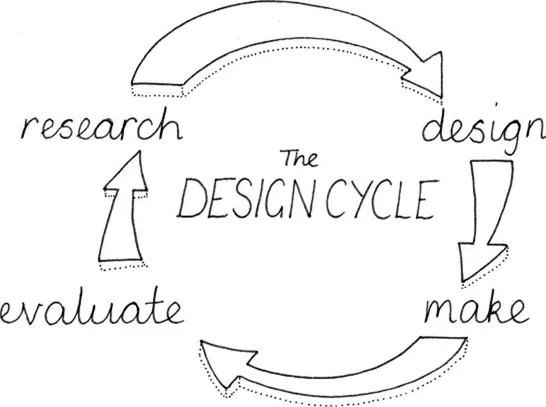
Children should experience a whole design process from first ideas to evaluation of a finished product. This process is often depicted as a cycle rather than a linear route, in order to emphasise the importance of continually evaluating and refining the product design. This is known as the Design Cycle.
Figure 2.1
The lesson plans in this book follow the Design Cycle. It is important that during each school year, the children experience every part of the design process from research to evaluation, but at some points it may be appropriate to focus on practical skills (sawing, sewing, mechanisms) rather than on designing and making a particular product.

Research

Research can take several forms. For young children, taking apart mechanisms from toys can help to give them an understanding about the means by which the toys can be made to move. A collection of moving toys (bath toys are particularly useful) and common mechanical items which the children can unscrew and take to pieces will be a popular addition to any classroom. It is important to avoid injury, so children should be supervised and it is wise to avoid electrical items which may remain charged even after they are unplugged or the battery removed. The knowledge children gain from this type of research can help them when they come to design their own products, because they should have some idea about t...

Table of contents

  1. Cover Page
  2. Half-title Page
  3. Series Page
  4. Title Page
  5. Copyright Page
  6. Table Of Contents
  7. Acknowledgements
  8. 1 INTRODUCTION
  9. 2 THE DESIGN CYCLE
  10. 3 COOKING AND NUTRITION
  11. 4 STRUCTURES
  12. 5 TEXTILES
  13. 6 MECHANISMS
  14. 7 ELECTRONIC SYSTEMS
  15. 8 IT CONTROL AND MONITORING
  16. 9 ASSESSMENT OF CHILDREN’S PROGRESS IN D&T
  17. 10 D&T SUBJECT LEADER: ROLES AND RESPONSIBILITIES
  18. Glossary
  19. Index