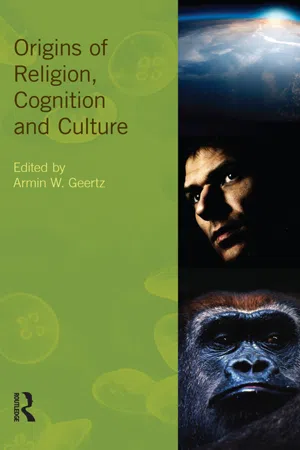
Attempts to understand the origins of humanity have raised fundamental questions about the complex relationship between cognition and culture. Central to the debates on origins is the role of religion, religious ritual and religious experience. What came first: individual religious (ecstatic) experiences, collective observances of transition situations, fear of death, ritual competence, magical coercion; mirror neurons or temporal lobe religiosity? Cognitive scientists are now providing us with important insights on phylogenetic and ontogenetic processes. Together with insights from the humanities and social sciences on the origins, development and maintenance of complex semiotic, social and cultural systems, a general picture of what is particularly human about humans could emerge. Reflections on the preconditions for symbolic and linguistic competence and practice are now within our grasp. Origins of Religion, Cognition and Culture puts culture centre stage in the cognitive science of religion.
- 488 pages
- English
- ePUB (mobile friendly)
- Available on iOS & Android
eBook - ePub
Origins of Religion, Cognition and Culture
About this book
Information
1
Whence religion? How the brain constructs the world and what this might tell us about the origins of religion, cognition and culture
Origins of religion
In cognitive theories of the origins of religion, it is held that religious thought and behaviour are by-products of or even parasitic on more basic cognitive processes.1 Religion is not an evolutionary adaptation, genetic or cultural, even though it may occasionally help individuals and groups. In the following, I take issue with this approach. It must be emphasized, however, that the work of cognitive scientists of religion, such as Pascal Boyer and Scott Atran, has raised issues and questions that have led to useful hypotheses, experiments and insights on religion and human cognition. For instance, they agreed that the age-old assumption that religion produces morals and values is neither the only, nor the most parsimonious, hypothesis for religion. According to Boyer and Atran, humans are more or less born with, or at least quite early on have, default moral sensibilities (cf. Pyysiäinen & Hauser 2010). The evidence is strong that the origins of such sensibilities are to be found in basic social cognition.
Boyer and Atran presented similar claims, which are useful to think with, about what religion is not. Boyer summarized what religion is not in four points:
1. religion provides explanations;
2. religion provides comfort;
3. religion provides social order; and
4. religion is a cognitive illusion (Boyer 2001: 5).
Even though Boyer rejects these scenarios for the origin of religion, he claims that they are not that bad (ibid.: 6), rather they point to phenomena that need explaining. Atran argued that religion did not originate to:
1. cope with death;
2. keep social and moral order;
3. recover the lost childhood security of father, mother or family;
4. substitute for, or displace, sexual gratification;
5. provide causal explanations where none were readily apparent; or
6. provoke intellectual surprise and awe so as to retain incomplete, counterfactual, or counterintuitive information (Atran 2002: 12–13).
According to Atran, “It is not that these explanations of religion are all wrong. On the contrary, they are often deeply informative and insightful. It is only that, taken alone, each such account is not unique to, or necessary or sufficient for, explaining religion” (ibid.: 13).
I agree that the various elements Boyer and Atran reject are insufficient as mono-causal explanations or scenarios for the origin of religion. I do not think, however, that current science shows clear signs of being able to distinguish religious elements from the strands of the evolution of human cultural traits. The position I argue for in this essay is that brain and cognition developed in a dialectical relationship with culture. If this holds, then it would suggest that issues such as morality, identity, solidarity, meaning and death must be considered from the beginning as religious issues and not secondary to other matters. Boyer argued that “having a normal human brain does not imply that you have religion. All it implies is that you can acquire it, which is very different” (Boyer 2001: 4). But if you admit, as I do, that having a normal human brain implies that you have culture (otherwise you can’t use your brain), then how can religion be filtered out of the discussion? If religion is something that was with us from the beginning, what would the advantages be? Here is where I take issue with many cognitive scientists of religion and evolutionary psychologists. All the elements in the catalogues of things that were supposedly not the origins of religion should be found here: meaning, dealing with uncertainty and death, developing and maintaining individual and group identities, group mobilization and so on.
In the following, I will argue that we have brains that co-evolved with culture with the result that we developed large brains with particular abilities and peculiar capacities. Furthermore, every human is born with an unfinished brain that takes decades to mature under the persistent and heavy influence of social and cultural pressures right from day one. Similar to many other species, however, our brains have evolved into predictive organs that help our bodies adapt and survive in complex environments. In warm-blooded animals, such brains are intricately driven by their affective systems. Humans, having learned to more or less control these systems through the invention of culture, were able to move out into hostile environments and ultimately gain control over them.2 Human brains, however, have weaknesses and biases that any talented magician, priest or politician can manipulate. These strengths and weaknesses, I argue, are the origins of religion.
The cultural evolutionary model I favour hypothesizes that:
We are intelligent apes that are highly emotional, easily spooked, very superstitious, extremely sensitive to social norms and virtual realities, and equipped with nervous systems that are vulnerable to influence from conspecifics and their symbolic worlds. These traits are prerequisites for religious behaviour.
The default condition for humans in my cultural evolutionary model is non-religious. Notably, other animals do not seem to evince anything approaching human religious tendencies.3 But all warm-blooded animals can get spooked and are highly tuned to social contexts and other animate creatures – apes and hominins have more of it. So the biological and psychological conditions are present, but what more is needed? I suggest that with the expansion of the prefrontal cortex, our added symbolic competence, self-reflection, a sense of mortality and a sense of patterns and external forces began to dominate. This may very well be the source of superstition and proto-magical behaviour – our “supersense” as Bruce Hood calls it (2009). In the following, I will present the evidence for my hypothesis.
Culture and cognition
Gene-culture co-evolutionary approach
My approach to evolution shares the basic assumptions of recent insights from biology.4 As evolutionary biologist Mary Jane West-Eberhard explained it, “The universal environmental responsiveness of organisms, alongside genes, influences individual development and organic evolution” (West-Eberhard 2003: vii). Thus she conceived of evolution in terms of nature and nurture, genes and environment within the framework of a “fundamentally genetic theory of evolution”. It is a theory that must include “the ontogeny of all aspects of the phenotype, at all levels of organization, and in all organisms”. What is new here is the addition of a developmental approach to evolutionary biology. Evolutionary biology has generally restricted itself to adaption and has traditionally not included “proximate mechanisms” (ibid.: viii). One of the advantages of this approach is relevant for us:
A deep look at the evolutionary role of development reaches beyond the issue of nature and nurture to illuminate such themes as the patterns of adaptive radiation, the organization of societies, and the origin of intelligence. For it is undoubtedly the assessment and management of environmental and social contingencies that has led to the evolution of situation-appropriate regulation, with the eventual participation of the sophisticated device we call “mind”. Indeed, seeing judgment and intelligence among other mechanisms of adaptive flexibility helps explain why learned aspects of human behaviour so closely mimic evolved traits.
(Ibid.: 20)
“Learning”, Eberhard argued, “is just one among many environmentally responsive regulatory mechanisms that coordinate trait expression and determine the circumstances in which they are exposed to selection” (ibid.: 338).5 Learning is, of course, one of the primary social strategies used by humans (Frith & Frith 2010: 169–70), and it is not simply copying. It is, as biologists Eva Jablonka and Marion J. Lamb have argued, “a function- or meaning-sensitive developmental process” (Jablonka & Lamb 2005: 209); thus rejecting the simplistic assumptions of meme theory.
Jablonka and Lamb have also argued for the new synthesis in evolutionary biology, claiming that:
• there is more to heredity than genes;
• some hereditary variations are nonrandom in origin;
• some acquired information is inherited; and
• evolutionary change can result from instruction as well as selection (ibid.: 1).
They claimed that assumptions about genetics in current neo-Darwinian theory are incorrect. Jablonka and Lamb provided evidence showing that cells can transmit information through epigenetic inheritance; that many animals transmit information through behaviour; and that humans do so through symbolic inheritance (ibid.). Thus, there are four types of hereditary systems. As Jablonka and Lamb argued:
It is therefore quite wrong to think about heredity and evolution solely in terms of the genetic system. Epigenetic, behavioral, and symbolic inheritance also provide variation on which natural selection can act … By adopting a four-dimensional perspective, it is possible to construct a far richer and more sophisticated theory of evolution, where the gene is not the sole focus of natural selection.
(Ibid.: 1–2)
In consequence, Jablonka and Lamb also rejected the widespread gene-based evolved-module view that evolutionary psychologists have been promoting until recently. The alternative view is to see human behaviour and culture “as consequences of hominids’ extraordinary behavioural plasticity coupled with and enhanced by their powerful system of symbolic communication”, thus increasing their adaptive abilities in the “extremely variable ecological and social environments that humans construct for themselves” (ibid.: 213).
Why did the brain evolve?
With these caveats in mind, let me proceed to the main question here: Why did the brain evolve? One of the answers to this was the appearance of systematic tool use, in other words, the appearance of culture. This point was already noted in the middle of the twentieth century, as indicated by the conference anthology edited by J. N. Spuhler (1959). Scholars from a variety of disciplines met at the Plenary Session of the Fifty-Sixth Annual Meeting of the American Anthropological Association in 1957 to discuss the relationship between tools and biological evolution. The conclusion, as expressed by Spuhler, was unequivocal: there was no doubt that “our heads, brains, and faces reached their present shape following, rather than preceding, the making of tools” (ibid.: v). One of the participants, physical anthropologist Sherwood L. Washburn at the University of Chicago, argued that bipedalism and tool use were incremental to human evolution and that tools put new selection pressures on biological evolution:
Tools changed the whole pattern of life bringing in hunting, cooperation, and the necessity for communication and language. Memory, foresight and originality were favored as never before, and the complex social system made possible by tools could only be realized by domesticated individuals. In a very real sense, tools created Homo sapiens.
(Washburn 1959: 31)
These insights were picked up shortly afterwards by anthropologist Clifford Geertz in his seminal essays “The Growth of Culture and the Evolution of Mind” (C. Geertz [1962] 1973) and “The Impact of the Concept of Culture on the Concept of Man” (C. Geertz [1966a] 1973).6 As he noted in 1962:
Most crucially, it then becomes apparent that not only was cultural accumulation under way well before organic development ceased, but that such accumulation very likely played an active role in shaping the final stages of that development. Though it is apparently true enough that the invention of the airplane led to no visible bodily changes, no alterations of (innate) mental capacity, this was not necessarily the case for the pebble tool or the crude chopper, in whose wake seems to have come not only more erect stature, reduced dentition, and a more thumb-dominated hand, but the expansion of the human brain to its present size. Because tool manufacture puts a premium on manual skill and foresight, its introduction must have acted to shift selection pressures so as to favour the rapid growth of the forebrain as, in all likelihood, did the advances in social organization, communication, and moral regulation which there is reason to believe also occurred during this period of overlap between cultural and biological change. Nor were such nervous system changes merely quantitative; alterations in the interconnections among neurons and their manner of functioning may have been of greater importance than the simple increase in their number. Details aside, however – and the bulk of them remain to be determined – the point is that the innate, generic constitution of modern man (what used, in a simpler day, to be called “human nature”) now appears to be both a cultural and a biological product in that “it is probably more correct to think of much of our structure as a result of culture rather than to think of men anatomically like ourselves slowly discovering culture”.
(C. Geertz [1962] 1973: 67).7
Thus, we can assume that two factors were incremental to the expansion of the brain: the use of tools and the further development of social cognition.
Geertz wrote that human history has shown a fundamental dialectical relation between our evolutionary development (the expansion of the brain) and the development of culture. The two go hand in hand. As Geertz argued, in comparison with other animals, where genetic information plays a much larger role in controlling behaviour patterns, humans are born with much more general response capacities that allow far greater plasticity, but which leave behaviour much less regulated.8 Culture is not an added ingredient to an already completed animal, Geertz claimed, rather, it is “centrally ingredient in the production of that animal itself” (C. Geertz [1966a] 1973: 47). There is, in other words, “no such thing as a human nature independent of culture” (ibid.: 49). These claims have greater impact today because of insights gained through the development of advanced techniques during the past few decades in palaeoanthropology, archaeology, cognitive archaeology, evolutionary psychology and genetic analysis. My colleagues and I at the Religion, Cognition and Culture research unit (RCC) in Aarhus emphasize the pivotal claim that symbolic systems are not just important, they are, in fact, fundamentally formative to cognitive development. This claim is aligned with recent advances in neuroscience.9
The engine of culture, Merlin Donald claims, is found in metacognitive awareness (Frith 2012), “but the patterns of culture, the mazes we must penetrate, are generated by the cultural matrix itself … The patterns that emerge at t...
Table of contents
- Cover
- Half Title
- Title Page
- Copyright Page
- Table of Contents
- Contributors
- Introduction
- PART I: EVOLUTIONARY SCENARIOS
- PART II: COGNITIVE THEORIES
- Index
Trusted by 375,005 students
Access to over 1.5 million titles for a fair monthly price.
Study more efficiently using our study tools.
Frequently asked questions
Yes, you can cancel anytime from the Subscription tab in your account settings on the Perlego website. Your subscription will stay active until the end of your current billing period. Learn how to cancel your subscription
No, books cannot be downloaded as external files, such as PDFs, for use outside of Perlego. However, you can download books within the Perlego app for offline reading on mobile or tablet. Learn how to download books offline
Perlego offers two plans: Essential and Complete
- Essential is ideal for learners and professionals who enjoy exploring a wide range of subjects. Access the Essential Library with 800,000+ trusted titles and best-sellers across business, personal growth, and the humanities. Includes unlimited reading time and Standard Read Aloud voice.
- Complete: Perfect for advanced learners and researchers needing full, unrestricted access. Unlock 1.5M+ books across hundreds of subjects, including academic and specialized titles. The Complete Plan also includes advanced features like Premium Read Aloud and Research Assistant.
We are an online textbook subscription service, where you can get access to an entire online library for less than the price of a single book per month. With over 1.5 million books across 990+ topics, we’ve got you covered! Learn about our mission
Look out for the read-aloud symbol on your next book to see if you can listen to it. The read-aloud tool reads text aloud for you, highlighting the text as it is being read. You can pause it, speed it up and slow it down. Learn more about Read Aloud
Yes! You can use the Perlego app on both iOS and Android devices to read anytime, anywhere — even offline. Perfect for commutes or when you’re on the go.
Please note we cannot support devices running on iOS 13 and Android 7 or earlier. Learn more about using the app
Please note we cannot support devices running on iOS 13 and Android 7 or earlier. Learn more about using the app
Yes, you can access Origins of Religion, Cognition and Culture by Armin W. Geertz in PDF and/or ePUB format, as well as other popular books in Theology & Religion & Psychology of Religion. We have over 1.5 million books available in our catalogue for you to explore.