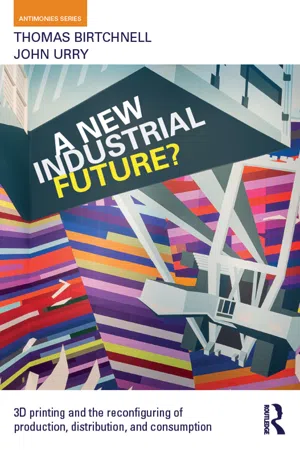
A New Industrial Future? examines whether a further industrial revolution is taking place around the world. In this compelling book Birtchnell and Urry examine such a new possible future involving the mass adoption of 3D printing. The locating of 3D printers in homes, offices, stores and workshops would disrupt existing systems and pose novel challenges for incumbents. The book drawing upon expert interviews, scenario workshops and various case studies assesses the potential future of global manufacturing, freight transport, world trade and land use. It offers the first book-length social scientific analysis of the character and impacts of a new system of manufacturing that is in formation. The book will be of interest to urban planners, policy makers, social scientists, futurologists, economists, as well as general readers by offering inquiry on this future upheaval in the means of production.
eBook - ePub
A New Industrial Future?
3D Printing and the Reconfiguring of Production, Distribution, and Consumption
- 134 pages
- English
- ePUB (mobile friendly)
- Available on iOS & Android
eBook - ePub
A New Industrial Future?
3D Printing and the Reconfiguring of Production, Distribution, and Consumption
About this book
Information
1 THINKING ADDITIVELY
DOI: 10.4324/9781315776798-1
Introduction
Industry consultants Wohlers Associates foresee the worldwide market for 3D printing products and services growing to US$10.8 billion by 2021 and driving economic growth. 1 Industry consultants Gartner are more cautious in their foresight, noting a wide degree of hype with many hurdles to mass adoption by consumers and producers. 2 Already estimates are being made that the global 3D printing market will reach approximately US$3 billion by 2018 according to the executive summary of the report ‘3D Printing – A Global Strategic Business Report’ by Global Industry Analysts. 3 The decentralization and distribution of the means of production through digital fabrication could be epochal since it involves a reconfiguration of the current systems transforming the very notion of manufacturing. Anticipated changes are a closer proximity of production to design as consumers access online repositories of files to print out themselves. A forerunner is the innovation of the Internet whereby music or films or books became downloadable at a price and in some cases for no cost at all. 4
Three decades ago 3D printers became available in the pre-production, or prototyping, stages of manufacturing objects. Architects, industrial engineers, designers and other users requiring models for testing and bringing concept-to-prototype now use 3D printers every day. When early forms of 3D printing, known as ‘stereolithography apparatus’ (SLA), became available in the mid-1980s, there was already speculation that it would be a game-changer for production systems. The inventor of this early process and founder of major 3D printing company 3D Systems, Charles ‘Chuck’ Hull, cited a report by Californian research firm DATAquest describing how the innovation works. He noted: ‘Stereolithography has the potential to change the (manufacturing) industry, as we know it today. Never before has a manufacturing process achieved such dramatic time and expense reduction in prototypic manufacturing’. 5 SLA was integrated into pre-production processes for the purpose of what became known as ‘rapid prototyping’, whereby a user could produce an experimental or unfinished object for testing without having to resort to costly factory settings, which are only economically feasible for very many finished products. Alongside polymers other heat sensitive materials became popular as rapid prototyping went mainstream.
A visitor to the London 3D Print Show will realize that the major interests in 3D printing involve rapid prototyping either through bureaus or desktop 3D printers, yet this is rapidly changing. Many experts are examining both the wider implications of 3D printing for economies and societies and how the social world itself will structure the consequences of 3D printing. 6 It should be noted that there are many different processes here: heated extrusion, laser sintering, electron beam melting, chemical binding and others still in testing. Consumers can purchase more affordable versions off the shelf in major high street suppliers; or make use of services with industrial machines and professionally trained staff.
Various innovations in scanner, sensor, laser, electron beam and chemical technologies have been pivotal in bringing these processes into product development and allowing certain 3D printers to reach the market. As the technologies grouped under the umbrella term ‘3D printing’ have matured into consumer and industrial products they look more like 2D printers, whether this is the latest desktop unit or the larger model of ‘office’ type printer. However, there will not be a like-for-like emergence. Indeed 3D printers could combine with other technologies into a ‘digital fabricator’, such as suggested by the Kickstarter project ‘Maker-Arm’: a complete digital fabrication system combining a wirelessly controlled robotic arm with a 3D printer, laser-cutter, carver, printed circuit board (PCB) mill, drill, solder-paste dispenser, pick and place assembly, and automated solderer. 7 3D printing is just one of many automation machines.
It should also be noted that 3D ‘prints’ do not appear out of thin air. Each object requires feedstock as well as some additional material for scaffolding, and in some models of printer enough excess material to fill the build tray to capacity. Feedstock refers to stock material that is fed into a printer, whether in the form of powder, liquid, gel, filament, gas or some other standardized raw material. 8 Initial innovations in the printing of objects occurred in experiments with lasers, chemicals and binding agents and were a progression from the moulding of materials to change their state through a phase shift. Rather than pouring or injecting a material into a mould (as in the modern process of ‘injection moulding’ and in the practice of metal casting where metal is melted and poured into a mould) a computer solidifies material feedstock layer by layer with micro-millimetre detail. Because of the visibility of the layering in many cases of 3D printing, some form of minor ‘finishing’ is often required for objects to be visually satisfactory.
In low-end 3D printing an object is produced using affordable and widespread composite plastic filament (known as ABS or acrylonitrile-butadiene-styrene) through a process of melting, extrusion and solidification. This innovation made 3D printing affordable and also freed the process from control by material patents and expensive printer technologies. And more importantly, with the use of an end product material such as ABS the idea of ‘rapid manufacturing’ became a possibility. With open source and commercial desktop laser sintering this likelihood increases markedly. 9
Projected market barriers for 3D printing are the total cost (including materials, software, designs, power), the usability of software (interface and design), production times and product quality. 10 Objects now 3D ‘printed’ include many plastic consumer accessories and novelties; metal car, aeroplane and motorbike parts; textiles, ornaments and clothing; and even cardiovascular tissue. 11 In some cases, nature inspires the designs now made possible through this technique, for instance honeycomb structures in bioengineering. 12 Alongside the diversification of objects being printed there are also a growing number of websites offering repositories of designs and online services in a range of possible materials. These online services range from open source and peer-to-peer aggregators of user-submitted designs to multi-national businesses with sophisticated supply chains and products ranging from household objects and novelties to luxury items.
In this book we are suggesting that in the future there will be far more flexibility, choice and variety in the global system people currently rely on for the objects they use in everyday life. As a consequence social, geopolitical and economic upheaval, disruption and transformation are also on the horizon. The ubiquity of the automobile, personal computer or smart phone certainly suggests there could be social ramifications for 3D printing. However, a closer and critical examination of these technologies and others suggests that combinations of different innovations will result in a reconfiguration of the incumbent systemic triad of production, distribution and consumption. 13 At the moment predictions of the social impacts of 3D printing take into account the range of printers and the power and significance of existing interests, including patterns of low cost manufacturing, containerization and supply chains, and brand-centric capitalism. We will see how 3D printing might be transformative of very many freight miles and this requires examination of contrasting scenarios for 2050 and the forms in which novel socio-technical systems might emerge and generate different forms of personal and object transportation in coming decades. We consider 3D printing through examining its potential to reconfigure the triad.
3D printing is not completely unforeseen or left field. There are already additive manufacturing systems in place in today’s society. The conventional retail high street includes both suppliers of manufactured objects, those who craft or repair an already manufactured item, and ones who combine various prefabricated ingredients into a product on site. A shopper might choose to have their shoes re-heeled by a high street cobbler (an additive process of repair, as replacement soles are layered on top of the existing one), and while they wait will buy something to eat from a donut stall where an operator uses an extrusion machine to combine a mixture of dough, sugar and other ingredients into a product deep-fried in a second machine where it is ‘finished’: glazed with sugar or icing.
A common sight in the world’s cities, the donut seller, uses a 3D printer-like extrusion technology. Certainly, the ingredients for the donut-maker’s wares are likely to have been transported some distance from farming and packaging facilities. The economic and logistical benefits of extruding donuts on site stem from profits made in standardizing and optimizing the weight, density and packaging of the ingredients, which keeps overhead costs down. And the donut seller can also advertise the donuts as ‘freshly made’ regardless of the distance and time between origin and sale.
Similarly, coffee shops are places for meeting people, spending time working, as well as purchasing hand-made coffee. A popular iPhone app called ‘London Coffee’ illustrates the growing success of boutique cafés in central London with an impressive listing of small businesses. Such cafés will have an espresso machine – that is, another heat extruder – alongside other types of coffee equipment. Feedstock materials for the espresso machine include a range of coffee beans for processing in a blender, which converts them into a powder. A successful café involves not only stocking the best coffee but also training the most proficient ‘baristas’.
Baristas pay attention to the cleanliness of their equipment, the length of time they heat milk, the angle of the frothing wand, the consistency of the crema and the movement of the jug as they pour milk to make ‘marbling’ effects on the surface of the coffee: their craft. There is an acknowledgement of artistry in coffee preparation and baristas receive accredited training, with some going on to compete in regional, national and international competitions, where they receive additional credit for their skills. Being a barista can be a lifetime career combining technical skill, presentation and a degree of ‘flair’. The growth of boutique cafés alongside a wide range of affordable home espresso machines is a useful analogy for 3D printing.
Similar to coffee making, 3D printing necessitates a material feedstock; loose powders or cartridges; a technical process involving blending, heating and extrusion; and some technical skill in making all this work together. And like 3D printing there are high-end coffee machines for industry purposes and low-end home units too. There is a wide range of product quality types and consumer expectations.
So what do these food and beverage industries suggest for the future of 3D printing? First, the widespread proliferation of home or desktop 3D printers would not necessarily spell disaster for industry, craft or bureau 3D printing. While it is true that innovations in digital printing saw the demise of the ubiquitous camera film print shop, there remains niche demand for digital print shops where consumers can print out copies of their digital photos. Unlike the camera film industry, the café industry has grown alongside the development of a huge market in highly technical and affordable home espresso machines. Furthermore, the home printing of exotic materials such as steel, titanium, aluminium and ceramics will require innovations in printing technology currently inconceivable by today’s standards. These materials require expensive high-end machines with technically trained users. Such rumination is relevant to the future of food products specifically, with one recent study on the chocolate industry highlighting that the adoption of 3D printing technology and the mass customization it affords is ‘a matter of survival’ for manufacturers. 14 This chapter thus examines the pending system innovation arising from the digitization of data and the decentralization of 3D printers engendering a new system that will be unfamiliar to people today.
From 2D to 3D
The subject of this book might be a singularly known technology – that is, 3D printing – however, we wish to distance ourselves from deterministic accounts of social change arising from this innovation. There is a way to imagine 3D printing for everyday, household objects becoming ubiquitous without sinking into deterministic thinking, namely that it would arise from a transformation in an epochal sense of what we understand as ‘capitalist’ societies.
Elaboration on a new system driving the ubiquity of 3D printing is far from whimsical. With the imminent threats to society of climate change governments around the world are now assessing the future of high-carbon living and the greenhouse gas emissions (GHGs) occurring as a result of regional manufacturing clusters, transoceanic freight, and the rapid global flows of objects as commodities and ultimately waste. These features of capitalist societies came about fairly recently through a process one of the authors termed the ‘end of organized capitalism’ in the mid-1980s in a book with sociologist Scott Lash. To some degree, this book also represents an attempt to reconcile the original thesis with the idea put forward by management theorist Gibson Burrell of ‘reorganization’ being a more appropriate idea than ‘disorganization’: ‘It is one set of structures being transformed into another set of equally organized but different structures through a process of re-organizing’. 15 Here the term ‘reconfiguring’ is used in lieu of ‘reorganizing’.
The rapid prototyping phase of 3D printing is an oft-unacknowledged enabler of what Nobel Prize-winner Joseph Stiglitz termed the ‘roaring nineties’ as the economy of the United States (US) shifted to services and manufacturing and was offshored within a free market system. 16 Without 3D printing in pre-production form, fit and function processes multinational corporations (MNCs) could not chase competitive advantages and leanness with the degree of profitmaking witnessed in late modernity, as the economies of scale in bulk volume production and distribution required the intensity of consumer demand to be matched by supply. The digitization of object designs and the spread of the Internet saw rapid prototyping as the solution of choice for MNCs to further de-concentrate their activities across great distances.
Most 3D printers on the market today use some sort of cartridge system in the same fashion as their 2D relatives. Just like in paper printers vario...
Table of contents
- Cover
- Frontmatter
- Half Title Page
- Frontmatter
- Title Page
- Copyright Page
- Contents
- List of figures
- Foreword
- Preface
- 1 Thinking additively
- 2 A brief history of 3D printing
- 3 The 3D system
- 4 Resources
- 5 Transitions
- 6 Futurity
- 7 Scenarios
- Index
Trusted by 375,005 students
Access to over 1.5 million titles for a fair monthly price.
Study more efficiently using our study tools.
Frequently asked questions
Yes, you can cancel anytime from the Subscription tab in your account settings on the Perlego website. Your subscription will stay active until the end of your current billing period. Learn how to cancel your subscription
No, books cannot be downloaded as external files, such as PDFs, for use outside of Perlego. However, you can download books within the Perlego app for offline reading on mobile or tablet. Learn how to download books offline
Perlego offers two plans: Essential and Complete
- Essential is ideal for learners and professionals who enjoy exploring a wide range of subjects. Access the Essential Library with 800,000+ trusted titles and best-sellers across business, personal growth, and the humanities. Includes unlimited reading time and Standard Read Aloud voice.
- Complete: Perfect for advanced learners and researchers needing full, unrestricted access. Unlock 1.5M+ books across hundreds of subjects, including academic and specialized titles. The Complete Plan also includes advanced features like Premium Read Aloud and Research Assistant.
We are an online textbook subscription service, where you can get access to an entire online library for less than the price of a single book per month. With over 1.5 million books across 990+ topics, we’ve got you covered! Learn about our mission
Look out for the read-aloud symbol on your next book to see if you can listen to it. The read-aloud tool reads text aloud for you, highlighting the text as it is being read. You can pause it, speed it up and slow it down. Learn more about Read Aloud
Yes! You can use the Perlego app on both iOS and Android devices to read anytime, anywhere — even offline. Perfect for commutes or when you’re on the go.
Please note we cannot support devices running on iOS 13 and Android 7 or earlier. Learn more about using the app
Please note we cannot support devices running on iOS 13 and Android 7 or earlier. Learn more about using the app
Yes, you can access A New Industrial Future? by Thomas Birtchnell,John Urry in PDF and/or ePUB format, as well as other popular books in Technology & Engineering & Sociology. We have over 1.5 million books available in our catalogue for you to explore.