- 192 pages
- English
- ePUB (mobile friendly)
- Available on iOS & Android
eBook - ePub
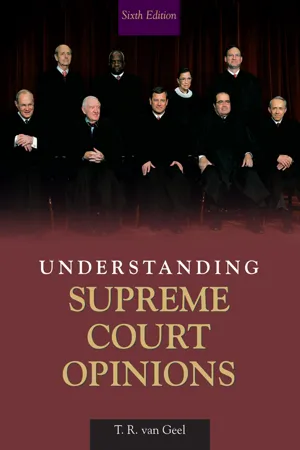
Understanding Supreme Court Opinions
About this book
This book provides an introduction to the legal reasoning and the modes of persuasion and justification used by Supreme Court justices in the United States, as well as others engaged in constitutional adjudication. It is designed to be used as a supplement to a constitutional law casebook.
PART 1
The complete understanding of a Supreme Court opinion requires both a grasp of a certain body of background information and certain techniques of analysis. The three chapters that compose this part of the book provide essential background information regarding the Supreme Court, as an institution, and the Constitution. Chapter 1 simultaneously introduces constitutional conflicts and the role the Supreme Court plays in resolving those conflicts. Chapter 2 carries the discussion begun in Chapter 1 of the Constitution’s content a step further by examining in more detail five of the most important areas of the Constitution and constitutional law. Chapter 3 also extends a point raised in Chapter 1—the topic of judicial opinion writing. Though you are not reading this book in order to prepare to be a justice of the Supreme Court, it is useful to look at the writing of opinions from the perspective of a justice in order to become a better reader of them.
1
Chapter
The Supreme Court: Policy Maker and Teacher
The United States Constitution is the supreme law of the land. Federal, state, and local governments; their legislative, judicial, and administrative branches; as well as all federal and state officials and employees must conform their actions, policies, and laws to constitutional requirements (see the Addendum to Chapter 2). Sometimes this task is easily accomplished because the constitutional text is precise. Few would debate whether each state is to be represented by two senators. But other phrases and words of the Constitution are not so clear. For example, Article 2, Section 1, states that no person except a “natural born” citizen is eligible to become president. Presumably this requirement means the president must have been born on American soil and not have obtained citizenship through naturalization procedures. But what of the person born on an American ship sailing in international waters? Less seriously, does the phrase “natural born” exclude from the presidency men and women born by means of cesarean section? These “silly” questions have not yet been officially answered, and the very fact we can ask them suggests that the constitutional text is not always clear.
A vague or ambiguous constitutional text, conflicts between different parts of the Constitution, and omissions are obvious invitations to disputes over its meaning. In fact, disputes regularly arise between different branches of the federal government, between the federal government and the states, and between federal or state government and individuals. Therefore a need exists for having some way to resolve disputes and for providing authoritative interpretations. Since 1803 the Supreme Court has played this role. In Marbury v. Madison (1803) the Court declared that the Constitution authorized it to determine when the challenged law or policy was inconsistent with the Constitution.1
In deciding a question of this sort the Court plays three roles. First, it is a court of law that settles the legal dispute between the parties. Its ruling is binding on the parties before it and settles the rights and duties that are to shape the legal relationship of the parties. In addition, the Court’s ruling in the case establishes law and doctrine that is binding on the lower courts, which must now follow the Court’s ruling when confronted with cases like that in which the Court ruled. Lawyers use this same precedent when they advise their clients (which include governmental officials) regarding what they now believe is constitutionally permitted and what is constitutionally prohibited. (Whether the precedent established in the Supreme Court controls the case before the lower court, or whether the precedent with which the lawyer is dealing applies to the problem the client has brought to the lawyer is often a matter of dispute, as we shall discuss. See Chapter 6.)
A second role the Court plays is that of policy maker. By ruling on what is constitutionally permissible and impermissible the Court affects the direction of public policy. (It is widely assumed that the other parts of the government are obligated to follow the rulings of the Supreme Court.) Goals that the legislature may have wanted to pursue may now be seen to be permissible or impermissible. Methods of achieving permissible goals may now be declared to be permissible or impermissible.
Third, the Court often acts as teacher to the nation. Because we as a people expect the Supreme Court to justify its exercise of this politically, economically, and socially important power of judicial review, the Court at the conclusion of many of its cases writes an opinion explaining and justifying the decision it reached. The opinions serve to educate the general public, especially in our age when far-reaching media extensively report on the Court’s rulings. Sometimes the Court educates like an Old Testament prophet announcing to the nation that a course of conduct is constitutionally unacceptable. At other times the Court is cast more in the role of a teacher like Socrates who is engaged in a protracted “dialogue” with the other branches of government. In these situations the policy-making branch speaks first, and the Court responds in an opinion saying, “No, that is not permissible.” Then the other branch responds by adopting a modified policy, saying in effect, “Well, how about this?” The Court then may respond, “Yes, but only if modified in this way.”
In carrying out these functions some justices believe it is the role of the Court to “keep the Constitution up to date,” whereas other justices believe changes in the Constitution must be the result of the formal amendment process. This crucial dispute derives from two different conceptions of the Constitution itself—is it a document of binding law that enshrines fixed fundamental values, or is it a document that speaks to our aspirations and puts into place new principles that had not been sufficiently recognized in the past?
CONSTITUTIONAL CONFLICTS
Constitutional conflicts involve fundamental issues of right and wrong; principles of social justice, power, and authority; oppression and liberty; economic development; and even war and security. But the language of right and wrong, liberty and justice, is not the language in which the Supreme Court discusses these disputes. Take, for example, the issue of the minimum wage. In the legislature the question of whether a law should be passed requiring employers to pay a minimum wage may be debated in terms of the free market versus the welfare state, or the protection of the working poor versus the loss of jobs. Once a minimum wage law has been passed it may be subjected to several different constitutional challenges; for example, it may be challenged as beyond the power delegated to Congress in Article 1 of the U.S. Constitution and, or alternatively, it may be challenged as a violation of the Fourteenth Amendment’s prohibition against the deprivation of life, liberty, or property without due process of law.
The difference between policy-making language and constitutional language can be illustrated in a different way. Of central importance to American policy makers is the problem of how to honor the principle of tolerance of antithetical political and cultural differences without going so far as to flirt with social disunity. The Supreme Court has played an important “navigator’s” role in steering the ship of state on this course. But it has done so using language and concepts derived from the constitutional text. Thus the Court’s opinions touching upon these issues have spoken in terms of concepts such as equal protection and the free exercise of religion.
It is important to realize that the language of the law is not merely a verbatim “translation” of the language of policy making or the language of morality. Take for example the phrase “equal protection of the laws” from the Fourteenth Amendment. You cannot assume that this phrase means precisely the same thing as what, for example, your favorite moral philosopher means when he or she speaks of equality.
Thus because Supreme Court opinions speak about fundamental issues of social policy in the language of the Constitution, it is important to move toward an understanding of these opinions by looking at the Constitution itself.
AN OVERVIEW OF THE CONSTITUTION
The Constitution includes these five fundamental features:
• Provisions that touch upon such matters as the relationship between Congress, the president, and the Supreme Court, their respective powers, and how the officers of these three branches are elected or appointed
• Provisions that regulate the relationship between the federal government and the states
• Provisions designed to protect individuals against governmental invasions of their liberty, privacy, and other rights
• Provisions that guarantee persons the equal protection of the laws or otherwise prohibit invidious discrimination
• The two clauses of the First Amendment regulating the relationship between government and religion
There are, of course, other provisions of the Constitution of great importance (e.g., Article 4, Section 3, which governs the admission of new states to the Union; Article 5, which establishes the procedures for amending the Constitution; and Article 6, which declares the Constitution the supreme law of the land). Although these other provisions of the Constitution exist, one can nevertheless obtain a general understanding of the constitutional framework and the interpretative role that the Supreme Court has played by addressing only the five features listed above.
In most situations no one would have difficulty deciding whether the offending party was a governmental entity (federal, state, local) or a governmental official or a private actor. But there are “gray” areas that have led to litigation to decide this question. As a consequence, the Supreme Court has developed various tests for resolving the question of whether or not the offending actor is the “state” or a private actor, and hence whether the Constitution may be used in a suit against the offending party. The typical gray area is one in which a private entity is somehow involved with the government—the nature and degree of that involvement is what the Court examines to determine whether the otherwise private entity should be considered for these purposes as a “governmental” actor. The mere fact that a private entity, for example, a private university, receives governmental assistance or has its charter from the state government does not turn it into a “governmental” actor. The “entwining” of the private entity and the government must be, according to the cases, qualitatively and quantitatively different. These are decisions made by the Court on a case-by-case basis. Thus the Court has concluded that the National Collegiate Athletic Association (despite the fact that many of its members are public colleges and universities) was not a government actor, but that the Tennessee Secondary School Athletic Association was a “state actor” (National Collegiate Athletic Association v. Tarkanian [1988]; Brentwood Academy v. Tennessee Secondary School Athletic Ass’n [2001]).
Whether or not the offending party is seen as a “state actor” is a threshold issue in constitutional litigation. A finding that the offending party is not a “state actor” means that the case cannot proceed as a constitutional case. The suit, if it is to proceed, must rely on nonconstitutional theory, such as a breach of a statute, a breach of contract, or it may proceed as a tort suit claiming personal injury of some kind.
This reality of constitutional law leads to some perhaps surprising conclusions. Take the case of the father who had been beating his infant son for two years. Local officials were aware of the problem but took no steps to remove the boy from the father’s care until after the child was brain damaged. Does this raise a constitutional issue? “No,” said the Supreme Court. First, the father’s abuse was the abuse by one private individual of another. The Constitution does not itself regulate this behavior (state criminal law does). Second, the failure of the local social services agency to act also was not a constitutional violation because the Constitution does not require government to protect the life, liberty, and property of its citizens. “The [Constitution] is phrased as a limitation on the State’s power to act, not as a guarantee of certain minimum levels of safety and security” (DeShaney v. Winnebago County Department of Social Services [1989]). In fact, the police do not have a constitutionally based duty to respond to even repeated calls for assistance (Castle Rock v. Gonzales [2005]).
GETTING THE SUPREME COURT TO PLAY ITS ROLE
The Supreme Court has played the role of educator and policy maker in each of the five basic areas listed above. Now it is time to look at the mechanics and procedures by which the Court is brought into the policy-making process.
The Supreme Court, in sharp contrast to the other branches of the federal government, may not on its own initiative thrust itself into a policy arena and start issuing opinions announcing that this policy is constitutionally permissible but that policy is not. The Court may act only when a suit is initiated by someone else and brought to the Court for resolution. To see how these cases get into the Supreme Court we need to take a quick look at the federal judicial system.
A Snapshot of the Federal Judicial System
The federal judicial system consists of four basic types of courts: a small number of specialized federal courts that deal with specific matters such as customs and patent appeals, federal district courts found in the states and U.S. territories, U.S. courts of appeal, and the U.S. Supreme Court. Our discussio...
Table of contents
- Cover Page
- Half-Title Page
- Title Page
- Copyright Page
- Table of Contents
- Preface
- Introduction
- Table of Cases
- Index
Trusted by 375,005 students
Access to over 1.5 million titles for a fair monthly price.
Study more efficiently using our study tools.
Frequently asked questions
Yes, you can cancel anytime from the Subscription tab in your account settings on the Perlego website. Your subscription will stay active until the end of your current billing period. Learn how to cancel your subscription
No, books cannot be downloaded as external files, such as PDFs, for use outside of Perlego. However, you can download books within the Perlego app for offline reading on mobile or tablet. Learn how to download books offline
Perlego offers two plans: Essential and Complete
- Essential is ideal for learners and professionals who enjoy exploring a wide range of subjects. Access the Essential Library with 800,000+ trusted titles and best-sellers across business, personal growth, and the humanities. Includes unlimited reading time and Standard Read Aloud voice.
- Complete: Perfect for advanced learners and researchers needing full, unrestricted access. Unlock 1.5M+ books across hundreds of subjects, including academic and specialized titles. The Complete Plan also includes advanced features like Premium Read Aloud and Research Assistant.
We are an online textbook subscription service, where you can get access to an entire online library for less than the price of a single book per month. With over 1.5 million books across 990+ topics, we’ve got you covered! Learn about our mission
Look out for the read-aloud symbol on your next book to see if you can listen to it. The read-aloud tool reads text aloud for you, highlighting the text as it is being read. You can pause it, speed it up and slow it down. Learn more about Read Aloud
Yes! You can use the Perlego app on both iOS and Android devices to read anytime, anywhere — even offline. Perfect for commutes or when you’re on the go.
Please note we cannot support devices running on iOS 13 and Android 7 or earlier. Learn more about using the app
Please note we cannot support devices running on iOS 13 and Android 7 or earlier. Learn more about using the app
Yes, you can access Understanding Supreme Court Opinions by T.R. van Geel in PDF and/or ePUB format, as well as other popular books in Law & Law Theory & Practice. We have over 1.5 million books available in our catalogue for you to explore.