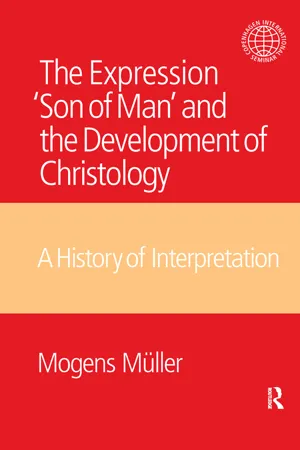
'Son of Man' is practically the only self-designation employed by Jesus himself in the gospels, but is used in such a way that no hint is left of any particular theological significance. Still, during the first many centuries of the church, the expression as it was reused was given content, first literally as signifying Christ's human nature. Later 'Son of Man' was thought to be a christological title in its own right. Today, many scholars are inclined to think that, in an original Aramaic of an historical Jesus, it was little more than a rhetorical circumlocution, referring to the one speaking. Mogens Müller's 'The Expression 'Son of Man' and the Development of Christology: A History of Interpretation' is the first study of the 'Son of Man' trope, which traces the history of interpretation from the Apostolic Fathers to the present, concluding that the various interpretations of this phrase reflect little more than the various doctrinal assumptions held by its interpreters over centuries.
The seeming obviousness of the use of the expression in the New Testament, that is, in the Gospels, stops almost immediately upon leaving them.1 It is clear that its meaning changes. Apparently, it does not survive in continuous use but primarily in an interpretation of the Son of man sayings in the canonical Gospels.2 The few examples of a use similar to the one found in the Gospels are exceptions which prove the rule. It comes to be understood genealogically, with a self-contained content. Very soon, the context becomes mostly polemical. Thus Irenaeus’ treatment—and a little later Tertullian’s—reflects the Gnostic interpretation which, in all its diversity, is uniform in that the genitive ‘of man’ is generally understood as referring to the divine Anthropos, an interpretation which has its own ratio and will therefore be treated separately (see below Chapter 2, ‘The Son of Man in Gnosticism’). Besides these, there also exist examples of interpretations which take into account Son of man sayings in the Gospels and what is said about the Son of man. We see this expression in the Gospels about the Son of man introduced in different ways in the often ardent strife about the correct understanding of the nature of Christ and his role in redemption.
1. Apocryphal Sayings and the Apostolic Fathers3
The above pertains less to the New Testament Apocrypha and agrapha, where it is difficult to distinguish between quotation and agraphon, as for instance in Clement of Alexandria, Stromata IV 6.35: ‘The Son of man, on coming to-day, has found that which was lost’.4
Other places offer examples of a varied use.5 In Acts of John 109, in eucharistic praise we find it as an apposition to ‘the diadem’: ‘him that for us was called Son of man’
; Acts of Peter 24 quotes Dan. 7.13, while Acts of Thomas 66 lets Thomas declare himself in contrast to Jesus to be only a human: ‘For I also am a man clothed with a body, a son of man like one of you’
Apocalypse of Peter 1 quotes Mt. 24.27, while in Apocalypse of Peter 4 it introduces words from Ezek. 37.4 as prophesied by the Son of Man. None of these resembles the use in the New Testament Gospels.
Only in a few places outside the New Testament has the expression survived in apocalyptic sayings, as, for instance, in a saying which stems from James, the brother of Jesus, according to Hegesippus, giving Jesus’ reaction to the question of the Scribes and Pharisees:6
‘What is the gate of Jesus?’ [cf. Jn 10.9]. And he answered with a loud voice, ‘Why do ye ask me concerning [Jesus,]7 the Son of man
? He himself sitteth in heaven at the right hand of the great Power, and is about to come upon the clouds of heaven
’.
The familiarity with texts such as Mk 14.62par. is obvious, the more so if the saying is understood as pointing to the exaltation and not the Parousia. The two parallel participles in the Gospel saying are replaced by two finite verbs (Matthew’s ‘you will see’, ὄψεσθε, is left out) where ‘sitteth’ refers to the present time, while the Parousia appears in a separately in the future tense. There also seems to be a connection with Acts 7.56. At both places, a persecuted person speaks about the Son of man at the right hand of God.
Another example comes from the Gospel to the Hebrews, from a legend about a meeting between the risen Christ and the same James who ‘had sworn that he would not eat bread from that hour wherein he had drunk the Lord’s cup until he should see him risen again from among them that sleep’. The risen Christ invites him to supper with the words:
‘Bring ye, saith the Lord, a table and bread’, and immediately it is added, ‘He took bread and blessed and brake and gave it unto James the Just and said unto him: My brother, eat thy bread, for the Son of Man is risen from among them that sleep (quia resurrexit Filius hominis a dormientibus).’8
The connection with New Testament tradition is obvious, for example, with Mk 14.22par and 8.31par. Both apocryphal sayings probably originate in the second century, the Gospel to the Hebrews being known to Hegesippus. There seems no need to take these two instances as evidence of a special Jewish Christian Son of man concept,9 which is also found in the Pseudo-Clementine Homilies and Recognitions. The interpretation of the Son of man characteristic of this literature is not present in these sayings.10
As will be seen in the next chapter, there are a few instances of a similar, seemingly obvious use of Son of man in Gnostic sources, but the context indicates that it has a special meaning.
Otherwise, outside the New Testament, the expression always occurs with a definition or within an argument, if not directly interpreted.11 Among the Apostolic Fathers12 it turns up once in the letters of Ignatius of Antioch (died c.110),13 where in Ephesians 20.2, with regard to the breaking of the one bread, ‘which is the medicine of immortality (ϕάρμακον ἀθανασίας)’, the congregation is admonished to come together ‘in one faith and in Jesus Christ, “who was in the family of David according to the flesh”, the Son of Man and Son of God
. In spite of the indefinite form, the saying seems to reflect the Gospel usage of the expression. On the other hand, it is also clearly understood as a designation for the human nature of Christ. The background should be seen in Rom. 1.3 or in the eventual source for the creedal formula there. Clearly, it is not a title, but a definition.14
The same seems true of the use of the expression in the expanded Georgian translation of Didache 16.8, with content which differs from the Greek text: ‘Then this world will see our Lord Jesus Christ, the Son of man, who (at the same time) is Son of God, (as) coming on the clouds’, and so on.15 In spite of the connection with Mk 14.62par (and Dan. 7.13), the translator obviously felt it necessary to underline that Jesus is Son of God.16
This is not quite the case in the Epistle of Barnabas. Here, in 12.9, the unknown author points to what Moses said ‘to Jesus the son of Naue, after giving him this name, when he sent him to spy out the land, “Take a book in thy hands and write what the Lord saith, that in the last day the Son of God shall tear up the roots of the whole house of Amalek”’. In 12.10, he then urges: ‘See again Jesus, not as son of man, but as Son of God, but manifested in a type in the flesh’
. The expression does not designate the human nature of Christ, but Jesus as human, not with regard to one of his two natures, but exclusively in his human appearance.17 Thus the Epistle of Barnabas (probably from c. 130) rejects, on the basis of Ps. 110.1 and Isa. 45.1, that Christ should be the son of David.
Already in the Apostolic Fathers, Son of man is perceived as an alternative to Son of God. ‘Of man’ has been ascribed a new and independent signification, qualifying the one so designated as of a different nature than indicated by the title Son of God. Such an understanding is, however, not obvious anywhere in the Gospels, where—with the possible exception of Jn 5.27—the expression never appears with a clear predicative meaning. This contrast, suggesting that Son of God and Son of man say something fundamentally different, became dominant in the interpretation in the following periods and was only neutralized where ‘man’ was taken as the god ‘Man’ as in Gnostic texts, the whole expression being...
Table of contents
Cover
Half Title
Title Page
Copyright Page
Table of Contents
Preface
Abbreviations
Introduction
1. Early Church
2. The Son of Man in Gnosticism
3. Nicene and Post-Nicene Fathers
4. The Son of Man in Medieval Exegesis
5. Reformation, Orthodoxy, Counter-Reformation, and Pietism
6. Enlightenment, Rationalism, and Idealism
7. Son of Man and the Life of Jesus Project
8. The Emergence of a Specific Apocalyptic Son of Man Concept
9. The First Aramaic Stage in the Son of Man Research
10. The Eschatological Interpretation
11. Mostly Backwater
12. The History of Religions School
13. Interlude
14. Continuations
15. The Second Aramaic Stage
16. Exit the Apocalyptic Son of Man?
17. Son of Man as a Product of the Gospel Tradition
18. Conclusion
Bibliography
Index of References
Index of Authors
Trusted by 375,005 students
Access to over 1.5 million titles for a fair monthly price.
Study more efficiently using our study tools.
Frequently asked questions
Yes, you can cancel anytime from the Subscription tab in your account settings on the Perlego website. Your subscription will stay active until the end of your current billing period. Learn how to cancel your subscription
No, books cannot be downloaded as external files, such as PDFs, for use outside of Perlego. However, you can download books within the Perlego app for offline reading on mobile or tablet. Learn how to download books offline
Perlego offers two plans: Essential and Complete
Essential is ideal for learners and professionals who enjoy exploring a wide range of subjects. Access the Essential Library with 800,000+ trusted titles and best-sellers across business, personal growth, and the humanities. Includes unlimited reading time and Standard Read Aloud voice.
Complete: Perfect for advanced learners and researchers needing full, unrestricted access. Unlock 1.5M+ books across hundreds of subjects, including academic and specialized titles. The Complete Plan also includes advanced features like Premium Read Aloud and Research Assistant.
Both plans are available with monthly, semester, or annual billing cycles.
We are an online textbook subscription service, where you can get access to an entire online library for less than the price of a single book per month. With over 1.5 million books across 990+ topics, we’ve got you covered! Learn about our mission
Look out for the read-aloud symbol on your next book to see if you can listen to it. The read-aloud tool reads text aloud for you, highlighting the text as it is being read. You can pause it, speed it up and slow it down. Learn more about Read Aloud
Yes! You can use the Perlego app on both iOS and Android devices to read anytime, anywhere — even offline. Perfect for commutes or when you’re on the go. Please note we cannot support devices running on iOS 13 and Android 7 or earlier. Learn more about using the app
Yes, you can access The Expression Son of Man and the Development of Christology by Mogens Mueller,Mogens Muller in PDF and/or ePUB format, as well as other popular books in History & Ancient History. We have over 1.5 million books available in our catalogue for you to explore.