Although awareness of campus sexual assault is at a historic high, institutional responses to incidents of sexual violence remain widely varied. In this volume, a diverse mix of expert contributors provide a critical, nuanced, and timely examination of some of the factors that inhibit effective prevention and response in higher education. Chapter authors take on one of the most troubling aspects of higher education today, bridging theory and practice to offer programmatic interventions and solutions to help institutions address their own competing interests and institutional culture to improve their practices and policies with regard to sexual violence. The Crisis of Campus Sexual Violence provides higher education scholars, administrators, and practitioners with a necessary and more holistic understanding of the challenges that colleges and universities face in implementing adequate and effective sexual assault prevention and response practices.
eBook - ePub
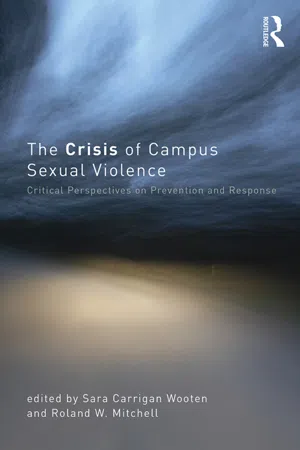
The Crisis of Campus Sexual Violence
Critical Perspectives on Prevention and Response
- 204 pages
- English
- ePUB (mobile friendly)
- Available on iOS & Android
eBook - ePub
The Crisis of Campus Sexual Violence
Critical Perspectives on Prevention and Response
About this book
Information
1 Introduction
DOI: 10.4324/9781315725604-1
As scholars, policymakers, administrators, and activists we find ourselves in a historical moment in the United States of increased interest in, and awareness of, campus sexual assault. Each year seems to carry with it a flood of news stories involving sexual assault scandals in higher education. This is in part due to changes in technology that have enabled survivor stories to spread swiftly through the media. The work of the Office of Civil Rights has also played a significant role in bringing Title IX violations regarding sexual violence in higher education to prominent national attention. While the increased attention to the reality of rape and sexual assault in higher education is a major step in the right direction, institutional response to highly publicized incidents of sexual violence remains widely varied. For example, colleges and universities are increasingly reliant on bystander intervention programs due to federal mandates to implement them as part of a broader anti-sexual violence strategy. Such prevention programming, while rightfully unifying the campus community in its obligation to prevent violence, also sustains the notion that sexual violence is an inevitable part of campus life. Additionally, bystander intervention programs largely remain extremely hetero-normative, where the possibility of lesbian, gay, bisexual, and transgender (LGBT) student assaults are at best briefly mentioned and at worst silenced. Such programming has also been largely silent on the necessity of distinguishing between different cultural values and pressures, where concerns about reporting sexual violence may be radically different from one group to another. For example, the rationale to not report for a White, straight woman may be entirely different than the rationale to not report by a Latino, bisexual man, depending on the circumstances of their assaults.
The example of bystander intervention programs highlights the incredible complexity of sexual assault prevention. For each component of prevention and response efforts, a multiplicity of questions unfolds regarding how best to serve all students and effectively provide a safe and survivor-supportive campus. This volume attends to the difficulties that higher education institutions (HEIs) face in implementing adequate and effective sexual assault prevention and response practices. We acknowledge the plethora of concerns that HEIs must attempt to balance when considering how best to serve students and illuminate a number of questions that risk remaining unanswered in the national fervor to develop immediate, practical solutions. To this end, this book provides scholars, administrators, leadership, and practitioners with a more holistic understanding of the challenges that higher education institutions face when attempting to prevent sexual violence on campus. However, this volume goes beyond a mission of simply highlighting these difficulties. We begin with experiential and theoretical chapters that lay a foundation for chapters that offer new perspectives on pragmatic solutions. Some authors offer insights into programmatic developments that they have been a part of developing and implementing, while others take a critical standpoint in assessing the barriers to adequate prevention, education, and response efforts that exist. We argue that developing programmatic interventions that are not held in conversation with, and at times in tension with, theoretical perspectives regarding the manner in which sexual violence is being framed in higher education is to act without an appreciative understanding of the problem. Ultimately, these essays represent a political project aimed at calling attention to the kinds of institutional dynamics that make eradicating sexual violence in higher education a difficult enterprise, at best. Collectively, they constitute an honest, nuanced, and timely take on one of the most troubling features of higher education.
Sexual Violence in Higher Education
The focus of sexual violence in higher education research has typically been aimed at understanding prevalence rates, incidence types, and risk factors such as alcohol and drug use as well as party and fraternity culture. In their groundbreaking study on sexual violence in higher education, Koss, Gidycz, and Wisniewski (1987) illuminated the significant prevalence of rape during college years for women. Research has consistently demonstrated over the past four decades that college women are at high risk of an attempted or completed rape while in college (Baum & Klaus, 2005; Fisher, Cullen, & Turner, 2000; Karjane, Fisher, & Cullen, 2005; Koss, Gidycz, & Wisniewski, 1987; U.S. Department of Justice, 2002). Research on sexual violence in higher education has identified that reporting rates are consistently low when held against prevalence rates.
While this research has dramatically altered what is known about rape and sexual assault in particular, much less has been written about the role that leadership, for example, plays in developing institutional strategies for mitigating campus sexual violence or how legal mandates shape, or fail to shape, HEI responses to incidents of rape and sexual assault. Such questions are critical for those working to combat high prevalence rates of sexual violence against college students. Understanding institutional culture, priorities, and decision-making strategies reveals the at times overwhelming problems that HEIs face when developing prevention and response initiatives.
Higher education institutions in the United States reflect the dominant social norms of our culture. The theoretical standpoint of this volume identifies that culture as patriarchal, whereby violence against women by men is responded to generally in a manner that either blames women for the violence done to them or focuses on prevention strategies that identify how women can better protect themselves. Institutional culture in higher education often promotes a mission of helping women help themselves to prevent sexual violence through bystander education, self-defense trainings, warnings to not walk alone at night, warnings to not go to parties alone, warnings to always watch their alcoholic beverage so as to prevent them from being spiked with “date rape” drugs, and providing information on where to seek help in the event of an assault, rather than fundamentally altering aspects of that culture that promote violence against women.
Publicity, Strategy, and Response
In February of 2012, Boston University hockey player Max Nicastro was arrested and charged with sexually assaulting a female student on campus. This was not the first allegation of sexual violence brought against a member of the team to be made public, and a subsequent investigation commissioned by Boston University President Robert A. Brown revealed a dangerous attitude of sexual entitlement shared amongst players. Two months after Nicastro’s arrest, the university announced that it was establishing a sexual violence crisis center on campus. The need for such a center was a popular initiative, one that had been called for by numerous parties over the years. The center would be responsible for implementing prevention education training and providing support for victims of violence. The university also increased its bystander intervention efforts by requiring officers of all student organizations to undergo specific bystander intervention training.
In April of 2012, the Office of Civil Rights (OCR) announced that it would be investigating Title IX violations alleged to have been committed by the University of Montana. After two sexual assaults were reported in 2011, the university conducted an independent investigation, the results of which revealed a total of nine sexual assaults of women from the fall of 2010 to the winter of 2011 that had been reported to the university and insufficiently handled. Complainants asserted that they had been discouraged from reporting due to several of the university’s football players, including the quarterback, being accused. Several reforms were instituted as a result of the 2011 internal investigation, including the development of a 20-minute online training ironically1 named Personal Empowerment Through Self Awareness (PETSA) for incoming students. Despite such action, the OCR investigation concluded that the university had violated Title IX mandates in a number of areas and entered into agreement with the university for further institutional reform.
The work done by higher education institutions to prevent sexual violence on their campuses has historically been carried out in a reactionary manner to incidents on campus or federal mandates. While federal mandates exist for all institutions receiving federal funding, the actual implementation of these mandates can be inconsistent. For example, while most institutions are in compliance with the Clery Act mandate to report crime statistics for each year, many also remain in violation of other provisions of the Clery Act such as distinguishing between forcible and nonforcible sexual assault (Fisher, Cullen, & Turner, 2000). The result of inconsistencies in sexual assault prevention, response, and reporting has been a multitude of different programmatic approaches across institutions with limited success in addressing what is understood to be an epidemic of rape and sexual assault occurring on campuses every year. In the case of Boston University, the institutional response to the violence committed by members of the hockey team was to create a fixed location within the university to handle education and prevention efforts as well as crisis intervention. For the University of Montana, reliance on a 20-minute online training for students, which they must complete before being allowed to register for classes, has been the chosen method of broadly educating students on sexual assault in the hopes of preventing such violence. Neither of these interventions, however, were part of a broader institutional effort to critically examine and alter the campus culture itself.
Addressing Institutional Culture
Changing institutional culture is an almost unthinkable goal given the basic compliance challenges that have been illuminated by the OCR investigations of Title IX violations over the past several years. In her analysis of 64 higher education sexual assault policies, Anderson (2004) concluded that HEIs often have multiple incentives for discouraging sexual violence reporting by students. This is typically carried out through a variety of implicit means. Universities and colleges have adopted archaic legal mandates such as, “prompt complaint, corroboration requirement, and cautionary instructions” (Anderson, 2004, p. 1). These mandates have a deterrent effect on sexual assault reporting by students and “may correlate with powerful institutional incentives to deter student complaints of sexual assault” (p. 7). Anderson establishes the powerful nature of rape myths regarding women and sexual violence, myths that often portray women as vindictive, conniving, and untrustworthy. These myths are so enmeshed in our cultural attitudes toward rape and sexual assault, that the manner in which campus leadership and administrators structure institutional policy may reflect a socioculturally hostile attitude toward victims, who are often, if not always, assumed to be heterosexual women.
Besides this general suspicion of women who report rape, HEIs benefit from deterring complaints in a number of ways, including preventing damage to their institutional reputation if too many incidents of sexual violence are reported via the Clery Act and preventing civil suits from being brought by students who are determined by the institution to have committed an act or acts of sexual violence. While Anderson points out that the fear of civil suits from students is extremely remote if all policies and procedures in investigating a complaint are followed precisely, the risk of harm to a university’s reputation if large numbers of women report their assaults is very real. This prioritization of reputation and prestige encourages HEIs to construct a system in which the less they know about the extent of the problem on their own campus, the better. The Dear Colleague letter of 2011 and the White House Task Force to Protect Students from Sexual Assault, which produced its first report in 2014, have sought to provide more rigorous guidelines for universities and colleges regarding their responsibility to meaningfully engage the crisis of campus sexual violence. However, such policy changes and clarifications of the law have not thus far led to a dramatic rise in sexual violence reporting by students.
A Critical Approach to Sexual Violence Prevention and Response
While the literature has done much to illuminate the scope and breadth of sexual assault and rape in higher education, it has not gone far enough in exposing the multiplicity of competing interests that higher education institutions must contend with when developing and implementing sexual violence prevention and response mechanisms. Furthermore, powerful discourses about sexual violence that are informed by heteronormative and White supremacist constructions of women and ideal victimhood remain largely unquestioned within analyses of prevention policy and programming. Constructing meaningful policy that addresses the concerns of different student groups, negotiating regulations and mandates, promoting rather than discouraging reporting, and implementing effective prevention education programming are just some of the issues that the essays in this volume contend with. Rather than continuing to reproduce the same systems of thought about sexual violence that have been encoded into the literature for decades, this volume is a critical interrogation of higher education with a focus on shifting the conversation. The authors contribute a vast amount of professional experience in negotiating and observing the dynamics of sexual violence prevention in higher education that have thus far constrained essential change and ultimately make a substantial contribution to what is known about how institutions are, and are not, rising to the challenge of protecting and advocating for the safety of their students.
In Chapter 2, Susan V. Iverson conducts a critical policy discourse analysis on sexual assault policies in higher education. She contends that for institutions of higher education to truly address the problem of sexual assault,2 in reality as much as in perception, colleges and universities must consider how the problem of sexual assault is portrayed. Her chapter examines the text of sexual assault policies to investigate embedded assumptions and predominant meanings constructed through the policies. Her study was designed to understand the “effects of policy proposals and the representations they necessarily contain” (Bacchi, 1999, p. 13). The use of assumptive concepts in language may limit a policy’s effectiveness and actually reinscribe the very problem the policy seeks to alleviate (Allan, 2007; Allan, Iverson, & Ropers-Huilman, 2010; Bacchi, 1999; Ball, 1990; Scheurich, 1994). Iverson concludes that if the construction of solutions diverts attention away from understanding the complexity of campus sexual assault, then incidence of sexual assault will not be reduced.
Sara Carrigan Wooten illuminates the ways in which universities and colleges construct and (re)produce a specifically heterosexist discourse of sexual violence in Chapter 3. The discourse is made manifest through various “sites” in higher education, including prevention programming materials and resources such as rape aggression defense trainings. This chapte...
Table of contents
- Cover Page
- Half Title Page
- Title Page
- Copyright Page
- Table of Contents
- Foreword—by Caroline S. Turner
- Acknowledgments
- 1 Introduction—Sara Carrigan Wooten and Roland W. Mitchell
- PART I Constructions of Sexual Violence in Higher Education
- PART II Power and Reputation in Institutional Decision Making
- PART III Federal Policy and Institutional Compliance
- PART IV The Possibilities of Programmatic Solutions
- Afterword: Questioning the Scripts of Sexual Misconduct—Rebecca Ropers-Huilman, Kaaren M. Williamsen, and Garrett Drew Hoffman
- Contributor Biographies
- Index
Trusted by 375,005 students
Access to over 1.5 million titles for a fair monthly price.
Study more efficiently using our study tools.
Frequently asked questions
Yes, you can cancel anytime from the Subscription tab in your account settings on the Perlego website. Your subscription will stay active until the end of your current billing period. Learn how to cancel your subscription
No, books cannot be downloaded as external files, such as PDFs, for use outside of Perlego. However, you can download books within the Perlego app for offline reading on mobile or tablet. Learn how to download books offline
Perlego offers two plans: Essential and Complete
- Essential is ideal for learners and professionals who enjoy exploring a wide range of subjects. Access the Essential Library with 800,000+ trusted titles and best-sellers across business, personal growth, and the humanities. Includes unlimited reading time and Standard Read Aloud voice.
- Complete: Perfect for advanced learners and researchers needing full, unrestricted access. Unlock 1.5M+ books across hundreds of subjects, including academic and specialized titles. The Complete Plan also includes advanced features like Premium Read Aloud and Research Assistant.
We are an online textbook subscription service, where you can get access to an entire online library for less than the price of a single book per month. With over 1.5 million books across 990+ topics, we’ve got you covered! Learn about our mission
Look out for the read-aloud symbol on your next book to see if you can listen to it. The read-aloud tool reads text aloud for you, highlighting the text as it is being read. You can pause it, speed it up and slow it down. Learn more about Read Aloud
Yes! You can use the Perlego app on both iOS and Android devices to read anytime, anywhere — even offline. Perfect for commutes or when you’re on the go.
Please note we cannot support devices running on iOS 13 and Android 7 or earlier. Learn more about using the app
Please note we cannot support devices running on iOS 13 and Android 7 or earlier. Learn more about using the app
Yes, you can access The Crisis of Campus Sexual Violence by Sara Carrigan Wooten, Roland W. Mitchell, Sara Carrigan Wooten,Roland W. Mitchell in PDF and/or ePUB format, as well as other popular books in Education & Education General. We have over 1.5 million books available in our catalogue for you to explore.