- 336 pages
- English
- ePUB (mobile friendly)
- Available on iOS & Android
eBook - ePub
About this book
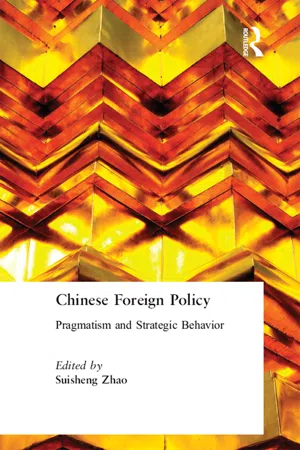
This volume explores how China is adapting to international norms and practices while still giving primacy to its national interests. It examines China's strategic behaviour on the world stage, particularly in its relationships with major powers and Asian neighbours.
Information
1
Chinese Foreign Policy
Pragmatism and Strategic Behavior
After more than a century of struggle with economic weakness and political turmoil, China entered the twenty-first century as a rising power thanks to the progress of market-oriented economic reform. While many Western businessmen welcomed the massive economic opportunities provided by China’s rise, China’s long-term great power potential has prompted politicians in some Western capitals and Asian countries to wonder whether an increasingly strong and assertive China would become a rational, peaceful, and pragmatic power or an irrational, bellicose, and expansionist state. Scholars and policy analysts have also taken different positions.1 Some have been alarmed and argued that the rising economic and military power of China by its own accord makes China a threat to Asian and global security because it may upset the balance of power and spark realignments in East Asia as well as the world. In particular, the neo-conservativists in the Bush administration of the United States have warned of the prospect of China emerging as a great power to challenge American predominance in the post-Cold War world and seek extended sovereignty by launching aggressive warfare against its neighbors. Neoconservatists thus have raised the oldest question in diplomacy once again: “How [can] the international community … manage the ambitions of a rising power [China]?”2 In contrast to this view, some other scholars have held that China is a conservative power and “in the foreseeable future it will seek to maintain the status quo.”3 China’s increasing integration into the international system, evident in its growing memberships in international security regimes and economic organizations, such as the World Trade Organization (WTO), has created “constraints on its foreign conduct as well as incentives to adapt to the prevailing norms in contemporary international relations.”4 Although the September 11, 2001, terrorist attack on the United States and the subsequent war on terrorism has pushed the debate to the back burner, the issue remains and will certainly return to the forefront and confront policy-makers in the West and Asia-Pacific if the threat of terrorism somehow subsides. This policy debate coincides with the theoretical debate between realism and liberalism among international relations scholars. While the realist argument holds that a rising China will become assertive and expansionist because, as the People’s Republic of China’s (PRC) capabilities increase, its intentions will become less benign, the liberal argument believes that China’s reform and growing economic interactions with the capitalist world will make it more open and democratic, which will help to promote international stability and security. While both international relations theories have provided valuable insights, neither of them alone is able to unravel the puzzle of whether a prosperous and powerful China will be a major force of stability or a threat to international peace.
With an eye on the debate, this book tries to explore how unique and particularistic or general and common in comparison with other states China, constrained by its changing status in the international system, is pursuing its national interests and to examine China’s strategic behavior in the global stage, particularly in its relations with major powers and its Asian neighbbrs. It represents a modest effort to help understand if China has acted prudentially in response to the particular set of opportunities and constraints that its position in the international system has created since the founding of the PRC, particularly in recent decades.
Focusing on China’s sovereign state behavior, this book takes mostly an international system-centered approach, which assumes that state behavior is guided by the logic of national interests, defined in terms of survival, security, power, and relative capacities. This approach is in contrast to domestic-centered approaches that look into ideological preferences and objectives of key decision-makers and their factional conflicts or bureaucratic cleavages in explaining Chinese foreign policy essentially as an extension of domestic politics. Since China began taking steps to reform and to open up to the outside world in the late 1970s, many scholars have made fruitful efforts to explore the role of a variety of domestic factors in China’s foreign policy-making process. The rationale for the increased interest in domestic-centered approaches is provided partly by the fact that “as compared to Chinese foreign policy in the Maoist era, the domestic context of Chinese foreign policy today has become both more important and more complex,”5 and partly by the obvious shortcomings of soveriegn state-centered approaches in which the policy-making process is treated as a “black box” and foreign policy is reduced to a predictable reaction based solely on the national interest or on realpolitik considerations. Nevertheless, the rationale for domestic-centered approaches by no means overrules the merits of sovereign state-centered approaches. Given the progress of reform and opening up toward the outside world in recent decades, China has increasingly become a part of a larger international environment that provides opportunities for, as well as constraints on, its policy options. Consistently pursuing the overarching goal of economic modernization, Chinese leaders have to be more and more sensitive to China’s position in the changing international environment, in which Beijing has had only a limited role in shaping. As a result, these leaders have developed a pragmatic strategy to work with the major powers and China’s Asian neighbors and to adopt some established international norms beneficial to its foreign policy objectives while rejecting others it deems in conflict with its national interests. Pragmatism by definition is “behavior disciplined by neither set of values nor established principles.”6 Pragmatist strategy is therefore ideologically agnostic, having nothing, or very little, to do with either communist ideology or liberal ideals. It is a firmly goal-fulfilling and national-interest-driven strategic behavior conditioned substantially by China’s historical experiences and geostrategic environment.
China’s pragmatic foreign policy behavior took shape in Mao’s final years and has fully developed in the post-Mao era. In the early 1970s, Mao developed a non-Marxist international strategy based on a perceived hierarchical structure of three worlds. Cooperation with the developing countries of the Third World as well as a developed Japan and Western Europe, which constituted Mao’s Second World, could be a force to counter the alleged hegemonism of the two superpowers that constituted the First World. After the United States extended diplomatic recognition to Beijing in 1979, post-Mao leaders worked very hard to shape a strategic triangle in which China played a crucial role by maneuvering between the two superpowers, the United States and the Soviet Union. After the end of the Cold War, Beijing’s foreign policy-makers envisioned and worked hard to promote a world of multipolarization (duojihua) against the speculation of some Western commentators that a unipolar world characterized by United States hegemony had emerged from the ashes of the Cold War. For its own interests, China emphasized the desirability and likely emergence of a multipolar community of sovereign nations mutually respecting the principle of noninterference. To work toward the perceived trend of multipolarization and to insure a favorable international environment for its modernization, pragmatic Chinese leaders have tried to avoid confrontational relations with the United States and other Western powers and, in the meantime, pursued a policy of defusing tensions along its immediate borders. They have concluded that the failure of the Soviet Union was largely due to its strategy of confrontation with the United States in a competition for the position of world superpower that exhausted its economic and military capacity. Shen Jiru in his book, China Does Not Want to Be Mr. No, suggested that, as one of the weaker poles in the multipolar world, China should not become the second “Mr. No” after the former Soviet Union to confront the United States and exhaust itself. Instead, China should defend its national interest by conducting a shrewd diplomacy, which “requires rationality and calmness,”7 because “both the nation’s problems and most of the possible solutions were perceived as coming from outside.”8 Pragmatic strategy has thus gained power both from reacting to and absorbing from the outside world. Pragmatic strategic behavior is flexible in tactics, subtle in strategy, and avoids appearing confrontational, but it is uncompromising with foreign demands that involve China’s vital interest or that trigger historical sensitivities.
Chinese Foreign Policy Behavior under Constraints
Taking a pragmatic posture has resulted from an awareness among Chinese leaders that they are under many international and domestic constraints. Setting economic modernization as their top national objective, pragmatic Chinese leaders have paid special attention to China’s economic relations, particularly its trade relations, with other countries. In this case, Chinese leaders’ expectations from international economic interactions in general and trade in particular set a major constraint on China’s foreign policy behavior. This is the argument made in the chapter by Rex Li. Drawing on the theory of trade expectations, Li investigates the proposition of whether high interdependence between China and its trading partners is more likely to pacific or to belligerent Chinese behavior. If Chinese decision-makers’ expectations for future trade are high, they will be less likely to use force to deal with unresolved disputes with neighboring countries. If, however, they have a negative view of their future trading environment, they will likely take measures, including military action, to remove any obstacles that might forestall their pursuit of great-power status. For the moment, China’s expectations of future trade are by and large optimistic, but there is evidence of growing Chinese suspicion of a Western “conspiracy” to contain China. This may alter Beijing’s future perceptions. To ensure that the rise of China will not cause regional and global instability, the outside world should seek to integrate China into the international community by pursuing policies that will have a positive influence on China’s expected value of trade. In the meantime, some elements of the balance of power strategy need to be introduced in order to curtail China’s expected value of war.
In addition to trading expectations, China’s foreign policy behavior is constrained by many other factors, including its perceived power position, established principles, and policy options in the changing world. Since the end of the Cold War, the new generation of Chinese leaders has been confronting a more and more complicated world as the more or less predictable and manageable bipolar competition and ideological confrontations have been replaced by unpredictable and hardly manageable ethnic, religious, and nationalistic conflicts among states as well as nonstate and transnational actors. They have found that China’s foreign policy is constantly tested by different sets of contradictions. The chapter by Wu Xinbo examines four sets of contradictions that have constrained China’s foreign policy behavior: self-images of great power versus poor country, “open-door” incentive versus sovereignty concern, principle versus pragmatism, and bilateralism versus multilateralism. China views itself as a major power and wants to play a role accordingly in the world arena, but it still lacks an adequate material basis to do so. The open-door policy requires China to be fully integrated into international society, but the strong concern over sovereignty makes it difficult for Beijing to embrace some of the mainstream values. China believes in a set of principles in international affairs, but consideration of its national interest causes Beijing to make a pragmatic compromise from time to time. Beijing has long been accustomed to dealing with others in bilateral settings, but the post-Cold War era is witnessing a rise of multilaterism in international politics, which is creating more and more pressure on China’s traditional diplomacy. These contradictions have given rise to a dichotomy in China’s foreign policy behavior. While Beijing cherishes the aspiration of being a major power and expects to be treated as such, it is highly selective in assuming the responsibility of a major power. While China seeks to integrate its economy into the international system, it stands vigilant on the sovereignty issue and rejects any interference into its internal affairs. While Beijing reacts to many international issues with strong rhetoric, in practice it acts in a deliberate and restrained manner. While Beijing expresses enthusiasm about multilateralism, it still feels more comfortable with bilateralism.
Of course, these contradictions may become less important in constraining China’s foreign policy behavior as China comes closer to its goal of modernization and becomes fully integrated into regional and global economic and security communities. With the growth of China’s overall national power, the dual-identity syndrome of great power versus poor country will diminish, and China will be able to play a more visible role in international affairs. With the full integration of China into regional and global communities and hence enhanced confidence in securing its national security and territorial integrity, China will likely take a more flexible attitude toward the issue of sovereignty, growing more reflective of the new reality in a more interdependent world. As China grows into a mature power and becomes deeply involved in international affairs, Beijing will approach many issues more from a pragmatic basis and less from a principled standpoint. Finally, when China becomes more experienced and confident with multilateral activities, it will find less tension between bilateralism and multilateralism and feel comfortable to conduct both types of activities in its diplomacy. This development would help narrow the gap between China’s accorded status and expected status and hence strengthen the pragmatic strategy in pursuing China’s national interests.
The underlying force behind the pragmatic strategy is Chinese nationalism, which has remained a bedrock political belief shared by most Chinese people, including many of the Communist regime critics, after the rapid decay of Communist ideology in post-Mao China. However, some analysts in the West are concerned with possible negative impacts of rising nationalism upon Chinese foreign policy, because nationalism has often resulted in irrational behavior and fueled interstate warfare in modern world history. Indeed, if Chinese nationalism is unconstrained, it may become a source of international aggression; however, Chinese nationalism is a particularly historical product that has been more defensive than offensive in relations with other countries because Chinese political elites have embraced nationalism largely due to its instrumentality for China’s regeneration and defense against foreign imperialism.
The last chapter in Part I, by Suisheng Zhao, shows that the development of Chinese nationalism in recent decades has been a function of its utility to the Communist state in response to both domestic and external challenges. Nationalism is a double-edged sword as it may be used by the regime to replace the discredited Communist ideology as a new base of legitimacy, but it may also cause a serious backlash and place the government in a tight spot causing trouble from both internal and external sources. Domestically, nationalism is both a means for legitimizing the Chinese Communist Party (CCP) rule and a means for the Chinese people to judge the performance of the Communist state. As Nicolas Kristof observed, “All this makes nationalism a particularly interesting force in China, given its potential not just for conferring legitimacy on the government but also for taking it away.”9 Internationally, Chinese leaders are constrained by China’s relative weakness in its power capacity to obtain their nationalist objectives, and they certainly do not want to stir up nationalist demands for an assertive international position that they are not in a position to satisfy. Nationalism, thus, could become a dangerous Pandora’s box. Without constraints, it could release tremendous forces for unexpected consequences. It is not hard for pragmatic leaders to realize that the Boxer Rebellion-style xenophobia that prevailed during the Cultural Revolution may do more harm than good to the Communist regime. Its complex effects thus set a limit on the utility of nationalism to pragmatic Communist leaders. Therefore, pragmatic leaders have been careful to prevent the nationalist sentiment of Chinese people from getting out of hand. While pragmatic Communist leaders have consciously cultivated nationalism as a new glue to unite the nation against the so-called “splitting” (fenhua) and “Westernization” (xihua) of China by Western countries, nationalism has not made China’s foreign policy behavior particularly irrational or inflexible as strong nationalist rhetoric has often been followed by prudential policy actions in foreign affairs. This behavior pattern is particularly clear in China’s dealing with the major powers as well as its important Asia-Pacific neighbors. In particular, pragmatic Chinese leaders have tried very hard to assure that its foreign policy remains based on pragmatic consideration of China’s national interest rather than being dictated by nationalist rhetoric.
Ideology, Strategic Culture, and Pragmatism
In the early years of the PRC, Communist leaders tried to apply a highly articulated and systematic Communist ideology to the realm of foreign policy on the assumption that it could provide them with an accurate guide to the choices they faced in the international arena. Communist ideology is “a formal system of ideas which provided a perceptual prism” through which the Communist leaders view the world and which, they believe, explain the reality.10 Perceiving international relations through the ideological concepts, Chinese Communist leaders believed in the inevitable victory of anti-imperialism, socialist revolution, and national liberation struggles. Acting upon the belief that “the East wind was prevailing over the West wind,” Mao Zedong adopted aggressive foreign policies against the capitalist world in the 1950s and tried to export the Chinese model of socialism in the 1960s. These Communist ideology-driven foreign policies, however, caused more harm than good to the Communist regime. After Mao’s death and the inception of Deng’s market-oriented economic reform, the importance of ideology has dramatically declined in its importance and “lost salience to the motivation of pragmatic power politics.”11
It is indeed widely held that, before the CCP’s shift of its emphasis from worldwide Communist revolution to national economic modernization in the late 1970s, China’s foreign policy was largely driven by Communist ideology, and, as a result, rational calculations of power and interests were often relegated to a secondary position. Since the inception of China’s reform in 1978, the emphasis on economic modernization and opening-up to the outside world have propelled China’s foreign policy toward pragmatism and realism. The rhetoric of Marxism-Leninism has tended to be overshadowed by the pragmatic calculation of national interests. While this understanding of Chinese foreign policy is generally true, the inconsistencies between ideological predicts and policy practices existed even in the Mao years, as Chinese leaders had to devise pragmatic policies to achieve some specific and mundane objectives on issues involving China’s vital national interests.
Lau Siu-kai’s chapter on China’s policy toward Hong Kong under the British rule, which was an integral part of its foreign policy, examines a distinctive case that reveals the limited influence that ideological fervor had on foreign policy even in the early years of the PRC. Lau argues that the Hong Kong policy was primarily driven by utilitarian calculations of national interests and the interests of the Chinese Communist Party. Its primary goals we...
Table of contents
- Cover
- Half Title
- Title Page
- Copyright Page
- Dedication
- Table of Contents
- List of Tables and Figures
- List of Abbreviations
- Foreword
- Introduction
- 1. Chinese Foreign Policy: Pragmatism and Strategic Behavior
- Part One. Understanding Chinese Foreign Policy Behavior
- Part Two. Ideology, Strategic Culture, and Pragmatism
- Part Three. Strategic Relations with the Major Powers and Asian-Pacific Neighbors
- About the Editor and Contributors
- Index
Trusted by 375,005 students
Access to over 1.5 million titles for a fair monthly price.
Study more efficiently using our study tools.
Frequently asked questions
Yes, you can cancel anytime from the Subscription tab in your account settings on the Perlego website. Your subscription will stay active until the end of your current billing period. Learn how to cancel your subscription
No, books cannot be downloaded as external files, such as PDFs, for use outside of Perlego. However, you can download books within the Perlego app for offline reading on mobile or tablet. Learn how to download books offline
Perlego offers two plans: Essential and Complete
- Essential is ideal for learners and professionals who enjoy exploring a wide range of subjects. Access the Essential Library with 800,000+ trusted titles and best-sellers across business, personal growth, and the humanities. Includes unlimited reading time and Standard Read Aloud voice.
- Complete: Perfect for advanced learners and researchers needing full, unrestricted access. Unlock 1.5M+ books across hundreds of subjects, including academic and specialized titles. The Complete Plan also includes advanced features like Premium Read Aloud and Research Assistant.
We are an online textbook subscription service, where you can get access to an entire online library for less than the price of a single book per month. With over 1.5 million books across 990+ topics, we’ve got you covered! Learn about our mission
Look out for the read-aloud symbol on your next book to see if you can listen to it. The read-aloud tool reads text aloud for you, highlighting the text as it is being read. You can pause it, speed it up and slow it down. Learn more about Read Aloud
Yes! You can use the Perlego app on both iOS and Android devices to read anytime, anywhere — even offline. Perfect for commutes or when you’re on the go.
Please note we cannot support devices running on iOS 13 and Android 7 or earlier. Learn more about using the app
Please note we cannot support devices running on iOS 13 and Android 7 or earlier. Learn more about using the app
Yes, you can access Chinese Foreign Policy by Suisheng Zhao in PDF and/or ePUB format, as well as other popular books in Política y relaciones internacionales & Política asiática. We have over 1.5 million books available in our catalogue for you to explore.