Being surrounded by bullshit is one thing. Having your mind fucked is quite another. The former is irritating, but the latter is violating and intrusive (unless you give your consent). If someone manipulates your thoughts and emotions, messing with your head, you naturally feel resentment: he or she has distorted your perceptions, disturbed your feelings, maybe even usurped your self. Mindfucking is a prevalent aspect of contemporary culture and the agent can range from an individual to a whole state, from personal mind games to wholesale propaganda.In "Mindfucking", Colin McGinn investigates and clarifies this phenomenon, taking in the ancient Greeks, Shakespeare and modern techniques of thought control. McGinn assembles the conceptual components of this most complex of concepts - trust, deception, emotion, manipulation, false belief, vulnerability - and explores its very nature. Is philosophy, as a discipline, a type of mindfuck, asks McGinn? Is romantic love a species of mindfuck? The essence is psychological upheaval or disorientation, often abetted by the weaknesses of the victim. Jealousy, insecurity and prejudice can aid the mindfuck. Delusion is the general result, sometimes insanity. How mindfucked are you? It's hard to say from the inside, but being aware of the phenomenon offers at least some protection.
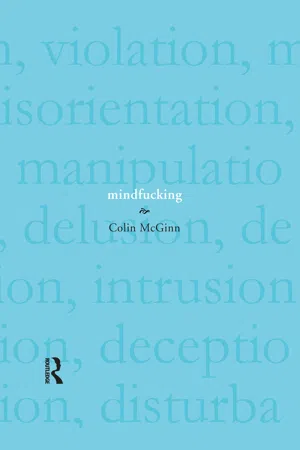
- 96 pages
- English
- ePUB (mobile friendly)
- Available on iOS & Android
eBook - ePub
About this book
Information
Preliminary delineation of the concept
Not everyone is perhaps familiar with the vernacular term “mindfuck”, although the constituent words themselves are suggestive of at least some of its sense as a composite expression. The term brings together a pair of incongruous elements – one mental, the other physical – to produce a kind of internal semantic dissonance (lexical friction, we might say). It feels oxymoronic, yet intelligible. Hearing the expression, we naturally form the idea of some sort of assault on the mind, an invasive operation performed on the psychological state of the person. The sexual meaning of “fuck” suggests something unusually intimate, and potentially violating, even violent, although a connotation of the pleasurable is not ruled out. But it is a type of fucking directed towards the mental part of a person, not the bodily part (not that regular fucking has no mental target). The online encyclopedia Wikipedia has defined it succinctly thus: “Mindfuck means either a thing that messes with the minds of those exposed to it or the act of doing so”. The HarperCollins American Slang has the following entry under “mind-fuck” (they retain the hyphen): “To manipulate someone to think and act as one wishes”, and it equates the word with “brain-wash”. The Oxford English Dictionary (OED) offers a greater variety of definitions. As a noun, the word is defined as “An imaginary act of sexual intercourse” and “A disturbing or revelatory experience, esp. one which is drug-induced or is caused by deliberate psychological manipulation. Also: deception”. As a verb, we have “To manipulate or otherwise interfere with a person’s psyche; to disturb psychologically”. The OED dates the first uses of the term to the 1960s, when drugs and political manipulation were salient cultural features, citing such uses as: “Their consciousness has been permanently altered. Forever altered. They’ve been mind-fucked”, and “He rarely gets a hard-on, but the mind-fuck is really irresistible” (said of a Hollywood big-shot). These are perfectly adequate definitions, providing clear directions for how the term is to be employed, but they are only a beginning to enquiry. We need to be much more precise about the notion of “messing” with someone’s mind or manipulating a person’s psyche, and about the scope and limits of the concept. What exactly is involved in manipulating a person’s mind in this particular way? How widely does the concept apply? Is being mindfucked a good or a bad thing?
To physically fuck someone is undoubtedly to “mess” with them in some way, and bodily “manipulation” is clearly implicated. To mindfuck someone, by analogy, is to mess with that person’s mind in a comparable fashion: it is some sort of interference or intervention or invasion. It is an action with a result and an associated means. We should distinguish the act of mindfucking from the vehicle of it. The former use – “mindfuck” as a verb – is perhaps more natural than the latter – “mindfuck” as a noun denoting some type of entity – but both uses are legitimate and useful. Thus one may refer to a particular piece of discourse or a film as a mindfuck, as well as to the process of mindfucking somebody by performing suitable acts. In both cases we are speaking of something done to the mind that bears some resemblance to what is done to the body (and whole person) when that person is penetrated sexually: either the process or its vehicle. The question is what exactly this resemblance is supposed to consist in (it is certainly not a matter of literally inserting a phallic object into the brain!). Where precisely does the analogy lie?
We should note, to begin with, that the meaning of “mindfuck” is not exclusively negative. When my lecture on the mind–body problem was described in that way, the intent was not negative: I was said to be messing with people’s minds in some fashion, but the suggestion was not that this was illegitimate or morally objectionable. Also, the phrase is sometimes used to describe the positive sensation involved in having, or being presented with, some striking new idea, or having some sort of agreeably life-altering experience (hence the OED’s mention of a “revelatory” experience). Indeed, in some uses of the word, mindfucking is what happens in a certain kind of romantic encounter, when the other person somehow operates pleasurably on the mind to produce a welcome reaction (we shall consider later whether all romantic love is a species of mindfucking.) When a book or film or conversation is described as a mindfuck, this can be taken as a favourable evaluation: the psychological messing that has occurred is of the desirable kind. Perhaps there is always a tinge of danger in such a mindfuck, but the result is nonetheless regarded positively. This makes the word “mindfuck” different from “bullshit” and “lie”: there is no good kind of bullshitting or lying, to be set beside the bad kinds. There may be white lies and harmless bullshit (as in the “bull sessions” so well described by Frankfurt), but this is not to say that such things are positively excellent; they are intrinsically bad things whose natural badness has been neutralized or bracketed. You cannot imagine a correct use of “bullshit” or “liar” to compliment somebody (“Hey, that was a great piece of bullshit you gave us today”, or “That was one of the most commendable lies I’ve ever fallen for”), except ironically. But you can use “mindfuck” in a fully complimentary sense, as when you enthusiastically assert, “Go to see Fight Club, it’s a terrific mindfuck”. We cannot sort lies and bullshit into two piles – the good examples and the bad ones – but mindfucks do seem to come in two distinct varieties. I may go to the cinema or to a lecture hoping for a mindfuck, but I cannot in this way (except masochistically) hope to be lied to or bullshitted to. Of course, this duality in the sense of “mindfuck” reflects its origins in describing the act of sexual intercourse, since there are also two kinds of that activity too: the good kind and the not so good kind. That is, there is the welcomed act of intercourse and there is the imposed act: the act of voluntary intercourse and the act of rape (as well as the reluctant but voluntary kind, and no doubt others). Mindfucking, like ordinary fucking, is not by definition bad or undesirable, although it certainly may be. But the concepts of lying and bullshitting are more like the concept of rape: these are all bad things by definition.
However, that said, I think that the common use of “mindfuck” is generally negative. This is the predominant sense of the word: what it usually connotes. We generally resent being mindfucked, blaming those responsible; and the techniques of mindfucking (which we need to investigate) are generally deployed to nefarious ends. It is this negative understanding of the term that I shall be primarily concerned with in what follows, although the positive use will also continue to be relevant. The definition in terms of “messing with the mind” conveys this negative connotation, since messing with someone is not something done in the best interests of that person, and a mess is not something we favour. To mess with someone is to leave them in a mess. Mindfucking is, we might say, prima facie a bad thing, although in certain circumstances this badness can be overridden or reversed or channelled towards something desirable. So the concept does not behave exactly like its model – physical fucking – since there is no presumption of negativity in the use of that concept. Put differently, “mindfuck” is close...
Table of contents
- Cover
- Half Title
- Title
- Copyright
- Contents
- Preface
- Preliminary delineation of the concept
- Deeper into mindfucking
- Some illustrations
- Extending the concept
- Conclusion
Trusted by 375,005 students
Access to over 1.5 million titles for a fair monthly price.
Study more efficiently using our study tools.
Frequently asked questions
Yes, you can cancel anytime from the Subscription tab in your account settings on the Perlego website. Your subscription will stay active until the end of your current billing period. Learn how to cancel your subscription
No, books cannot be downloaded as external files, such as PDFs, for use outside of Perlego. However, you can download books within the Perlego app for offline reading on mobile or tablet. Learn how to download books offline
Perlego offers two plans: Essential and Complete
- Essential is ideal for learners and professionals who enjoy exploring a wide range of subjects. Access the Essential Library with 800,000+ trusted titles and best-sellers across business, personal growth, and the humanities. Includes unlimited reading time and Standard Read Aloud voice.
- Complete: Perfect for advanced learners and researchers needing full, unrestricted access. Unlock 1.5M+ books across hundreds of subjects, including academic and specialized titles. The Complete Plan also includes advanced features like Premium Read Aloud and Research Assistant.
We are an online textbook subscription service, where you can get access to an entire online library for less than the price of a single book per month. With over 1.5 million books across 990+ topics, we’ve got you covered! Learn about our mission
Look out for the read-aloud symbol on your next book to see if you can listen to it. The read-aloud tool reads text aloud for you, highlighting the text as it is being read. You can pause it, speed it up and slow it down. Learn more about Read Aloud
Yes! You can use the Perlego app on both iOS and Android devices to read anytime, anywhere — even offline. Perfect for commutes or when you’re on the go.
Please note we cannot support devices running on iOS 13 and Android 7 or earlier. Learn more about using the app
Please note we cannot support devices running on iOS 13 and Android 7 or earlier. Learn more about using the app
Yes, you can access Mindfucking by Colin McGinn in PDF and/or ePUB format, as well as other popular books in Philosophy & Philosophy History & Theory. We have over 1.5 million books available in our catalogue for you to explore.