eBook - ePub
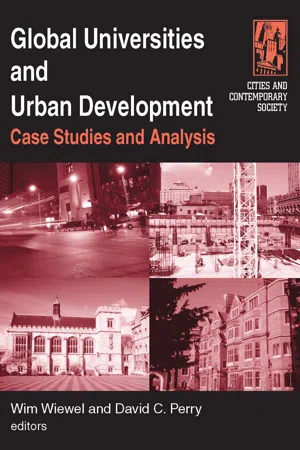
Global Universities and Urban Development: Case Studies and Analysis
Case Studies and Analysis
- 360 pages
- English
- ePUB (mobile friendly)
- Available on iOS & Android
eBook - ePub
Global Universities and Urban Development: Case Studies and Analysis
Case Studies and Analysis
About this book
The editors of "The University as Urban Developer" now extend that work's groundbreaking analysis of the university's important role in the growth and development of the American city to the global view. Linking the fields of urban development, higher education, and urban design, "Global Universities and Urban Development" covers universities and communities around the world, including Germany, Korea, Scotland, Japan, Mexico, South Africa, Finland - 13 countries in all.The book features contributions from noted urban scholars, campus planners and architects, and university administrators from all the countries represented. They provide a wide-angled perspective of the issues and practices that comprise university real estate development around the globe. A concluding chapter by the editors offers practical evaluations of the many cases and identifies best practices in the field.
Information
Part I
Introduction
1
The University, the City, and Land
Context and Introduction
David C. Perry and Wim Wiewel
The Centrality of the University and the City in the Twenty-first Century
This book is about the university and the city and the ways the relations between the two “come to ground” in land development practices. In his introduction to an influential collection of essays actually titled The University and the City, historian Thomas Bender points out how attractive the overall topic is. It is, he observes, “as capacious as it is important” with a “compelling” rhetorical ring to it because there is no doubting the important historic linkage of the two—from their “mutual medieval origins” forward (Bender 1988, 3; Pirenne 1925). In an international collection of essays, Herman van der Wusten (1998) focuses on the contemporary importance of universities to cities, and vice versa, underscoring the cultural significance of urban universities as physical features of the urban morphology and as institutional partners or, in some cases, agencies of the modern state.
While scholars such as van der Wusten and Bender find historic and contemporary mutuality between universities and cities worldwide, there is certainly not perfect institutional symbiosis (Shapiro 2005). In fact, the relationship of university to city is often quite complex and conflictive—especially in the United States, where the “pastoral” features of the university campus in cities (Bender 1988; Turner 1984) are seen as evidence of the decidedly “anti-urban bias” (Jackson 1987; Bender 1988) found in U.S. culture. The relationship of universities to cities in the United States has been defined as much by what separates them as what binds them and is expressed in concepts such as the ivory tower, the political contentiousness of town-gown relations, professional legitimations based on disciplinary autonomy and academic governance, and land-use and physical design rules of campus planning and real estate development (Dober 1991; Perry and Wiewel 2005).
Moving from the United States, it is somewhat ironic to note that while universities and cities have reached new levels of political and analytic importance in the present era of what is called “globalization,”1 the relationships between universities and cities have not been the subject of much serious study. The roles of cities in the globalizing environment are studied essentially independent of the institutional place of their universities. For example, an ambitious range of studies points to the increasing importance of cities in globalization (Scott 2005; Brenner 1999), stressing their place in the networks of production and distribution of the new world economy and their increasing prominence relative to the nation-state (Swyngedouw 1997). Conversely, in the literature more directly focused on higher education, it is argued that this changing global and local climate requires more of the tertiary sector throughout the world, as evidenced in studies of new management practices in universities (Gaffikin and Perry 2006; Gaffikin, McEldowney, and Perry 2006), as well as in new assessments of their economic import.2 The cities of which these universities are a part, have, in many cases, achieved new and reconfigured global prominence (Sassen 1991, 2002), but the role of their universities in such urban ascendancy is rarely the focus of study.
Put another way, both of these literatures, on cities and on universities, speak clearly of the importance of their topic to the modern global order, but the mutuality of relationship between cities and universities referred to by Bender and van Wusten, among others, is not well articulated.3 In the main, where the linkages between the urban and the global and the informational are made very well (Castells 1997, 2004; Sassen 1991, 2002; Scott 2001, 2005; Roy 2006), the role of the university in the city in such a dynamic and forceful context is not made well at all.4 In the scant literature that does turn its attention to the relationship of the university to the economy of the city, the discussion is as much prescriptive (Grogan and Proscio 2000; CEOs for Cities 2002; Clusters on Innovation Group 2004) as it is descriptively analytical (Perry and Wiewel 2005). More to the point of this book, these few studies of universities and the urban environment do not focus on the significance of land development as a critical nexus between the economic promise and political conflicts that shape relationships between universities, their neighborhoods, and the other institutions of cities (Perry and Wiewel 2005). In this book we set out to address such topics, intending to contribute, on the one hand, to the burgeoning institutional study of higher education (Breton and Lambert 2004; Bender 1988; Harkavy and Puckett 1994; Rhodes 2001) and, on the other, to the role of universities in city real estate development, urban land-use planning, and politics.5
In this chapter, we set the stage for the remainder of the book. To do so, we will first, briefly, discuss the prominence of universities and cities in these times. Second, since this is an international collection of cases, our intention will be to place the case studies in the broader global context of change enveloping cities and higher education in both developed and developing economies. At the most general level, our argument will be that, for cities, at this global moment, universities matter. Third, we want to show how cities, in turn, are formative environments for universities, suggesting how university land development is better understood in a broader, urban, land development context. Our final goal for this chapter is to show how each of the following chapters contributes to this approach to the study of university real estate and land development. We believe that each of these studies of the university and the city offers its own particular window through which to view and better understand some of the institutional factors of city building in the present era of globalization.
To help accomplish all this, we have organized the book into several parts. Following this introductory one, Part II concerns university land development policies and the changing features of the state; Part III, university land development practices and the market; Part IV, university land development practices and the politics of globalizing cities. Part V comprises a single chapter, organized around key questions of development, the answers to which serve as a summary of the entire topic.
We are clearly interested in the role of urban universities as real estate developers; we are also interested in their role as agencies of the “state” and the “market” in urban restructuring. For example, while higher education in the United States is split between private and public institutions, higher education elsewhere has historically been overwhelmingly public in its funding and institutional development. Given this, it would initially appear that the substantially public universities outside the United States would perform in ways quite different from the privatizing (Shapiro 2005) and commodified practices (Slaughter and Rhoades 2004; Rhodes 2001) of the mixture of public and private universities in the United States. However, as several chapters in this book will suggest, that is not always the case. Universities are changing in most parts of the world in response to, among other things, the changing role and diminishing fiscal support of the state, the increasing “public-to-private” or “entrepreneurial” roles of the public university (European Commission 2006), the growing number and roles of private institutions of learning in the tertiary education sector, and the shifting politics of access to higher education brought on by major urban patterns of student “massification,” especially in cities in developing economies (Altbach and Umakoshi 2004; Scott 2005). The remainder of this chapter refers to such changes and more as we set the global and institutional context for our discussion of “the university, the city, and land.”
Universities: How They Matter in the World and in Cities
In 1963, in his influential Uses of the University, Clark Kerr (1972, 86ff.) argued that the period following the Second World War constituted a “second great transformation” in American higher education. He placed the first transformation in the last quarter of the nineteenth century, when the land grant movement in the United States and German intellectualism’s emphasis on the university as a research institution combined to bring about “extraordinary change.”
The stuff of Kerr’s second great transformation was part governmental, part market driven, and part political. Governmentally, the American university, both public and private, was the beneficiary of what Kerr called the building of the “federal grant university”; the national government was stimulating, through grants and contracts, a “new federalism” with education at its core. In this second transformation of the university, the success of the liberal democratic state and its institutions of higher education were bound “inextricably” together.
Economically, the decades following the Second World War were a time when the universities were called upon, as never before, to “merge their activities” with industry, pushing the “extension” traditions of the land grant mission to new levels of university-industrial partnerships in professional training and in research. And politically, the university was “called upon to educate previously unimagined numbers of students,” creating new goals of democratic access and constituency for higher education.
If all these societal requirements—of state, market, and liberal democracy—were met, Kerr predicted the rise of “a truly American university, an institution unique in world history, an institution not looking to other models but serving, itself, as a model for universities in other parts of the globe.” For Kerr this was not a boastful statement but rather the outcome of adherence to institutional “imperatives” for the development of the modern (American) university. The university that emerged in such an institutional setting would, perforce, have formative impact on university systems around the world.
There is no disagreement: The “great transformation” that Kerr predicted has come about. In general, higher education in the United States sets the standard—both in technology, with its scientific and engineering base, and in its overall array of tertiary educational options of public and private liberal arts and professional and training institutions. A recent European study, The Future of European Universities: Renaissance or Decay? (Lambert and Butler 2006), points to the centrality of top U.S. research and teaching institutions in American technological and economic achievements and the correlation “between a country’s higher education attainment levels and its economic prosperity.”6
The study’s authors worry about the current position of European universities relative to the technological and scientific superiority of U.S. institutions and suggest that without great effort the universities of Europe will fall further “behind in terms of innovation and technical excellence” (p. 1). For the commission and its researchers this is all the more difficult to imagine considering that universities in Europe, already in an “uncompetitive” intellectual and scientific position, employ more than one-third of the continent’s researchers and produce over 80 percent of its basic research (European Commission 2003). Ironically, this dominance of universities in European research and development circles is perceived as a weakness, with the regional economy being overly dependent on universities for new knowledge. This weakness is especially clear when a comparison is made with the United States, which exhibits a much more balanced pattern of R&D, in which about half of all basic research is university based, the rest coming from commercial and other non-university settings.
If the leaders of European universities are worried by their comparative technological and scientific inferiority (European Commission 2006; Gaffikin, McEldowney, and Perry 2006), leaders in the United States are showing concern over the future place of the U.S. tertiary educational sector in this new global era, as well (Domestic Policy Council 2006). Shirley Ann Jackson, the 2004 president of the American Association for the Advancement of Science and the president of Rensselaer Polytechnic Institute, suggests that while U.S. universities still fuel “the leading engine of innovation in the world … with the best graduate programs, the best scientific infrastructure and the capital markets to exploit it... there is a quiet crisis in U.S. science and technology that we have to wake up to” (Friedman 2005, 253). Jackson’s statement sets the stage for a discussion of the growing fragility of the American research university’s position of prominence in a changing global network of universities and research capacities.
What both scholars and political observers are pointing to is a change in the global context of higher education. Their sense of the changing competitiveness of higher education signals the potential for another “transformation” in higher education: from the primacy of the American university model to a more worldwide accession of universities in increasingly important global cities. In this new era of “globalization,” education has taken on even more importance in all regions of the world. The aforementioned studies of higher education in Europe find it to be the “prime” feature of Europe’s economic future. While the United States remains the magnet for capital and students in such a competitive environment, other parts of the world are now equally involved in building universities and attracting students. In a comparative study of Asia, Altbach and Umakoshi (2004) find “enormous resources” being deployed to expand and upgrade university systems. The two million graduates coming from Chinese universities every year have surpassed the U.S. number and are fast closing on the three million graduating from all countries in Europe (Altbach and Umakoshi 2004; Lambert and Butler 2006). Breton and Lambert (2004, 27) describe such conditions as part of the “new global space” of higher education—one where the challenges and opportunities represented in higher education are “n...
Table of contents
- Cover
- Half Title
- Title Page
- Copyright Page
- Table of Contents
- List of Tables and Figures
- Foreword
- Preface
- Part I Introduction
- Part II The University, the Devolving State, and Development
- Part III The University as a Zone of Development
- Part IV The University and the Contested City
- Part V Lessons Learned
- About the Editors and Contributors
- About the Lincoln Institute of Land Policy
- Index
Trusted by 375,005 students
Access to over 1.5 million titles for a fair monthly price.
Study more efficiently using our study tools.
Frequently asked questions
Yes, you can cancel anytime from the Subscription tab in your account settings on the Perlego website. Your subscription will stay active until the end of your current billing period. Learn how to cancel your subscription
No, books cannot be downloaded as external files, such as PDFs, for use outside of Perlego. However, you can download books within the Perlego app for offline reading on mobile or tablet. Learn how to download books offline
Perlego offers two plans: Essential and Complete
- Essential is ideal for learners and professionals who enjoy exploring a wide range of subjects. Access the Essential Library with 800,000+ trusted titles and best-sellers across business, personal growth, and the humanities. Includes unlimited reading time and Standard Read Aloud voice.
- Complete: Perfect for advanced learners and researchers needing full, unrestricted access. Unlock 1.5M+ books across hundreds of subjects, including academic and specialized titles. The Complete Plan also includes advanced features like Premium Read Aloud and Research Assistant.
We are an online textbook subscription service, where you can get access to an entire online library for less than the price of a single book per month. With over 1.5 million books across 990+ topics, we’ve got you covered! Learn about our mission
Look out for the read-aloud symbol on your next book to see if you can listen to it. The read-aloud tool reads text aloud for you, highlighting the text as it is being read. You can pause it, speed it up and slow it down. Learn more about Read Aloud
Yes! You can use the Perlego app on both iOS and Android devices to read anytime, anywhere — even offline. Perfect for commutes or when you’re on the go.
Please note we cannot support devices running on iOS 13 and Android 7 or earlier. Learn more about using the app
Please note we cannot support devices running on iOS 13 and Android 7 or earlier. Learn more about using the app
Yes, you can access Global Universities and Urban Development: Case Studies and Analysis by Wim Wiewel,David C. Perry in PDF and/or ePUB format, as well as other popular books in Architecture & Urban Planning & Landscaping. We have over 1.5 million books available in our catalogue for you to explore.