![]()
1 Introduction
The original Language for Learning book was first published in 2004, winning the NASEN and TES Book Award for Teaching and Learning in 2005. The book proved to be highly popular with practitioners as it offered an easy-to-use format, was quickly accessible and full of practical ideas to support 5 to 11-year-old children experiencing speech, language and communication needs (SLCN). We have worked in partnership for 15 years within the wider Language for Learning® project, developing practical training and resources to support practitioners working in mainstream settings. This self-funding, not-for-profit project is jointly owned by Worcestershire County Council and Worcestershire Health and Care NHS Trust supporting a joint, collaborative approach towards meeting SLCN.
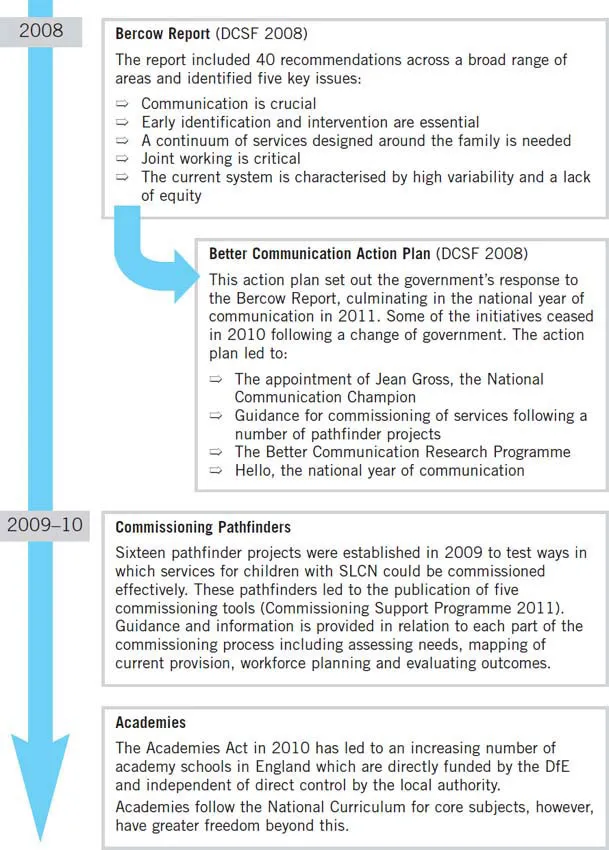
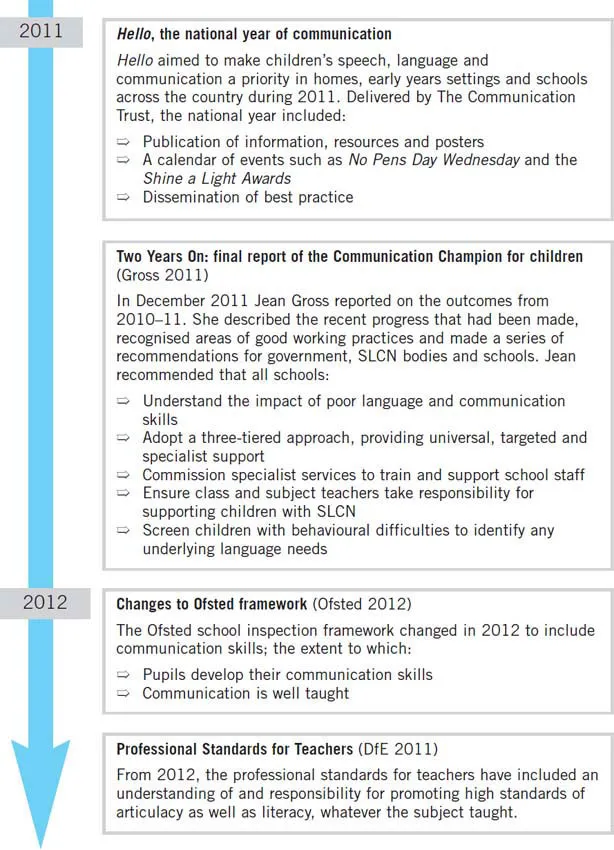
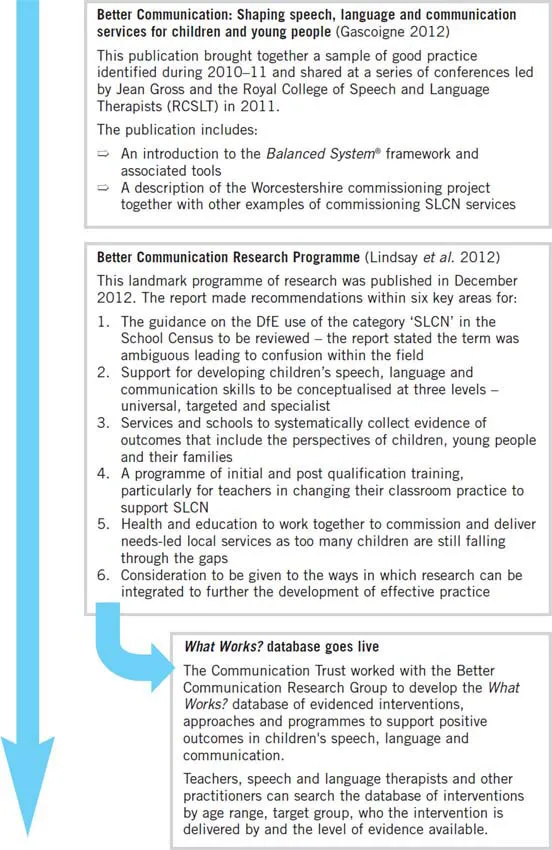
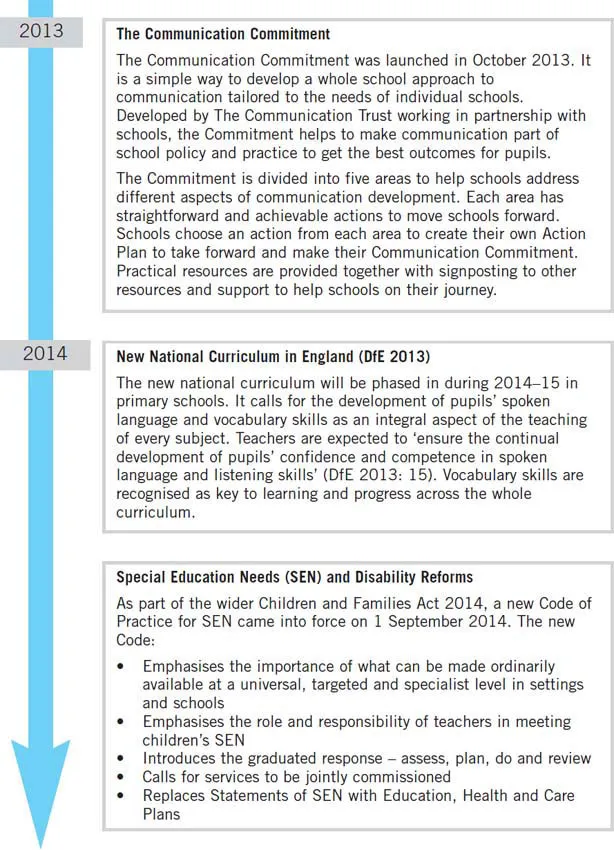
Ten years on and much has happened in the field, beginning with the Bercow Report (DCSF 2008) and most recently the publication of the new Special Educational Needs (SEN) Code of Practice (DfE and DoH 2014). During this time much has been written about speech, language and communication needs, commissioning services and evidence-based practice. In the UK we have seen the development of The Communication Trust, a successful national year of communication in 2011, development of the What Works? online database of evidenced interventions, a new national curriculum and publication of the Better Communication Research Programme (Lindsay, Dockrell, Law and Roulstone 2012), a landmark extensive programme of interrelated research projects in speech, language and communication needs.
Timeline
Below is a timeline summarising the key events, government initiatives, developments and changes to national policy and practice in relation to SLCN since 2008 in the UK.
Some of the language we use to talk about speech, language and communication difficulties has changed and the framework we use to plan support for children is different, however, what needs to happen on the ground, in classrooms remains the same. Practitioners need to be confident and competent in identifying children experiencing SLCN as early as possible and providing support at the most appropriate level within the context of the educational curriculum, working in partnership with parents to create a wide range of meaningful language learning opportunities.
The Balanced System® (Gascoigne 2012) has shaped our thinking over recent years. It provides a map for services and support for children with SLCN. The system is outcomes focused, describing the elements needed to effectively meet children’s needs. It specifies the roles and responsibilities of the wider and specialist workforce; the range of support required at a universal, targeted and specialist level; workforce training and development; and leadership and management of the whole system. Gascoigne (2012) identifies five key strands we need to consider at a universal, targeted and specialist level – supporting parents and carers, supporting the environment to facilitate communication, supporting workforce development, identification of SLCN and intervention for SLCN. These strands need to be included when planning provision in schools.
This second edition has the same aims as the first, however, the format of the book has been redeveloped, utilising the same framework as Language for Learning in the Secondary School (Hayden and Jordan 2012). It provides guidance for some of the strands identified by Gascoigne (2012) including the identification of SLCN, supporting the environment, working with parents and carers and delivery of interventions for SLCN at a universal and targeted level in mainstream settings. Specific guidance on adopting a whole school approach and a broader approach to planning within the curriculum, considering each subject area has been included.
The book aims to help readers to:
• Understand speech, language and communication skills
• Identify children with speech, language and communication needs (SLCN)
• Consider roles and responsibilities at primary school
• Consider the language demands across subjects
• Plan a differentiated and adapted curriculum
• Adopt a whole school approach
• Make use of a wide range of positive strategies
• Empower children to access the curriculum
Key to Symbols
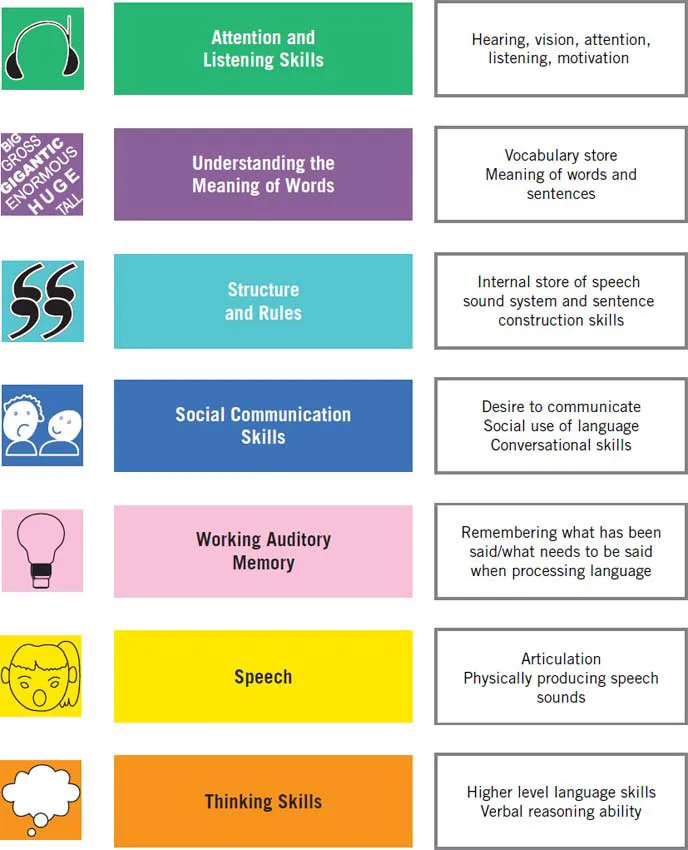
Areas of Speech, Language and Communication
Within Chapter 2, areas of speech, language and communication are identified and described. For ease of reference, these areas are both colour and symbol coded throughout the book:
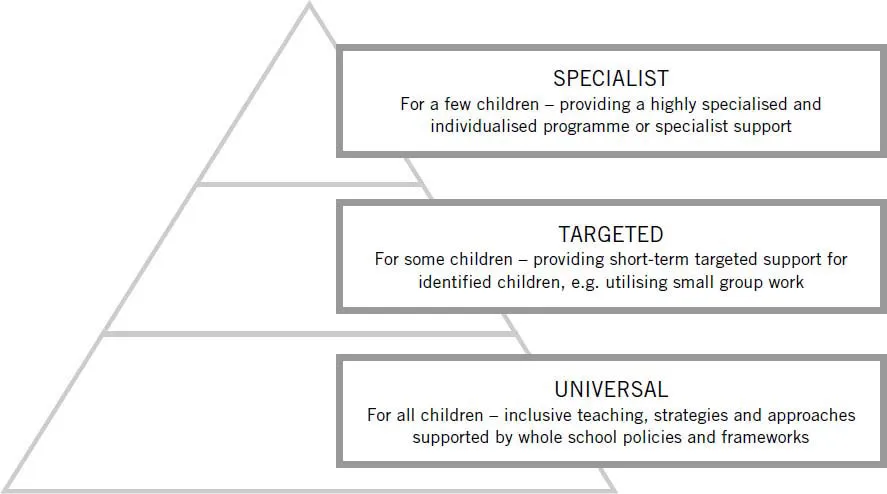
Levels of Support
Supporting the development of children’s speech, language and communication needs at three levels, universal, targeted and specialist, was first introduced to us by Gascoigne (2006) and recommended by the Bercow Report (DCSF 2008) and subsequent Better Communication Research Programme (Lindsay et al. 2012). Most recently it can be found in the new SEN Code of Practice (DfE and DoH 2014). Schools need to ensure they are providing support at the most appropriate level, starting with quality first teaching and an effective universal, whole school/whole class approach to identification and intervention. Some children will need some short-term targeted support to further identify needs and develop their speech, language and/or communication skills and a few children will need specialist level assessment and support. The vast majority of children’s needs can be met at a universal and targeted level. This book provides an extensive range of strategies and approaches, all of which are identified by level of support:
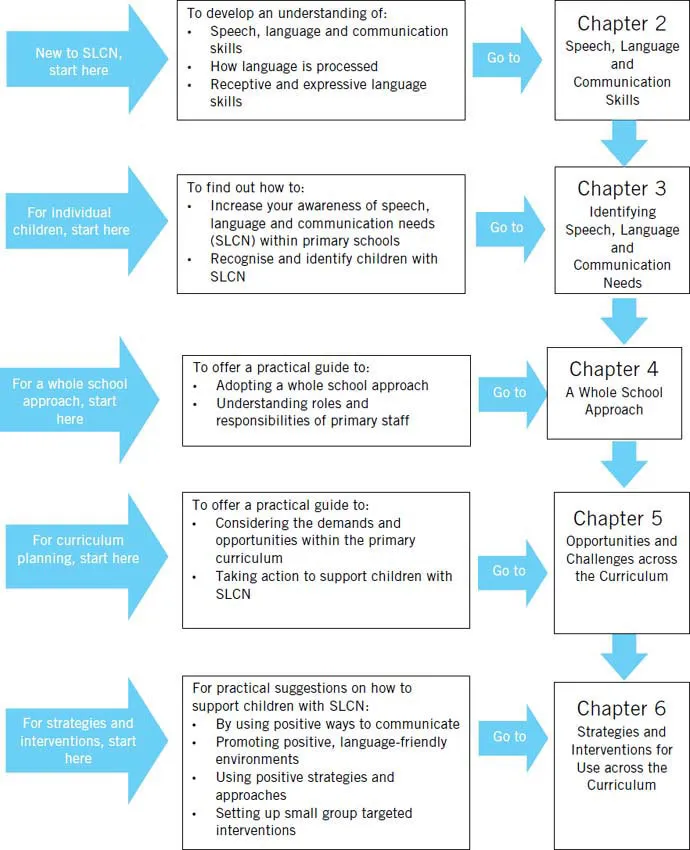
Making Practical Use of this book
The structure of the book can be seen below to allow readers ease of access whether considering how to meet the individual needs of a child or planning a whole school approach:
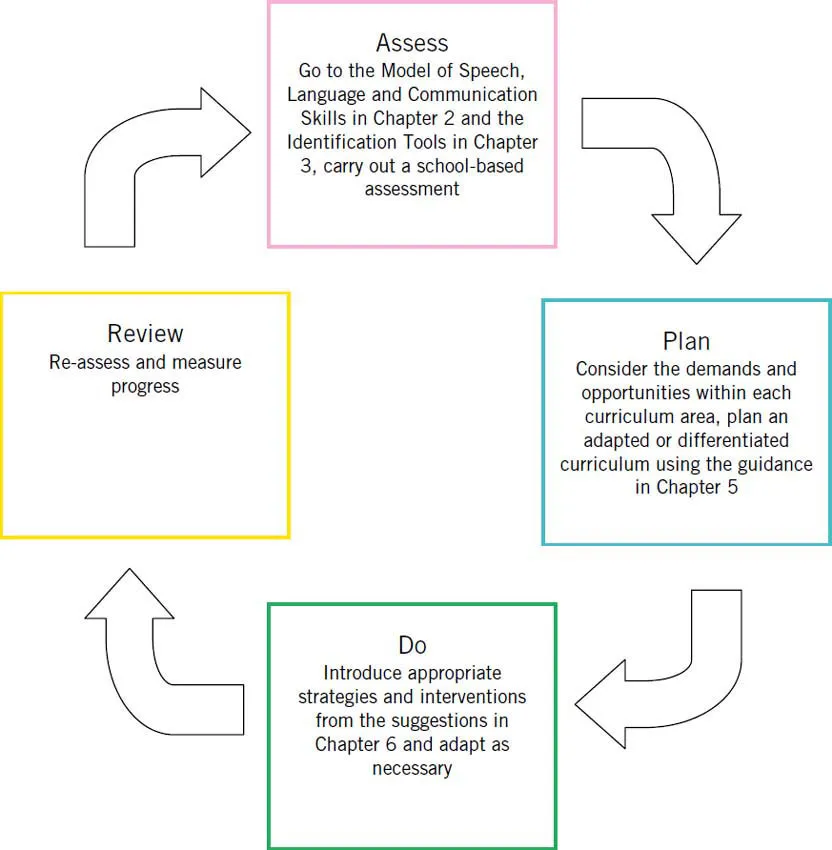
The ‘graduated response’ (DfE and DoH 2014) framework for meeting individual children’s needs can be found below:
![]()
2 | | Speech, Language and Communication Skills |
This chapter describes speech, language and communication skills. It aims to provide practitioners with a shared language to talk about language. It describes the theoretical Language for Learning® model of speech, language and communication skills; identifies and defines areas of speech, language and communication; describes how language is processed and the difference between receptive and expressive language skills.
The Language for Learning® Model of Speech, Language and Communication Skills
The process of understanding and using language is a complicated one, involving a number of different skills. The Language for Learning® model provides a structured approach, a framework for thinking and talking about speech, language and communication...