- 240 pages
- English
- ePUB (mobile friendly)
- Available on iOS & Android
eBook - ePub
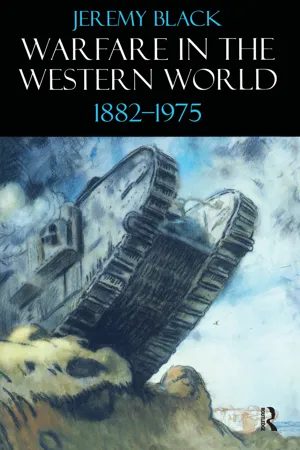
Warfare in the Western World, 1882-1975
About this book
In this companion volume to "Western Warfare, 1775-1882," Jeremy Black takes his analysis of modern warfare into the twentieth century. As before, a distinctive feature of the author's approach is the coverage of both land and naval warfare as well as conflict within the West and between Western and non-Western powers. Beginning with the British conquest of Egypt in 1882, this book goes on to examine the Spanish-American War of 1898, the Boer War and the Balkan conflicts leading to world war in 1914. A revisionist account of the First World War is followed by a discussion of Western expansionism in the period to 1936. Chapters on the interwar years and the Second World War lead on to a discussion of the retreat from empire and the advent of Cold War. The narrative closes with the end of the Vietnam War in 1975 and a discussion of the limitations of Western military technique, doctrine and technology. Throughout, the themes of military change and modernization are brought into sharp focus and the revolutionary characteristics of the machination of war in this period are questioned. Jeremy Black offers a new and challenging interpretation of modern warfare that will be required reading not only for students of military history but for all those interested in the impact of war in the making of the modern world.
Chapter One
From Egypt to Ethiopia: Western Expansionism, 1882–1936
The fact cannot be too plainly stated that throughout Egypt and the Soudan, and throughout the great Protectorates of Uganda and British East Africa, our whole position depends entirely on prestige. We are governing with a mere handful of white officials vast populations alien to us in race, language and religion, and for the most part but little superior in civilization to savages. Except for the small, and from a military point of view inadequate, British force in Egypt, the authority of these officials is supported only by troops recruited from the subject races, whose obedience to their officers rests on no other basis than a belief in the invincibility of the British government and confidence in its promises. If that belief and confidence be once shaken, the foundations of all British authority between Cairo and Mombasa will be undermined, and at any moment a storm of mutiny and insurrection will sweep us into the sea.
(British Director of Military Operations, Military Situation in Somaliland, March 1904)1
Introduction
The prime global context of this book is that of the rise of the West to a situation in which Western economic and financial power and Western norms and values had an impact throughout the world. That is not the same as Western territorial power, which indeed receded in this period. The latter, however, is the main focus of the global dimension of the military history of the period, as force was involved in making and retaining conquests and, frequently, in the loss of territorial possessions. For ease, this global section has been divided into two chapters. This chapter deals with the high point of Western imperialism, from the British defeat of Egypt in 1882 to the Italian conquest of Ethiopia in 1936. The second (Chapter 8) focuses on subsequent decline.
The principal value of such a coverage in this book is twofold. First, although security within Europe was the foremost concern of the grand strategy of European powers, and the pull of European concerns on imperial policy grew stronger in the 1900s, nevertheless, individually and collectively, conflicts outside the West were of enormous importance to the history of the world. Control over large tracts of the globe, and over a significant portion of its population, changed hands. Furthermore, areas that did not experience such a change in control, most obviously Japan, were, nevertheless, affected by processes of modernization that hinged on the need to respond to the challenge of Western imperialism. Secondly, the range and variety of these conflicts underlines the hazard of thinking of Western warfare largely in terms of a paradigm, or key pattern or example – most prominently, for the first three decades of the period, the German army. Instead, it is possible to stress a multiplicity of challenges facing Western armies, and the need to be flexible in response.
Two other general points should be made at the outset. First, the choice of dates for this chapter represents a deliberate attempt to look for continuity through World War One. The operations of Western militaries in the 1920s and 1930s, such as in Morocco and Ethiopia and on the North-West Frontier of India, need to be assessed in the perspective of campaigns prior to 1914. Secondly, military achievements have to be set in a wider context. This is not easy in a book devoted to military history, for there is neither the space nor the intention to write a history of everything else. Nevertheless, Western expansion was about more than the military progress of the West against much of the rest of the world. Military success was an enabler of Western expansion but by no means the sole one. Demographic, economic, cultural-ideological and political factors were also all very important. The first was particularly so where the indigenous population was sparse. Western demographic growth in this period was rapid and this led to significant levels of emigration. Successful imperial expansion provided both opportunity and encouragement for migration. Thus, Russians went to Kazakhstan, the French to Algeria, and the British to Australasia and Canada, while, although imperial links were not involved, many different kinds of Europeans went to the USA. Migration to all of these areas had begun prior to 1882, but continued thereafter, helping to consolidate Western control. Migration within large states that had internal “frontiers” of control, where the effective power of the state ceased, such as Argentina, Brazil, Chile and the USA, was also very important.
The supposed economic value of colonies expanded as states looked for sources of raw materials and for markets, and as steamships and railways aided continental and global economic integration; as they also did migration. Furthermore, economic growth within the West greatly increased the available investment capital for the world outside.2 However, some areas did not yield the anticipated economic return until after the colonial period.
Cultural-ideological factors focused on the romantic attraction of empire. Imperialism became normative in Western political culture. This drew on a sense of mission, as well as on triumphalism, racialism and cultural arrogance, all supporting a belief that the West was unbeatable and was bringing civilization to a benighted world. The net result was a commitment that encouraged persistence in the face of adversity. Imperialism, a compound of force and a self-righteous commitment to betterment on European terms, led to a determination to win over local support, but also to destroy native culture if necessary, which was described by Sir Ralph Moore, British High Commissioner, speaking at the recently devastated town of Iboum in southeastern Nigeria in January 1902:
There was a big palaver of chiefs and himself [Moore] . .. He told them that we had come to help them in order that they might learn how to help themselves – we came for the good of the black man but that they would be subjects of the Great White King – not his slaves. While war lasts they must obey the order of any white man in the country. When war is over equal justice to all. The one thing to end the war was absolute submission, the handing over of all juh-juh priests and guns. He also compared a threepenny bit which he held up in his hand to the size of a native “rod” of same value. He held out two pounds ten shillings – the value of 200 rods – and showed the ease with which large amounts could be carried whereas £2 10s worth of brass currency is an impossible medium of exchange.3
Despite some defeats and failures, Western expansionism maintained a pace unprecedented in the seventeenth and eighteenth centuries. Furthermore, this was true in a variety of military environments. As victory and conquest became easier, so expansionism and a sense of superiority were encouraged. However, because it was not necessary to transform Western armies (or navies) to achieve these goals, this expansionism did not have an impact on Western military thought or practice comparable to that of conflict within the West.
1880–1900
The last two decades of the nineteenth century saw the rapid allocation among the European and American powers of a sizeable amount of the world’s surface; European expansion was especially rapid in Africa. In part, this was achieved at the expense of developed states with armed forces using firearms, such as Madagascar, which the French conquered in 1895 and annexed in 1896.4 At another scale of conflict, a war between France and China in 1883-85, that arose as a result of French expansion into Indo-China, was a victory for the French and was followed by the annexation of Tonkin.
Peoples who lacked such armed forces also suffered; for example in New Guinea, which was divided between Britain, Germany and the Netherlands. The same process can be seen in the New World. Native American resistance was crushed, the Sioux being defeated in 1890 at Wounded Knee, the last major clash in more than 350 years of conflict. This was less a battle than a policing operation gone amiss: the clash arose from a scuffle during an attempt to disarm the Miniconjou Sioux. Outnumbered, they lost most of their men, in part to shells from the four Hotchkiss guns deployed by the American Seventh Cavalry.5 Historic centres of resistance to Western power also fell: Oman became a British protectorate in 1891, while the Dutch overcame guerrilla resistance in the hinterland of Aceh in Sumatra, forcing their leading opponents to surrender in 1903.6
Western expansion, however, was not achieved without considerable difficulty, including some significant reverses. These included French defeats in Indo-China, such as at Lang Son (1885), a Chinese victory that destroyed the political career of Jules Ferry, Italian defeats by the Ethiopians at Dogali (1887) and, even more seriously, Adowa (1896), and the French loss to a surprise night attack of a force near Timbuktu in 1894. Some of these defeats were small in scale, although they could still be important given the modest size of colonial armies. The French lost only 82 men near Timbuktu in 1894, which was the largest French loss on a single day in the conquest of the western Sudan,7 but the Italians lost 430 at Dogali, north of Asmara, when the Ethiopian use of enveloping tactics destroyed an Italian column. At Adowa, the outnumbered and badly led Italians lost 10,000 men.8
Menelik II, the victor at Adowa, serves as a reminder that it was not only Western states that were expanding, although it was they who did so most successfully. The Ethiopians had developed a successful army, 150,000 strong by 1896, with nearly half armed with modern weapons. French and Russian advisers improved the Ethiopian artillery in the 1890s, and this helped at Adowa. Hotchkiss machine guns were used there, but victory over the far smaller Italian army owed more to poor Italian tactics, not least the failure to coordinate operations. After the Italian threat had been disposed of, Menelik made a major push to the south. Although Adowa earned Ethiopia a reputation as a leader of the liberation struggle in Africa, the neighbouring Somalis saw it differently. Ethiopia joined Italy, Britain and France in dividing up Somaliland, gaining the Ogaden region, which was later to poison relations after decolonization.
No other African state was as successful as Ethiopia, although a number of powerful, but short-lived, polities developed. In the 1870s and 1880s, Toure Samory, leader of the Mandinke people, the “Napoleon of the Sudan” according to the French, who thus acquired greater glory by fighting him, established a state on the upper Niger. He relied on the sofa, professional troops, trained along Western lines and equipped with modern firearms, who were supported by a larger militia. The firearms were bought in part from British traders, but also manufactured in Samory’s own workshops: he had placed agents in the French arsenal in Senegal to learn how to make rifles and cannon. Samory’s forces fought a mobile and, frequently, guerrilla war that delayed the French conquest of the western Sudan.
Another dynamic African polity, the Hova Kingdom of Merina in central Madagascar, conquered most of the island by 1880. The potential of African forces with a different force structure to that of Westerners was shown in the Sudan, much of which was taken over from 1881 by Muhammad Ahmad-Mahdi. He destroyed a demoralized Egyptian army under the command of William Hicks, formerly an officer in the British Indian army, at the battle of Shaykan on 5 November 1883. He then captured Khartoum by assault on 26 January 1885, pre-empting the arrival of a British relief force. The Mahdists saw spearmen as crucial, although they also had an infantry force armed with Western rifles, the jihadiyya, which played a crucial role at Shaykan.
It was not only in Africa that successful non-Western forces could be found. In the Far East, Japan heavily defeated China on land and sea in the Sino-Japanese war of 1894–95, acquiring Formosa (Taiwan), which they had unsuccessfully attacked in 1874, and the neighbouring Pescadores islands as a consequence. In the war, the Japanese were victorious on land and sea. Despite problems with logistics and transport, Japanese forces advanced through Korea into Manchuria, and captured the major bases of Port Arthur and Weihaiwei, while their fleet beat the less speedy and manoeuvrable Chinese at the Yalu River (1894). But the West could still dominate the situation if it chose; Japan was obliged in the peace settlement to limit its territorial gains from China due to pressure from Russia, Germany and France.9
On the world scale, therefore, it was not a case of Western powers expanding into a passive void of decrepit states and undeveloped societies, but rather of the Westerners as an increasingly dominant element in the dynamic non-European world. The West eventually prevailed in most places due to superior military force, improved disease control and enhanced communications. Precisely because non-Western societies were not decrepit, primitive, undeveloped or weak, the Western success in conquering large areas was a formidable military achievement. By 1900, the British had an empire covering a fifth of the world’s land surface and including 400 million people; France had one of six million square miles and 52 million people. Belgium, Germany, Italy, Portugal and Spain each also had African colonies, and the Dutch ruled an empire in the East Indies.
In this, better weaponry played a major role. Hilaire Belloc observed, “Whatever happens we have got | The Maxim Gun; and they have not” (The Modern Traveller, 1898). Indeed the Maxim (machine) gun, introduced in 1883, was important, although, across much of Africa, it would have been more appropriate for Belloc to mention the breech-loading rifle, because it was better suited for the dispersed fighting that was more characteristic of colonial warfare. The French did not use machine guns in Africa: they could jam, and early types, such as the Mitrailleuse, were heavy, which was a major problem in an area where mobility was crucial. The Germans were slow to use machine guns. Single-shot breech-loaders, such as the British Martini-Henry and the French Gras, were replaced by more effective magazine rifles, such as the Lee-Metford, the Kropatschek, and the model 1886 Lebel.
Artillery was also important. In 1885, General Roberts stressed the unsuitability of light guns:
[P]ower is of even more importance than mobility. In Afghanistan, from the absence of roads, it is seldom that artillery can move faster than infantry, and no field gun that we now possess can make any impression on the thick mud walls of which all forts and houses in that country are built.10
In Senegal and Algeria, the French used artillery to breach the gates of positions, and then stormed them. Artillery, especially 95 mm siege guns using powerful explosives, played a crucial role in the conquest of the Tukulor forts by the French in 1890–91, and the walls of Kano in Nigeria were breached within an hour by British cannon in 1903.
Artillery also played a role in the field, although in the mountainous terrain of the North-West Frontier of India, the British found it difficult to use artillery effectively. However, as was characteristic of European military activity, there was a process of challenge and response, and a practical engineered solution was devised. Mobile screw-guns were found best. These guns were light, and were carried in sections and then screwed together for firing.
In Africa, in the 1890s, the Belgians used Krupp 75mm cannon and machine guns to help overcome opposition in the Congo, while, further east, the Germans used their Krupps against the Unyamwezi people: the latter’s rifles were simply outgunned. In the Sudan, at Atbara, on 8 April 1898, advancing British troops also outgunned the Mahdists, who had no artillery, and successfully stormed their camp. The Anglo-Egyptian forces lost 81 killed and 487 wounded, and their opponents 3,000 and 4,000. At Omdurman, on 1 September 1898, British rifles, machine guns and artillery, including high-angle howitzers, devastated the attacking Mahdists. Winston Churchill, who was present, wrote of Omdurman, “It was a matter of machinery”. The Anglo-Egyptian forces lost 49 killed and 382 wounded, and their opponents about 11,000 and 16,000.
Far more than “machinery” was involved in European expansion, including in the battles and other engagements. Bayonets, rather than cannon, were crucial to the French conquest of most of West Africa, and at Tel el Kebir in Egypt, in 1882, the British attacked the Egyptian earthworks with bayonets, without any preliminary bombardment. The British commander, Wolseley, preferred to gain the advantage of surprise. Logistics were also very significant in the war theatre, for example in the Sudan campaign.11 In the wider field of grand strategy, mobility, as well as force, was important. Steamships, railways and telegraph lines combined to facilitate transfe...
Table of contents
- Cover
- Half Title
- Title
- Copyright
- Dedication
- Contents
- Preface
- Introduction
- 1 From Egypt to Ethiopia: Western Expansionism, 1882-1936
- 2 The West, 1882-1913
- 3 World War One, 1914-18
- 4 The Inter-war Years
- 5 World War Two
- 6 Naval Power and Warfare
- 7 Air Power and Warfare
- 8 The Retreat from Empire: Singapore to Mozambique, 1942-75
- 9 Military Power in the West, 1946-1975
- 10 Social and Political Contexts
- 11 Conclusions
- Notes
- Selected Further Reading
- Index
Trusted by 375,005 students
Access to over 1.5 million titles for a fair monthly price.
Study more efficiently using our study tools.
Frequently asked questions
Yes, you can cancel anytime from the Subscription tab in your account settings on the Perlego website. Your subscription will stay active until the end of your current billing period. Learn how to cancel your subscription
No, books cannot be downloaded as external files, such as PDFs, for use outside of Perlego. However, you can download books within the Perlego app for offline reading on mobile or tablet. Learn how to download books offline
Perlego offers two plans: Essential and Complete
- Essential is ideal for learners and professionals who enjoy exploring a wide range of subjects. Access the Essential Library with 800,000+ trusted titles and best-sellers across business, personal growth, and the humanities. Includes unlimited reading time and Standard Read Aloud voice.
- Complete: Perfect for advanced learners and researchers needing full, unrestricted access. Unlock 1.5M+ books across hundreds of subjects, including academic and specialized titles. The Complete Plan also includes advanced features like Premium Read Aloud and Research Assistant.
We are an online textbook subscription service, where you can get access to an entire online library for less than the price of a single book per month. With over 1.5 million books across 990+ topics, we’ve got you covered! Learn about our mission
Look out for the read-aloud symbol on your next book to see if you can listen to it. The read-aloud tool reads text aloud for you, highlighting the text as it is being read. You can pause it, speed it up and slow it down. Learn more about Read Aloud
Yes! You can use the Perlego app on both iOS and Android devices to read anytime, anywhere — even offline. Perfect for commutes or when you’re on the go.
Please note we cannot support devices running on iOS 13 and Android 7 or earlier. Learn more about using the app
Please note we cannot support devices running on iOS 13 and Android 7 or earlier. Learn more about using the app
Yes, you can access Warfare in the Western World, 1882-1975 by Jeremy Black in PDF and/or ePUB format, as well as other popular books in History & Military & Maritime History. We have over 1.5 million books available in our catalogue for you to explore.