- 224 pages
- English
- ePUB (mobile friendly)
- Available on iOS & Android
eBook - ePub
About this book
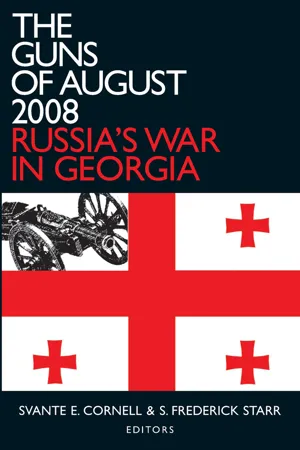
In the summer of 2008, a conflict that appeared to have begun in the breakaway Georgian territory of South Ossetia rapidly escalated to become the most significant crisis in European security in a decade. The implications of the Russian-Georgian war will be understood differently depending on one's narrative of what transpired and perspective on the broader context. This book is designed to present the facts about the events of August 2008 along with comprehensive coverage of the background to those events. It brings together a wealth of expertise on the South Caucasus and Russian foreign policy, with contributions by Russian, Georgian, European, and American experts on the region.
Information
1
Introduction
In the summer of 2008 an unprecedented event occurred. For the first time since 1979 the Russian military crossed national borders to attack a sovereign state. This attack followed a period of intensive and mainly negative developments in Russia’s relations with Georgia and, more significantly, in Russia’s relations with the West. What appeared to have begun in the breakaway Georgian territory of South Ossetia rapidly escalated to the most significant crisis in European security in a decade.
This war took the world by surprise. Yet over the preceding months those closely watching events in the Caucasus had been calling attention to the escalating conflict in the region. Steps taken by the Russian leadership following the Western recognition of Kosovo’s independence in February 2008, and the NATO Bucharest Summit in April brought the situation in the Caucasus to an entirely new level. In spite of a mass of readily available information on the Russian arms buildup, however, Western governments were caught off guard when simmering tensions in the Georgian conflict zones exploded into full-scale war.
Few international events of this magnitude have been so quickly submerged under a cloud of polemics involving both spin and disinformation. The media coverage of the war during the crucial first few days largely reflected Russia’s line. We now know part of the reason for this, namely, that the Russian government had flown some fifty Russian reporters to Tskhinvali days before the war began. In the West, the media’s opinion-dominated news cycle from the outset prevailed over more authoritative reporting. Staff cutbacks in many news media left few qualified reporters available. Even though the region is readily accessible from Europe by air, scarcely any Western news media managed to post a professional war correspondent to the scene. The few Western reporters who went to the region faced belligerents who understood the need to disseminate their view of the events, which they each did in a predictably one-sided manner.
Thanks both to Russia’s information initiative and the ineffectiveness of Western news media, initial opinions that had been hastily formed on the basis of incomplete or inaccurate information soon came to dominate the airwaves and print media. Rarely, if ever, were these opinions identified as such; in most cases they were offered as fact rather than as hypotheses. This in turn led to a climate in which it was possible, even likely, that policymakers in Western governments and civic organizations could make policy on the basis of premature judgments, erroneous information or, occasionally, very little information at all.
Months after the events, analysts have focused more on the consequences of the war than on the war itself and its antecedent events. But any analysis of the August war’s consequences is inevitably shaped by the narrative one accepts on the events themselves, and particularly on their deeper historical context. In order to understand the war, one must understand the evolution of Russian-Georgian relations, as well as Georgia’s and Russia’s respective relations with the West, over the past two decades.
Should this confrontation be understood primarily as one between Russia and Georgia, or as the tailwind of Russia’s relations with the West? The link between Russia’s policies in Georgia and its relationship with the West is inescapable. Russian-Georgian relations had long since soured. Georgia was moving rapidly toward Euro-Atlantic integration, and at a time when an increasingly assertive Russian foreign policy was being shaped by sphere of influence-thinking. No less important, the escalation in the Caucasus came in the immediate aftermath of Western policy decisions on Kosovo and NATO enlargement. Indeed, Russian officials during the spring of 2008 explicitly cited these decisions to justify their actions in the months before the outbreak of war.
A number of Western officials and analysts followed this process with great concern. Among them was the Joint Center led by the two editors of this volume. Over the year preceding the outbreak of war, the Central Asia-Caucasus Institute & Silk Road Studies Program issued several publications on the acrimonious Russian-Georgian relationship. In the fall of 2007 the Center published a short monograph on Russia’s missile attack at the Georgian village of Tsitelubani, which occurred on August 6—a year to the day before the start of the August war. The Joint Center then proceeded to issue four more policy papers on Georgian affairs, including one of the first analytical studies on the August war, which appeared less than three weeks after the start of fighting. Given this, it was a natural step to seek to bring together more detailed information on the events leading up to the war, on the war itself, and its likely implications for the future.
This volume draws on the expertise of ten Russian, Georgian, European, and American analysts and scholars. With backgrounds in academia, journalism, military affairs, administration, and diplomacy, they bring to the task a broad and diverse knowledge of the South Caucasus, Russian foreign policy, and international relations more generally. The book traces the origins of the conflagration beginning with the process of the dissolution of the Soviet Union in the late 1980s. It then follows the relationship between Georgia, its breakaway republics of Abkhazia and South Ossetia, and Russia over the sixteen years between the establishment of Georgian independence and the war.
Some readers may ask whether it is really necessary to dwell at length on events that took place long before August 2008. Yet the contributors to this volume had all come to the independent conclusion that the events of August 2008 were the culmination of a long preparatory period that began with the dissolution of the Soviet Union, if not earlier.
The war has already been given many names: the “War Over South Ossetia,” or the “Five-Day War,” etc. Most of these are misleading to the extent that they suggest that the war was only about South Ossetia or was limited in time. Russia’s words and deeds made it clear from the outset that even though the war may have started in South Ossetia, it embraced all of Georgia, if not the South Caucasus. Contributors to this volume provide much evidence that the fighting in South Ossetia was only one theater of the broader Russian-Georgian conflict.
Even if one accepts that the war began on August 7, 2008 (though there are strong arguments to suggest it began days or even months earlier), it did not end with the cease-fire agreement signed on August 12. Russian military operations on Georgian territory continued long after that date. Even now, nearly a year later, Russia remains in violation of commitments it made in the cease-fire agreement.
This book is organized chronologically. It begins with an account of developments in Georgia during the transition to independence—a period marked by the rebirth of Georgian nationalism and a strong movement to secede from the Soviet Union. These years saw the rise and fall of Georgia’s first nationalist president, Zviad Gamsakhurdia, the return to power of Georgia’s Soviet-era leader, Eduard Shevardnadze, and the emergence of the conflicts in South Ossetia and Abkhazia. Thomas Goltz, who covered these events for leading American publications, provides a vivid picture of the chaotic time that led to Georgia’s rebirth as a state; he also gives evidence of how Russia’s interventions contributed to the overall weakening of this new Georgia as a state.
We turn then to the post-independence period dominated by the leadership of Boris Yeltsin in Russia and of Eduard Shevardnadze in Georgia. While more calm than either the preceding or subsequent periods, this era, as Thornike Gordadze shows, was more turbulent than it is generally thought to have been. On the one hand, Georgia sought to strengthen its independence. On the other, Russia worked to slow this process by intervening in its internal affairs, particularly in the conflict zones. Gordadze concludes that the rough treatment of Georgia by Yeltsin’s Russia led Shevardnadze to orient Georgia increasingly toward the West, which in turn prompted a Russian reaction, which began in the last years of Yeltsin’s rule but accelerated significantly after Vladimir Putin came to power in 1999.
The rise of Putin was accompanied by significant changes in Russia’s attitude toward the former Soviet space. From the outset Georgia emerged as one of the Putin government’s main targets. Former advisor to Vladimir Putin Andrei Illarionov, who resigned in 2005, presents a systematic overview of the measures affecting Georgia that began with Putin’s ascent to power. His meticulous chronology reveals the steady march of premeditated actions that led to the escalation of tensions between Russia and Georgia since the fall of 1999. Readers will recall the widely disseminated view that the deterioration in Russian-Georgian relations traces to the “Rose Revolution” of 2003 and Mikheil Saakashvili’s rise to power. But the evidence offered by Illarionov discredits that view, as well as its corollary that it was the rise of democracy in Georgia that brought the Russian army across the Russian-Georgia border. As Illarionov shows, the process had begun well before 2003 and unfolded inexorably thereafter.
This is by no means to say that the Rose Revolution was irrelevant. In his chapter Swedish researcher Niklas Nilsson details the transformation of the Georgian state from reactive and ineffective under Shevardnadze to proactive and demanding under Saakashvili. Nilsson shows how the Georgian government pushed relentlessly to change the status quo in Abkhazia and South Ossetia. Backing its position with numerous United Nations resolutions, the new government in Tbilisi refused to accept Putin’s steadily mounting steps to control these territories and looked instead to the Euro-Atlantic community to back Georgia’s claims to sovereignty.
These chapters bring the reader to the present day and to more focused questions on what transpired during 2008. The chapters that follow detail Western and Georgian reactions to Moscow’s increasingly assertive policies, which reached a fever pitch following the Western recognition of Kosovo and the NATO Bucharest Summit in early 2008. In his analysis of European and American reactions, Stephen Blank lays bare the ineptitude of both the European and American reactions to Moscow’s escalation in the Caucasus. He shows that Europe’s rising profile in the region focused mainly on its own needs in the sphere of energy and its wishes in the sphere of governance. It conveniently ignored the region’s own security requirements and the urgent need for conflict resolution there. By doing so the Europeans failed to devise a coherent response to Russian policies that threatened stability and Europe’s own interests in the region. Meanwhile, the United States also failed to respond to what was clearly a growing threat to the sovereignty of states in the South Caucasus and to its own interests there. Inadequate intelligence and the diversion of attention to Iraq and Afghanistan reinforced this failure of policy.
David Smith focuses closely on Georgia’s own reaction to the developments of 2008. His analysis finds that Saakashvili’s government was increasingly aware of the likelihood of war, but also of its growing isolation and the probability that no one would come to Georgia’s assistance if it were attacked. Smith shows how Georgia responded to Moscow with a series of tough-worded but diplomatic responses that reflected Tbilisi’s unwillingness to bow to Putin’s demands and, at the same time, its urgent appeals for the international community to rein Moscow in.
The three subsequent chapters assess the war itself. Johanna Popjanevski, who found herself on the ground in Georgia when the war erupted, provides a chronology of the events that triggered large-scale military action and discusses the most acrimonious questions that it raises. Popjanevski reviews the debate over responsibility for the war and details the mixture of political and legal arguments that both sides have advanced in their own defense. She shows how both sides have focused their arguments on the events of August 7, but suggests that these events are of lesser relevance to the issue of responsibility than Russia’s military and other preparations over the weeks and months prior to that fateful date. In the next chapter the distinguished Russian military affairs analyst Pavel Felgenhauer draws the reader’s attention to the full-scale invasion of Georgia by Russian land, air, and sea forces. Felgenhauer details the process by which a detailed plan for the assertion of military power was actually implemented. Even though planning and preparations had gone forward for months and even years, the Russian military encountered unexpected problems on the ground. For the Georgians the war presented staggering challenges at every turn. He concludes by outlining the important military lessons both sides have drawn from the conflict.
Closely paralleling the war on the battlefield was a war of information, which the contending parties both considered to be on almost the same level of importance as the actual military confrontation. The American expert on post-Soviet affairs, Paul Goble, details the process of the Russian-Georgian war in the arena of international opinion. He acknowledges Moscow’s clear advantages in the media war arising from its vastly greater resources and institutional clout. Goble shows how a significant number of Western media borrowed the story disseminated by Moscow and blamed the fighting on reckless provocations by Mikheil Saakashvili. Certain Western political leaders, notably in Germany, also bought this “blame the victim” line, without testing or confirming the evidence on which it relies. Notwithstanding these notable achievements in the information war, Goble asserts that in the end Russia did not prevail. Citing intriguing evidence from bloggers, including many from within Russia itself, he shows how Russian claims were undermined by the contrary data and inconsistencies that Moscow itself had put out.
What, finally, are the broader implications of the war in August 2008? Obviously, a full answer to this question will require years, even decades. In the meanwhile, James Sherr, who heads the Russia and Eurasia program at Chatham House in London, shows how even before the war the West had failed to respond to Russia’s revival of a classically modern, Realpolitik culture of security. The Georgia war simply brought this failure to the surface. It is too early to draw firm conclusions on the deeper implications of the war. But for now Sherr asserts that the post-war Western response remains inadequate, even counter-productive.
In this volume the editors endeavored to assemble a competent team of scholars and analysts in order to provide a comprehensive view of the war of August 2008. Aside from offering an initial outline, which itself evolved in the course of writing, the editors did not propose any organizing hypotheses, nor were they guided in their selection of authors by any expectation that they would adhere to one view or another. Indeed, it was assumed that the various writers would have different perspectives and that they might reach different conclusions. Rather than seek to iron out all of the resulting discrepancies, the editors chose to present them as submitted. After all, this is a first attempt at assembling a comprehensive picture of complex events extending over decades, not the last.
It is assumed that in coming years new evidence will come to light that will require revisions in the various conclusions that might be drawn from this volume. This is natural and desirable. But the dedicated analysts who participated in this volume have established one truth that is beyond dispute: vast amounts of information on the background, planning, preparation, and execution of the war of August 2008 is readily available in open sources. Anyone advancing new claims on the events leading up to the war or on the war itself will have to address these data, either discrediting them on rational grounds, embracing them, or showing how they in fact support different conclusions from those drawn to date.
At the very least, it will be all but impossible hereafter for anyone to deny that Russia had engaged in detailed planning for precisely the war that occurred, and that this planning had been underway for months, even years, prior to August 2008. Did Saakashvili fall into a trap? Maybe so, but Felgenhauer and Illarionov both suggest that even if he had not, a pretext would have been found to proceed with the campaign as it had been planned.
2
The Paradox of Living in Paradise: Georgia’s Descent into Chaos
Any telling of Georgia’s complicated past ineluctably seems to start with the following myth, and then moves by fits and starts and leaps and bounds toward the equally complicated present: when God was dividing up the world between the nations, the Georgians missed their chance to select a homeland because they were sleeping off a festive drunk. When they awoke, everything was gone with the exception of that part of the world that the Almighty had been reserving for himself, which was, of course, literally heaven on earth.
“Where can we go?” wailed the Georgians. “And we were late only because we were toasting you and singing your praises!”
“Gosh,” said a flattered God. “I guess I’ll have to give you a piece of paradise.”
Thus began, even in legend, the unique client status of the inhabitants of Georgia, who have been flattering Friends in High Places to achieve their ends, including ensuring their collective survival, since the theoretic beginning of time.
But being in possession of a little piece of paradise comes with costs, and Georgia has not only been coveted and conquered by outsiders since the dawn of time, but so beset by factional infighting among Georgians themselves, often in alliance with those same outside powers, that it has frequently disappeared from the map for decades or even centuries, only to reemerge in a modified and often severely divided guise.
The reason for this is rather simple. Along with neighboring Armenia to the south and Caucasian Albania (more or less today’s Azerbaijan) to the east, Georgia has long served as a strategic transit corridor between East and West, as well as constituting the “cork in the bottle” down the North-South isthmus of land separating the Caspian and Black seas. This geographic position would be the curse the proto-Georgians would have to live with no matter who the great powers of the day might be: Achaemenid Iran versus Alexander the Great’s Seleucids, the Parthian and then Sassanian Persian empires, the “New Roman” empire of Byzantium, the seventh century Muslim Arabs punching into the region from the south, Seljuks, the Mongols, competition between the Turkic Ottomans and the Iranian Safavids, and then the slow, piecemeal absorption of the entire Caucasus region in the eighteenth and nineteenth centuries by the new great power on the scene, Russia, which in turn had its claim to a near exclusive sphere of influence in the region challenged by imperial Britain, then Germany, and now, since the collapse of the Soviet Union in 1991, by the United States.
It has been a rough-ride down the historic highway for little Georgia, and it is again so today. Indeed, the geopolitical entity we thi...
Table of contents
- Cover
- Half Title
- Title Page
- Copyright Page
- Table of Contents
- List of Tables and Illustrative Materials
- List of Acronyms
- Acknowledgments
- 1. Introduction
- 2. The Paradox of Living in Paradise: Georgia’s Descent into Chaos
- 3. Georgian-Russian Relations in the 1990s
- 4. The Russian Leadership’s Preparation for War, 1999–2008
- 5. Georgia’s Rose Revolution: The Break with the Past
- 6. From Neglect to Duress: The West and the Georgian Crisis Before the 2008 War
- 7. The Saakashvili Administration’s Reaction to Russian Policies Before the 2008 War
- 8. From Sukhumi to Tskhinvali: The Path to War in Georgia
- 9. After August 7: The Escalation of the Russia-Georgia War
- 10. Defining Victory and Defeat: The Information War Between Russia and Georgia
- 11. The Implications of the Russia-Georgia War for European Security
- Notes
- Contributors
- Index
Trusted by 375,005 students
Access to over 1.5 million titles for a fair monthly price.
Study more efficiently using our study tools.
Frequently asked questions
Yes, you can cancel anytime from the Subscription tab in your account settings on the Perlego website. Your subscription will stay active until the end of your current billing period. Learn how to cancel your subscription
No, books cannot be downloaded as external files, such as PDFs, for use outside of Perlego. However, you can download books within the Perlego app for offline reading on mobile or tablet. Learn how to download books offline
Perlego offers two plans: Essential and Complete
- Essential is ideal for learners and professionals who enjoy exploring a wide range of subjects. Access the Essential Library with 800,000+ trusted titles and best-sellers across business, personal growth, and the humanities. Includes unlimited reading time and Standard Read Aloud voice.
- Complete: Perfect for advanced learners and researchers needing full, unrestricted access. Unlock 1.5M+ books across hundreds of subjects, including academic and specialized titles. The Complete Plan also includes advanced features like Premium Read Aloud and Research Assistant.
We are an online textbook subscription service, where you can get access to an entire online library for less than the price of a single book per month. With over 1.5 million books across 990+ topics, we’ve got you covered! Learn about our mission
Look out for the read-aloud symbol on your next book to see if you can listen to it. The read-aloud tool reads text aloud for you, highlighting the text as it is being read. You can pause it, speed it up and slow it down. Learn more about Read Aloud
Yes! You can use the Perlego app on both iOS and Android devices to read anytime, anywhere — even offline. Perfect for commutes or when you’re on the go.
Please note we cannot support devices running on iOS 13 and Android 7 or earlier. Learn more about using the app
Please note we cannot support devices running on iOS 13 and Android 7 or earlier. Learn more about using the app
Yes, you can access The Guns of August 2008 by Svante E. Cornell,S. Frederick Starr in PDF and/or ePUB format, as well as other popular books in Politics & International Relations & Military & Maritime History. We have over 1.5 million books available in our catalogue for you to explore.