- 192 pages
- English
- ePUB (mobile friendly)
- Available on iOS & Android
eBook - ePub
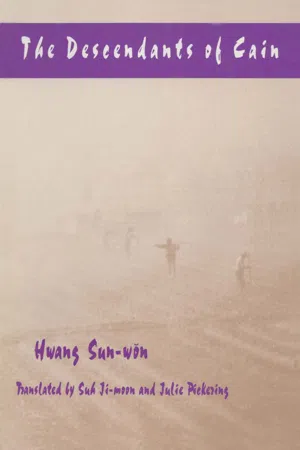
The Descendants of Cain
About this book
Hwang Sun-won, perhaps the most beloved and respected Korean writer of the 20th century, based this extraordinary novel on his own experiences in his North Korean home village between the end of World War II and the eve of the Korean War when Korea had been divided into North and South by its two "liberators" - the United States and the Soviet Union. In this story the Soviet-backed communist party, using the promise of land reform, sets people at each other's throat. Portrayed here is an entire community caught in the political and social firestorm that brings out the selfishness, cruelty and ignorance of simple people, but also shows their loyalty and nobility. Compelling here, too, is a heroine who represents the "eternally feminine" for all Korean men, and the setting, the harsh political, psychic and physical landscape of rural postwar North Korea rarely glimpsed by the outside world. Hwang Sun-won is an artist of consummate delicacy and subtlety, and his writing is marked by keen psychological insight and steely asceticism. While three collections of his short stories have appeared in Hong Kong and the West, "The Descendants of Cain" is the first English translation of a Hwang Sun-won novel.
Information
The Descendants of Cain
1
DOI: 10.4324/9781315699998-1
An icy wind shook the stars that night. It was mid-March, but in the northwest the night air was still biting cold.
A man approached the village along the hilly path that ran past the tavern. It was Pak Hun.
He stumbled along, as if quite drunk. The previous evening, the night school where he had found some satisfaction teaching for the past four months had been shut down by a man from party headquarters. There had been no warning at all. Hun had gone to school at the usual hour, only to find a young man he had never seen before standing at the lectern. It may have been the feeling of emptiness caused by that loss that made him drink so heavily tonight.
To the right of the path was a sloping expanse of newly cleared land, to the left a pine forest. In summer the narrow path was almost entirely overrun with mugwort and wild strawberry vines.
The wind lashed the pines, and the forest moaned like a heavy sea. Hun lifted his head to take the wind full in his face. Though drunk, he smelled pine sap in the icy gust, a sure sign of spring’s arrival. He inhaled deeply.
Dark silhouettes of trees began to appear on the slope which rose gently to his right. The trees were part of an orchard belonging to his uncle. Neglected for years, most were blighted and useless now. Hun turned to look at them. They’ll blossom again this year, he thought, but the meager fruit will fall and rot before it ripens.
The dark shadows of the orchard spread gradually wider. A fence of acacia saplings, planted around the fruit trees years before, had, for lack of trimming, grown quite large. At the far end of the acacias stood a faint white shadow. It was Ojaknyŏ. She was waiting for him.
Hun recalled the tavern mistress’s ribbing earlier that evening. Shouldn’t you be getting home, she quipped, if only for poor Ojaknyŏ’s sake? Think of her waiting there, craning her neck to catch sight of you. He had simply ignored the remark.
That the villagers talked was no surprise. He and Ojaknyŏ had been living under the same roof for three years, ever since he returned to the village. And it was true: for some time he had found a certain solace in knowing that Ojaknyŏ would be waiting at that same spot every night.
He felt it even now, but realized that his life with her would soon be over. That prospect made him want to play one last practical joke on her. I’ll stop here, he thought, and make her come to me.
He stopped short, but the figure at the end of the acacias did not move. Only the wind lashing through the pines grew louder. As one gust raced into the distance, another followed, launching a new assault on the pines. Listening to the wind, Hun suddenly felt that his joke was silly, and he decided to start walking again.
Just then, the figure at the end of the acacias came forward. Hun thought she was running to him, but her pale form cut in front of him and darted into the pine forest. She moved with surprising speed.
Hun snapped to attention. Another shadow seemed to be running ahead of Ojaknyŏ through the pines. His instinct told him it was a man. A shiver ran down his spine, and before he knew it, he was running through the woods after them.
Where did all these jagged stones come from? Hun thought, and the woods are so thick. He stumbled and nearly fell several times, scratching his face and neck on the stiff branches. Still, he ran all out, frantically thrashing the darkness to push the branches aside. The two shadows raced ahead, darting through the woods like wild animals accustomed to the rough terrain.
In the end, Hun lost sight of them. He stopped and listened, but heard nothing, not the slightest trace of human life, only the wind roaring like the sea.
Despite the darkness, he sensed that he was near the old tomb, worn almost flat by the years. To one side of the tomb stood the Mountain Spirit Tree, its dark silhouette looming tall and imposing above the other pines. He flopped down beside the tomb. It was in the middle of a clearing where he went to sun himself from late autumn to early spring.
His throat burned from the short run, and he was sweating. The cuts on his face, neck and hands stung. Weariness flooded through him and he stretched out on the ground. The stars swirled overhead. He closed his eyes. Who could it be? he wondered. Who was Ojaknyŏ chasing? His sweat cooled, and the cold seeping up from the ground sent shivers through his body. The shivers seemed to grow worse as he pondered the identity of the mysterious figure.
One thing was certain—it was a man. And this man was following him or hiding somewhere perhaps, spying on him.
The vague misgivings he had been experiencing now that the so-called land reform was imminent had taken on a certain tangibility in the past few days. They came over him now with new force. The night school had been closed the night before. Who knows what would happen to him next? As a new wave of shivers passed through his body, he realized he was completely sober.
At any rate, it’s time to head home, Hun thought. Stay here much longer and I’m sure to catch a cold. He found it difficult, however, to lift himself from the ground.
The wind subsided for a moment. The silence was palpable and Hun felt isolated, as if floating in a small space all his own. It was eerie. He sensed that someone was hiding somewhere outside that space, watching him. He opened his eyes and sat up with a start.
“We’d better be getting home now,” said Ojaknyŏ. She was standing beside him.
Hun rose silently and led the way down the hill. The road home was dark but Hun knew every inch of it, as he had walked it almost every day for the past three years. But for some reason he kept stumbling. He tripped in the brush several times. It wasn’t because of the alcohol now, though. It was the thought of that other shadow.
Ojaknyŏ overtook him and acted as a guide, gauging his pace and walking exactly two paces ahead of him.
“Who was that, Ojaknyŏ?”
There was no answer.
“You didn’t catch him?”
“No.”
“So?”
Again no answer.
“Was it a stranger?”
“No.”
“Then who?”
“Sir,” said Ojaknyŏ after a moment’s silence. Then after another pause, she asked almost pleadingly, “Do you mind if I tell you tomorrow?”
Ojaknyŏ had never evaded his questions before. Something must be seriously wrong. This made Hun all the more anxious to learn the man’s identity. And he knew if he pressed her she would tell him. But he didn’t. It wouldn’t be right to force her to say something she didn’t want to say. Now all he wanted to do was go home and lie down.
As they emerged from the woods, the houses of Sunny Hollow came into sight. Lying in an arc with their backs to the path, the houses looked like mounds of straw in the darkness. The largest one, in the middle of the arc, was Hun’s.
After taking a dinner tray to Hun, Ojaknyŏ stepped quietly outside. She had to go see her parents. It was time to have it out with them, whatever the cost. How could Samdŭk, her own younger brother, do such a thing? Spying! And on Mr. Pak of all people!
Her parents’ tin-roofed house stood about fifty yards from Hun’s. She hesitated for an instant as she entered the yard. Her dog Spotty scampered up and rubbed against her legs. Her heart pounded. Then she calmed herself and grasped the door handle.
Her mother was alone. She sat sewing beside the oil lamp. At the sound of the door, she looked up in surprise.
“Oh, is that you?”
“Where’d everyone go?”
“They went out after dinner.”
There was a hint of uneasiness and fear in her mother’s voice. It seemed to have grown more pronounced lately.
As a girl, Ojaknyŏ’s mother was known for her gay laughter. She’d laugh at the slightest provocation. Even after her marriage, with no parents-in-law to constrain her, she would often chat and laugh merrily with the other young women in the village. It wasn’t long, however, before all trace of that laughter disappeared from her round, girlish face. It was not because they were poor.
Perhaps it was the dark shadow of her husband, stubborn and unyielding as a stone, that had changed her. Not that he abused her or gave her a hard time. It was as if he were a huge rock that withered the plants in its shade. Crushed by that rock of a husband, Ojaknyŏ’s mother lost her smile and a certain shadow took its place. Lately it had become more pronounced. She jumped with fright at the slightest thing.
“Does Samdŭk stay out late every night?”
“Pretty much.”
In fact, her son did not stay out late every night, but she exaggerated her anxiety to gain her daughter’s sympathy. “I wish they’d stay home at night,” she said, as if to herself.
“Why is Father acting this way?”
“I have no idea.”
“Why don’t you talk to him?”
Her mother turned her frightened eyes on her.
“How can Father act that way to Mr. Pak? He should think of the past. How can he act like that, just because there’s going to be land reform? Can’t you say something to him, for once in your life?”
Tosŏp, Ojaknyŏ’s father, had been Hun’s family estate agent for close to thirty years. His life was as comfortable as any landowner’s. But now, with the talk of land reform, he had changed completely. That upset Ojaknyŏ.
Her mother’s eyes grew even more frightened at her daughter’s words. How could she talk like that about her father, whom nobody ever dared to cross? If he found out, there’d be hell to pay.
“And Samdŭk…”
“Shhh …” Her mother’s hand trembled ever so slightly, then her sewing dropped to the floor. She grabbed her daughter’s arm and whispered, “It’s your father.”
Ojaknyŏ winced and listened. But she heard nothing.
“It’s him!” her mother whispered again.
After decades of marriage, the woman recognized her husband’s footsteps when no one else could.
A moment later Ojaknyŏ heard someone enter the yard. She jumped up, though she had not meant to avoid her father. As she reached for the door handle she remembered something and turned. “When Samdŭk gets back, tell him to come over to make the fence tomorrow.”
But her mother simply bent over her sewing. It was a way of hiding from her husband the anxiety and fear written on her face.
Ojaknyŏ brushed past her father on the stone stoop. Head bent low, she hurried toward the gate. Suddenly she regretted what she had said to her mother. What if Mother does say something to Father? Then she’d be in trouble.
But the next moment, Ojaknyŏ felt a steely resolution rising within her. It was stronger than anything she had felt before. She had to do something. She couldn’t put it off forever. Father’s wrong, very wrong. He shouldn’t treat Mr. Pak like that. And why is Samdŭk acting so strangely?
“Hey girl,” her father’s gruff voice called out.
Ojaknyŏ stopped dead, as if someone had grabbed her by the nape of her neck.
“Your husband’s back.”
This time she felt as if she had received a blow on the head. She stood there for a moment, like one not comprehending what she’d heard. Then she rushed away, as if fleeing what she’d heard. She walked as fast as she could.
A whirlwind blew in her ears. “Your husband’s back, your husband’s back,” it sang.
Her head swam. Her legs shook. She felt as if she did not have the strength to hold this body of hers up.
When she reached Hun’s house, she grasped the gatepost and leaned against it. Looking up, she saw the light was out in Hun’s room.
She collected her thoughts. What am I doing? I left the dinner tray in Mr. Pak’s room. I must clear the dishes at once. She had no other thought now.
As she stepped into the yard, her legs were steady, as if something in that house was infusing her with new strength.
Hun hardly touched his dinner before going to bed. Weariness spread through his body and he fell into a troubled dream-ridden sleep.
He was standing in front of the primary school, a long, single-storied building where they held the night school. A light was burning at the center of the building in the classroom they used.
Hun was sick that e...
Table of contents
- Cover
- Halftitle Page
- Title Page
- Copyright Page
- Introduction
- Halftitle Page 1
- 1
- 2
- 3
- 4
- 5
- 6
- 7
- 8
- 9
Trusted by 375,005 students
Access to over 1.5 million titles for a fair monthly price.
Study more efficiently using our study tools.
Frequently asked questions
Yes, you can cancel anytime from the Subscription tab in your account settings on the Perlego website. Your subscription will stay active until the end of your current billing period. Learn how to cancel your subscription
No, books cannot be downloaded as external files, such as PDFs, for use outside of Perlego. However, you can download books within the Perlego app for offline reading on mobile or tablet. Learn how to download books offline
Perlego offers two plans: Essential and Complete
- Essential is ideal for learners and professionals who enjoy exploring a wide range of subjects. Access the Essential Library with 800,000+ trusted titles and best-sellers across business, personal growth, and the humanities. Includes unlimited reading time and Standard Read Aloud voice.
- Complete: Perfect for advanced learners and researchers needing full, unrestricted access. Unlock 1.5M+ books across hundreds of subjects, including academic and specialized titles. The Complete Plan also includes advanced features like Premium Read Aloud and Research Assistant.
We are an online textbook subscription service, where you can get access to an entire online library for less than the price of a single book per month. With over 1.5 million books across 990+ topics, we’ve got you covered! Learn about our mission
Look out for the read-aloud symbol on your next book to see if you can listen to it. The read-aloud tool reads text aloud for you, highlighting the text as it is being read. You can pause it, speed it up and slow it down. Learn more about Read Aloud
Yes! You can use the Perlego app on both iOS and Android devices to read anytime, anywhere — even offline. Perfect for commutes or when you’re on the go.
Please note we cannot support devices running on iOS 13 and Android 7 or earlier. Learn more about using the app
Please note we cannot support devices running on iOS 13 and Android 7 or earlier. Learn more about using the app
Yes, you can access The Descendants of Cain by Ji-moon Suh,Sun-won Hwang,Julie Pickering,J. Suh in PDF and/or ePUB format, as well as other popular books in Literature & Literary Criticism. We have over 1.5 million books available in our catalogue for you to explore.