- 224 pages
- English
- ePUB (mobile friendly)
- Available on iOS & Android
eBook - ePub
About this book
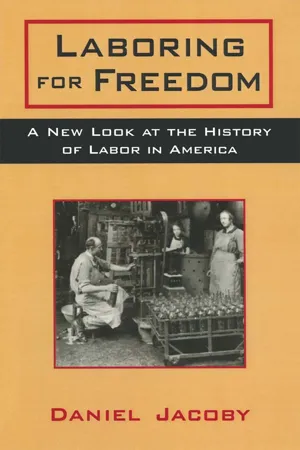
This text examines the concept of freedom in the context of American labour history. Nine essays develop themes in this history which show that liberty of contract and inalienable rights form two contradictory traditions concerning freedom.
——— PART I ———
INDEPENDENCE OR CONTRACT
——— Chapter 1———
Republican Soil
Nothing is a due and adequate representation of a state, that does not represent its ability, as well as its property. But as ability is a vigorous and active principle, and as property is sluggish, inert, and timid, it never can be safe from the invasions of ability, unless it [property] be out of all proportion, predominant in the representation. It must be represented too in great masses of accumulation, or it is not rightly protected. The characteristic essence of property, formed out of the combined principles of its acquisition and conservation is to be unequal. The great masses therefore which excite envy, and tempt rapacity, must be put out of the possibility of danger.
—Edmund Burke, Reflections on the Revolution in France
It is an underlying theme of this book that there are only two types of workers: those who are struggling to be free and those who are unfree. Although absolute freedom is a fable, the failure to struggle toward it guarantees that conditions will not improve. In revolutionary America, the impulse toward freedom was best captured by the mythic allure of the independent yeoman: The proud homesteading farmer was the central symbol of American life. Our discussion of labor and freedom in America begins by examining this symbol as it has survived through historical memory.
Farmers and Master Craftsmen: At the Heart of Republican Ideals
Today, when labor issues and history are discussed, farmers are seldom mentioned. This was not always so, and why it should be so now requires explanation. Farming is obviously work, but whether it is also labor depends upon the definition one chooses. If we imagine—incorrectly—that farmers always worked their own land, then it might be said of them that they comprised a unique class of workers one that by virtue of its self-employment was not forced to sell its labor, but instead simply sold the grain or meat that its labor produced. To sell your labor conjures up two immense social, legal, and economic questions: Is it possible to sell labor without also selling yourself? If not, can a person whose survival requires the sale of his or her labor ever be free? The questions flow from the fact that in selling our labor we sell to others the right to direct and control that labor. If labor is not separable from the person, then the sale of labor is the sale of freedom. The farmer, like the independent or master craftsman, stands at one end of the spectrum of labor freedom while the hired hand stands at the other.
It can be argued that this distinction is merely one of appearance, not of substance. After all, if economic need forces the farmer to produce goods demanded by the open market, is it not a chimera to call the sale of goods “independence” and the sale of labor “servility”? The ideas that dominated political thought during the revolutionary era, ideas that are encompassed under the label republicanism, sustained exactly this distinction.1 Furthermore, although much has changed, this distinction continues to weigh heavily upon conceptions of freedom today.
Although republicanism was an outgrowth of European Enlightenment thinking, its hold over the imagination was nowhere so great as in the United States. In Europe, tradition and status played too great a role to permit common people to constitute themselves as free citizens in an independent republic of their own making. American colonists, however, carried away the seeds of Europe’s new thought to their more fertile soil. Human imagination fertilized the crude customs and practices they brought to this land so as to nurture republican ideals; ideals that promised to satisfy the colonists’ needs and aspirations. The image of the yeoman farmer, and also of the master artisan, stood at the heart of these republican ideals. Although late colonial and early American life often fell short of realizing its ideals, it provided enough hopeful signs to sustain the emerging republican faith.
The yeoman farmer and master artisan were European, not American, creations. But it was Americans who allowed themselves to believe that the independence they promised was universally achievable. Where such faith was not practical in the old world, their new land-abundant and labor-scarce environment nourished colonists’ peculiar hopefulness. The prospect of a homestead was the prospect of independence. By successfully establishing and governing a household enterprise, a man established the rough equality that entitled him to the full rights and privileges of citizenship in a republic. More important than the mere possession of land and property, however, was the ability conveyed by such ownership to act independently without need to curry favor. Only this enabled citizens to exercise their political judgments with integrity. A family household was regarded as its own “little commonwealth.” Successful household management and property were in this way linked to the proper governance of a republic. Americans differed from their European forefathers chiefly in their belief that it was reasonable for the common man to aspire to such independence. This republican ideology found anchor in the conditions of labor that the New World offered.
To understand the New World, one must know something of what was left behind in the Old. The first American colonies were planted in the early seventeenth century just as social, intellectual, and commercial revolutions began to jolt Europe’s aristocratic society. Feudalism had passed centuries earlier without undoing the formal structures of titled status and privilege. As the Kings of Europe grabbed power for themselves, their increasingly centralized military control established a civil order that, by the thirteenth century, eroded the feudal society. The manorial system that superseded feudalism converted warlords into landlords. The new civil order vitalized commerce and, in turn, expanded the class of merchants and manufacturers. These men of commerce sometimes achieved wealth so great that they could buy the lordly titles that, in centuries past, had been accorded solely through heredity or battle.
In the 1600s the old and new nobility constituted roughly 5 percent of Britain’s population. Atop this social hierarchy, Lords of the Realm (dukes, earls, marquees, viscounts, and barons) and Lords Spiritual (archbishops and bishops) comprised the peerage that was entitled to sit in the House of Lords.2 By the colonial period, however, the value of this privilege was reduced, and would subsequently be reduced still further, by the increasing importance of the less aristocratic House of Commons.
Although the formal power of Britain’s landed lords diminished substantially, their influence remained much greater than that of the rent collectors we call landlords today. Since antiquity these lords had enforced the customs of their manors and exercised personal dominion over the land upon which peasants were bound. Ancient lords had exacted payments from their tenants for everything from their marriages to their burial rights, not to mention the simple tilling of their soil. In the Middle Ages those payments customarily involved labor services. Such obligations to their lords defined the peasant’s servile condition. By the thirteenth and fourteenth centuries labor obligations had generally been commuted to monetary rents.3 By the seventeenth century, the most visible legacy of the past lay in the deference common people owed to their titled gentlemen. In the colonies, however, only a few untempered remnants of the old order survived. Along the Hudson River in New York, for example, Dutch Patroons continued to command the fealty and services of their tenants. More often, however, the hereditary transfer of noble land, titles, and status were not easily reestablished in a fresh land. Although crown land grants to men like William Penn and Lord Baltimore raised the possibility of resurrecting a titled nobility upon American shores, in actuality this did not happen.
Colonization was simply a dimension of the ongoing commercial revolution that had earlier conspired to convert servile labor dues into the freedom of cash payments. Colonization similarly advanced the spread of freer, more contractually oriented relationships by increasing the demand for labor at precisely the moment when commercial life endowed money with new possibilities. Money gave master and servant alike the freedom to pursue more options than did custom-defined service payments. This new freedom was important because it enabled both to pursue self-defined best interests. Economic and personal incentives, not custom, would govern individual behavior.
Not too much should be made of these tentative movements as not all people were equally affected. Hired peasants, for instance, were not cornpletely exempt from all customary obligations. For example, agricultural workers were often obliged to render a year’s service ending at harvest time. Failure to perform their contractual labor obligations was a imprisonable offense.4 As legal historians like Robert Steinfeld point out, the ability to use the law to enforce labor contracts was what distinguished early English labor markets from latter-day “free” labor markets.5 That is, during colonial times, failure to fulfill a contract to work was a criminal offense whereas today, at worst, it would only constitute grounds for a suit to recover damages. Among common country folk, only the yeoman farmer, the man who had used his release from custom to sizably increase the land he held in fee simple—free of obligation—was considered an independent man. Aside from religious tolerance, the principle attraction stirring American settlement lay in the greater prospects the new land afforded for such independence.
Ironically, in order to attain independence, many British emigrants to America submitted to lengthy servitudes called indentures.6 Merchant Cornpanies, like the Virginia Company, sought to people their commercial plantations in the New World by dangling inducements, particularly the prospect of landed independence. As before, trade continued to expand the freedoms that one’s labor might achieve. In the seventeenth and eighteenth centuries close to three-quarters of the immigrants to British Atlantic coast colonies were indentured servants. Indenture contracts detailed the terms of the transaction. To ensure its validity, the contract was ripped in two, one part for each party, so that its validity was guaranteed only when the teeth of the two halves fit together. The indenture system was a colonial innovation, adapted from the European tradition of guild apprenticeship. Under English guild practice, youngsters were bound to artisan masters— usually until age twenty-four—in exchange for being taught the “mysteries” of their craft. Apprenticed boys exchanged labor for training, whereas indentured servants, on the other hand, received transportation instead. Such service enabled men, women, and children to borrow the payment for their passage to America in exchange for a number of years of labor.
Indentured servitude may be distinguished from apprenticeship in a second way. Overlooking the young orphans of London who periodically were forcibly shanghaied to the Chesapeake, indentured servitude was, at least in principle, a matter of choice. By contrast, the English Statute of Artificers required children to be bound by apprenticeship unless parents could ensure that their children would not become public burdens requiring poor relief. This 1563 law was intended to buttress the English guild system, then already in decline. Prior to this law, the guilds, not the government, were responsible for regulating their own crafts and apprenticeship systems.
In their time, the guilds too had converted commercial opportunities into freedom, two elements of which were central to British liberty. As commerce initially expanded, serfs who ran away from manorial lords found protection under town guilds. It was said that, “Town air makes men free.” Thus, one element of liberty was freedom from obligatory personal service to a manorial lord. This was not the personal liberty we think of today. In fact, guilds regulated membership through apprenticeship, the conditions of work, and the quality of production; rules that many today would regard as antithetical to freedom. These regulations were frequently stipulated in minute detail. For example, weavers’ guilds dictated to their members how many threads each piece of cloth must contain. As the medievalist Stephen Epstein points out, although these regulations deprived members of considerable personal liberty, they were tolerated, if not actually encouraged, because through the maintenance of quality and the suppression of uncontrolled competition and innovation they stabilized their trades.7 The privilege guild members enjoyed in regulating their own affairs constituted an important second meaning of English freedom. The two freedoms—freedom from personal service, and collective governance—are aspects of liberty that coexist in tension with each other.
The enactment of the Statute of Artificers in 1563 signaled that the power of guilds was waning. The state, aided by bounty-hunting informers, undertook responsibility to regulate countryside infractions that the guilds could no longer enforce on their own. Enacted just forty years prior to the first American settlements, the statute’s coercive labor regulations correct any misimpressions that colonial American life was built upon a strong tradition of individual freedom. Although the heritage of British freedom was real, it had not reached so far, or so many, that American citizens today would want to return to those times. Though England was fast removing the yoke of customary personal servitudes, state compulsion, economic desperation, and deference to persons of high status continued to separate common people from meaningful personal freedom.
The Mercantilist System
The Statute of Artificers was a key element in the emerging mercantilist system, the workings of which are important to an understanding of the times. Under that system, aggressive merchants contested the control that landed lords had traditionally exercised over public policy. Mercantilists argued that the protection of commercial interests was prerequisite to the maintenance of national power. In pursuit of this end, nations like England granted merchants protective tariffs and monopolies in exchange for taxes and royalties.8 This revenue made it possible to levy a royal navy and this, in turn, made it possible for Britain to dominate the sea. Sea power enabled England to plant and secure the colonies that supplied its home workshops with vital raw materials. The symbiotic relationship between industry and state stoked the fires of Nationalism and Empire. What mattered was not the wealth of the individuals who comprised the nation, on whose behalf economist and moral philosopher Adam Smith would later argue, but the wealth of the traders upon whom the state depended. Insofar as the state had concerns about its working people, its regulations were intended to ensure that they not impair Britain’s trade position—and that usually meant low wages and minimal economic rights and freedoms. For example, mechanics were denied the right to emigrate, lest they take with them England’s trade secrets. Democracy widened only so far as to extend citizen control from those peers who inherited it to those merchants who could pay for it. Mercantilism, insofar as it was a coherent set of ideas, tipped the levers of state toward those commercial interests in whose self-interest ever greater govemmental protections and favors were required.
Nonetheless, mercantilism inadvertently seasoned a revolutionary brew in America. Just as mercantilism’s quest for trade and profit made America possible, it also stymied many dreams for which colonists had endured numerous hardships and servitudes. Ultimately, it made bedfellows of diverse colonists who, had they remained in Britain, would have been divided by social rank. For merchant, artisan, and farmer alike, mercantilism undermined faith that Britain would rule its empire justly. Crown policies were perceived as partial to domestic interests and harmful to those of its colonists. Not only did mercantilism require sacrifices from colonial traders and manufacturers, it also denied America’s would-be gentry the self-rule possessed by their European cousins.
Foremost, it was merchants who defined British policy as intolerable. Had American merchants enjoyed the same sovereignty as their British counterparts, whose consent to taxation was required before policies affecting them were imposed, grievances might have been settled more amicably. Colonial discontent was excited not just by particular policies—policies that seldom exacted from colonists more than the value of services British administration yielded—but by the perception that the crown was usurping privileges that the merchants believed to be rightfully theirs. These colonists told themselves that if they ceded self-government without protest, they could never be sure that England’s rule would not regularly sacrifice their interests. Rich and influential colonial merchants opposed the British Navigation Acts that enumerated specific goods and prohibited their direct transport from the colonies to foreign destinations. Such rules gave rise to smuggli...
Table of contents
- Cover
- Half Title
- Title Page
- Copyright Page
- Dedication
- Table of Contents
- Acknowledgments
- Prologue
- Part I: Independence or Contract
- Part II: Illusory Freedoms
- Part III: New Deals and Old Ideals
- Epilogue: Memories and Challenges
- Notes
- Bibliography
- Index
- About the Author
Trusted by 375,005 students
Access to over 1.5 million titles for a fair monthly price.
Study more efficiently using our study tools.
Frequently asked questions
Yes, you can cancel anytime from the Subscription tab in your account settings on the Perlego website. Your subscription will stay active until the end of your current billing period. Learn how to cancel your subscription
No, books cannot be downloaded as external files, such as PDFs, for use outside of Perlego. However, you can download books within the Perlego app for offline reading on mobile or tablet. Learn how to download books offline
Perlego offers two plans: Essential and Complete
- Essential is ideal for learners and professionals who enjoy exploring a wide range of subjects. Access the Essential Library with 800,000+ trusted titles and best-sellers across business, personal growth, and the humanities. Includes unlimited reading time and Standard Read Aloud voice.
- Complete: Perfect for advanced learners and researchers needing full, unrestricted access. Unlock 1.5M+ books across hundreds of subjects, including academic and specialized titles. The Complete Plan also includes advanced features like Premium Read Aloud and Research Assistant.
We are an online textbook subscription service, where you can get access to an entire online library for less than the price of a single book per month. With over 1.5 million books across 990+ topics, we’ve got you covered! Learn about our mission
Look out for the read-aloud symbol on your next book to see if you can listen to it. The read-aloud tool reads text aloud for you, highlighting the text as it is being read. You can pause it, speed it up and slow it down. Learn more about Read Aloud
Yes! You can use the Perlego app on both iOS and Android devices to read anytime, anywhere — even offline. Perfect for commutes or when you’re on the go.
Please note we cannot support devices running on iOS 13 and Android 7 or earlier. Learn more about using the app
Please note we cannot support devices running on iOS 13 and Android 7 or earlier. Learn more about using the app
Yes, you can access Laboring for Freedom by Daniel Jacoby in PDF and/or ePUB format, as well as other popular books in History & Business General. We have over 1.5 million books available in our catalogue for you to explore.