eBook - ePub
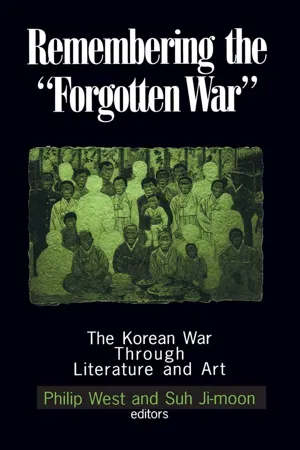
Remembering the Forgotten War
The Korean War Through Literature and Art
- 256 pages
- English
- ePUB (mobile friendly)
- Available on iOS & Android
eBook - ePub
Remembering the Forgotten War
The Korean War Through Literature and Art
About this book
In contrast to the many books that use military, diplomatic, and historic language in analyzing the Korean War, this book takes a cultural approach that emphasizes the human dimension of the war, an approach that especially features Korean voices. There are chapters on Korean art on the war, translations into English of Korean poetry by Korean soldiers, and American soldier poetry on the war. There is a photographic essay on the war by combat journalist and Pulitzer Prize winning photographer Max Desfor. Another chapter includes and analyzes songs on the Korean War - Korean, American, and Chinese - that illuminate the many complex memories of the war. There is a discussion of Korean films on the war and a chapter on Korean War POWs and their contested memories. More than any other nonfiction book on the war, this one shows us the human face of tragedy for Americans, Chinese, and most especially Koreans. June 2000 was the fiftieth anniversary of the outbreak of the Korean War; this moving volume is intended as a commemoration of it.
1
Some Reflections on the Korean War
Steven I. Levine
As Americans born in the middle third of the twentieth century, men and women of my generation have lived most of our lives in war or in the shadow of war. This is true even of those like myself who have never hefted a more serious weapon than a BB gun or worn a uniform other than that of the Boy Scouts or academic robes. Born on the cusp of World War II, we passed through childhood during the Korean War, graduated from college during the “long peace” of the cold war, and embarked upon our careers during the Vietnam War. For a student of international relations like myself, an abstract grasp of war as an element of international politics grates against a visceral understanding of the terrible intimacy of war. I realize that, consciously or not, we bear upon us and within us the scars of each one of the far too many wars our nation has fought within our lifetimes. At least, we should bear these scars. If we do not, we have failed the memories of everyone on all sides of each conflict.
Our memories of “good wars”—wars in whose justice we continue to believe—are more nearly alike than our memories of “bad wars”—wars that either at the time or in retrospect we acknowledge were mistaken, fought in error, or both. Of America’s twentieth-century wars in Asia, the Pacific War, as part of the global antifascist crusade, retains for most Americans its aura of a good war even though the atomic bombings of Hiroshima and Nagasaki that marked its termination are bitterly contested. The Vietnam War, like the nasty counterrevolutionary war fought in the Philippines at the beginning of the twentieth century, has long since fallen into disrepute, becoming a matter for regret if not quite for apology. We like to think our motives in Vietnam were good, even if we acted in ignorance and arrogance. Whether this is true or not is another matter.
What of Korea? On this fiftieth anniversary of the outbreak of the Korean War, a war no longer forgotten, the jury is still out, perhaps because the war itself has not yet ended. When we engage in the sometimes unnerving exercise of confronting our own preconceptions with the memories, passions, and judgments of others, Koreans in particular, we are nonplussed. This is what happened during the Mansfield Center’s Korea/America Dialogue in June 1999, which gave birth to the present book. On that occasion, some of South Korea’s most distinguished writers repeatedly voiced bitter anti-American sentiments. Although I, too, have been quite critical of U.S. policy in South Korea, I was still surprised to hear these sentiments. After all, if not for U.S. intervention in Korea, these writers would likely be intellectual serfs in Kim Jong-il’s dismal kingdom. The explanation for their bitterness, of course, lies in politics rather than ingratitude. When we as Americans consider the fate of Korea over the past half century, our memories and our judgments tend to be divided like Korea itself. When we contemplate the role that the United States has played in the politics of the Korean peninsula since the end of World War II, judgment is no easier. To get at the truth, we must hack our way through a thicket of thorny questions.
Even where to begin our interrogation of history is far from self-evident. Does the American share of responsibility for the tragedy of Korean history begin with the division of Korea in 1945? Or should it be pushed further back to supposed U.S. acceptance of Japan’s domination of Korea in 1905 via the Taft-Katsura Agreement, an agreement the significance of which, incidentally, the newer scholarship has discounted? If we begin with 1945, we need to consider what role the division of Korea by the United States and the Soviet Union in July of that year played in the sequence of events leading to the Korean War. Had the United States not rescued South Korea in the summer of 1950, would a unified communist Korea over the past half century have exacted a toll in Korean lives and suffering similar to that of communist regimes in China and Vietnam? How can one measure such a hypothetical cost against the terrible loss of life and human suffering that the Korean War actually brought about?
After the Korean War, the United States supported South Korean authoritarian military rulers Park Chung Hee and Chun Doo Hwan, invoking the security threat from North Korea as grounds for overlooking the repressive character of the generals’ regime. At the strategic level, the United States treated South Korea as just another pawn in the cold war. Throughout the postwar years, should the United States have intervened more effectively to support the forces for democratic change in South Korea?
Hanging over these and many more questions is the very status of a divided Korea with its painful separation of families, allocation of enormous resources to military security, hair-trigger confrontation between two garrison states, and periodic armed skirmishes along land and sea frontiers. Is this division a historical enormity so monstrous that it overshadows the emergence of a prosperous, democratic South Korea, home to two-thirds of Korea’s people? It is difficult, if not impossible, for outsiders to empathize with, or even fully comprehend, the ache in the heart and the anger in the gut that the division of Korea engenders among Koreans, both north and south.
That the Korean War haunts very few Americans the way it haunts many Koreans, particularly from the older generations, is only natural. Nevertheless, wars have a way of taking hold of our memories. Among children, an awareness of war is part of a growing consciousness of the world outside of home, family, and local community. My own boyhood memories of growing up in Indiana and New York City during the Korean War are rather banal, but their very banality may shed a weak shaft of light on the political climate of the times. It was a paranoid time, dominated by fears of war and communism that percolated down from the national level into communities and families across the country.
The national emergency declared by President Truman in mid-December 1950 did not pass unnoticed in the Frances B. Slocum Elementary School I attended in Fort Wayne, an industrial city in northeast Indiana, where my family lived for two years. Sometime during that terrible first year of the war, my fourth-grade teacher informed her class of a wastepaper collection drive occasioned by the war in Korea. The little red wagon I had received for my ninth birthday was pressed into service as my personal contribution to the national mobilization for the Korean War. Thereafter, I regularly hauled down our driveway for collection at the curb neatly tied bundles of the Fort Wayne News-Sentinel. Even in retrospect, I admit to some difficulty in understanding the link between this act and the fighting going on in Korea, my first vague awareness of which came from the pages of that same newspaper. But it felt good to be doing one’s bit for the war effort.
Several months later we moved from Fort Wayne to New York City. Just before Christmas 1951, at Public School 187 on Cabrini Boulevard in upper Manhattan, my homeroom schoolmates and I assembled Christmas stockings for hospitalized Korean War combatants from items we had each brought from home. On our grubby lists, we carefully checked off “comb, soap, pencil, pad of paper, hard candies, playing cards,” and assorted other trinkets that were intended, I suppose, to help the wounded forget their amputated limbs and shattered bodies. It was many years later, reading Chinese-language accounts of the Korean War, that I learned Chinese schoolchildren had prepared very similar “comfort bags” (weidai) for delivery to the far greater number of Chinese wounded in Korea. (Given the primitive state of medical services in the Chinese People’s Volunteers, and the devastating effects of UN weapons, including napalm and flamethrowers, only a fraction of Chinese troops with serious wounds survived.)
Around this time, my political consciousness took a great leap forward. I graduated from the Fort Wayne News-Sentinel to the New York Times, the New York Post (a liberal newspaper in the 1950s), the odd copy of the Herald-Tribune, and even an occasional issue of the World-Telegram and Sun. Precocious and indiscriminate reader that I was, a Korean geography of battles was drilled into my head by a daily drumbeat of datelines from that tortured peninsula, halfway around the world from New York. My parents were 1930s leftists who, I learned much later, had been hounded out of Fort Wayne following the publication of an article by the nationally syndicated columnist Victor Reisel viciously attacking them as Progressive Party (Henry Wallace) moles, Jewish Reds from New York, who had “infiltrated” a God-fearing midwestern community. Amidst the clutch of newspapers we received in our Manhattan apartment was the National Guardian, a “fellow traveling” newsweekly, which regularly carried dispatches from Korea by Wilfred Burchett, an Australian communist journalist. Burchett, who spent a long career reporting on the hot spots of the cold war from the other side of the lines, conveyed a quite different version of the Korean War from that transmitted by the mainstream American press. His telling reversed the heroes and villains, the triumphs and tragedies of the war. It was, I realize now, a very useful lesson on the complexities of politics and history.
This was also, of course, the era of the early cold war, when fear of a nuclear Armageddon was almost palpable. In 1953, the Boy Scout troop to which I briefly belonged was tasked by our scoutmaster with the job of establishing an alternative neighborhood communications network that could function after the expected Soviet nuclear attack had destroyed the telephone system. I instinctively balked at becoming a link in what I thought was a paranoid fantasy but, lacking the courage to tell the scoutmaster, I invented some pretext to drop out. It was around this time that New York schoolchildren were issued aluminum dog tags so that our charred and/or vaporized corpses could be easily identified after the nuclear holocaust. I’m unsure who was supposed to undertake this grim task—perhaps Boy Scouts on a field trip from suburban Westchester or Connecticut, which lay outside the prime impact area.
One other source of my early education about the Korean War may be mentioned briefly—Korean War comic books, which I and most of my friends read voraciously. The early 1950s were the twilight of the golden age of comics.1 The genre of combat comic books, which had flourished during and after World War II, now turned to Korean War themes, depicting heroic GI’s battling brownish-yellow hordes of North Korean and Chinese troops. Portrayed as unwitting pawns in the Kremlin’s world conspiracy, communist forces were usually shown engaging in “human wave” attacks, proof positive of the Oriental disregard for human life. (That Kim Il-sung and Mao Zedong were doing Stalin’s dirty work was a common theme in both low and high American discourse at the time. It was unfortunately true that Mao, and probably Kim as well, regarded his troops as a disposable commodity in plentiful supply.2) Oddly, a very few U.S. Korean War comics intimated the common humanity of the communist enemy. Their deaths in combat, it was suggested, were no cause for celebration because these poor innocents, too, left behind grieving mothers, wives, and children. But such humanistic comics were the exception. The standard comic book version of the Korean War, a morality tale of good versus evil, echoed the line of our national media and our national leaders. Needless to say, with three such disparate sources of information at my disposal—the mainstream press, the National Guardian, and Korean War comics—my childish understanding of the Korean War was confused and incomplete. It has remained so ever since. This, I now realize, is the proper condition for a teacher and historian like myself.
During the Korea/America Dialogue, Professor David McCann, a leading scholar of Korean literature, brought up Mikhail Bakhtin’s notion of heteroglossia. The concept refers to a cacophony of disorderly and centrifugal voices that, by their very existence, implicitly challenge the tidiness of official narratives.3 This idea, which subverts master narratives and monolithic truths in favor of multiple subjectivities, is very near in spirit to the Mansfield Center’s America’s Wars in Asia project. Our project seeks to make accessible a broad and disparate range of Asian, American, and other voices on the wars. We believe that listening to and engaging such a panoply of voices will help enrich our understanding of war in all of its complexity.
One of the first orders of business is what to call the Korean War, a problem that historians have wrestled with for several decades. William Stueck’s chapter in this volume (see chapter 10) provides a critical discussion of the various labels that have been attached to the Korean War. Here, just a few words are in order. At various points in the Korea/America Dialogue, participants referred to the Korean War as a necessary war, a civil war, an international war, a tribal war, and an unfinished war.
Although I accept Stueck’s labeling of the Korean War as an international war, I would like to highlight the notion of Korea as an unfinished war in three ways. First, and most obvious, the political and military conflict between North and South Korea is still unresolved, and the international ramifications arising from the conflict continue as well. Therefore, the Korean War, which may seem a mere interjection between the Pacific War and the Vietnam War, is actually the longest of the three wars. The Korean War is unfinished in another sense. There is not, and probably never will be, a consensus among historians as to its origins, its outcome, and its significance. If anything, the temperature of the scholarly discussions on the war has risen recently. A case in point is the contentious round table on the Korean War that took place at the January 2000 meeting of the American Historical Association, where leading scholars again failed to agree on how to categorize the Korean War. To be sure, this is the normal state of affairs, and it is what makes history a living discipline. One may suppose that even when the Korean War has achieved the antiquity of, say, the Peloponnesian War, historians will still debate its meaning. The Korean War is unfinished in yet a third sense. It has become a living part of our cultural as well as historical heritage in the realm of literature, the arts, film, music, and many other kinds of expression. Although much good literature and art have already been created on Korean War themes, the experiences and memories of the war will continue to inspire writers and artists for a very long time to come. Unfinished in these two realms of historical explanation and the humanities, the Korean War, like all wars, enriches the human experience, terrible as it may seem to say so.
Central to the historical question of the origins of the Korean War is the concept of responsibility, at the levels of both the nation-state and the individual decision maker. For students of the Korean War, one of the most exciting developments of the past decade or two has been the increasing availability of new research materials, including selective archival and memoir material from Soviet and Chinese sources as well as materials in English and Korean (see chapter 9). Access to these materials allows scholars to explore some of what had previously been forbidden zones, although we still await unfettered access to Chinese and Korean archives. The new sources shed considerable light on such critical questions as the role of the Soviet Union and China in the origins of the Korean War, the Chinese decision to intervene in the fall of 1950, the controversy concerning the UN’s alleged use of biological weapons during the war, and the armistice negotiations. These new sources enrich the scholarly discussion of the Korean War.
Soviet and Chinese sources in particular enable scholars to achieve a better understanding of the role that individual leaders played in the decision for war in Korea. To focus on Stalin, Mao, and Kim Il-sung is not at all to deny that large-scale historical forces were at work on the Korean peninsula in the period 1945 to 1950. But the well-known centralization of foreign policy decision making in both the USSR and the PRC during this period requires that we focus on the motivations, calculations, thoughts, doubts, and actions of these men. To cite but two examples, we now know that Stalin refused Kim Il-sung’s request for Soviet support of a North Korean invasion of South Korea on two occasions before finally agreeing early in 1950. We also know that Mao agonized over the question of whether to dispatch Chinese troops to Korea, pacing the floor for several nights.
A focus on elite-level decision making, however, need not preclude an interest in the activities of the “little people” who fight, suffer, and die in wars, and the civilians whose lives are uprooted, twisted, and often destroyed. Every one of the persons impacted by war has a story to tell, a colored pebble to add to the mosaic. Several of the Korean writers at the Korea/America Dialogue referred to the relative powerlessness of writers to influence history. The point should not be overstated. One remembers Aleksandr Solzhenitsyn’s dictum that the writer is an alternate government. (Vaclav Havel proved that point in Czechoslovakia.) The writer can be an alternate voice in the sense of being a teller of truths that subvert official lies, of being a moral conscience for a people, a repository of cultural traditions, the bearer of hope in apparently hopeless situations. Korean writers, who take as their mission the bearing of witness and the promotion of national reconciliation, have already made extraordinary contributions to history by participating in the struggles for democracy and social justice that took place in South Korea over the past generation and more.
Yet the role of writers, like that of other intellectuals, is shaped by the society in which they work. The differences between the functions of literature on the American and South Korean sides of ...
Table of contents
- Cover
- Half Title
- Title Page
- Copyright Page
- Table of Contents
- Foreword
- Preface
- 1. Some Reflections on the Korean War
- 2. Whether Enemy or Brother: Patriotism in Conflict with Brotherhood in the Korean War Poems by Korean Poets
- 3. Above All, the Waste: American Soldier-Poets and the Korean War
- 4. The Korean War and the Visual Arts
- 5. The Korean War Through the Camera of an American War Correspondent
- 6. The Korean War in the Lives and Thoughts of Several Major Korean Writers
- 7. Reluctant Crusaders: Korean War Films and the Lost Audience
- 8. The Korean War in Korean Films
- 9. Interior Stories of the Chinese POWs in the Korean War
- 10. In Search of Essences: Labeling the Korean War
- 11. Imagining a Different Korea: What If …
- Contributors
- Index
Trusted by 375,005 students
Access to over 1.5 million titles for a fair monthly price.
Study more efficiently using our study tools.
Frequently asked questions
Yes, you can cancel anytime from the Subscription tab in your account settings on the Perlego website. Your subscription will stay active until the end of your current billing period. Learn how to cancel your subscription
No, books cannot be downloaded as external files, such as PDFs, for use outside of Perlego. However, you can download books within the Perlego app for offline reading on mobile or tablet. Learn how to download books offline
Perlego offers two plans: Essential and Complete
- Essential is ideal for learners and professionals who enjoy exploring a wide range of subjects. Access the Essential Library with 800,000+ trusted titles and best-sellers across business, personal growth, and the humanities. Includes unlimited reading time and Standard Read Aloud voice.
- Complete: Perfect for advanced learners and researchers needing full, unrestricted access. Unlock 1.5M+ books across hundreds of subjects, including academic and specialized titles. The Complete Plan also includes advanced features like Premium Read Aloud and Research Assistant.
We are an online textbook subscription service, where you can get access to an entire online library for less than the price of a single book per month. With over 1.5 million books across 990+ topics, we’ve got you covered! Learn about our mission
Look out for the read-aloud symbol on your next book to see if you can listen to it. The read-aloud tool reads text aloud for you, highlighting the text as it is being read. You can pause it, speed it up and slow it down. Learn more about Read Aloud
Yes! You can use the Perlego app on both iOS and Android devices to read anytime, anywhere — even offline. Perfect for commutes or when you’re on the go.
Please note we cannot support devices running on iOS 13 and Android 7 or earlier. Learn more about using the app
Please note we cannot support devices running on iOS 13 and Android 7 or earlier. Learn more about using the app
Yes, you can access Remembering the Forgotten War by Philip West,Suh Ji-moon,Donald Gregg in PDF and/or ePUB format, as well as other popular books in History & History of Contemporary Art. We have over 1.5 million books available in our catalogue for you to explore.