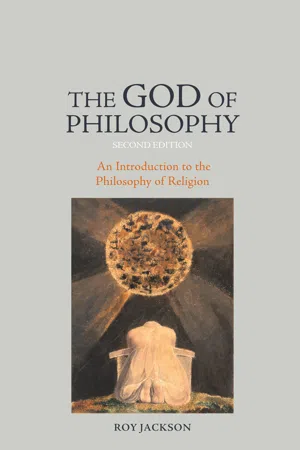
- 192 pages
- English
- ePUB (mobile friendly)
- Available on iOS & Android
eBook - ePub
About this book
For centuries philosophers have argued about the existence and nature of God. Do we need God to explain the origins of the universe? Can there be morality without a divine source of goodness? How can God exist when there is so much evil and suffering in the world? All these questions and many more are brought to life with clarity and style in The God of Philosophy. The arguments for and against God's existence are weighed up, along with discussion of the meaning of religious language, the concept of God and the possibility of life after death. This new edition brings the debate right up to date by exploring the philosophical arguments of the new atheists such as Richard Dawkins, as well as considering what the latest discoveries in science can tell us about why many believe in the existence of the divine.
Information
1 The concept of God
DOI: 10.4324/9781315730028-1
The fault lies not with God, but with the soul that makes the choice.(Plato, Republic)
Before we consider the various arguments for and against the existence of God, we need to have some appreciation of the historical, philosophical and theological understanding of the term ‘God’. This is important, because the understanding of God will have obvious implications in terms of defending his existence. What is also significant in terms of the philosophy of religion is the massive impact Greek philosophy has had on Christian belief.
1 The God of the Greeks
1.1 Plato
Plato is one of the founding fathers of Western philosophy and he has had a massive impact on religious and philosophical thought. He lived from around 427–347 bce, spending most of his life in Athens. Plato founded the Academy in Athens and this institution has often been described as the first European university. Here people studied works in philosophy, politics, mathematics, theology and the sciences for nearly a thousand years.
The importance of Plato’s philosophy for religious belief cannot be overestimated. As we shall see, some of the greatest Christian thinkers were familiar with the teachings of Plato, and his works were also translated into Arabic where they were a powerful force in Islamic philosophy.
However, there is another important philosopher that we should mention who was alive before Plato. At around twenty years of age, Plato met a remarkable man: Socrates. Because Socrates himself wrote nothing down, what we know of his teachings is mainly through Plato’s works.
The main (although by no means only) concern for Socrates was morality. Whereas Socrates believed in absolute standards, there were a group of itinerant teachers who thought the opposite: the Sophists. The greatest Sophist of all, Protagoras, famously declared that “Man is the measure of all things”. By that he meant that it was mankind that established what is right or wrong, not the gods or the existence of a morality independent of man. In other words there is no such thing as an absolute morality, rather it is relative to the individual, the period or the society. This, of course, has important implications for our knowledge of things. If morality is relative, then it is impossible to say that one thing is ‘good’ and another is ‘bad’. For example, the practice of slavery was seen as quite acceptable for the ancient Greeks (it wasn’t even perceived as a moral issue) whereas, in our society, it is considered an immoral practice. We would like to believe that our morality is more ‘enlightened’ in this respect, but to suggest such a thing implies that there is a ‘good’ morality and a ‘bad’ morality: that to return to the practice of slavery would be regressive. However, if there is no such thing as an absolute moral standard, then you cannot either ‘regress’ or ‘progress’; it is just a relative matter.
Socrates considered this implication, that there can be no moral standards, as simply unacceptable. There must be standards, there must be such a thing as a moral Truth. This was effectively Socrates’ mission in life: to ‘interrogate’ the man in the street, to get them to question their beliefs and subject them to philosophic scrutiny in order to determine what ultimately is right and wrong.
During Socrates’ latter years his beloved city of Athens was in decline. Its arch-enemy, the militaristic state Sparta, defeated it in 405 bce. This proved to be a massive blow to its confidence and the belief in itself as the mightiest and most sophisticated city-state in Greece. It led the people of Athens to question what had gone wrong and to look for a scapegoat. Led, no doubt, by the politicians who sought power by following the prejudices and passions of the masses, the blame was directed towards Socrates. Athens, seeking security and identity, returned to its old traditions and saw in Socrates the man who most publicly questioned the beliefs in the gods and the old ways, as well as corrupting the youth with his disruptive ideas. As a result Socrates was arrested and was compelled to drink the poison hemlock as his method of execution.
When Socrates was executed, Plato was only twenty-nine years old. Plato was a student, indeed, a disciple, of Socrates, and the belief that there are such things as eternal truths was something that Plato took much further than the topic of morality. He believed that all knowledge is eternal.
The analogy of the cave
One reason why Plato has remained so popular after so many years is that he was aware of his audience. He wrote mostly in the form of a dialogue, with Socrates as the main character, so the reader feels that he is experiencing an unfolding drama. Plato appreciated the importance of explaining often-difficult concepts in a way that could be more readily understood. To achieve this, Plato would make use of analogy. An analogy is a way of comparing one thing with another to help bring out their similarity. For example, comparing the structure of an atom to the solar system helps you get a better (although inaccurate) image of how an atom is made up. Perhaps Plato’s best-known example of this form is the analogy of the cave.
This analogy is from Plato’s work the Republic. As usual in Plato’s dialogues, Socrates is the main character. It is Socrates who asks his fellow conversers to imagine a cave. Deep down at the bottom of this cave are a group of prisoners who are firmly shackled so that they cannot move or turn their heads. They can face in one direction only: the wall of the cave. These prisoners have been in this condition since they were very young children, so the wall of the cave is the only life they have known. Behind the prisoners there is a fire, and between this fire and the prisoners there are many people walking by, carrying artificial objects such as wooden figures of men and animals. A screen hides these people walking by, so that only the objects they are carrying appear above the screen. The fire casts a shadow of these objects on to the wall that the prisoners can see. The prisoners are not aware of what is happening behind them, so, for them, the whole of their reality consists of the shadows cast on the wall of the cave. Even the voices of the people walking behind them they interpret as coming from the shadows.
However, Socrates then tells of one of the prisoners who is freed from his chains and is forced to turn around, look and walk towards the fire and the people. The released prisoner naturally finds all this confusing and painful; the light of the fire is dazzling, the people like some strange creatures from another planet. The prisoner wants only to return to the safe and secure world that he has known, but he is then dragged further upwards towards the entrance of the cave. Exposed to the outside world, the prisoner is unable to adjust to the daylight. Only over time does he gradually grow used to it, first by perceiving the lights of the night sky, then the shadows of objects cast by the sun, and finally the objects themselves in broad daylight. In time, the released prisoner is even able to gaze at the sun itself. By being able to perceive the sun, the prisoner realizes it is the source of all things; it is the cause of the changing of the seasons and the giving of life.
Forced to experience the world outside, the prisoner undergoes a gradual awakening; an awareness that there is a more beautiful and real world that is so very different from the dark and superficial world that he has known all his life and was previously so keen to return to. The prisoner also realizes that all the things he previously felt were so important no longer matter and are all illusions. What, asks Socrates, would happen if the prisoner then returns to the world of the cave and tells the prisoners what he has seen? Would they welcome him and want to see this world for themselves? On the contrary, the other prisoners would think he had gone mad, for he would not be able to make out the shadows anymore and would come across as a bumbling fool. If the released prisoner attempted to release them by force, they would threaten him and even kill him if they had to.
The theory of the Forms
The curious tale of the cave works on many levels. What is it meant to teach us? On one level, the audience of the time would have recognized the released prisoner as Socrates himself: the man who dared to question the conventions of his time; the man who claimed that there was a greater, better, truer world beyond the trivia of everyday life; the man who ultimately had to pay with his life for forcing others to question those things they held so dear. On another level, the released prisoner is every philosopher; anyone who searches for truth and sees it as their mission in life to teach this truth to others, regardless of the dangers.
At another level, however, the analogy of the cave is Plato’s way of explaining the theory of the Forms. What are these ‘Forms’? The French poet and writer Antoine de Saint-Exupéry recounts in his book The Little Prince how, as a child, he lived in a house where there was supposed to be some buried treasure. The treasure, of course, was never found but it was the possibility that it might exist that gave the house a magical quality. As Saint-Exupéry says, “What is essential is invisible to the eye”. This is what Plato also meant by the Forms; they are the ‘essential’ things that are invisible to the eye or our other senses.
In the Republic, Plato points out that the analogy is a picture of the human condition. People are trapped within the illusory world of the senses like the prisoners at the bottom of the cave. However, Plato believed that it is possible to escape from this illusion and to perceive the truth that exists within our very souls. For example, we can see many beautiful things: a beautiful sunset, a beautiful person, a beautiful flower. But what is beauty itself? How do we know that so many different kinds of objects share the attribute of ‘beauty’? For Plato, we know what beauty is because there exists a ‘Form’ of beauty; Beauty itself. In fact, everything has a Form; a table, a tree, a horse.
For Plato, the Forms represent truth, or reality. They cannot be attained by the senses (touch, taste, smell, sight or hearing), but through the exercise of the mind. However, these Forms are independent of the mind: they are eternal, unchanging and perfect. Our knowledge of the Forms is innate, contained within our very souls, so when we perceive them we are recollecting our knowledge of the Forms, of truth.
Plato and religion
For Plato, therefore, there are two realms. There is the visible realm, that is the world of matter, of the senses, of change, the world in which everything is always becoming something else, the world where everything is imperfect and subject to decay. However, there is the other realm, the intelligible realm in which there is perfection, permanence and order. This is the unchanging, the timeless realm. It is reality. The implications of the existence of these two realms is that man is faced with a choice: to live a life ‘in the shadows’, living an animal existence and pursuing pleasures and prizes that are temporal and fleeting; or to exercise our powers of reason and achieve awareness of the eternally good and beautiful. The latter option is the most difficult, for it requires self-discipline, a denial of sensual pleasures and the temptations of the world. Plato saw the weaknesses of the body as an ‘evil’ that gets in the way of the pursuits of the mind. Bodily pleasures and desires hinder the progress of the eternal soul in its journey towards the realm of the Forms.
All of this will be familiar to many religious believers, especially within the Christian tradition. This is no coincidence. In many respects, the Bible of the Jews – the Hebrew Scriptures – is very different from what became the New Testament. Early Christianity developed its doctrines within the Roman Empire; a society that was culturally bound to Greek philosophy. St Paul (c.3–62 ce), the man who more than any other promoted and developed Christian thought, was born a Jew, educated a Greek and raised as a Roman citizen. To make Christianity accessible and understandable to the Roman mind, it was necessary to incorporate Greek thought within it. Socrates and Plato were considered ‘Christians before Christ’; they paved the way for the coming of Christianity by providing it with philosophical and theoretical foundations that would be acceptable to the Western mind.
In the analogy of the cave, the sun represents the Form of the Good. In the same way that the sun is the source of all things and gives light to them, the Form of the Good is over and above the other Forms, giving them light and allowing us to perceive them. Therefore, when you have awareness of the Form of the Good you have achieved true enlightenment. In Christianity, the Form of the Good becomes God: the source of all things.
1.2 Aristotle
The nature of being
Aristotle (384–322 bce) was a student of Plato’s at the Academy. However, he later criticized Plato’s Forms because he could not see how such things could exist, or what possible evidence there is for their existence. Plato, for example, argued that there is a Form for our morals. That is to say, there is a Form for justice so that, when we can perceive the Forms, we will know what to do in moral situations. Aristotle, however, believed that morality is such a changeable thing that it is impossible for something like a Form, so unchangeable and universal, to be applied to everyday situations.
A crucial question for Aristotle was, what is being? Aristotle was raising an important and interesting problem here. We can accept that the whole universe is made up of ‘stuff’ or ‘matter’. But how does this matter, this raw material of the universe, become existing things? How does a pile of matter ‘turn into’ a planet, a sun, a tree, an animal? What gives things their being?
For Plato, ‘being’ resides in the realm of the Forms. Raw matter is turned into things through the artistry of the ‘Demiurge’, the divine creator. In Christianity, God is the grand artisan, the designer and builder. However, Aristotle believed that we should look to this world for the nature of things. For example, what makes a car what it is? It is not simply the material – the metal, the glass, the rubber, the plastic and so on – that makes it a car; if you were to buy a car and it was delivered to your door as a heap of unconnected materials you would not be too happy. Rather, what makes a car what it is – what gives it being – is its structure or its form. Whereas, for Plato, there is a metaphysical Form of a horse, for Aristotle, the form lies within the species of horse, not outside of it.
The four causes
If we are not prepared to accept that there is a Grand Designer of some kind that gives things their form, then we are led down the path of materialism. That is, all that exists is matter and nothing else. However, the problem here is, how can matter become something? What is the motivating force behind, or within, matter that causes it to form into a tree or an animal? For Aristotle, there are four...
Table of contents
- Cover Page
- Half Title Page
- Title Page
- Copyright Page
- Dedication
- Table of Contents
- Introduction
- 1 The concept of God
- 2 The cosmological argument
- 3 The teleological argument
- 4 The ontological argument
- 5 The moral argument
- 6 The argument from religious experience
- 7 Miracles
- 8 Faith and reason
- 9 Religious language
- 10 The problem of evil and the free-will defence
- 11 Life after death
- 12 The ‘origins’ of God and the new atheism
- Index
Trusted by 375,005 students
Access to over 1.5 million titles for a fair monthly price.
Study more efficiently using our study tools.
Frequently asked questions
Yes, you can cancel anytime from the Subscription tab in your account settings on the Perlego website. Your subscription will stay active until the end of your current billing period. Learn how to cancel your subscription
No, books cannot be downloaded as external files, such as PDFs, for use outside of Perlego. However, you can download books within the Perlego app for offline reading on mobile or tablet. Learn how to download books offline
Perlego offers two plans: Essential and Complete
- Essential is ideal for learners and professionals who enjoy exploring a wide range of subjects. Access the Essential Library with 800,000+ trusted titles and best-sellers across business, personal growth, and the humanities. Includes unlimited reading time and Standard Read Aloud voice.
- Complete: Perfect for advanced learners and researchers needing full, unrestricted access. Unlock 1.5M+ books across hundreds of subjects, including academic and specialized titles. The Complete Plan also includes advanced features like Premium Read Aloud and Research Assistant.
We are an online textbook subscription service, where you can get access to an entire online library for less than the price of a single book per month. With over 1.5 million books across 990+ topics, we’ve got you covered! Learn about our mission
Look out for the read-aloud symbol on your next book to see if you can listen to it. The read-aloud tool reads text aloud for you, highlighting the text as it is being read. You can pause it, speed it up and slow it down. Learn more about Read Aloud
Yes! You can use the Perlego app on both iOS and Android devices to read anytime, anywhere — even offline. Perfect for commutes or when you’re on the go.
Please note we cannot support devices running on iOS 13 and Android 7 or earlier. Learn more about using the app
Please note we cannot support devices running on iOS 13 and Android 7 or earlier. Learn more about using the app
Yes, you can access The God of Philosophy by Roy Jackson in PDF and/or ePUB format, as well as other popular books in Teología y religión & Historia y teoría filosóficas. We have over 1.5 million books available in our catalogue for you to explore.