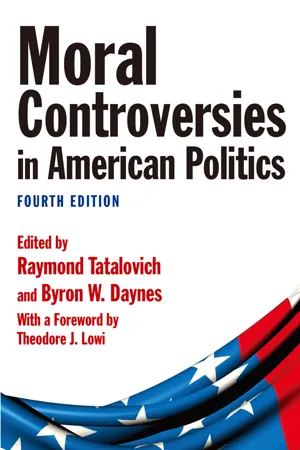
No area of public policymaking is more hotly debated than the use of government authority to enforce certain standards of behavior in areas of moral controversy. Now thoroughly revised and updated, this collection examines a variety of such policy areas - ranging from abortion and affirmative action to gay rights - including two new chapters on animal rights and hate crimes. In discussing each policy area the book examines relevant issues and arguments, as well as policy shifts over time. It considers the roles of key political and institutional actors in policymaking - including lobbies and interest groups, the bureaucracy, the president, Congress, the judiciary, and state and local authorities. Written in an accessible style that is sure to spark classroom discussion, each chapter of this new edition includes a list of relevant books, web sites, and videos for further research.
Near the thirtieth anniversary of the watershed decision of Roe v. Wade, Norma McCorvey, the original plaintiff in the case, announced that she would petition the Supreme Court to reopen Roe. Based on changes in law and technology since 1973, McCorvey sought to have Roe overturned. Also, since the 1973 ruling, the nine original Roe justices have died or retired. Although McCorvey was not successful in her bid to overturn Roe, the abortion question is far from settled, and Roe v. Wade could be significantly modified or even overruled. President George W. Bush, a self-proclaimed pro-life advocate, appointed two more justices to the high court—Justice Samuel Alito and Chief Justice John Roberts—both of whom have not only expressed concerns about Roe v. Wade but have also voted pro-life in the major abortion cases before them.
The abortion wars between pro-choice and pro-life advocates continue in Congress, the state legislatures, and state and federal courts. Roe opens up many unanswered questions: “When does life begin?” and “When should the fetus be given the chance to develop and thrive?” It pushes society to ponder reproductive privacy, the degree of bodily integrity guaranteed to women, and the extent to which abortion is an individual right. The abortion issue divides people into seemingly irreconcilable camps—those who sponsor family values and the rights of the unborn versus those who champion women’s individual rights and choice.
Before her appointment to the Supreme Court, Ruth Bader Ginsburg argued that Roe stymied the political process that already was moving in a reformist direction and significantly prolonged the abortion controversy by making consensus less likely.1 The framing of abortion as a right may have undercut the emerging consensus that favored abortions for therapeutic or medical purposes. Undoubtedly the trimester formula in the Roe ruling opened the door to the viability issue and intensified the moral debate over when a fetus becomes a person who therefore deserves due-process guarantees. Because the issue has been framed in the United States as a question of a woman’s right to bodily integrity and privacy versus a fetus’s right to life—unlike in Europe, where it is considered a public health concern— common ground and compromise in the political arena have been almost impossible to attain.
Historical Evolution of the Abortion Issue
Abortion was not always considered an offense under Roman law or Catholic canon law, and throughout most of the 1800s there were no national legal restrictions on obtaining an abortion in the first few months of pregnancy. The standard of quickening (or the first notice of fetal movement by a pregnant woman) was used to determine whether abortion was permitted in any given case. English common law throughout most of the nineteenth century did not recognize fetal rights in criminal prosecutions until quickening.2 The quickening standard became controversial in 1821 when Connecticut—a predominantly Catholic state—enacted the first statute making abortion illegal after quickening. Missouri (1825), Illinois (1827), and New York (1828) followed suit, but the New York law was unique in its “therapeutic” qualification, legalizing abortions necessary to save a mother’s life. Sixteen more states adopted restrictive abortion laws between 1830 and 1849, mostly making abortion a crime after quickening. Maine’s law made any method of abortion a crime except if the mother’s life was in danger.3 During the period between 1840 and 1870, estimates hold that there was one abortion for every five to six live births. Abortion was a highly visible, frequently performed, commercial procedure from 1800 through 1870.4
A chilly climate toward the abortion procedure was created during the mid-nineteenth century by the medical community, which mobilized to oppose abortion on moral grounds and amid fears that abortions were not being performed safely.5 The American Medical Association (AMA) lobbied against abortions obtained without a physician’s designation of the abortion as “therapeutic.”6 Dr. Horatio Storer, an obstetrician and gynecologist who led a movement to criminalize all abortions, eventually persuaded the AMA to pass a resolution in 1859 that urged state legislatures to forbid all abortions. As a consequence, most abortions were outlawed in most states during the Civil War period.7 Abortions were permitted only if, in the opinion of the physician, a woman’s life was at stake. Ten states required the concurring opinion of a second physician.8
In 1873 Congress passed the Comstock Act, which aided and abetted the antiabortion agitation. This antiobscenity law also included a ban on the transportation through the mails of any drug, medicine, or object that could be used for abortion or contraceptive purposes and a prohibition on mailing advertisements of such items.9 In effect, the Comstock Act stifled dissemination of information and discussions about birth control or abortion.
The historical record is important to the modern abortion controversy, especially the rationales offered for why antiabortion restrictions emerged. According to pro-choice advocates and some feminists, declining birth rates, especially among native white Protestants as compared to immigrant Catholics, was a major concern. According to this argument, the passage of antiabortion laws arose in part out of a nineteenth-century desire to promote homemaking as a vocation by increasing the birth rate among middle-class women and to decrease it among the lower class. This perspective is supported by estimates that by 1900 it was unwed lower-class women or immigrant wives that sought and obtained abortions, not married, middle-class, Protestant women.10
Another perspective is that abortions were banned in order to save women from themselves, because early surgical abortion procedures exposed women to risks and possibly death. In 1828, for example, one estimate of the death rate from sepsis after abortion surgery was greater than 30 percent. Still another perspective held that antiabortion laws came about due to the public’s and medical community’s disgust at the commercial spectacle and large profits earned from performing abortions.11 A pro-life argument that emerged in the twentieth century advocated protecting not only the mother but also the fetus, holding that under the Fourteenth Amendment the unborn had due-process rights.12
Once federal and state antiabortion laws were in place, a period of quietude reigned in the American social and political landscape from 1900 through 1950, at least on the surface. Data on illegally obtained abortions during this period suggest that women continued to have them at roughly the same rate, despite the newly enacted restrictions.13 By the 1950s, hospitals had established abortion committees to process requests for abortions and to designate whether, in the judgment of the physician, the abortion was necessary to save the mother’s life.14 In 1955 Planned Parenthood sponsored a conference on abortion, promising to keep the event “quiet,” and for the first time since the criminalization of abortion, physicians and other professionals attending the conference called for legislative reforms that would make “therapeutic” abortion a matter between patient and physician.15 In 1959, one year after the Planned Parenthood conference proceedings were published, the American Law Institute (ALI), alarmed by illegal abortions in unsanitary conditions and back-alley deaths, proposed legalized abortions when the physical or mental health of the mother was at stake or when the child would be born with serious physical or mental defects.
The case of Sherry Finkbine in 1962 further highlighted the problems with existing antiabortion laws. A mother of four, Finkbine chose to have an abortion after learning that the drug thalidomide, which she had taken early in her pregnancy, caused gross birth defects. She petitioned an Arizona hospital to provide her an abortion (the hospital had routinely allowed such abortions in the past under a liberal interpretation of Arizona’s abortion statute), but when her story made the headlines in newspapers across the country, the local prosecutor threatened the assisting physician with arrest, and subsequently the hospital canceled the surgery. (Finkbine eventually obtained the abortion abroad.) Also in 1962, in Grove, Oklahoma, Dr. W. J. Bryan Henrie was convicted of a crime—performing abortions—and was sentenced to two years in jail. After serving his sentence, Dr. Henrie began a solo campaign to liberalize abortion laws.16
In the mid-1960s Lawrence Lader, who authored a book on family- planning advocate Margaret Sanger, started pushing for abortion law reform. Two pro-choice groups—the Association for the Study of Abortion (New York-based) and the Parents’ Aid Society—were created in 1964. Patricia Maginnis, founder of the San Francisco-based Society for Humane Abortion, in 1965 advocated repeal of all abortion restrictions in order to give women rather than physicians control over the abortion decision. Maginnis also established an underground operation that reportedly sent thousands of women seeking abortions to Mexico, Japan, Sweden, and other less hostile environments.17
In 1968 the National Association for the Repeal of Abortion Laws was formed (originally named the New York Abortion Rights Action League and one year later renamed the National Abortion Rights Action League, or NARAL). In the late 1960s the liberalization movement began to develop a national base of support. The National Organization for Women (NOW) in 1967 adopted a plank demanding the right of women to control their reproductive capacities and, therefore, seeking repeal of restrictions on access to abortion. In 1968 the American Civil Liberties Union (ACLU) also called for the repeal of all criminal abortion laws, and the Planned Parenthood Federation reversed its earlier position and endorsed abortion rights in 1969.
The liberalization movement resulted in eighteen states’ reforming their original antiabortion statutes. In 1966 Mississippi added rape as another therapeutic exception. In 1967 Colorado was the first state to adopt the American Law Institute guidelines proposed in 1959. N...
Table of contents
Cover
Half Title
Title Page
Copyright Page
Dedication
Table of Contents
List of Tables and Figures
Foreword: New Dimensions in Policy and Politics
Introduction: Moral Conflicts and the Policy Process
1. Abortion: Pro-Choice Versus Pro-Life
2. Death Penalty: Just Punishment or Legalized Homicide?
3. Gay Rights: Nature or Nurture?
4. Hate Crimes: Protected Prejudice or Punishable Motive?
5. God and Country: Debating Religion in Public Life
6. Gun Control: Constitutional Mandate or Myth?
7. Global Warming: Environmental Crisis or Scientific Hoax?
8. Animal Rights: Subordinate or Equal Species?
About the Editors and Contributors
Index
Trusted by 375,005 students
Access to over 1.5 million titles for a fair monthly price.
Study more efficiently using our study tools.
Frequently asked questions
Yes, you can cancel anytime from the Subscription tab in your account settings on the Perlego website. Your subscription will stay active until the end of your current billing period. Learn how to cancel your subscription
No, books cannot be downloaded as external files, such as PDFs, for use outside of Perlego. However, you can download books within the Perlego app for offline reading on mobile or tablet. Learn how to download books offline
Perlego offers two plans: Essential and Complete
Essential is ideal for learners and professionals who enjoy exploring a wide range of subjects. Access the Essential Library with 800,000+ trusted titles and best-sellers across business, personal growth, and the humanities. Includes unlimited reading time and Standard Read Aloud voice.
Complete: Perfect for advanced learners and researchers needing full, unrestricted access. Unlock 1.5M+ books across hundreds of subjects, including academic and specialized titles. The Complete Plan also includes advanced features like Premium Read Aloud and Research Assistant.
Both plans are available with monthly, semester, or annual billing cycles.
We are an online textbook subscription service, where you can get access to an entire online library for less than the price of a single book per month. With over 1.5 million books across 990+ topics, we’ve got you covered! Learn about our mission
Look out for the read-aloud symbol on your next book to see if you can listen to it. The read-aloud tool reads text aloud for you, highlighting the text as it is being read. You can pause it, speed it up and slow it down. Learn more about Read Aloud
Yes! You can use the Perlego app on both iOS and Android devices to read anytime, anywhere — even offline. Perfect for commutes or when you’re on the go. Please note we cannot support devices running on iOS 13 and Android 7 or earlier. Learn more about using the app
Yes, you can access Moral Controversies in American Politics by Raymond Tatalovich,Byron W. Daynes,Theodore J. Lowi in PDF and/or ePUB format, as well as other popular books in Politics & International Relations & Economic History. We have over 1.5 million books available in our catalogue for you to explore.