eBook - ePub
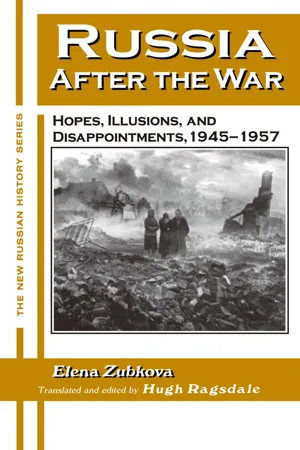
Russia After the War
Hopes, Illusions and Disappointments, 1945-1957
- 250 pages
- English
- ePUB (mobile friendly)
- Available on iOS & Android
eBook - ePub
Russia After the War
Hopes, Illusions and Disappointments, 1945-1957
About this book
The years of late Stalinism are one of the murkiest periods in Soviet history, best known to us through the voices of Ehrenburg, Khrushchev and Solzhenitsyn. This is a sweeping history of Russia from the end of the war to the Thaw by one of Russia's respected younger historians. Drawing on the resources of newly opened archives as well as the recent outpouring of published diaries and memoirs, Elena Zubkova presents a richly detailed portrayal of the basic conditions of people's lives in Soviet Russia from 1945 to 1957. She brings out the dynamics of postwar popular expectations and the cultural stirrings set in motion by the wartime experience versus the regime's determination to reassert command over territories and populations and the mechanisms of repression. Her interpretation of the period establishes the context for the liberalizing and reformist impulses that surfaced in the post-Stalin succession struggle, characterizing what would be the formative period for a future generation of leaders: Gorbachev, Yeltsin and their contemporaries.
Information
PART I
STRATEGIES OF SURVIVAL
Chapter 1
The Social Psychology of the War
The literature on the Great Patriotic War, as the Armageddon of the eastern front during World War II is known in Russia, is so large that it has generated a historiography of historiography. Hundreds, even thousands of books are devoted to military operations, to command staff proceedings, to the reasons for the early defeats and the subsequent victories, and to the study of defense industry and the organization of support in the rear. The history of the war, based on precise reports of the production of tanks and planes, comparative body counts, inventories of cities taken and lost, and assessments of strategic trumps and mistakes—all of this is, of course, a necessary part of history. It is, however, military history of a limited perspective. War has an additional face, the social dimension, which epic deeds at the front and labor heroism in the rear do not describe. The social history of the Great Patriotic War is often overlooked, it seems, because war is perceived as an interruption of normal life, or at least as a deviation from an imaginary norm. But conflict, tragedy, and disaster are part of Russian life, if not of life itself. More important, the wartime experience was the foundation for the outlook of many in the postwar generation, and the source of their expectations.
The social history of the war is still weakly represented in scholarship although it is abundantly recorded in letters from the front, diaries, soldiers’ memoirs, in the documentary publications of Ales Adamovich, Daniil Granin, and Svetlana Aleksievich;1 in the letters, interviews, and documentary films collected by Konstantin Simonov; and in the wartime prose of soldier-authors Viktor Nekrasov, Viktor Astafiev, Vasil Bykov, Boris Vasiliev, Grigorii Baklanov, and Viacheslav Kondratiev.2 These sources, although well known, have not yet been exploited systematically for research in social history.
The war itself is not the subject of this book. It is the reference point, the first chronological landmark. But not chronological only: the social psychology of the war years shaped all of postwar life. Without an understanding of the phenomenon of the war as it entered the flesh and blood of that generation, postwar history and social behavior are incomprehensible. We must therefore consider several social features of the war that subsequently influenced the formation of the postwar atmosphere.
Stalin prepared his people for the impending war, but it was a peculiar preparation. Peculiar not only in that on the very eve of the war he destroyed the leaders of the officers’ corps and bled the army white. The greater peculiarity was the particular concept of war that was stubbornly drilled into the minds of the people. In the first place, the war was represented as a counter-stroke, that is, as a defensive war, an act of retribution against the aggressor. Second, the people were persuaded that if war were unavoidable, it would be of short duration and would take place on enemy territory. No one thought that the war would spill over into the Soviet border districts. “With little loss of blood and a powerful blow, we will rout and destroy the enemy.” These words of a popular song were the leitmotiv of all the propaganda of the prewar period. Official propaganda inspired faith in the invincibility of Soviet arms. The war was portrayed not only as victorious and short but as inevitable. “If there is war, if there is a campaign tomorrow, let’s get ready today.” Such songs corresponded to the outlook of the people. Konstantin Simonov, reflecting on the characteristics of peacetime that formed the people’s expectations of war, described the popular attitude.
Above all, the psychological, ideological preparedness for sacrifices, the highest form of which was the sacrifice of life in battle, was learned from the Five-Year Plans…. The tempo of construction in the conditions of capitalist encirclement—either we become an industrial power or they will not respect us—was a tempo demanding sacrifice under great pressure, preparation for a sharp decline in living standards, for the interruption of ordinary life, for family separations, for so much of what war in various circumstances brings to people.3
People continued to live as usual, but in the back of their minds they were ready at a moment’s notice to unite with and to fight unreservedly with the army. The prewar atmosphere was saturated with a martial spirit reinforced by the militarization of all ranks of society: everyone belonged to at least one organization with a prescribed agenda of duties, be it a youth organization or a collective farm. Soviet society of the 1930s is commonly described as a grand barracks. If the description is in some respects apt, it is not so in all. From the viewpoint of its mentality, prewar society does not fully correspond to the barracks model, as many contemporaries did not feel themselves to be in a barracks atmosphere. Sergei Alekseev, now a corresponding member of the Russian Academy of Sciences, captured the difference in his own words.
In the face of all of the tragic features of life in those days, in the hearts and souls of us boys and girls a romantic spirit, a sense of joy and brotherhood, lived on …, and expressed itself, moreover, in moral matters…. Perhaps I am idealizing…. But it is dreadful for me to think of life now—or then either—without the clean, clear, civic romanticism of my youth that somehow served as a saving grace at the very height of the terrorist madness of Stalin’s dictatorship.4
We cannot, of course, attribute feelings characteristic especially of the younger generation to the society as a whole, but they give us an example of a social consciousness in prewar society close to that of the army. Notwithstanding the likeness of their outward appearance and the particulars of their internal organization (strict discipline, strong hierarchy, subordination to command, etc.), the army and the barracks are not one and the same. Intrinsic to the social psychology of the army is a spirit of militant morale not necessarily at home in the barracks. Practically all psychologists have observed this characteristic of the army. They disagree only in their various approaches: if Lev Voitolovskii identified such concepts as army and crowd, calling the former an “inspired crowd,”5 Gabriel Tard ranked the army in psychological organization higher than the crowd, emphasizing the principle of psychic unity characteristic of the army.6
Both army and barracks, as models of public organization subordinated to strong discipline, are ideally manageable units of administration. Moreover, the greater leveling of factors of personality in the barracks makes it even more submissive. Why, then, did the Stalinist regime deliberately cultivate the spirit of the army, never allowing society to retire completely into itself and stand apart as one gigantic barracks?
In fact, the explanation is clear: the psychology of the regime was to design a model administrative unit endowed with a clearly stipulated element of initiative, easily defined and easily revised—not for the sake of generosity but in order to establish a kind of collateral dedication to duty. The limited freedom of the unit of administration allowed it to execute the decision made on high in an optimal fashion, which it could not do if it were supervised heavy-handedly from above. The Stalinist personality in power was, on the one hand, “a mere executant,” as historian Mikhail Gefter wrote. On the other hand, “was not this same person all-powerful within the bounds of the authority granted him? This strange blend of plenary power and accountability conferred a kind of shock-brigade mentality.”7
Side by side with this shock-brigade mentality, however, was an entirely commonplace psychology of the barracks, and it was this contradictory state of affairs that explains the well-known paradox of the early period of the war. Society, so long and so fully prepared psychologically and ideologically for the impending attack, was simply shocked, was for a time paralyzed and incapable of the necessary response. How could this happen?
The shock of the first days and months of the war was produced not so much by the surprise attack as by the news of the Red Army’s retreat. No one was prepared for this news—not the army, the society as a whole, or Stalin himself. A difficult period of readjustment began as the disparate elements of society formulated something like the concept of “a people at war.” It was not an instantaneous process. The idea that everyone rose up as one man is, according to historian Gennadii Bordiugov, just another myth: “Some fought for socialism. Others thought not of socialism but of the Fatherland. Yet others, the bureaucratic time-servers, were paralyzed. Still others in the first days, weeks, and months simply joined the common cause of the people.”8
The first reaction of the leadership was to use the principles of barracks life to establish maximum administrative control of the army. This effort failed.9 It is not hard to understand why: the barracks had not even had time to mobilize. To undertake an attack on tanks with a .30-caliber rifle, a political commissar ahead and a machine gun behind, was hopeless. Something altogether different was needed, something coming purely from the human spirit, the spirit of self-sacrifice. The initiative of the people compensated for the paralysis of authority and the incapacity of the military command, though it cost, of course, millions of lives. Such was the price of the incompetence of the Stalinist system.
But this is a retrospective assessment. It does not reflect what took place in the hearts and minds of the people who voluntarily or otherwise departed for the front, fought, suffered defeat, and eventually triumphed. Understandably, many veterans reject the charge that their whole war effort was directed to the defense and support of the regime, which, without their stubborn commitment, would have simply disintegrated. Such charges are not only morally offensive; they are incompatible with the facts, as they overlook the chief consideration, the outlook of the front-line soldiers themselves. This outlook was not, of course, perfectly uniform and stable. The war was viewed differently from different vantage points—the trenches, the staff headquarters, the penal battalions, and the guards’ corps. But there were in the various perceptions of the war common factors shared by all. The soldiers’ letters and diaries often represent the experience of the front not in the usual halo of heroism but simply as an ordinary, stressful kind of life, the most terrible part of which was death. As people gradually grew accustomed to this new life, it was not the new but the old prewar life that seemed strange and unimaginable.
Thus the wishes of the soldier, as one of them, Mansur Abdulin, relates, “were most often the simplest: to have a good sleep, to bathe, to spend perhaps a week under a roof, to receive a letter from home. The grandest dream was to remain alive and to see what would become of life.”10 These were the thoughts of the soldiers at war. As the dream receded into the past, the very perception of the war years was transformed. As veteran Viacheslav Kondratiev put it, the war “was remembered fondly by those fighting it, because all that was physically terrible and dreadful was forgotten, and what remained was the inspiring side of it, that is, the bright and pure elements, the features of justice and liberation.” In sum, “the war was the most important experience of our generation.”11 Viktor Astafiev voiced similar reflections: “In the course of time you suddenly discover what your life has consisted of, what you are proud of, what you are sad about—and that is the war.”12 This acknowledgment reflects not only the experience of the war but the background of postwar life against which the war stands out as incomparably more vivid, and especially, more inspiring. The emotional temper of the war years was in many respects unique, not only by virtue of its extreme stress but above all because it required a reordering of previous priorities both in political and in human relations.
As paradoxical as it seems, the value of the individual rose just as whole armies were being lost, as the life of the soldier seemed to grow cheap. The psychological turning point, unrelated to the military turning point, grew out of the triumph over this paradox. For the war brought a rare opportunity for the spontaneous development among the people of a civic spirit, which for decades had been cultivated only as duties—often impractical and abstract—handed out by the regime. And suddenly this spirit acquired the flesh and blood of a concrete purpose, the defense of the Fatherland, in tandem with the historical traditions of the past. A person began to feel the sentiment of citizenship. “In the war I was indispensably necessary,” recalled the hero of Viacheslav Kondratiev’s story, “Znamenatelnaia data” (A Red-Letter Day). “Not just anyone could replace me. Let’s suppose that instead of me on this left flank was another soldier with the same weapon. And without the confidence that he could hold off the Germans, with a different gaze, different wits, and a weaker nature…. At the front you had the feeling that the fate of Russia lay in your hands alone.”13
The character of civic spirit is conveyed here surprisingly accurately: an inner overestimation of one’s self that acquires the imprimatur of society’s sanction (“I was indispensably necessary”). In this circumstance, the quality of personal spontaneity grows accordingly. It was no accident that many veterans remembered that in the war they felt freer than during peacetime. But free from what?
The well-known veterans’ saying that “the war cancels the past” is especially true of freedom. Thus in conditions in which the function and jurisdiction of formal controls over social behavior were restricted, the boundaries between such concepts as liberty and license were easily crossed. The place of formal control, which was earlier preemptive, was taken by self-control or informal control exercised by the informal social units that took shape in dugouts or common trenches. As a rule this informal outward and inward control was considerably more effective than the state system of comprehensive surveillance. In any event, as Konstantin Simonov wrote, the saying “the war cancels the past” did not acquire general currency at that time. “For all of its seductiveness, it was rarely...
Table of contents
- Cover Page
- Half Title Page
- Title Page
- Copyright Page
- Contents
- Translator's Introduction
- Part I Strategies of Survival
- Part II The Illusion of Liberalization
- Part III Repression
- Part IV The Thaw
- Notes
- Index
Trusted by 375,005 students
Access to over 1.5 million titles for a fair monthly price.
Study more efficiently using our study tools.
Frequently asked questions
Yes, you can cancel anytime from the Subscription tab in your account settings on the Perlego website. Your subscription will stay active until the end of your current billing period. Learn how to cancel your subscription
No, books cannot be downloaded as external files, such as PDFs, for use outside of Perlego. However, you can download books within the Perlego app for offline reading on mobile or tablet. Learn how to download books offline
Perlego offers two plans: Essential and Complete
- Essential is ideal for learners and professionals who enjoy exploring a wide range of subjects. Access the Essential Library with 800,000+ trusted titles and best-sellers across business, personal growth, and the humanities. Includes unlimited reading time and Standard Read Aloud voice.
- Complete: Perfect for advanced learners and researchers needing full, unrestricted access. Unlock 1.5M+ books across hundreds of subjects, including academic and specialized titles. The Complete Plan also includes advanced features like Premium Read Aloud and Research Assistant.
We are an online textbook subscription service, where you can get access to an entire online library for less than the price of a single book per month. With over 1.5 million books across 990+ topics, we’ve got you covered! Learn about our mission
Look out for the read-aloud symbol on your next book to see if you can listen to it. The read-aloud tool reads text aloud for you, highlighting the text as it is being read. You can pause it, speed it up and slow it down. Learn more about Read Aloud
Yes! You can use the Perlego app on both iOS and Android devices to read anytime, anywhere — even offline. Perfect for commutes or when you’re on the go.
Please note we cannot support devices running on iOS 13 and Android 7 or earlier. Learn more about using the app
Please note we cannot support devices running on iOS 13 and Android 7 or earlier. Learn more about using the app
Yes, you can access Russia After the War by Elena Zubkova,University of Alabama in PDF and/or ePUB format, as well as other popular books in Storia & Storia sociale. We have over 1.5 million books available in our catalogue for you to explore.