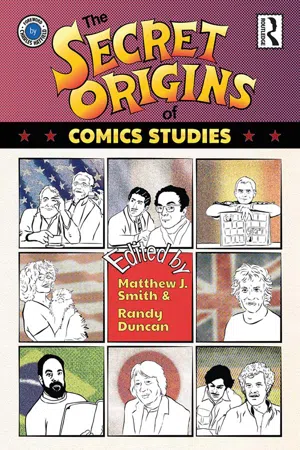
In The Secret Origins of Comics Studies, today's leading comics scholars turn back a page to reveal the founding figures dedicated to understanding comics art. Edited by comics scholars Matthew J. Smith and Randy Duncan, this collection provides an in-depth study of the individuals and institutions that have created and shaped the field of Comics Studies over the past 75 years. From Coulton Waugh to Wolfgang Fuchs, these influential historians, educators, and theorists produced the foundational work and built the institutions that inspired the recent surge in scholarly work in this dynamic, interdisciplinary field. Sometimes scorned, often underappreciated, these visionaries established a path followed by subsequent generations of scholars in literary studies, communication, art history, the social sciences, and more. Giving not only credit where credit is due, this volume both offers an authoritative account of the history of Comics Studies and also helps move the field forward by being a valuable resource for creating graduate student reading lists and the first stop for anyone writing a comics-related literature review.
eBook - ePub
The Secret Origins of Comics Studies
- 302 pages
- English
- ePUB (mobile friendly)
- Available on iOS & Android
eBook - ePub
The Secret Origins of Comics Studies
About this book
Information
PART 1
The Educators
1
EDUCATING WITH COMICS
Comics have been part of classrooms for at least a century. In the early 20th century, for instance, when tuberculosis was still a prominent health threat in the United States, a writer in the Journal of Education proposed that having students draw comics to highlight hygienic practices related to the disease was a useful instructional strategy (Routzahn, 1910). Around the same time, an English teacher at Columbia Teachers College’s Horace Mann School reflected on an instructional unit on newspapers and other periodicals. One group of students, he wrote, delivered a “highly interesting reflectoscope talk on cartoons” (Abbott, 1913, p. 423). A history teacher in Baltimore praised the use of comics in making history vital to students. He wrote, “a cartoon is, so to speak, a double exposure. It is a picture, not only of an individual, but of a public” (Millspaugh, 1914, p. 682).
This early interest in using comics as instructional aides is unsurprising. In the years after the Civil War in the United States, editorial and political cartooning flourished in popular periodicals and newspapers. In the first decade of the 20th century, newspapers’ pages swelled with cartoons and the new comic strips, incurring wide readership. These developments in the comics medium coincided with an interest in the new Progressive educational techniques of child-centered instruction, active learning, and the broader use of visual aids and technologies such as comics and reflectoscope, an early opaque projector (cf. Cremin, 1961, Saettler, 2004). The result was a burgeoning interest in bringing comics into educational settings.
This chapter surveys efforts—some systematic, others more idiosyncratic—to infuse comics into teaching and learning. It will emphasize cartooning in all of its forms, unlike McCloud’s Understanding Comics (1994), which excludes single-panel editorial and gag cartoons from comics’ sphere. Furthermore, the chapter will focus on efforts to integrate comics in primary and secondary-level teaching and learning in the United States during roughly the first half of the 20th century. Rather than focus exclusively on schools, this chapter will include libraries, museums, and similar sites of informal learning for young people. Further, it extends previous work by Nyberg (2002, 2010), Thomas (2011), Tilley (2013), and Tilley and Weiner (2016).
The Pioneers: Comics as Educational Tools before 1940
The examples noted in this chapter’s introduction describe some of the earliest documented uses of comics in primary and secondary school classrooms, but they are not the only ones. Of the early attempts to integrate comics into classrooms, perhaps none was as widespread or as widely known as Texas History Movies. The brainchild of Dallas Morning News’ managing editor E. B. Doran, Texas ran Monday through Friday during the school years 1926–1927 and 1927–1928. Dallas school superintendent Dr. J. F. Kimball reportedly gave his blessing to the project and came up with the name. Through more than 400 strips, Texas showcased the state’s history from the 16th through the 19th century. During the next several decades, these strips were collected into published volumes and distributed for use in schools throughout the state. Despite racial stereotyping common in comics of this era and an Anglo-centric focus, Texas seemed to be popular with teachers and students. Pulitzer Prize-winning writer Larry McMurtry recalled, “Texas History Movies…stopped two generations of Texas public school students dead in their tracks where history is concerned…The effect, not to mention the irreverence, of those comics would be hard to overstate” (2004, pp. 92–93).
In contrast to the widespread use of Texas History Movie, most other classroom applications of comics were modest and singular. Published editorial cartoons made their way into social studies classes, but at least one teacher proposed that students also draw their own cartoons to connect with current and historical events; in providing guidance to teachers who wished to emulate his practice, he encouraged them to emphasize “the idea involved and not the artistry of the production” (Wilson, 1928, p. 197). In language arts classes, comics provided opportunities for active learning. For instance, students presented on current events as expressed in editorial cartoons (Russell, 1914), gathered examples of grammar errors in comic strips and then created comics explaining preferred usage (Trovillion and Renard, 1917), and created comics for a class newspaper (Burkholder, 1914). In a secondary school English class in Athens, Ohio, students engaged in a variety of projects to help them understand Treasure Island. According to the teacher, one of the projects was “a booklet of the story done in pen pictures, with short sentences explaining each. The order was that of the comic strips minus the conversation” (Bryant, 1932, p. 139). Interestingly, the format Bryant described is similar to the one adopted by the artists who serialized Treasure Island in Malcolm Wheeler-Nicholson’s National Comics publications in the mid-1930s (cf. Tilley, 2013a).
It is quite likely that comics found their way into more classrooms than one might ascertain from reports by teachers. The National Council of Teachers of English (NCTE), the key organization representing language arts teachers at primary, secondary, and collegiate levels, published its first national curriculum document in 1935. As with many standards documents, one might argue that An Experience Curriculum in English (Hatfield, 1935), which embodied more than five years of work, articulated current practices as much as it set expectations for teaching and learning. The NCTE document included topics and activities that integrated more traditional language arts experiences with activities representing the everyday worlds of younger students. As detailed in Tilley (2013b), An Experience Curriculum encouraged teachers to discuss comic strips as part of lessons on taste discrimination and humor. It also urged teachers to use then-contemporary mass media such as newspapers in the classroom, heightening the likelihood of school-based encounters with comics.
Through clubs and convocations, schools helped young people engage with comics outside of formal learning activities. For instance, junior high students in Rochester, New York, in the 1920s could join more than five-dozen clubs (Sheehan, 1921). One of these clubs was Cartooning, which had a membership cap of 25 students and required prospective members to submit work samples for approval by the club’s director. A similar club was open to students at Ambridge Junior High School in Pennsylvania (Grose, 1929), and Cartooning was one of the representative high school clubs mentioned in an educational guidance text (Hill and Mosher, 1931). In at least one school, a cartoonist was invited to speak about his work: Herbert Johnson, a conservative political cartoonist with the Saturday Evening Post, spoke to students about newspaper and magazine comics during a convocation at the McKinley Preparatory School in Lincoln, Nebraska (Pyrtle, 1915).
Museums and libraries capitalized on children’s interests in comics to fulfill their goals for outreach and instruction. For instance, during the last half of the 1930s, the Cleveland Museum of Art began a cartooning club—for boys only—for children of members (Munro, 1936). In Chicago, the Art Institute offered occasional lectures on cartooning aimed at young people such as the one advertised for October 1927 (Bulletin, 1927). Chicago’s Field Museum of Natural History created a comic strip story, Joe Elk, to go along with one of its exhibits of North American Mounds Dwellers. It justified its decision by pointing to the comic strip-like Mixtec Codexes from the 15th century that shared the story of Eight Deer Jaguar Claw (Winn, 1944). At least one library, the Enoch Pratt Free Library in Baltimore, intended to use comic strips commissioned from cartoonist Richard Yardley of the Baltimore Sun, to help educate younger library users about library practices (Wheeler, 1935).
A handful of educational researchers studied the instructional value of comics during these years. One of them, Laurance Shaffer (1930), a doctoral candidate at Columbia’s Teachers College, studied more than a thousand children in grades four through twelve to understand how young people developed in their abilities to understand editorial cartoons. He found that the period of greatest development occurs in junior high-aged students and that the facility to interpret cartoons requires knowledge and skill just as progress in reading and mathematics does. In his conclusion, he recommended that cartoons be used in elementary school classrooms. A similar study by Lena Roberts Smith (1940) showed that there seems to be an association between interpretative abilities and intelligence, but that children regardless of ability would benefit from direct instruction in interpreting cartoons. Furthermore, she argued that “subject materials which may appear dull might be made to appear just a little brighter by the proper use of cartoons” (Smith, 1940, p. 67). Another researcher, Lewis Smith Jr. (1938) examined the literary merit of comic strips such as The Gumps and Tarzan. Using his analytic framework that included emotional richness and characterization, Smith determined that existing strips as a whole failed to meet the criteria of “literature.” Still, he proposed that “the construction of a comic dealing with child experience and utilizing the appeals of children on a literary level would result in the placing of literature in the hands of more children. Comics could become one of the most effective non-school educational agencies” (Smith, 1938, p. 94). This early and eclectic enthusiasm for comics, though, gave way to more focused attempts.
The Legitimizers: Comics in Classrooms during the 1940s and 1950s
Comics publishers—in particular, National (DC) Comics and its sometimes affiliate All-American Comics—helped to make comics a more legitimate tool for teaching and learning. As Tilley (2013a) details, National Comics, under the direction of its founding publisher Malcolm Wheeler-Nicholson, included a number of serialized classics such as A Tale of Two Cities and Ivanhoe in the pages of its general comics magazines throughout the mid- and late-1930s. National also experimented with reviews of juvenile books and illustrated poems. In the early 1940s, National and All-American Comics, the latter helmed by M. C. Gaines, regularized juvenile book reviews, printing a contribution from Josette Frank of the Child Study Association of America in the pages of nearly every issue between 1941 and 1945. National also worked with libraries to sponsor the “Superman Good Reading” project, which used the superhero to recommend books for young readers. Although none of their endeavors lasted more than a few years, both Wheeler-Nicholson and Gaines seemed to understand the educative and communicative potential of comics. Gaines in particular strived to make comics tools for learning through his later Educational Comics (EC, which became Entertaining Comics a few years after his death) line of Picture Stories from the Bible and similar titles.
More than publishers’ efforts, the sheer force that was comic books in the mid-20th century United States demanded that educators pay attention. The 1930s invention of comic books coincided with young people’s growing economic power and leisure time, quickly making this new format a publishing phenomenon that could not be ignored. Only two years after Superman’s debut in Action Comics, comic book sales outstripped traditional children’s books by a five to one margin (Bechtel, 1941), made all the more impressive by considering comics’ 10-cent cover price in comparison to the typical children’s hardcover that might cost two dollars. Comic books’ popularity astounded educators and educational researchers, and while many of them responded to the new format with fear and suspicion (cf. Tilley, 2007), some resolved to understand how this format might be usefully integrated into teaching and learning.
Foreign language instructors found easy purchase in comics of all kinds. A high school Spanish language instructor, for instance, reported ordering a variety of comics from Mexico, Venezuela, Cuba, Argentina, and Spain to supplement his students’ regular texts. He reported that students’ oral fluency had improved since reading comics, and that these books “broaden the range of pupils’ vocabularies and deepen their knowledge of structure, thus increasing reading comprehension” (Vacca, 1959, p. 291). Plus, he reported that their attitudes toward the class and language improved. In another instance, a teacher from the New Mexico Military Institute enlisted the school’s librarian for assistance in ordering Spanish-language Sunday newspapers so he could provide students with comics and other high-interest materials for reading (Hespelt and Williams, 1943, p. 454). Newspaper comics also found their way into college-level language classes. At the University of Cincinnati, Spanish students acted out the dialogues from the comics, taking the roles of various characters (Hutchings, 1946), while at Baldwin-Wallace College, students offered extemporaneous descriptions of action in nearly wordless comic strips like Henry (Sinnema, 1957).
NCTE’s Experience Curriculum continued to hold sway during these decades, making comics a continued feature of language arts classes. Often in English and similar classes, teachers made comics the center of discussions on reading taste and aesthetic appeal, hoping to persuade impressionable and dedicated comics fans to look elsewhere for their recreational reading. The approaches differed: for example, junior high students in Pennsylvania conducted surveys, held discussions, and even created their own comic strips, all in an effort to extend their reading beyond comic books (Something Better, 1952), while elementary school students in California investigated the folkloric and literary origins of characters like Superman, in hopes that those source texts might have greater appeal (Santa Barbara, 1942). A veteran high school teacher in Arizona, working from the decidedly Experience Curriculum strategy “to begin with the child’s interests” (Kinneman, 1943, p. 331), built a unit around comics that provided opportunities for discussion, analysis of appeals, and even the production of a multi-part radio program for parents and community members on the role of comics in young people’s lives. In one Buffalo, New York, classroom, the teacher even encouraged her fifth graders to read comics such as True Comics and Classics Illustrated for the purpose of preparing oral reports. These students presented their reports to an assembly of several classes, and the teacher noted that her colleagues “were impressed with the children’s dramatic appeal in their manner of speaking. This apparently reflected the appealing style of the comics. Possibly the writers of children’s texts may do well to study the style of the comics” (Denecke, 1945, p. 8).
Perhaps the most likely avenue for comics to enter classrooms during these years was as texts for remedial readers. Contemporary reading textbooks such as Adams, Gray, and Reese’s (1949) Teaching Children to Read and McCullough, Strang, and Traxler’s (1955) Problems in the Improvement of Reading, while not promoting the wholesale and indiscriminate use of comics in reading, saw value in meeting students at their current levels even if that meant using comics. Albert Harris, the author of How to Increase Reading Ability (1947), was more keen on comics: “Anything to which children respond as enthusiastically as they do to comic books must have educational values that can be developed” (p. 433). Similarly, in an article focused on...
Table of contents
- Cover
- Half Title
- Title Page
- Copyright Page
- Dedication
- Table of Contents
- List of Figures
- Foreword: Comics Studies, the Anti-Discipline
- Preface
- PART 1 The Educators
- PART 2 The Historians
- PART 3 The Theorists
- PART 4 The Institutions
- Contributors
- Index
Trusted by 375,005 students
Access to over 1.5 million titles for a fair monthly price.
Study more efficiently using our study tools.
Frequently asked questions
Yes, you can cancel anytime from the Subscription tab in your account settings on the Perlego website. Your subscription will stay active until the end of your current billing period. Learn how to cancel your subscription
No, books cannot be downloaded as external files, such as PDFs, for use outside of Perlego. However, you can download books within the Perlego app for offline reading on mobile or tablet. Learn how to download books offline
Perlego offers two plans: Essential and Complete
- Essential is ideal for learners and professionals who enjoy exploring a wide range of subjects. Access the Essential Library with 800,000+ trusted titles and best-sellers across business, personal growth, and the humanities. Includes unlimited reading time and Standard Read Aloud voice.
- Complete: Perfect for advanced learners and researchers needing full, unrestricted access. Unlock 1.5M+ books across hundreds of subjects, including academic and specialized titles. The Complete Plan also includes advanced features like Premium Read Aloud and Research Assistant.
We are an online textbook subscription service, where you can get access to an entire online library for less than the price of a single book per month. With over 1.5 million books across 990+ topics, we’ve got you covered! Learn about our mission
Look out for the read-aloud symbol on your next book to see if you can listen to it. The read-aloud tool reads text aloud for you, highlighting the text as it is being read. You can pause it, speed it up and slow it down. Learn more about Read Aloud
Yes! You can use the Perlego app on both iOS and Android devices to read anytime, anywhere — even offline. Perfect for commutes or when you’re on the go.
Please note we cannot support devices running on iOS 13 and Android 7 or earlier. Learn more about using the app
Please note we cannot support devices running on iOS 13 and Android 7 or earlier. Learn more about using the app
Yes, you can access The Secret Origins of Comics Studies by Matthew Smith, Randy Duncan, Matthew Smith,Randy Duncan in PDF and/or ePUB format, as well as other popular books in Social Sciences & Media Studies. We have over 1.5 million books available in our catalogue for you to explore.