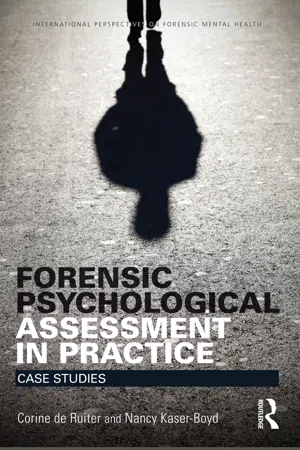
Forensic Psychological Assessment in Practice: Case Studies presents a set of forensic criminal cases as examples of a scientist-practitioner model for forensic psychological assessment. The cases involve a number of forensic issues, such as criminal responsibility, violence risk assessment, treatment planning, and referral to long term forensic care. Likewise, different types of offenses are covered, for example, sexual offending, arson, homicide, robbery and domestic violence. The authors address a variety of mental disorders including psychosis, posttraumatic stress disorder, psychopathy and other personality disorders. The book will be useful for novice and experienced forensic psychologists and psychiatrists who are looking for case studies that integrate the most recent empirical evidence with psychological test findings.
eBook - ePub
Forensic Psychological Assessment in Practice
Case Studies
- 298 pages
- English
- ePUB (mobile friendly)
- Available on iOS & Android
eBook - ePub
About this book
Information
1 The Forensic-Clinical Psychologist as Expert in Criminal Court
DOI: 10.4324/9781315723310-1
This book provides the reader with an intimate, detailed look into the casework of two forensic-clinical psychologists from different continents with different legal systems. Every clinical-forensic psychologist who offers her1 services as an expert witness to the legal arena needs to be cognizant of the way the law and the legal system operate in her jurisdiction. Because the authors work within different systems, the adversarial system of the US and the inquisitorial system of The Netherlands, this book also provides a unique opportunity to compare the role of the expert witness, the procedures and regulations governing her work, and the practical opportunities and limitations involved. This chapter will first provide a brief overview of the most important differences between the two legal systems. Second, the role of the forensic psychologist as expert witness in both systems will be reviewed, including specific regulations which determine the legal acceptance of expert testimony. Finally, the argument will be made that despite the conceptual differences between the two systems, actual practice may be more similar than predicted from theory. The final part of this chapter is devoted to a discussion of the unique characteristics of forensic mental health assessment (FMHA) in comparison to clinical mental health assessment. Besides differences in terms of context and assessee, FMHA requires use of specialist Forensic Assessment Instruments (FAIs) and independent data from collateral sources.
Adversarial versus Inquisitorial Justice
It is important to realize first that each adversarial system differs greatly from the other, and the same applies to the different inquisitorial systems (van Koppen & Penrod, 2003). In an adversarial system, legal proceedings are essentially a contest between two opposing parties (Crombag, 2003). The contest is governed by rules of fair play and the fundamental equality of the parties involved (van Koppen & Penrod, 2003). The adversarial model often includes judgment by lay peers (the jury system) and the oral presentation of evidence (Damaška, 1973). Because lay people are the decision makers, there is a strong emphasis on rules of evidence to assure jurors are presented with reliable evidence. In an adversarial system, the judge is the arbiter who decides on the admissibility of evidence (van Koppen & Penrod, 2003).
In the inquisitorial system, legal proceedings are considered an inquiry into the truth, which is the responsibility of the court (Damaška, 1973). Thus, for instance, plea bargaining is considered irreconcilable with the inquisitorial system, because it is in conflict with the search for truth (van Cleave, 1997). And even though oral presentation of evidence is not inconsistent with an inquisitorial system, it is a fact of tradition that inquisitorial systems have a preference for written presentation of evidence (Damaška, 1973; Nijboer, 2000). Another important difference is the absence of rules of evidence in inquisitorial systems, the assumption being that the judge is trusted with the task to weigh the evidence in line with its reliability (van Koppen & Penrod, 2003).
These theoretical differences between the systems result in a large number of practical differences. One of the most remarkable of these is the fact that in The Netherlands, police officers record all witness and suspect statements into sworn statements (in Dutch: proces-verbalen). These statements become part of the official case file and this emphasis on written documents makes Dutch courts reluctant to hear witnesses in court (van Koppen & Penrod, 2003), unless the judge deems the written information unclear or insufficient.
Of all European criminal justice systems, the Dutch is probably one of the most inquisitorial, compared to, for instance, the German and Scandinavian systems (Geeroms, 2002; van Koppen & Penrod, 2003). Still, there have been rather profound changes in criminal procedure as a result of the European Convention on Human Rights and Fundamental Freedoms and jurisprudence of the European Court of Human Rights (ECHR) in Strasbourg (van Kampen, 2003; Swart, 1999), as a consequence of which more adversarial elements have entered the legal system. Particularly, Article 6 of the European Convention refers to notions of equality of arms and the right to a fair trial. Entirely different from countries such as the US and Germany, in The Netherlands, there is no system of constitutional review by the courts. Had there been such a system, it is likely that the European Convention and the ECHR would have played a more limited role in public debates on civil liberties and basic individual rights in The Netherlands. Swart (1999) comments as follows: “The European Convention has become to the Dutch legal system what the national Constitution is to the legal systems of the United States of America or Germany” (p. 41).
The ECHR has come to exert an important influence in transforming a number of practices in Dutch criminal procedure; basically these transformations have made the system more adversarial and more civil rights-oriented. Not all of these changes will be listed here; the reader is referred to Swart (1999) for a more detailed discussion. Here, a few examples will be highlighted. First, the practice of not hearing witnesses (including experts) in court has changed due to jurisprudence of the ECHR ruling that the statement of a witness cannot be used as evidence against the defendant, unless the defense has been given an opportunity to question the witness (Unterpertinger v. Austria).2 Another area where the European Constitution and the ECHR have had a major influence on Dutch practice is access to legal counsel during police interrogations. In Art. 57, line 2 of the Code of Criminal Procedure, it is stated that: “The suspect is authorized to the assistance of counsel during the interrogation. Counsel is provided the opportunity to make the necessary remarks.”3 Still, in practice, it often happens that legal counsel is not present, especially not during the interrogations immediately after arrest, for practical reasons. In June 2009, however, the Dutch Minister of Justice wrote in a letter to parliament that in his opinion two ECHR decisions from 2008 (Salduz v. Turkey and Panovits v. Cyprus), even though not requiring the right to the presence of counsel during police questioning, did require adaptation of the legislation on the point of informing and providing legal assistance to suspects prior to police interrogation. The conclusion that the accused prior to the first police interrogation must have had the opportunity to discuss his trial position with counsel seemed inevitable (Letter of the Minister of Justice, June 8, 2009).4 Similarly, the videotaping of police interrogations has become much more common due to ECHR jurisprudence. In 2006, the Dutch Minister of Justice promised parliament the phased introduction of auditory or audiovisual registration of all police interrogations (Letter of the Minister of Justice, August 25, 2006).5 This resulted in a major logistical operation, with 30 interrogation studios for audiovisual registration built by July 2009. Since October 1, 2006 the legal obligation to audiovisual recording of interrogations of persons under 16 and intellec tually disabled individuals has been enforced.
Jury versus Professional Judges
One large difference between the legal systems of the US and The Netherlands is the fact the US has a jury system and The Netherlands has a system of professional judges. In cases of serious crime, the Dutch system employs a court comprising three judges. Lesser crimes are handled by a one-judge court, comparable to so-called “bench trials” in the US (Hans & Vidmar, 1986). The jury system brings with it one important difference between the two systems which is the two-stage justice process. First, the jury decides whether the defendant is guilty or not guilty (i.e., actus reus). In the second, sentencing stage, the professional judge decides on the sentence. This two-stage process has important implications for the clinical-forensic psychologist, because she may be brought into the procedure only at this second stage. In many cases, however, the forensic psychologist is asked to evaluate the defendant's mental state at the time of a crime (mens rea; Packer, 2009). In such cases, the psychologist's report, or testimony, might be amended and used for sentencing. In cases where the death penalty is a possibility, or where the defense of Not Guilty By Reason of Insanity (NGRI) is raised, there are three parts to the trial (guilt, sanity, and sentencing) and the forensic psychologist could be called to testify at any stage. In death penalty cases, there is a trial focused on guilt or innocence, and if the jury finds the defendant guilty of the “special circumstances” that lead to the death penalty, there is a separate hearing, with the same jury, that focuses on mitigation (Cunningham, 2010). Then the judge holds a hearing to pronounce sentencing. In The Netherlands, the stages of guilty and sentencing are merged, and it is up to the judges to ascertain that the two evidentiary issues (guilty/not guilty and criminal responsibility/ violence risk) are considered separately. As we will see in some cases in this book (e.g., Chapter 6) judges, like all human beings, are quite prone to expectancy bias and may have difficulty with rational and objective reasoning and decision making (McAuliff & Bornstein, 2012).
How a Suspect Goes through the Systems
Van Koppen and Penrod (2003) provided a bird's eye review of the US and Dutch criminal justice systems by demonstrating how a suspect of a robbery would be dealt with by either system. We will not completely restate their review here, but point out some important highlights, as they are relevant for the present book.
Upon arrest as a suspect, American police officers have to inform the suspect of his Miranda rights (after Miranda v. Arizona, 1966), i.e., the right to remain silent, the right to legal counsel, free counsel if necessary, and that anything the suspect says can be used against him in court. The Dutch police have to present the suspect with the so-called caution, i.e., that he has the right to remain silent. Even though the American suspect has a right to have counsel present during police interrogations, this right is often not invoked, for a variety of reasons, for example, confusion about when one can have a lawyer (Leo, 1996). As pointed out above, the Dutch suspect has the right to counsel during interrogations by the police based on ECHR rulings. In The Netherlands, a suspect who does not have the financial means to pay a legal counsel herself has the right to choose one who will then be paid by the government. In the US, a defendant of limited resources will be provided with a legal counsel paid for by public funds, such as a public defender or counsel appointed from a panel of attorneys paid by the jurisdiction (county, state, or Federal).
In both jurisdictions, obtaining confession evidence is an important goal of interrogations (van Koppen & Penrod, 2003). In the US, interrogations are often taped and transcribed and the forensic psychologist has access to the live version and the transcript. In the Dutch system, the police type down the confession statement in a proces-verbaal (see p. 2, this chapter), and whether the defendant adds his signature on the statement is not relevant. This important difference with the US system is related to the acceptability of hearsay evidence in Dutch criminal procedure. The Dutch Supreme Court ruled in 1926 that hearsay evidence is acceptable, by reasoning that a hearsay witness personally experienced what another person said (HR December 20, 1926, NJ 1927, 87). Under this ruling, the sworn statement of police officers with a display of the defendant's statement is as valuable evidence as the defendant's statement itself. Thus, even statements that have subsequently been withdrawn by the defendant can be used as evidence (see Chapter 6 of this book for an example of a case in point; van Koppen & Penrod, 2003). Thus, the legal principle of immediate observation as a witness is lost in Dutch criminal procedure. As mentioned above, the recent introduction of audiovisual recording of police interrogations has reintroduced the immediacy aspect to some extent. At the least, audiovisual recording helps to prevent police from representing a biased version of the defendant's statements.
A Dutch criminal investigation is led by the...
Table of contents
- Cover Page
- Half-Title Page
- Series Page
- Title Page
- Copyright Page
- Table Of Contents
- About the Authors
- Acknowledgements
- Foreword by Ronald Roesch, Series Editor
- Preface
- 1 The Forensic-Clinical Psychologist as Expert in Criminal Court
- 2 Domestic Estrangement and Familicide
- 3 Neonaticide in a Young Immigrant Woman
- 4 A Firesetter in Longstay Forensic Care
- 5 Indecent Exposure, Exhibitionism, and Other Paraphilias
- 6 Filicide or False Confession?
- 7 Domestic Violence: Evaluating the Effects of Intimate Partner Battering
- 8 An Adolescent Violent Offender: Avoiding Premature Labeling
- 9 Threat Assessment in Homicide/Suicide: The Duty to Warn
- 10 Mistakes or Malpractice: Ethics in the Practice of Forensic Psychological Assessment
- 11 Forensic Report Writing: The Science and the Story
- 12 Providing Effective Expert Testimony
- Index
Trusted by 375,005 students
Access to over 1.5 million titles for a fair monthly price.
Study more efficiently using our study tools.
Frequently asked questions
Yes, you can cancel anytime from the Subscription tab in your account settings on the Perlego website. Your subscription will stay active until the end of your current billing period. Learn how to cancel your subscription
No, books cannot be downloaded as external files, such as PDFs, for use outside of Perlego. However, you can download books within the Perlego app for offline reading on mobile or tablet. Learn how to download books offline
Perlego offers two plans: Essential and Complete
- Essential is ideal for learners and professionals who enjoy exploring a wide range of subjects. Access the Essential Library with 800,000+ trusted titles and best-sellers across business, personal growth, and the humanities. Includes unlimited reading time and Standard Read Aloud voice.
- Complete: Perfect for advanced learners and researchers needing full, unrestricted access. Unlock 1.5M+ books across hundreds of subjects, including academic and specialized titles. The Complete Plan also includes advanced features like Premium Read Aloud and Research Assistant.
We are an online textbook subscription service, where you can get access to an entire online library for less than the price of a single book per month. With over 1.5 million books across 990+ topics, we’ve got you covered! Learn about our mission
Look out for the read-aloud symbol on your next book to see if you can listen to it. The read-aloud tool reads text aloud for you, highlighting the text as it is being read. You can pause it, speed it up and slow it down. Learn more about Read Aloud
Yes! You can use the Perlego app on both iOS and Android devices to read anytime, anywhere — even offline. Perfect for commutes or when you’re on the go.
Please note we cannot support devices running on iOS 13 and Android 7 or earlier. Learn more about using the app
Please note we cannot support devices running on iOS 13 and Android 7 or earlier. Learn more about using the app
Yes, you can access Forensic Psychological Assessment in Practice by Corine de Ruiter,Nancy Kaser-Boyd in PDF and/or ePUB format, as well as other popular books in Psicología & Psicología forense. We have over 1.5 million books available in our catalogue for you to explore.