![]() Section II
Section II
Critical-Thinking Strategies That Fine-Tune Constructed Responses for Emerging and Independent Writers![]()
Chapter 4
Something on the Page That Helps You Remember What You Were Thinking
(Letters, Words, Phrases, Numbers, Symbols, or Drawings)
“All my students believe they can write when they come to me,” said a kindergarten teacher, Miss Robinson, to a group of student teachers I supervised early on in my career. “Most of them have been punished for writing on walls or on pages of books of checkbook registers. What makes many of them anxious is learning to read.”
“That’s not real writing, right?” quipped one of the students.
“That’s a fair question,” she responded. “It takes us right to the point. The first day of school, I tell the students that ‘writing is putting marks on paper that help you remember what you are thinking.’ This definition helps students know when they are writing and when they need to keep practicing.”
“You mean it doesn’t matter if students use letters and words when they write?”
“That’s right. Of course, a few of them write words and sentences from day one; the rest watch these few very carefully.”
“Don’t the ones who can’t write letters and words, uh, feel bad?”
“Not if they can remember what they were thinking when they drew or scribbled or borrowed words. That’s another really good question,” complimented the teaching veteran. “Let’s all have a seat at this large table in the back of the room, and I may answer most of your questions before you ask.”
She and I both knew she would.
The Remember Game for Emerging Writers
As she had with several student groups before, Miss R passed out a clean sheet of unlined paper to each student teacher seated around the expansive workspace.
“Follow my directions and you’ll see exactly how writing is the ultimate differentiator. It prompts all my kindergartners to trust what they are thinking.”
She directed students to draw a line from the top center of the page to the bottom and a line from center left side of the page to the right side. She showed what she had drawn as she directed them. Her page was divided into four equal quadrants.
“Nice,” she encouraged all who had created quadrants on their pages. “Now, place a tiny 1 in the corner of the box like I have” and showed them all a small number one in the corner of the upper left quadrant, “We’ll call this Box 1.” She continued to show them how to number all four boxes, “Now, put some marks in Box 1 that helps you remember the story we’ve read, ‘The Little Red Hen.’” Miss R shielded her writing, but the students could see she was modeling what she wanted them to do—write what they were thinking.
As always, the student teachers wrote exactly as directed.
with uppercase letters on each word like the title. Miss R showed them her page that had only one word in Box 1, three uppercase letters
“I borrowed the word red from the science word board on the cupboard by the sink,” she said as she gestured to the random arrangement of words around a color wheel behind the students.
“Now, here’s how the game proceeds. I direct them to place marks in the other three boxes that help them remember phrases from our study together:
- Three happy ghosts [It was just two weeks until Halloween.]
- The birthday circle [Juan’s mother brought cupcakes for his birthday today.]
- It’s raining outside [Indeed, it was, a fact indicated on the weather board.]
Miss R let me and the students write what we heard in boxes 1–3. She wrote the number three, the words birthday and rain in the boxes on her page. She held up what she had written and assessed the writing of the student teachers, “I see you have done as well as my kindergartners. Of course, it takes them ten minutes to write what took us about one, and they would include some nice drawings to elaborate on their thoughts and impress their teacher. I can see that didn’t cross your minds.” The students laughed as they looked at one another.
“Now it’s time for student self-assessment,” she announced as she stood and walked to a side bulletin board. “Here is our writing focus board. It’s the board that guides and stores our writing progress. As you can see it includes the Log of Entries (see p. 33) where I log a description of what we write and a place for us to post student exemplars for the nine patterns of writing development.”
“My students know that the minute they finish writing, they self-assess. For kindergarten, that means placing the number of the pattern that their writing resembles. I’ve already assessed my writing as a “5” since I borrowed all of the words I wrote from around the room: RED from the science word board, THREE from the math board, HAPPY and BIRTHDAY from the language boards, and RAIN from the science board.”
“Check out the nine patterns posted here, and decide which fits what you have written in your four boxes,” she guided the students through the nine patterns in the following way.
Picture Maker (1)— This writer spends his time on his art, then when he explains his work, he says what the picture brings to his mind at the moment. It is likely a different story each time.
Scribbler (2)— This writer has determined that writing is different from art. She mimics what she has seen older folks do as they write. She has even shown me her writing and asks me to read it for her. The best thing to do in this case is to ask what she was thinking when she was writing.
Verbal Story Teller (3)— In contrast to Pattern 1, this artist is more concerned about meaning than art. He tells a version of the same story each time he presents his writing to others.
Letter Shaker (4)— The writer of Pattern 4 shows a connection between the illustration and the letters. She writes letters from left to right; her story remains constant, but it may be due more to the illustration than the writing.
Borrower (5)— I demonstrated this pattern of writing in my model as I wrote with you. I borrowed a word from word walls and placed them on my paper, thinking they would help me remember all I’d said. It may not, but my story will remain the same. Borrowers know words are important in remembering writing and remembering their thoughts.
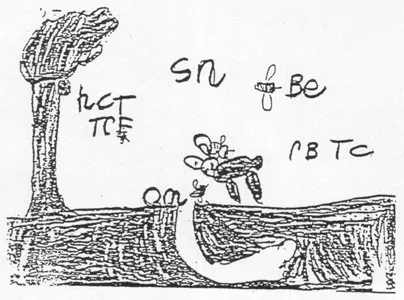
Sound Maker (6)— Moving beyond borrowing, this writer sounds out words she chooses to write with her illustrations. Since letter formation is tedious, few words actually appear. They may not be easily deciphered by others. This pattern is a critical hurdle for many kindergartners who suddenly worry about spelling, but you see, I haven’t, and don’t, mention the word spelling in writing. It’s just borrowing.
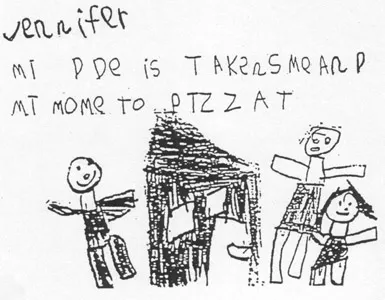
Labeler (7)— This writer is my budding Richard Scarry. She must feel compelled to label each feature of her illustration, writing quickly to provide all of the help that she can.
Sentence Maker (8)— This writer appears to have it all together and represents his thoughts in single sentences. When I ask him what more there is to the story, he gives me a look like What don’t you understand? I wrote the story. He may even read it again, this time a bit slower and louder for my benefit.
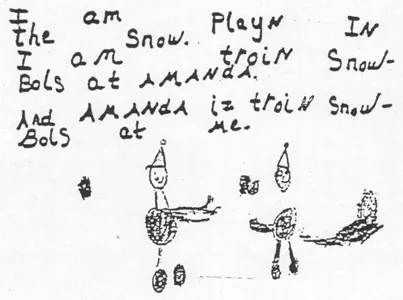
Story Maker (9)— In this writing, the proportion of letters to illustration has greatly increased. Notice the story line in these two sentences; the plot actually thickens, and the writer gladly tells you what happened next. He may even say he will write the rest later.
As Miss R finished, she asked the student teachers, “Well, there you have it; have you decided which pattern your writing fits?” One of them tentatively offered in the form of a question, “Pattern 9?”
“I know why you would think so, but let me be clear that none of you wrote sentences, so your writing is neither Patterns 8 nor 9. If you believe you borrowed what you wrote from me, your writing is Pattern 5. More likely, you labeled each box as I directed you, Pattern 7.”
One student raised her hand, “But none of us are...