![]()
1 Introduction
(Taken from ‘I CAN’, the national educational charity for children with speech and language difficulties.)
For most children, learning to communicate is something that happens naturally. However, for some children, something goes wrong. It’s not always known why it happens, but it’s more common than most people think. It has been estimated that over one million children in the UK have some kind of speech and language difficulty, which is equivalent to around one child in every classroom.
What is a speech, language or communication difficulty?
The term ‘speech, language and/or communication difficulty’ is an umbrella term, covering a wide range of speech, language and communication delays and disorders.
- Some children may have difficulty using certain sounds in words and can be unintelligible when they talk.
- Others have difficulty understanding words. Their vocabulary is small and they find gaining and remembering words extremely hard. These children need a lot of help extending their vocabulary, for example in school with subjects such as history and science, which have many specialist words.
- Some children have severe problems with grammar. For example, they might not be aware of the ‘ed’ marker at the end of a regular verb. As a result they would describe something that happened in the past as in the present tense.
- Others have difficulty coping with the order of words. A sentence such as ‘the boy was pushed by the girl’ may be interpreted as ‘the girl was pushed by the boy’.
- Some children have none of the above difficulties. They can pronounce words clearly, learn and remember new words and are able to put them in the right order using the correct grammar. Their difficulty lies in understanding or using words which express abstract ideas. Concepts such as time and distance hold little or no meaning. Their language is at a very literal level and they often do not see hidden meanings or implications.
- Language difficulties can affect children’s ability to read and write. For example, if children are not perceiving sounds accurately they won’t be able to reproduce them in spoken or written form.
- We use language to form relationships with others. Some youngsters with language difficulties find building friendships very difficult.
This is only a selection of the language and communication difficulties that children may experience and many may be affected by more than one.
Speech difficulties are easy to spot. By contrast, language difficulties can be more difficult to pinpoint and diagnose. In fact the latter are often called the ‘hidden’ learning difficulty. It is vital that class teachers feel that they are able to identify difficulties and incorporate appropriate objectives and strategies into their planning and differentiation.
The aim of this book is to provide class teachers with suggestions that will help them feel more able to support these children in school.
![]()
2 Inclusion in education
In order to understand the issues of speech, language and communication difficulties within the framework of the inclusion agenda, the following statements should be taken into consideration:
The Special Education Needs and Disability Code of Practice (2014) states that special educational needs and provision can be considered as falling under four broad areas:
- Communication and interaction
- Cognition and learning
- Social, mental and emotional health
- Sensory and/or physical.
Many children and young people have difficulties that fit clearly into one of these areas; some have needs that span two or more areas; for others the precise nature of their need may not be clear at the outset. It is therefore important to carry out a detailed individual assessment of each child or young person and their situation at the earliest opportunity to make an accurate assessment of their needs.
Communication and interaction
Children and young people with SEN may have difficulties in one or more of the areas of speech, language and communication. These children and young people need help to develop their linguistic competence in order to support their thinking, as well as their communication skills. Specific learning difficulties such as dyslexia or a physical or sensory impairment such as hearing loss may also lead to communication difficulties.
Those with speech, language and communication needs (SLCN) cover the whole ability range. They find it more difficult to communicate with others. They may have problems taking part in conversations, either because they find it difficult to understand what others say or because they have difficulties with fluency and forming sounds, words and sentences. It may be that when they hear or see a word they are not able to understand its meaning, leading to words being used incorrectly or out of context and the child having a smaller vocabulary. It may be a combination of these problems. For some children and young people, difficulties may become increasingly apparent as the language they need to understand and use becomes more complex.
Provision for children and young people with communication and interaction difficulties should reflect their likely need for support in developing social relationships and their increased risk of emotional or mental health problems. It may also cover support in making progress in related areas of learning such as literacy. Interventions might include creating rich oral language environments, individual support and augmentative and alternative means of communication.
In order to understand the issues of speech, language and communication difficulties within the framework of the inclusion agenda, the following statements should be taken into consideration:
- Inclusion recognises that all children have different abilities and experiences and seeks to value and gain from these differences. It is not about expecting or trying to make everyone the same or behave in the same way.
- Inclusion in education involves the process of increasing the participation of students in, and reducing their exclusion from, the cultures, curricula and communities of local schools.
- Inclusion involves restructuring the cultures, policies and practices in schools so that they respond to the diversity of students in their locality.
- Inclusion is concerned with the learning and participation of all students vulnerable to exclusionary pressures, not only those with impairments or those who are categorised as having ‘special educational needs.’
- Inclusion is concerned with improving schools for staff as well as for students. A concern with overcoming barriers to the access and participation of particular students may reveal gaps in the attempts of a school to respond to diversity more generally.
- All students have a right to an education in their locality.
- Diversity is not viewed as a problem to overcome, but as a rich resource to support the learning of all.
- Inclusion is concerned with fostering mutually sustaining relationships between schools and communities.
- Inclusion in education is one aspect of inclusion in society.
An inclusive culture is one in which:
- Everyone is made to feel welcome.
- Students help each other.
- Staff collaborate with each other.
- Staff and students treat one another with respect.
- There is a partnership between staff and parents/carers.
- All local communities are involved with the school.
- Staff and governors work well together.
Inclusive values are established when:
- There are high expectations of all students.
- Everyone has a philosophy of inclusion.
- Students are equally valued.
- Staff seek to remove all barriers to learning and participation in school.
- The school strives to minimise discriminatory practices.
![]()
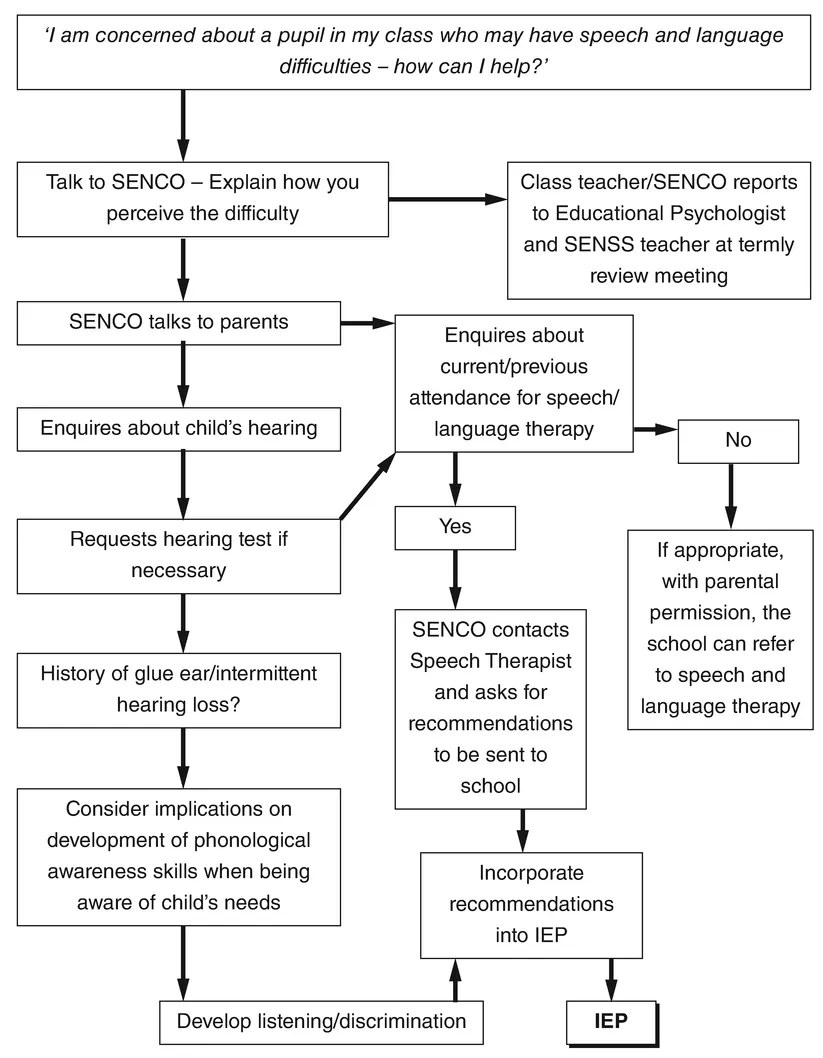
3 Flowchart: how can I help?
![]()
4 Attention, listening and memory skills
The following pages look at the areas of attention control, listening skills, memory and phonological awareness, which, while not language skills in themselves, are all vital precursors to language and learning.
Attention control refers to the ability to focus on a task and switch attention between activities. A school-age child would be expected to listen to information from the teacher while engaging in an activity at the same time. A child who is unable to do this will be at a considerable disadvantage. Language learning requires a fairly mature level of attention control.
Similarly if listening skills are poor, the child will find it difficult to learn new vocabulary and to acquire more sophisticated language skills. S/he may have difficulty developing the phonic skills necessary to be an effective reader.
The role of short-term auditory memory is also of great importance for it allows the child to hold and process information. The child who has memory difficulties will be unable to respond to follow instructions within the classroom and may well go on to have difficulties with reading.
Phonological awareness is the ability to recognise sounds within words. This may include recognising and discriminating between sounds within words, hearing and providing rhyming words or breaking up words into syllables. All these skills are important in the development of both spoken and written language.
![]()
5 Attention control: developmental stages
(From Helping Language Development by Cooper, Moodley and Reynell.)
Age levels are approximate; there is great variability.
Stage 1 During first year of life
Extreme distractibility — child’s attention held momentarily by whatever is the dominant stimulus.
Stage 2 Second year
Inflexible and rigid attention — child can concentrate for some time on a task of his own choice, but cannot tolerate any adult intervention. Attention level is best where the activity is one of his own choosing.
Stage 3 Third year
Single-channelled attention, but becoming more flexible. With adult’s help can focus attention. Child can transfer from his task to adult’s direction, and back to task. Attention is still adult-directed making it necessary for the teacher to ensure s/he has the child’s attention before giving instructions.
Stage 4 Fourth year
Still single-channelled to one task, but child can now transfer it spontaneously. Moves gradually to the stage where s/he only needs to look at the speaker if directions are difficult to understand.
Stage 5
Two-channelled attention, where the child is now able to attend to verbal instructions in relation to the task without actually looking at the adult. Attention ca...