eBook - ePub
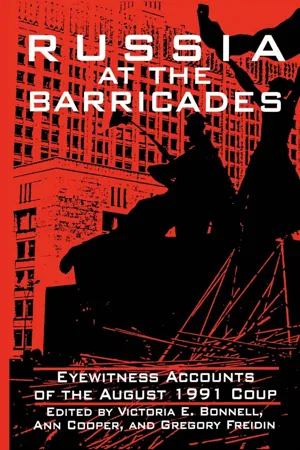
Russia at the Barricades
Eyewitness Accounts of the August 1991 Coup
- 384 pages
- English
- ePUB (mobile friendly)
- Available on iOS & Android
eBook - ePub
Russia at the Barricades
Eyewitness Accounts of the August 1991 Coup
About this book
What does the Congress do? How does it do it? Is the Congress up to the challenges ahead? This primer offers students an introduction to Congress and the role it plays in the US political system. It explores the different political natures of the House and Senate, and examines Congress's interaction with other branches of the Federal government.
III
In High Places
Between August 19 and 21, the barricades erected on the streets of Moscow and Leningrad came to signify the great divide that separated advocates of democratic reform from defenders of the old Communist order. In no group was this great divide more visible and wrenching than in the political elite—among those at the apex of the country’s government institutions, the Communist Party, and the military. For them, the coup was a moment of reckoning. Part III reveals how some of the leading figures in the Soviet political elite faced this challenge.
| MIKHAIL S. GORBACHEV | ||
1 | What Happened in Foros | |
After returning from his summer residence in the Crimea, where he was held incommunicado for three days, Gorbachev held his first press conference on Thursday, August 22. He devoted most of his long opening statement to an account of his and his family’s isolation at the Presidential compound in Foros, his dealings with the conspirators, and his attempts to resist their will. He spoke without notes and without pausing, ignoring the occasional gentle tugs of his press aide, Vitalii Ignatenko. It is this account, extractedfrom the opening statement, that we reproduce in its entirety.
[…] On August 18, at 4:50 P.M., I was informed by the head of [Presidential] security that a group of persons had come down to the compound and demanded to meet with me. I said that I was expecting no one, that I had not invited anyone, and that nobody had told me to expect anyone. The head of security, too, told me that he did not know anything about it either. “Then why did you let them in?” “Because,” was his answer, “they had the head of the Security Directorate of the KGB, [Yurii] Plekhanov, with them.” Otherwise the security people would not have let them pass into the President’s residence. Such are the rules; they are tough but necessary.
I decided to find out who might have sent them here. Nothing could be simpler, since I have at my disposal all means of communication: the ordinary [telephone] line, the government network, the strategic network, the satellite links, etc.… I picked up one of the telephones—I was working in my office just then—and it was dead. I picked up another phone, a third, a fourth, a fifth; they were all dead. I picked up the internal telephone—disconnected. That was it. I was isolated.
I realized that this mission was not going to be the kind of mission we deal with ordinarily. I asked my wife [Raisa Maksimovna], daughter [Irina], and son-in-law [Anatolii] to gather together and said to them: “Here is what has just happened.… I don’t need any additional information. I can see that something very serious is going on. Evidently they are going to try and blackmail me into something, or they will try to arrest me, or kidnap me, or something else. In other words, anything can happen.”
I told Raisa Maksimovna, Irina, and Anatolii that if it was a question of the most important matter—of policies, of [our political] course—I would stand my ground to the end. I would not give in to any blackmail, any threats, or any pressure, and I would not make any other decisions.
I considered it necessary to say this, and you understand why: anything at all could happen next … and especially, considering the consequences for the members of my family.… We understood that, too.
The whole family said that the decision was up to me: they were ready to share with me whatever might happen, right to the end. That was the end of our [family] council.
I walked out to invite the visitors in, but they, led by [Valerii] Boldin, the President’s chief of staff, had already gone up to the office on their own—an unprecedented breach of protocol.
The President was given an ultimatum to hand over his powers to the Vice President. I said: “Before I start answering questions, I would like to ask you: Who sent you?”
The answer was: “The committee.”
“What committee?”
“Well, the committee to deal with the emergency situation in the country.”
“Who created this committee? I didn’t create it, the Supreme Soviet didn’t create it, so who created it?”
I was told that people [in the leadership] had already joined together, and that now a decree from the President was needed. The matter was formulated like this: “Either you issue a decree [establishing the state of emergency] and remain here, or else you hand over your powers to the Vice President.”
“Why is the issue formulated in this manner?”
“The situation in the country is such—the country is sliding toward a catastrophe—that it is necessary to take measures, a state of emergency is needed. Other measures can no longer save the situation; we can no longer indulge ourselves in illusions.…”
And so it went, on and on.
In reply I said to them that I knew better than all of them the political, economic, and social situation in the country, the conditions of people’s lives, all the cares that burden them now. Further, [I said] that we had approached the phase when all that is necessary to improve life must be done faster and with more decisiveness. But I am a determined opponent—and not only for political and moral reasons—of those methods of dealing with problems, methods that have always led to the deaths of hundreds, thousands, millions of people. We must reject [those methods] once and for all. Otherwise, we would have to betray and bury everything that we have started to implement and resign ourselves to launching another round of bloodshed.
That’s why I said: “Both you and those who sent you are adventurists. You will destroy yourselves—but the hell with you, that’s your own business—most important, you will destroy the country, everything we have worked for. We have now reached the point when it is possible to sign the [Union] Treaty. After the signing—and we have worked on [this agenda] for a whole month—major decisions will be taken regarding the problems with fuel, food, and finances so that we can quickly stabilize the political and economic situation, speed up the transition to a market economy, and create opportunities for our people to apply themselves freely in all walks of life. And [you have come up with] all this just as we are about to reach agreement!* True enough, it is not a perfect agreement, and we have not yet gotten rid of our suspicions—on either side. We see it in the relations between the Union [government] and the republics, and between political and social movements. All that is true. But the only way to deal with this is to seek accord. Accord is emerging, and we have begun to move forward. Only those bent on suicide can propose at this point the introduction of a totalitarian regime in our country.”
There was a demand: “Resign!”
I said: “You’ll never see me do either one. Tell this to all those who sent you here. There won’t be any more conversations between us. You may say that the President is ready to put his signature under any telegram, at once. And we have a reason: on the 20th, we are signing a new Union Treaty.”
(By the way, this was the end of Sunday, and I was finishing work on my speech for this solemn occasion; as late as four o’clock, [Georgii] Shakhnazarov and I were exchanging opinions about it in the presence of my other aide, Anatolii Chemiaev, who was not at this meeting.)
“So, there we can meet with many leaders; and for the 21st, we have scheduled a meeting of the Federation Council—that’s where we will discuss all of these questions. [There] we will seek agreements [on the issues] that have eluded us on the government level.*
“Here they are for you, the central issues,” I said. “That’s where we must hammer out solutions, and not the way you propose. So, tomorrow you want to declare a state of emergency, do you? And then what? Why don’t you try to predict one day ahead, four moves ahead. What then? The country will reject it, it won’t support these measures. You are trying to exploit the difficulties, the fact that people are tired, that they might support any dictator.…”
(Incidentally, during the past few days I had been working with Comrade Chemiaev on a very long article—it was shaping up to be thirty-two pages. There was a scenario of this sort in it, and now its cast of characters had shown up in person. My argument concerning this scenario was that it spelled ruin for society, it was a dead end, it would throw society backward and bury everything that we now have.)
[I said:] “I am ready to convene the Congress of People’s Deputies and the Supreme Soviet, if some in the leadership have doubts. Let’s meet, let’s discuss things. The Deputies are all in their districts, they know what’s going on there, let’s adopt an emergency resolution, take other measures. I will defend the path of concord, the path toward deepening the reforms and cooperating with the West—these are the three main areas, and now they need to be synchronized and coordinated. Especially since there is a corresponding desire on the part of other nations to cooperate with us at this decisive stage.”
But it was a conversation with deaf-mutes. Evidently they had already prepared. The machinery had been set in motion—that’s clear now.
I said: “That’s it, there can be nothing more for us to talk about. Report that I am categorically opposed, and that you will be defeated. But I am concerned for the people and for what we have accomplished over these years.…” And that’s how it ended.
But after their ultimatum had been answered by my categorical demand that they report my conclusions, everything started to develop according to the logic of conflict. Total isolation by sea and land. I still had thirty-two of my guards with me. They decided to stand firm to the end. They divided up all the areas of defense, including my family, and assigned all the different posts. When I found out that it had been stated at the coup committee’s press conference that I was seriously ill and unlikely to return to a normal life, it became clear to me that the next thing would be to make reality correspond to this statement. The guards realized this as well. A decision was made not to order any food from outside and to live on what we had on hand. I was absolutely composed, although I was deeply shaken and angered by the political blindness and irresponsibility of these criminals. I was sure, I was convinced, that all of this couldn’t last long, that they wouldn’t get away with it.
Seventy-two hours of complete isolation, of struggle. I think that it was all done in order to break the President psychologically. It was hard. What more can I say?
Every day, morning and evening, I made and transmitted demands that communications be restored and that an airplane be sent immediately to fly me back to Moscow, back to my job. After the press conference, I added the demand that a retraction of the false report about the state of my health be published—the report made by those oh-so-healthy people whose hands were shaking as they faced you. [Laughter and applause from the reporters.] You raised good questions and mocked them. It was a farce.
Everything was cut off. But the resourceful lads found some old radio receivers in the service quarters, rigged up antennas, and started to tune in whatever they could. The BBC and Radio Liberty broadcasts came in best of all. Then the Voice of America came in—at least, that is what I was told, what they reported to me. […]
People took a civic, responsible position, and did not collaborate with the Emergency Committee. What happened was done by force. I know, I have already been told a lot about what went on.
I want to say here, before you, that I am really with you. We all have seen that it was not in vain that for the last six years, with such difficulties and so painfully, we have been looking for ways to move forward. Our society rejected the putschists. In the end, they were isolated . They did not succeed in turning the army against the people. The army came into contact with the people, and after that no one could do anything. They [the putschists] realized that they had failed.
The republics adopted the right position. In this regard...
Table of contents
- Cover
- Half Title
- Title Page
- Copyright Page
- Dedication
- Map of Central Moscow
- Table of Contents
- List of Photographs
- Preface
- Acknowledgments
- Note on Transliteration and Interpolations
- Guide to the Print Media
- Introduction
- I: Saving the Old Country
- II: The Public Reacts
- III: In High Places
- IV: Defending the White House
- V: Getting the News In and Out
- Chronology of Events of August 19,20,21,1991
- Index of Personal Names
Trusted by 375,005 students
Access to over 1.5 million titles for a fair monthly price.
Study more efficiently using our study tools.
Frequently asked questions
Yes, you can cancel anytime from the Subscription tab in your account settings on the Perlego website. Your subscription will stay active until the end of your current billing period. Learn how to cancel your subscription
No, books cannot be downloaded as external files, such as PDFs, for use outside of Perlego. However, you can download books within the Perlego app for offline reading on mobile or tablet. Learn how to download books offline
Perlego offers two plans: Essential and Complete
- Essential is ideal for learners and professionals who enjoy exploring a wide range of subjects. Access the Essential Library with 800,000+ trusted titles and best-sellers across business, personal growth, and the humanities. Includes unlimited reading time and Standard Read Aloud voice.
- Complete: Perfect for advanced learners and researchers needing full, unrestricted access. Unlock 1.5M+ books across hundreds of subjects, including academic and specialized titles. The Complete Plan also includes advanced features like Premium Read Aloud and Research Assistant.
We are an online textbook subscription service, where you can get access to an entire online library for less than the price of a single book per month. With over 1.5 million books across 990+ topics, we’ve got you covered! Learn about our mission
Look out for the read-aloud symbol on your next book to see if you can listen to it. The read-aloud tool reads text aloud for you, highlighting the text as it is being read. You can pause it, speed it up and slow it down. Learn more about Read Aloud
Yes! You can use the Perlego app on both iOS and Android devices to read anytime, anywhere — even offline. Perfect for commutes or when you’re on the go.
Please note we cannot support devices running on iOS 13 and Android 7 or earlier. Learn more about using the app
Please note we cannot support devices running on iOS 13 and Android 7 or earlier. Learn more about using the app
Yes, you can access Russia at the Barricades by Victoria E. Bonnell,Ann Cooper,Gregory Freidin in PDF and/or ePUB format, as well as other popular books in History & World History. We have over 1.5 million books available in our catalogue for you to explore.