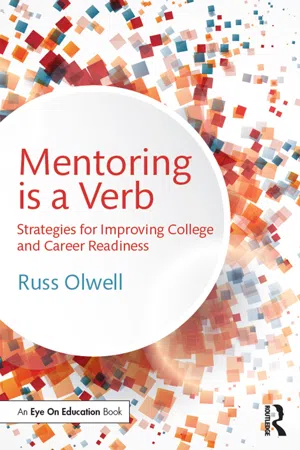
This accessible guide offers school leaders a wealth of strategies to foster a culture where educators engage with young people to encourage college readiness and career success. Based in research and best practices, Mentoring is a Verb explains how to build effective mentoring programs as well as encourage educators to individually mentor students. Olwell breaks down the key elements it takes to forge lasting relationships with students and addresses ways to connect to at-risk students. Packed with actionable steps, this book gives you the tools to help your students set high expectations and goals, recognize and address barriers to success, plan for the future, and reach their post-graduation aspirations.
- 154 pages
- English
- ePUB (mobile friendly)
- Available on iOS & Android
eBook - ePub
About this book
Information
1 Introduction
Mentoring Young People towards Post-Secondary Success
DOI: 10.4324/9781315680699-1
You know, sometimes I’ll go to an eighth-grade graduation and there’s all that pomp and circumstance and gowns and flowers. And I think to myself, “It’s just eighth grade.” To really compete, they need to graduate high school, and then they need to graduate college, and they probably need a graduate degree too. An eighth-grade education doesn’t cut it today. Let’s give them a handshake and tell them to get their butts back in the library!Barack Obama, June 15, 2008
Mentoring To and Mentoring Away From
Mentoring needs a direction. Without goals to strive for, mentoring programs are support groups, helping people endure and cope, not overcome. Some programs aim to mentor young people towards a positive path (such as college or a career); others aim to mentor young people away from more negative directions (such as juvenile crime). Both of these approaches are valid and their efforts can overlap. But this book focuses on mentoring that works to help young people attain their own goal of post-secondary education and careers.
Programs that have a singular focus, such as college, have a better chance of success because activities can be better planned, and results can be more accurately measured. To give examples, programs such as Upward Bound and GEAR UP (Gaining Early Awareness and Readiness for Undergraduate Programs) have an explicit goal in mind: successful application to, enrollment in, and completion of college. These programs certainly work best when participants share the program’s goals, and they are not designed to work with every single young person. But the program’s goals help structure its activities, and the results are more easily measured.
Why Getting Beyond High School Is Vital
Getting our children to graduate from high school is no longer enough in American education for the vast majority of families. Almost everyone will need some education or training beyond high school at some point in their career, and young people need to get in the habit of constantly improving their professional skills. For my grandparents, graduating from eighth grade was a significant achievement. My grandfather dropped out of high school to support his family in the Great Depression, meeting the expectations at the time for young men. Now, he and my grandmother would not be considered middle school graduates but high school dropouts, and federal programs would seek to enroll them in GED or other high school-completion programs.
My own parents’ academic achievements just a generation ago—a father with a BA in social work and a mother with a degree from a community college—while good for their neighborhood in Queens, would no longer be considered enough by many who point to the need for students to finish a bachelor’s degree and attend graduate or professional school. With many people in the workplace scrambling to add credentials and skills to their resumes (and LinkedIn pages), my parents’ career path—work at one work-place for decades—would seem stultifying or economically infeasible.
Over the past decade, the goal of moving students through the K–12 (kinder-garten to twelfth grade) system, graduating them with a diploma, and then expecting them to be able to find a job that provides for economic self-sufficiency, has dimmed. Young people themselves recognize the importance of graduating from high school with a diploma (not a GED), and moving on to college or some form of vocational training. While young people would like to contribute economically to their family through work, they recognize that the jobs that they can get without college are not a long-term solution to their family’s economic problems. Even while they may look for work and delay schooling to help their family, they continue to hold college as a long-term dream, if a dream deferred.
GEAR UP programs are designed to get students both excited about and ready for college. In our GEAR UP program, located in three low-income school districts in southeastern Michigan, we originally thought we would need to build motivation for attending college among students and their parents. But in our first surveys, we learned that more than 80 percent of students in seventh grade already held college as a goal, and more than 80 percent of their parents did as well. While students and parents were on the same page about college as a goal, their teachers did not view them as college material, estimating that only half as many of them (40 percent) would get to college.
The changing economy reinforces the need to build skills beyond high school. Jobs that require a bachelor’s degree are on the increase, as are “mid-skill” jobs that require some form of post-high school training or apprenticeship. In contrast, jobs that require limited skills or that are filled by people without even high school credentials are decreasing rapidly in numbers (Carnevale & Rose, 2015).

REFLECTION
- — What attitudes did you encounter about college in your family and neighborhood?
- — What is similar and different between those attitudes and those the young people you work with may have heard?
Encouraging the Next Steps
Efforts to get more young people to attend college date back over 50 years, to Sputnik and the War on Poverty. Upward Bound was founded in 1954 to help highly motivated high school students in low-income high schools graduate and attend college. Our Upward Bound program at Eastern Michigan University (EMU) in Ypsilanti, Michigan, serves 89 students in grades 9–12, as well as their families. More recent federal programs such as GEAR UP have worked to help entire grades of middle school students (usually a seventh grade) undertake a six-year march to college, often taking on hundreds or thousands of students in one program. (Our program at EMU had 1,200 seventh graders at the start.) Recent efforts such as the National College Access Network have sought to move whole twelfth-grade classes into college.
States have also undertaken ambitious changes to high school graduation requirements to try to boost college going. Based on the research of Clifford Adelman, states have required more mathematics classes to graduate from high school, more difficult coursework, and even taking math in twelfth grade to create a “toolbox” that offers the best odds of attending and succeeding in college. Adelman’s research (Adelman, 2006) showed that “of all pre-college curricula, the highest level of mathematics one studies in secondary school has the strongest continuing influence on bachelor’s degree completion. Finishing a course beyond the level of Algebra 2 (for example, trigonometry or pre-calculus) more than doubles the odds that a student who enters post-secondary education will complete a bachelor’s degree.”

TIE TO LEADERSHIP
Clifford Adelman’s study, The toolbox revisited (2006), had the following findings about high school curricula:
- The high school curricula that students take better predicts their graduation from college than their test scores or GPA (grade point average).
- The importance of curriculum is higher for African-American and Latino students than for white students.
- Students from a low SES (socio-economic status) background who attend a school with a strong curriculum perform better in college than the average high SES student.
No Easy Answers
All of the above efforts have run up against significant barriers that are often glossed over by politicians and educational policy makers. The schools that low-income students attend do not produce students who are “prepared” for many of the colleges to which they aspire. While students in low-income schools hope to attend selective colleges, and their GPAs can be at the level expected, standardized test scores lag, often far below what selective state institutions expect. While individual teachers and staff may struggle heroically to help students make this jump to college, the poorly functioning school system means that students ready to pursue their own aspirations are the exception at these schools.
While schools are part of the problem, families and neighborhoods can serve as barriers to students’ college going as well. The chaotic nature and complexity of American family life has meant that many parents and caregivers struggle with their own lives, never mind being able to positively impact the lives of their children. Despite high expectations and good intentions, many parents, grandparents, aunts, uncles, and other caregivers struggle to effectively help their children make a jump educationally that they themselves may not have made successfully.
The decline of blue-collar employment in many areas has pulled many neighborhoods into desperate circumstances. The new “lean enterprises” of today have shed many of the blue-, pink-, and white-collar jobs that meant the difference between poverty and prosperity for communities. This means that the financial and social resources that previous generations of students could rely upon are no longer there to support college and its tuition.

CONVERSATION STARTERS
- — How do you think your education and career will be different from those of your parents?
- — What trends do you see that may make your path different from theirs?
Students and their choices form another considerable barrier to college. While students profess high ambitions for themselves in terms of college and professional school, their day-to-day behavior sometimes does not match these goals. Choices based on the pursuit of popularity and celebrity, poor judgment that leads to unsafe behavior, and the use of violence to solve conflicts can all derail students’ academic careers.
These barriers—school, family, students, neighborhoods—are formidable. No program that works with young people can underestimate their impact. Policies that ignore these factors are doomed, or at least bound to be taught some hard lessons. Those who implement programs without respecting these barriers are simply inflicting pain on themselves and those they purport to help.

REAL PEOPLE
Some of a program’s mentees take longer to improve than others. A young man in our program struggled all the way from middle school to the first part of high school. Academically and athletically talented, he never seemed able to stay out of trouble, in or out of school. He argued with our program staff, fought fellow students, dropped out of programs we helped him get into, moved schools, disappeared.
Then one day in eleventh grade, he was back in the school we served— a new, focused young man. He attended our week of college search programming over the summer without incident. He was one of the few students we have who tackled the college application process with real determination, and got into the school he wanted to attend.
Resources
- Adelman, C. (2006). The toolbox revisited: Paths to degree completion from high school through college. Washington, DC: US Department of Education.
- Carnevale, A. & Rose, S. (2015). The economy goes to college: The hidden promise of college in the post-industrial service economy. Washington, DC: Georgetown University.
Part 1 What Is Mentoring?
DOI: 10.4324/9781315680699-2
2 What Does It Mean to Be a Mentor for Young People?
DOI: 10.4324/9781315680699-3
REAL PEOPLE
Many years ago, when I was an unfocused undergraduate, the world-famous philosopher, Cornel West, showed me what a mentor is ...
Table of contents
- Cover Page
- Half Title Page
- Title Page
- Copyright Page
- Dedication
- Table of Contents
- Meet the Author
- Preface
- Acknowledgments
- 1 Introduction: Mentoring Young People towards Post-Secondary Success
- Part 1: What Is Mentoring?
- Part 2: Becoming a Mentor
- Part 3: Basics of Post-Secondary Success
- Part 4: Mentoring over the Long Haul
- Part 5: Building Sustainable Programs
Trusted by 375,005 students
Access to over 1.5 million titles for a fair monthly price.
Study more efficiently using our study tools.
Frequently asked questions
Yes, you can cancel anytime from the Subscription tab in your account settings on the Perlego website. Your subscription will stay active until the end of your current billing period. Learn how to cancel your subscription
No, books cannot be downloaded as external files, such as PDFs, for use outside of Perlego. However, you can download books within the Perlego app for offline reading on mobile or tablet. Learn how to download books offline
Perlego offers two plans: Essential and Complete
- Essential is ideal for learners and professionals who enjoy exploring a wide range of subjects. Access the Essential Library with 800,000+ trusted titles and best-sellers across business, personal growth, and the humanities. Includes unlimited reading time and Standard Read Aloud voice.
- Complete: Perfect for advanced learners and researchers needing full, unrestricted access. Unlock 1.5M+ books across hundreds of subjects, including academic and specialized titles. The Complete Plan also includes advanced features like Premium Read Aloud and Research Assistant.
We are an online textbook subscription service, where you can get access to an entire online library for less than the price of a single book per month. With over 1.5 million books across 990+ topics, we’ve got you covered! Learn about our mission
Look out for the read-aloud symbol on your next book to see if you can listen to it. The read-aloud tool reads text aloud for you, highlighting the text as it is being read. You can pause it, speed it up and slow it down. Learn more about Read Aloud
Yes! You can use the Perlego app on both iOS and Android devices to read anytime, anywhere — even offline. Perfect for commutes or when you’re on the go.
Please note we cannot support devices running on iOS 13 and Android 7 or earlier. Learn more about using the app
Please note we cannot support devices running on iOS 13 and Android 7 or earlier. Learn more about using the app
Yes, you can access Mentoring is a Verb by Russ Olwell in PDF and/or ePUB format, as well as other popular books in Education & Education General. We have over 1.5 million books available in our catalogue for you to explore.