- 256 pages
- English
- ePUB (mobile friendly)
- Available on iOS & Android
eBook - ePub
Indian Buddhist Philosophy
About this book
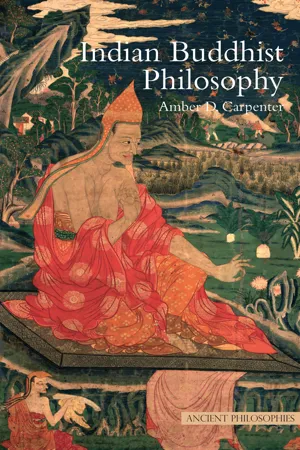
Organised in broadly chronological terms, this book presents the philosophical arguments of the great Indian Buddhist philosophers of the fifth century BCE to the eighth century CE. Each chapter examines their core ethical, metaphysical and epistemological views as well as the distinctive area of Buddhist ethics that we call today moral psychology. Throughout, this book follows three key themes that both tie the tradition together and are the focus for most critical dialogue: the idea of anatman or no-self, the appearance/reality distinction and the moral aim, or ideal. Indian Buddhist philosophy is shown to be a remarkably rich tradition that deserves much wider engagement from European philosophy. Carpenter shows that while we should recognise the differences and distances between Indian and European philosophy, its driving questions and key conceptions, we must resist the temptation to find in Indian Buddhist philosophy, some Other, something foreign, self-contained and quite detached from anything familiar. Indian Buddhism is shown to be a way of looking at the world that shares many of the features of European philosophy and considers themes central to philosophy understood in the European tradition.
Information
ONE
The Buddha’s suffering
The legend is familiar, and simply told. At the birth of the only heir to the family fortune, wise men confer and determine that the child will either be a great ascetic or else a great ruler. Greatly preferring the latter outcome for his son, the father does his best to bring up the boy in luxury, in a comfort designed to offer no occasion for untoward thoughts of renunciation or joining up with the wandering ascetics, society’s dropouts, known even in far-off Greece for their naked insight.
Suddhodana, even in the fifth century BCE, would not have been the first father whose careful, well-meaning plans were thwarted by a headstrong son. For adolescent Siddhartha Gautama, the heir apparent, takes to stealing away from the comforts of home, riding about town to discover what his father has been keeping from him. What he discovers, to his shock and dismay, is sickness: disease, aged decrepitude and death – all the ugly, mundane miseries that befall a person. Just as Suddhodana thinks he has his son safely married off, Siddhartha determines to leave it all behind and go out in search of some answers. Shortly after the birth of his own son, and in spite of all temptations to enjoy the goods that wealth, family and status can confer, Siddhartha slips away.
At that time there is no shortage of seekers and wanderers, so Siddhartha Gautama joins them, enduring all manner of extreme deprivation and learning what he can from whomever has something to teach. He quickly surpasses all his teachers in meditational states and ascetic practices but none of this gives him what he was looking for. On the verge of starvation, Siddhartha accepts an offering of food, sits beneath a pipal tree to meditate and wrestles with his demons – on some accounts for forty-nine nights – and in the morning he understands.
He is not at first convinced such understanding can be shared:
“I considered: ‘This Dhamma that I have attained is profound, hard to see and hard to understand … this generation delights in attachment …. It is hard for such a generation to see this truth …. If I were to teach the Dhamma, others would not understand me, and that would be wearying and troublesome for me.’ … Considering thus, my mind inclined to inaction rather than to teaching the Dhamma.”(MN 26, “Ariyapariyesana Sutta” [The Noble Search], §19)
He overcomes his reluctance, however, and without much confidence that he will be understood, Gautama – now awakened, buddha – begins to teach others what he has understood, and how. All his teachings are oral.1 He never returns to the householder’s life. After decades of teaching, the Awakened One passes away, without home, without possessions, without family, and without having written a word.
What he taught was collected after his death through the mutually verified recollection of those who were there. These sūtras, the discourses of the Buddha, form the basis of Buddhist thought and practice. The attempts by those who followed to make the descriptions of reality and of ourselves contained in these teachings clear, precise, consistent and compelling became the abhidharma – the higher teachings – and eventually became Buddhist philosophy.2
But what was it that bothered Siddhartha Gautama? What compelled him to abandon the palace? What was he looking for? The first thing the Buddha taught upon his enlightenment, and continued to teach for the rest of his life, was the truth of suffering; so this might provide some clue. But the banal, everyday misery we are all, to some extent, familiar with does not really explain anything, for it is precisely such misery that makes most of us long and strive for the cosseted life Siddhartha decides to abandon. Why did he not rather shrink back in horror when he saw the diseased man, decide his father was right, appreciate that he was himself a very lucky young man indeed and go on to become a powerful ruler over men? How was he seeing things instead?
The Buddha, Buddhism and Buddhist philosophy
Siddhartha Gautama, Sage of the Śakyas, belongs with Socrates and Diogenes of Sinope (called ‘dog-like’, cynicos) in being motivated to reflection by pressing practical concerns. The compulsion to philosophy comes from the question ‘How should I live?’, and this is a question in which everything is at stake.
Like the Greek tradition inaugurated by Socrates, followed through in various ways by Plato, Aristotle, the Stoics, the Sceptics and even the ancient Epicureans, the immediate and inescapable question ‘How should I live?’ leads Gautama, who will become awakened, just as immediately and inescapably to the question ‘What am I?’ and from there to ‘How am I situated?’ or ‘What is the nature of that reality I am part of?’ That is to say, ethics leads inexorably to metaphysics, to moral psychology, and to epistemology, as I ask about my relation to reality and capacities with respect to it.
The Buddhist tradition resembles the Greek in a more specific way, for both traditions favour strongly cognitivist, even rationalist, answers to these questions, although internal disputes remain about how that should best be understood. At the very least, knowing or investigating the true nature of reality and our own nature is part of the answer to the question ‘How should I live?’ The result is that, for the Buddhists, as for the Greeks, metaphysics matters.
From a contemporary perspective, this similarity between classical Greek and classical Indian philosophy is immediately striking because it is so strikingly at odds with contemporary academic philosophy. For the metaphysics that mattered to Plato and Vasubandhu alike was not some lofty examination of God, but metaphysics in that most mundane sense: the study of parts and wholes, of substance and attributes, and relations; questions about unity and multiplicity, identity over time and across distance, about causation – all those questions that arise in the examination of what things are real, and what is it for something to be real, and then by extension the study of our ways of relating to this reality.
Such everyday metaphysics and epistemology concern everyday life. Even if some kind of cognitive union with ultimate reality is itself a supreme good, the practice of seeing reality (and ourselves) as it is has practical consequences long before any such goal is reached. The way metaphysics matters morally is in the messy everyday of trying to live a better life and be a better person. In this, the similarity between ancient Greeks and Indians, and their distance from us, is manifested in a similarly comprehensive conception of the domain of the moral. We are concerned in both cases with living a life well, in all its aspects, and with improving our characters; for philosophers from both traditions such improvement and living well offered the only prospect for real happiness.
There are two ways in which metaphysics might matter morally, in this sense: (i) what is true makes a difference for ethical life; and (ii) seeking and understanding this truth matters. To say that metaphysics matters for the first reason is to see that one’s metaphysical view can underwrite or undermine various moral positions, moral behaviour or even morality itself (the ability to conceive of the ethical). It can lead to, force or preclude particular moral views, kinds of moral thoughts or even the possibility of thinking morally. In the second sense, it is doing metaphysics that matters: the practice of reflecting on, questioning and thinking over the basic nature of reality is good for your soul and good for your life; it is morally edifying to think about whether, for example, wholes are anything distinct from their parts. In what follows, we shall find that psychology, epistemology and metaphysics matter morally in both these ways for the Indian Buddhist philosophers.
Some methodological remarks are in order here. Buddhism is a religion and not every Buddhist has been interested in critical inquiry any more than every Christian has been interested in critical inquiry. Most people practising a religion want to know how the practice goes, what the framework is for thinking about things, and that basic questions as to the coherence of the view can be answered (by someone) satisfactorily. Others have cared very much to examine and discuss with each other what exactly the view of reality and of human nature and the good is, and what the implications of this are. And they have cared very much whether this view can be defended against the objections of less sympathetic inquirers. These latter engaged in philosophical debate with each other and with non-Buddhists, and they expected to be giving and receiving reasons and evidence that did not presuppose agreement.
Some of what we want to know is how this discussion unfolded and what the salient questions and debates were as they arose ‘from inside’, so to speak; but we might also bring our own questions to this discussion and look to draw out implications that – as it happened – never arose in classical India. In the former case, we must come to participate in a discussion that our familiarity with the European tradition has not equipped us to understand; in the latter case, we must in addition actually generate a discussion that has not yet taken place.
In this we must follow our instincts about which kinds of questions matter and we must not do our Buddhist authors the disrespect of keeping at such a careful, sanitized distance from their answers that any old absurdity might pass unchallenged, with an insipid ‘They thought differently then’. Refusing to engage critically is a refusal to take these thinkers seriously. At the same time, we must also engage respectfully, listening carefully to the texts we are reading, and making sure we do not simply force rigid preconceptions onto the material we are investigating. If we pose a question to which the texts seem only to offer stupid answers, or lame ones, we ought to consider whether our question is really as clever or deep as we suppose, or whether there might be a fundamental difference in orientation or aims, so that we are talking at cross-purposes. In the end, the whole exercise – like all good philosophical conversation – should reflect us back to ourselves, throwing into sharper relief our own categories, presuppositions and structures of thought, as well as illuminating new options for which we had not yet seen space.
What the Buddha understood: the four Noble Truths
There are four related claims at the centre of the Buddha’s teaching. Refinements in our understanding of these and their implications form the foundations out of which Buddhist philosophical thought developed. The four so-called ‘Noble Truths’ are:
- This is suffering.
- This is the cause of suffering.
- This is the cessation of suffering.
- This is the way to the cessation of suffering.
There is much left underspecified in these but we can see already that there are explicit claims being made about the nature of reality and its dynamics. The first Noble Truth asserts something about how things are. The second responds by inviting us to look at the cause or explanation: what makes reality be like that? And again, the third Noble Truth makes a reality claim: there is a cessation of suffering. And the fourth invites us to consider the cause of that previous claim: what are the causes of the state of affairs described in the third Noble Truth?
This dynamic move between observing what is, or how things are, and then investigating how they came to be so, is central to the character of Buddhist practical and ethical thought. ‘Seeing things as they are’ is one way of describing both Buddhist practice and the end to be attained; that everything has causes, and consequences cannot be changed without changing the causes, is one of the central lessons that one learns, and must learn over and over again. Pratītyasamutpāda – mutually dependent origination, or the insistence that everything comes to be depending on other things as their cause – is one of the core concepts deployed in articulating the Buddhist view of reality, and its precise meaning and implications will figure in one of the most important intra-Buddhist debates.
These debates move swiftly from suffering to mereology and trope theory; from dependent origination to anti-foundationalism; from psychology to non-conceptual content and a linguistic theory appropriate to it; from giving reasons to theories of reasoning. But as our exploration of the view framed by the four Noble Truths becomes increasingly sophisticated, we must not forget that these are the central claims of Siddhartha Gautama, known as Śakyamuni, the Sage of the Śakyas, who abandoned a life of luxury, fame, power and family – all the things that move us – because he could not go on living without seeking and finding this truth and, having found it, could never live in the same way again. That is, this might be metaphysics, epistemology, ethics, semantic theory and moral psychology – all the abstract areas of classical philosophical inquiry – but it is philosophy with consequences. Answers to these questions move us dynamically between the four Noble Truths, a deeper understanding of which moves us along the path out of suffering. There is a fundamentally practical, and ultimately optimistic, structure to the four principles taken together: although suffering does exist, it does not arise arbitrarily or inevitably. It has causes that we can not only grasp, but also remove. Experience does not have to be one of suffering, and we ourselves can make it otherwise.
Exploring the four Noble Truths
The centrality of suffering to Buddhism is both difficult to overlook and difficult to accept. It is fundamentally unlike the role suffering plays in Christianity, where it is presented as ennobling and purifying. For the Buddhist, suffering is simply how things are. In fact, it is how everything is: sarvaṁ duḥkhaṃ,3 ‘all is suffering’, or ‘everything suffers’.
This claim about the nature of reality – or of our experience of it – can strike one as either trivial or false, and not just at first blush. For it is not the case that every moment of life is miserable. But if the claim is merely that everyone suffers at some point or another, this is hardly news – and hardly worth leaving the comforts of a luxurious home to starve yourself for five years for, wandering homeless ever after. Granted that at some point or another everyone is faced with some suffering, it is hard to see what the problem is supposed to be here. On the other hand, if the claim is that everything is suffering – all our experiences are suffering ones – then this is just plainly false. There are moments of joy and rejoicing and pleasure and contentment, and even periods of life full of such things.
The claim might be the slightly more modest claim that on balance the miseries of life always outweigh the joys; or else that on reflection all those apparent joys are actually sufferings, whatever we might think or feel about them at the time. But again, both of these for...
Table of contents
- Cover
- Half Title
- Title Page
- Copyright Page
- Table of Contents
- Preface
- Acknowledgements
- Abbreviations
- Chronology
- Development of Buddhist thought in India
- 1. The Buddha’s suffering
- 2. Practice and theory of no-self
- 3. Kleśas and compassion
- 4. The second Buddha’s greater vehicle
- 5. Karmic questions
- 6. Irresponsible selves, responsible non-selves
- 7. The third turning: Yogācāra
- 8. The long sixth to seventh century: epistemology as ethics
- Epilogue
- Background information
- Notes
- Bibliography
- Index
Trusted by 375,005 students
Access to over 1.5 million titles for a fair monthly price.
Study more efficiently using our study tools.
Frequently asked questions
Yes, you can cancel anytime from the Subscription tab in your account settings on the Perlego website. Your subscription will stay active until the end of your current billing period. Learn how to cancel your subscription
No, books cannot be downloaded as external files, such as PDFs, for use outside of Perlego. However, you can download books within the Perlego app for offline reading on mobile or tablet. Learn how to download books offline
Perlego offers two plans: Essential and Complete
- Essential is ideal for learners and professionals who enjoy exploring a wide range of subjects. Access the Essential Library with 800,000+ trusted titles and best-sellers across business, personal growth, and the humanities. Includes unlimited reading time and Standard Read Aloud voice.
- Complete: Perfect for advanced learners and researchers needing full, unrestricted access. Unlock 1.5M+ books across hundreds of subjects, including academic and specialized titles. The Complete Plan also includes advanced features like Premium Read Aloud and Research Assistant.
We are an online textbook subscription service, where you can get access to an entire online library for less than the price of a single book per month. With over 1.5 million books across 990+ topics, we’ve got you covered! Learn about our mission
Look out for the read-aloud symbol on your next book to see if you can listen to it. The read-aloud tool reads text aloud for you, highlighting the text as it is being read. You can pause it, speed it up and slow it down. Learn more about Read Aloud
Yes! You can use the Perlego app on both iOS and Android devices to read anytime, anywhere — even offline. Perfect for commutes or when you’re on the go.
Please note we cannot support devices running on iOS 13 and Android 7 or earlier. Learn more about using the app
Please note we cannot support devices running on iOS 13 and Android 7 or earlier. Learn more about using the app
Yes, you can access Indian Buddhist Philosophy by Amber Carpenter in PDF and/or ePUB format, as well as other popular books in Philosophy & Eastern Philosophy. We have over 1.5 million books available in our catalogue for you to explore.