- 256 pages
- English
- ePUB (mobile friendly)
- Available on iOS & Android
eBook - ePub
W.V.O.Quine
About this book
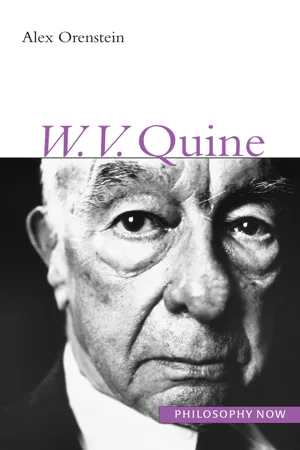
The most influential philosopher in the analytic tradition of his time, Willard Van Orman Quine (1908-2000) changed the way we think about language and its relation to the world. His rejection of the analytic/synthetic distinction, his scepticism about modal logic and essentialism, his celebrated theme of the indeterminacy of translation, and his advocacy of naturalism have challenged key assumptions of the prevailing orthodoxy and helped shape the development of much of recent philosophy. This introduction to Quine's philosophical ideas provides philosophers, students and generalists with an authoritative analysis of his lasting contributions to philosophy. Quine's ideas throughout are contrasted with more traditional views, as well as with contemporaries such as Frege, Russell, Carnap, Davidson, Field, Kripke and Chomsky, enabling the reader to grasp a clear sense of the place of Quine's views in twentieth-century philosophy and the important criticisms of them.
Information
Chapter 1
Introduction
Arguably, Willard Van Orman Quine is the most influential philosopher of the second half of the twentieth century. In many ways, his position and role in the second half of the century are comparable to Bertrand Russell’s in the first half. Quine is the leading advocate of a thoroughgoing form of naturalism whose central theme is the unity of philosophy and natural science. Philosophy so construed is an activity within nature wherein nature examines itself. This contrasts with views that distinguish philosophy from science and place philosophy in a special transcendent position for gaining special knowledge. The methods of science are empirical; so Quine, who operates within a scientific perspective, is an empiricist, but with a difference. Traditional empiricism, as in Locke, Berkeley, Hume, Mill and some twentieth-century forms, takes impressions, ideas or sense data as the basic unit of empirical thought. Quine’s empiricism, by contrast, takes account of the theoretical as well as the observational facets of science. The unit of empirical significance is not simple impressions (ideas) or even isolated individual observation sentences, but whole systems of beliefs. The broad theoretical constraints for choice between theories/systems such as explanatory power, parsimony, precision and so on are foremost in this empiricism. He is a fallibilist, and no belief is held as certain since each individual belief in a system is, in principle, revisable. Quine proposes a new conception of observation sentences, a naturalized account of our knowledge of the external world including a rejection of a priori knowledge, and he extends the same empiricist and fallibilist account to our knowledge of logic and mathematics.
Logic is confined to first order logic and is clearly demarcated from set theory and mathematics. These are all empirical subjects when empiricism is understood in its Quinian form. They are internal to our system of beliefs that make up the natural sciences. The language of first order logic – truth functional connectives, quantifiers, identity, schematic predicate letters and singular terms in the form of individual variables (names are dispensed with) – serves as a “canonical notation” in which to express our ontological commitments. The slogan “To be is to be the value of a variable” encapsulates this project. Deciding which ontology to accept is also carried out within the naturalistic constraints of empirical science; one’s ontological commitments should be to those objects that are indispensable to the best scientific theories. On this basis, Quine’s own commitments are to physical objects and to sets. Quine is a physicalist and a Platonist, since the best evidenced sciences require physical objects and the mathematics involved in these sciences requires abstract objects, viz. sets.
The theory of reference (which includes notions such as reference, truth and logical truth) is sharply demarcated from the theory of meaning (which includes notions such as meaning as opposed to reference, synonymy, the analytic–synthetic distinction and necessity). Quine is the leading critic of notions from the theory meaning, arguing that attempts to make the distinction between merely linguistic (analytic) truths and more substantive (synthetic) truths has failed. They do not meet the standards of precision to which scientific and philosophical theories ought to adhere, and which he maintains are adhered to in the theory of reference. He explores the limits of an empirical theory of language and offers as further criticism of the theory of meaning a conjecture of the indeterminacy of translation. His naturalist empiricism is also brought to bear on the theory of reference, where it yields a thesis of the inscrutability of reference (known also as ontological relativity and as global structuralism), and then to the theory of knowledge, where it gives rise to a naturalized epistemology.
Quine was born on 25 June 1908 and grew up in Akron, Ohio.1 He attended the local high school, where he pursued the scientific as opposed to the classical, technical or commercial courses. The choice was a natural one, as he exhibited a talent for mathematics. He also tried his hand at writing, contributing to the school newspaper and even winning a poetry contest. His extracurricular activities included an interest in geography and, during several summers, he drew and sold maps of nearby places. His pleasure in maps, along with a passion for travel, lasted a lifetime (years later he wrote reviews of atlases for the New York Review of Books). In his autobiography, The Time of My Life (1985), Quine mentions so many of the locations he visited that his friend Burton Dreben quipped that the autobiography should have been entitled “A Moving Van”.
Among his earliest philosophical reflections was a scepticism about religious matters. His reading of Edgar Allen Poe’s Eureka, which conveyed the excitement of coming to understand universe, was another occasion of early philosophical thought. Poe’s other writings furnished a rather mannered model for Quine’s early literary ventures. Quine is one of the most enjoyable philosophers to read (as quotations later in this work will reveal) and perhaps Poe’s use of alliteration was a factor influencing Quine’s colourful style. In his last year of high school, Quine developed a serious interest in language, particularly in questions of grammar and etymology.
When Quine entered Oberlin College in 1926, he was of a divided mind about whether to major in mathematics, philosophy or, for its linguistic interest, classics. A poker companion informed him that a certain Bertrand Russell had a mathematical philosophy. His friend’s knowledge was probably limited to the title of Russell’s book An Introduction to Mathematical Philosophy. Quine saw a way to combine two of his main interests and chose mathematics as a field of concentration and supplemented it with honours reading in mathematical philosophy. He started this reading in 1928. No one at Oberlin was versed in the recent revolutionary developments in logic – the works of Frege, Russell, Whitehead and so on. However, with outside help, Quine’s adviser, the chairman of the Department of Mathematics, came up with the list: Venn’s Symbolic Logic; Peano’s Formulaire de Mathématique; Couturat’s Algebra of Logic; Keyser’s The Human Worth of Rigorous Thinking; Russell’s Principles of Mathematics and Introduction to Mathematical Philosophy; Whitehead’s Introduction to Mathematics; and Whitehead and Russell’s Principia Mathematica. Quine would study these and report to his adviser on what he read. He pursued Russell into other domains on his own, reading Our Knowledge of the External World, The ABC of Relativity, various volumes of essays, and even, eventually, Marriage and Morals.
In the autumn of 1929, in his senior year, Quine began working on his honours thesis. He generalized a formula from Couturat and proved the generalization within the strict formalism of Principia Mathematica. If we form all intersections of n classes taken m at a time, and all unions n – m + 1 at a time, then the theorem says that the union of those intersections is the intersection of those unions. In order to do the proof, Quine had to master a significant portion of Principia Mathematica, one of the classics of the new logic. (He published a revised and much more elegant version of this proof a few years later in the journal of the London Mathematical Society.) His first scholarly publication, a review of Nicod’s Foundations of Geometry and Induction, was written for the American Mathematical Monthly at the close of his senior year.
Quine applied to Harvard to do graduate work because philosophy department was then the strongest in logic in the country. Its faculty included Alfred North Whitehead, the co-author of Principia Mathematica. Quine was awarded a scholarship and embarked on what was to result in a two-year PhD, studying with Clarence Irving Lewis, Henry Maurice Sheffer, David Wight Prall and, of course, Whitehead. Having completed his MA in the spring of 1931, Quine began his doctoral dissertation, “The Logic Sequences: A Generalization of Principia Mathematica”, that summer. In the dissertation there already appears a prominent theme of Quine’s philosophy: a concern with matters of ontology, that is, with questions of what there is. On such questions the classic Principia Mathematica, for all its greatness, embodies a number of excesses and confusions. In his dissertation and later works, Quine distinguishes and clarifies (1) the levels at which language is used, for example, to talk about non-linguistic objects or about linguistic ones, (2) the concepts of classes, properties, their names and the expressions used to describe them, and (3) he clarifies the status of and then rejects some aspects of Principia Mathematica, such as Russell’s ramified types and his axiom of reducibility. Wherever possible, Quine likes to get by with the fewest and clearest assumptions which will suffice to do the job at hand. Whereas Principia Mathematica is constructed on the basis of an ontology that comprises propositional functions, which are properties of a sort, and hence intensional entities, Quine’s revision tries accomplish the same goals with extensional objects such as classes.
In the same year, 1931, Quine had what he later described as his “most dazzling exposure to greatness”, when Russell came to lecture at Harvard.2 Russell was one of the most influential figures in Quine’s life, mainly through such works as Principia Mathematica, Introduction to Mathematical Philosophy, Our Knowledge of the External World and essays like the famous “On Denoting”. Both men shared a preoccupation with questions as to what there is. For example, Quine adopted and improved upon Russell’s view of how we express ontological claims. More significantly, as the dissertation already shows, Russell’s influence is that of a rival whose theories spurred Quine to criticize and to generate more acceptable alternatives. In ontology, Quine favours concrete individuals and, where necessary, classes, whereas Russell argued for properties as opposed to classes. In addition, some of Quine’s most famous systems of logic and set theory (theory of classes) are designed to achieve the same effects as Principia Mathematica while avoiding Russell’s theory of types.
As important as Quine’s two years of graduate work was his exposure to the European intellectual scene. Despite the strength of Harvard’s philosophy department in logic, it was out of touch with the much more advanced work then being done in Europe. Quine’s contact with this new material was to provide an intellectual awakening of the first order. During the first year (1932–33) of his four years of postdoctoral fellowships, Quine held Harvard’s Sheldon Travelling Fellowship and has written of this period as a personal renaissance in middle Europe.3 The reference is not so much to the time he spent in Vienna, as it is to the periods in Prague and Warsaw. In Vienna, Quine attended meetings of the Vienna Circle and became acquainted with Neurath, Schlick, Gödel, Hahn and Menger. (He had already met Herbert Feigl at Harvard the year before; indeed, it was Feigl and John Cooley who had suggested the trip.) Quine describes his six weeks in Prague and six weeks in Warsaw as “the intellectually most rewarding months I have known”.4 In Prague, he met Rudolf Carnap and attended lectures. He read, in German typescript, Carnap’s Logical Syntax of Language. Carnap was to become as strong an influence as Russell. The clash between Carnap and Quine, like that between Russell and Quine, has produced some of the most important philosophy of the twentieth century. Carnap was one of the more careful expositors of a number of ideas associated with contemporary philosophy, and especially with the central theses of the logical positivism of the Vienna Circle: (1) the verifiability criterion for the empirical meaningfulness of sentences; (2) the linguistic (analytic) character of a priori knowledge such as mathematics and logic; and (3) the triviality or meaninglessness of ontology as a species of metaphysics. Over the years, Quine subjected each of these theses to severe criticism and the debate on these issues can hardly considered to be over.
In Warsaw, Quine attended the lectures of Lesniewski, Lukasiewicz and Tarski. His exposure in Warsaw, Vienna and Prague to the developments in logic of that period brought Quine up to date in this area. In the next few years he would modify Tarski’s and Gödel’s “classic” formulations of modern logic to state some of his unique and most famous works in logic. Most immediately, he revised his dissertation into A System of Logistic (1934). Quine was very sympathetic to the Warsaw school of logicians and philosophers, particularly to those who took an extensionalist (i.e. abiding by certain replacement principles [see Chapter 7]), and at times even nominalistic (i.e. avoiding reference to abstract objects [see Chapter 3]), view.
Returning to Harvard in 1933, Quine was made a Junior Fellow of Harvard’s Society of Fellows. This freed him from teaching responsibilities for the next three years. (B. F. Skinner was another Junior Fellow. However, Quine’s behaviourism did not date from this acquaintance; it has its origin in his reading of Watson during his college days.) In this period prior to the Second World War, Quine worked out three of his distinctive positions: his conception of ontological commitment mentioned above; his most well-known systems of logic; and the first phase of his critique of the notion of analytic or linguistic truth. At this time, Quine also refined the ideas about existence and ontology which are by-products of the new logic. These ideas appeared implicitly at first in his dissertation and explicitly in such early works as “Ontological Remarks on the Propositional Calculus” (1934); “A Logistical Approach to Ontological Problem” (1939); and, in 1948, in one of his best-known essays, “On What There Is”.5
Throughout his life, Quine experimented with formulating different systems of logic and set theory. Most of these reforms were motivated by philosophical concerns. In the late 1930s and in 1940, he formulated his two most distinctive systems of logic and set theory, that of “New Foundations for Mathematical Logic” (1937) and that of Mathematical Logic (1940). Both systems are motivated by philosophical and in particular ontological concerns. They attempt to achieve the effects of Principia Mathematica – that is, a foundation for mathematics in terms of logic and set theory – while at the same time avoiding its excesses (especially the ontological ones). In addition, it is the formulation of these systems which provides the “canonic notation” of Quine’s philosophy.
The 1930s also saw Quine develop his criticism of the position that a priori knowledge as it purportedly exists in logic and mathematics is merely linguistic. This view that all a priori knowledge is analytic was a cornerstone of much analytic philosophy and an essential component of logical positivism. In 1934, Quine gave a series of lectures on Carnap’s work. Some of this material was eventually incorporated in his paper “Truth by Convention” (1936), in which he began to elaborate on his criticism of the view (to be found in Carnap among others) that at bottom, logic mathematics are based solely on linguistic conventions. In 1940, Rudolf Carnap, Alfred Tarski and Quine were together at Harvard and the three (joined at times by Nelson Goodman and John Cooley) would meet at Carnap’s flat and talk about philosophy. Carnap’s manuscript Introduction to Semantics provided the topic. Midway through Carnap’s reading of his first page, he distinguished between analytic and synthetic sentences (those based on language alone, e.g. “triangles have three sides” and those based on extra-linguistic facts, e.g. “the figure on the blackboard has three sides”). Tarski and Quine “took issue with Carnap on analyticity. The controversy continued through subsequent sessions, without resolution and without progress in the reading of Carnap’s manuscript.”5 Over the next few decades the controversy was to grow until the entire philosophical community became involved. In 1951 Quine would publish his most famous paper, “Two Dogmas of Empiricism”, where some of his criticisms of the analytic–synthetic distinction are crystalli...
Table of contents
- Cover
- Half Title
- Title
- Copyright
- Dedication
- Contents
- Preface
- 1 Introduction
- 2 Expressing an ontology
- 3 Deciding on an ontology
- 4 The spectre of a priori knowledge
- 5 The nature of logic
- 6 Analyticity and indeterminacy
- 7 Intensional contexts
- 8 Nature, know thyself
- Notes
- Bibliography
- Index
Trusted by 375,005 students
Access to over 1.5 million titles for a fair monthly price.
Study more efficiently using our study tools.
Frequently asked questions
Yes, you can cancel anytime from the Subscription tab in your account settings on the Perlego website. Your subscription will stay active until the end of your current billing period. Learn how to cancel your subscription
No, books cannot be downloaded as external files, such as PDFs, for use outside of Perlego. However, you can download books within the Perlego app for offline reading on mobile or tablet. Learn how to download books offline
Perlego offers two plans: Essential and Complete
- Essential is ideal for learners and professionals who enjoy exploring a wide range of subjects. Access the Essential Library with 800,000+ trusted titles and best-sellers across business, personal growth, and the humanities. Includes unlimited reading time and Standard Read Aloud voice.
- Complete: Perfect for advanced learners and researchers needing full, unrestricted access. Unlock 1.5M+ books across hundreds of subjects, including academic and specialized titles. The Complete Plan also includes advanced features like Premium Read Aloud and Research Assistant.
We are an online textbook subscription service, where you can get access to an entire online library for less than the price of a single book per month. With over 1.5 million books across 990+ topics, we’ve got you covered! Learn about our mission
Look out for the read-aloud symbol on your next book to see if you can listen to it. The read-aloud tool reads text aloud for you, highlighting the text as it is being read. You can pause it, speed it up and slow it down. Learn more about Read Aloud
Yes! You can use the Perlego app on both iOS and Android devices to read anytime, anywhere — even offline. Perfect for commutes or when you’re on the go.
Please note we cannot support devices running on iOS 13 and Android 7 or earlier. Learn more about using the app
Please note we cannot support devices running on iOS 13 and Android 7 or earlier. Learn more about using the app
Yes, you can access W.V.O.Quine by Alex Orenstein in PDF and/or ePUB format, as well as other popular books in Philosophy & Analytic Philosophy. We have over 1.5 million books available in our catalogue for you to explore.