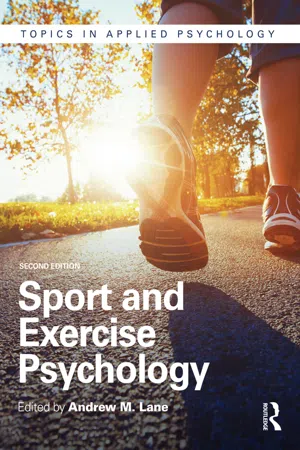
The new edition of Sport and Exercise Psychology asks four fundamental questions that get to the heart of this flourishing discipline: Taking an applied perspective that bridges the gap between sport and exercise, the book answers these questions by covering the key topics in the field, including confidence, anxiety, self-regulation, stress and self-esteem. There are also chapters on the role of music in performance, imagery and exercise addiction. Each chapter is written by an expert in that field, and includes a range of features illustrating specific issues, either within the research literature or their practical application. This is a comprehensive and engaging overview of an evolving discipline, and will be essential reading to any student of sport and exercise psychology. It will also be of huge interest to athletes and coaches seeking an accessible understanding of the role of psychology in sport.
- 346 pages
- English
- ePUB (mobile friendly)
- Available on iOS & Android
eBook - ePub
Sport and Exercise Psychology
About this book
Information
I What inner states influence what people think and feel and how they behave?
1 Mood and sport performance
Andrew M. Lane
DOI: 10.4324/9781315713809-1
Chapter Summary
Anecdotal quotes from athletes, coaches and fans report that playing and watching sport are emotional experiences. Watching Team GB win medal after medal during the summer Olympics of 2012 seemed to improve the mood of the nation. Yet, just 2 years later, England was feeling a sense of despair when the soccer team crashed out of the 2014 World Cup. The relationship between success and good and bad moods seems relatively straightforward on the face of it. Success brings happiness, and failure brings misery. Extending this thinking, does it also follow that feeling happy brings success, and feeling miserable brings failure? Listening to interviews with athletes and coaches alike, we hear evidence that sounds as though it supports this assumption. What is clear is that an inability to get it right mentally is cited by athletes and coaches as a reason for failure.
Amid the anecdotal evidence, the aspiring sport psychologist will be calling for an examination of evidence from scientific studies, and studies have focused on examining relationships between mood and performance. Researchers have taken measures of happiness and misery, examined how people performed and then correlated the two. If the above link between happiness and good performance held, then the researchers would find that happy performers were successful and miserable athletes failed. If we presume that the studies reported in the literature confirmed these ideas, then the extension would be to develop interventions to improve performance by making people happier, or worsen performance by making people feel miserable. And so, if that is the case, then sport psychologists should proceed to intervene at will! That is not the case, as the scientific basis for their work does not present such a clear view. Sport and exercise psychologists still believe that mood plays an important role in performance, and researchers continue to develop theories and methods to help identify meaningful relationships.
Sport and exercise psychology is a science, and practitioners base their work on evidence gathered from scientific studies. Evidence has to be gathered using rigorous methods, and, by the term rigour, I mean that the methods used are impartial and unbiased, and another researcher could reproduce them. One study finding that mood state X predicts performance is interesting, but 100 studies confirming this would provide a far more persuasive argument. The applied value of research is the extent to which it can say to a practitioner, if you do intervention X, it will have these effects, and be able to specify what those effects are. With reference to mood, we need to know the relationship between mood and performance, and so this chapter will focus on research that has investigated these two questions:
- ‘Does mood predict performance?’ (see Terry, 1995; Lane, 2007a); and
- ‘If I want to perform well, how should I feel?’ (see Lane, 2012; Lane et al., 2012).
In this chapter, I will focus on whether mood can predict performance: that is, if mood states assessed before competition predict performance. Fortunately, our task is made easier because a plethora of studies have examined mood–performance relationships. Unfortunately, the evidence base is not clear. Evidence indicates that mood–performance relationships are strong in some studies and weak in other studies. I will examine these studies and offer arguments to make sense of the literature.
Learning Outcomes
When you have studied this chapter, you should be able to:
- Evaluate mood–performance relationships reported in the literature and be aware of factors that influence this relationship
- Evaluate the conceptual model of Lane and Terry (2000) by examining studies that have tested it and describe the revised conceptual model proposed by Lane (2007a)
- Be aware of ethical issues that might be relevant in either the research or practical application of mood and performance
1.1 Activity
What mood states do I feel when I perform well? And what mood states do I feel when I perform badly? How do these states differ?
The aim of this activity is to examine whether your mood differs when you performed successfully in comparison with when you performed poorly. The method used to do this is seemingly simple and designed to help you explore what thoughts and feelings occurred when performing. Remember, this is a retrospective approach to assessing your moods, and how you remember you felt could be different from what you felt at the time. The aim of the exercise is to illustrate the fact that a great deal of measurement of mood depends on self-report. Engaging in the activity and thinking carefully about whether you can identify your thoughts and feelings should illustrate the difficulties researchers and practitioners face. It is hoped that you will get a sense that this is not an exact science, and that scores on the self-report scale or descriptions that come in qualitative accounts depend heavily on the extent to which you can accurately say how you felt.
| What to do? | Examples | Your go |
|---|---|---|
| 1 To start with, I want you to think carefully about when you performed very well in a competition. It’s up to you how you define very well. This could be achieving a personal best, winning or a sense that you performed your best; it’s up to you. Try to use a recent experience, but, if you have not competed recently, then think back to a time when you performed well; the more recent the better, as these experiences are fresh in your mind, but go back to an experience where your moods were intense and you remember how you felt, and remember it well | A distance runner: ‘Last weekend when I did a Personal Best’ A soccer player: ‘My best performance was in a game when I marked their best; I restricted her to just a few touches’ | |
| 2 Now remember how you felt before the competition started, consider how you felt physically, what were you thinking about and what emotions did you experience? | ‘I felt nervous, really nervous – constant loo stops but I felt positive and excited – I just wanted to get started’ ‘I felt up for the game; I was feeling full of energy’ | |
| 3 Write down all the moods you can recall experiencing. Use single words such as nervous, calm, excited, downhearted, happy, sad, vigorous or tired | ‘Excited’, ‘nervous’, ‘a little apprehensive’, ‘active’ | |
| 4 Write a sentence to capture what you felt | ‘I was excited because I thought I would perform well’ ‘I was sad because I knew I would not meet my expectations’ |
| What to do? | Examples | Your go |
|---|---|---|
| 1 To start with, I want you to think carefully about when you performed very poorly in a competition. It’s up to you how you define very poorly | A distance runner: ‘Last weekend when I felt I slowed down when I was tired – but I think I could have gone faster and I feel bad about myself now’ A soccer player: ‘My worst performance was in a game when I should have been concentrating on player X and I lost concentration in the game – my nerves were everywhere and I did not know what to concentrate on and then boom: 1 nil down and it’s down to me!’ | |
| 2 Now remember how you felt before the competition started, consider how you felt physically, what were you thinking about, and what emotions did you experience? | ‘I felt nervous, really nervous – constant loo stops; I wanted the event to be over – horrible’ ‘I felt so tired; I kept thinking, why do I feel like this, why now?’ | |
| 3 Write down all the moods you can recall experiencing. Use single words such as nervous, calm, excited, downhearted, happy, sad, vigorous or tired | ‘Downhearted’, ‘guilty’, ‘tired’, ‘grumpy’ | |
| 4 Write a sentence to capture what you felt | ‘I wanted to perform so well and when the day came I felt a wave of intense misery; I wanted to escape from these thoughts and feelings’ |
A very poor performance
Go through the same four-point procedure you used above, but this time think of a time you performed very poorly. Remember, how you define poor is up to you, but it should represent a performance when you performed below expectations.
I suspect your list will contain a mixture of pleasant and unpleasant emotions. For example, athletes can feel excited (pleasant) and nervous (unpleasant) before an important competition. Athletes usually feel a number of intense emotions.
There are not right or wrong mood states to feel, and sometimes athletes, and people in general, tend to think pleasant emotions (happiness, excitement) always help you perform better, and unpleasant emotions (anxiety, anger, sadness) get in the way of good performance.
The difficulty people have is that many people appear to perform very well when feeling anxious, or find happiness is not overly useful before competition. The idea is that anxiety tells you, ‘This is important, concentrate or you will fail’, and this type of message helps you get ready for performance, and that’s not a bad way to feel. Happiness can send the message, ‘All is well’. This is OK, but in sport, there are so many uncertain factors that it might not be wise to be overly happy; feeling happy is arguably a good thing if the athlete has a clear idea of what is required, however much he or she can do that. Feeling happy might not be a good thing if it signals complacency.
This exercise is useful, as it acts as a warm-up to the research questions that psychology literature has at...
Table of contents
- Half Title Page
- Series
- Title Page
- Copyright Page
- Contents
- List of contributors to the second edition
- Series preface—Graham Davey
- Introduction—Andrew M. Lane
- Part I What inner states influence what people think and feel and how they behave?
- Part II How can people manage or self-regulate their own inner states?
- Part III How can sport and exercise psychology professionals help people manage their inner states?
- Part IV Beliefs versus reality, or beliefs as reality?
- Index
Trusted by 375,005 students
Access to over 1.5 million titles for a fair monthly price.
Study more efficiently using our study tools.
Frequently asked questions
Yes, you can cancel anytime from the Subscription tab in your account settings on the Perlego website. Your subscription will stay active until the end of your current billing period. Learn how to cancel your subscription
No, books cannot be downloaded as external files, such as PDFs, for use outside of Perlego. However, you can download books within the Perlego app for offline reading on mobile or tablet. Learn how to download books offline
Perlego offers two plans: Essential and Complete
- Essential is ideal for learners and professionals who enjoy exploring a wide range of subjects. Access the Essential Library with 800,000+ trusted titles and best-sellers across business, personal growth, and the humanities. Includes unlimited reading time and Standard Read Aloud voice.
- Complete: Perfect for advanced learners and researchers needing full, unrestricted access. Unlock 1.5M+ books across hundreds of subjects, including academic and specialized titles. The Complete Plan also includes advanced features like Premium Read Aloud and Research Assistant.
We are an online textbook subscription service, where you can get access to an entire online library for less than the price of a single book per month. With over 1.5 million books across 990+ topics, we’ve got you covered! Learn about our mission
Look out for the read-aloud symbol on your next book to see if you can listen to it. The read-aloud tool reads text aloud for you, highlighting the text as it is being read. You can pause it, speed it up and slow it down. Learn more about Read Aloud
Yes! You can use the Perlego app on both iOS and Android devices to read anytime, anywhere — even offline. Perfect for commutes or when you’re on the go.
Please note we cannot support devices running on iOS 13 and Android 7 or earlier. Learn more about using the app
Please note we cannot support devices running on iOS 13 and Android 7 or earlier. Learn more about using the app
Yes, you can access Sport and Exercise Psychology by Andrew Lane, Andrew M Lane in PDF and/or ePUB format, as well as other popular books in Psychology & Applied Psychology. We have over 1.5 million books available in our catalogue for you to explore.