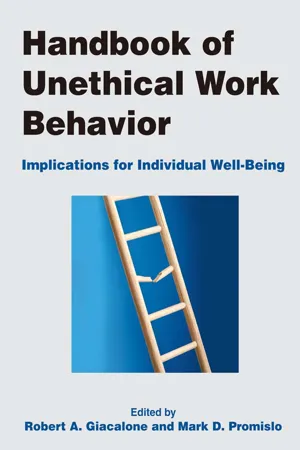
eBook - ePub
Handbook of Unethical Work Behavior:
Implications for Individual Well-Being
- 320 pages
- English
- ePUB (mobile friendly)
- Available on iOS & Android
eBook - ePub
Handbook of Unethical Work Behavior:
Implications for Individual Well-Being
About this book
This handbook covers the widest possible range of organizational misbehaviors (age, race, and gender discrimination, abuse, bullying, aggression, violence, fraud and corruption), all with an eye toward the effects on individual and organizational health and well-being. It is the first-ever single-source resource on this important topic.
Information
1
_________________________________________
_________________________________________
ETHICAL IMPACT THEORY (EIT)
Unethical Work Behavior and Well-Being
MARK D. PROMISLO, ROBERT A. GIACALONE, AND CAROLE L. JURKIEWICZ
If there was any doubt that ethical standards can have a significant impact on work life, research has shown that such doubt is unwarranted. A multitude of research has demonstrated that ethics is related to a variety of important job-related outcomes. For example, studies have shown that a higher ethical work climate (Mulki, Jaramillo, and Locander, 2008) and top leadership support for ethics (Viswesvaran, Deshpande, and Joseph, 1998) are both positively related to job satisfaction. Ethics codes (Valentine and Fleischman, 2008), ethics training, and perceived corporate social responsibility are also linked to job satisfaction.
Meanwhile, organizational commitment appears to be enhanced by a higher ethical climate, ethics institutionalization (the degree to which an organization incorporates ethics into its decisionmaking processes) (Singhapakdi and Vitell, 2007), and the existence of an ethics code (Valentine and Barnett, 2002). Employee retention is associated with ethics as well, as perceptions of a high ethical climate are negatively related to turnover intentions (Stewart et al. 2011). Schwepker’s (1999) research has shown that ethical conflict resulting from a lack of fit between a manager’s and employee’s values results in greater intention to leave the organization. Further, ethical climate influences both turnover intention (Mulki, Jaramillo, and Locander, 2008) and conflict with coworkers (Babin, Boles, and Robin, 2000).
Research has also shown the relationship of ethics to other aspects of organizational life. Corporate ethical values are positively related to person-organization fit (Valentine, Godkin, and Lucero, 2002), while ethical climate is associated with decreased individual misconduct (Andreoli and Lefkowitz, 2009), and a heightened degree to which employees identify with their organizations. Ethical practices can also reduce work-related conflict (Jaramillo, Mulki, and Solomon, 2006). A company’s ability to foster an ethical corporate culture is linked to an increased ability to attract employees (Sims and Kroeck, 1994) and to enhance job performance (Jaramillo, Mulki, and Solomon, 2006). Perhaps most interestingly, the perception of corporate ethical values is positively related to group creativity (Valentine et al., 2011).
While this research highlights the importance of ethics in creating valuable organizational outcomes, this chapter examines the other side of the coin and in a more personal domain. What are the effects on individual well-being when workers and organizations act unethically? Who gets hurt, and what are the negative outcomes of such behavior? Further, what processes (mediators) account for any harm to well-being? In this chapter we argue that the damage caused by unethical behavior needs to be examined holistically. To accomplish this, we adopt a human-centered approach advocated by Giacalone and Thompson (2006). This perspective targets the individual, nonfinancial effects of unethical behavior on employee well-being.
While evidence for the relationship between unethical actions and well-being has been documented (Agervold and Mikkelsen, 2004; Zapf, 1999), its scope has been circumscribed in a triangular fashion. One perimeter is constrained by a focus on discrete relationships between particular actions and well-being without connecting them to the broader domain of unethical work behavior. A second boundary is imposed by the lack of a conceptual link to theory; in other words, there is no framework within which to place this research. The third border limits research to those directly victimized by unethical actions, generally ignoring the wider number of individuals who are also harmed by unethical events. In this chapter, we transcend these limitations by advancing a theoretical approach to the relationship between unethical behavior and well-being, building on and expanding the work of Giacalone and Promislo (2010).
THE CONNECTION BETWEEN UNETHICAL BEHAVIOR AND WELL-BEING
Unethical behavior at work ranges from minor acts of deviance to immoral decisions that result in catastrophes such as the BP oil disaster in 2010 (National Commission on the BP Deepwater Horizon Oil Spill and Offshore Drilling, 2011). Three fields of research provide especially clear data on the connection between unethical workplace acts and well-being: discrimination, bullying, and injustice. Discrimination is conceptualized as either individual-level actions, such as biased personnel assessments (Landrine and Klonoff, 1996), or systemic conditions, such as segregation or glass ceilings (Krieger, 1999). Researchers have linked discrimination to detrimental effects on both psychological and physical well-being (Landrine et al., 2006). Individuals subjected to discrimination are likely to show symptoms such as cardiovascular reactivity (Guyll, Matthews, and Bromberger, 2001), sleep problems (Thomas et al., 2006), anxiety (Klonoff, Landrine, and Ullman, 1999), and mental health troubles (Schneider, Hitlan, and Radhakrishnan, 2000).
Arguably, the sturdiest evidence of the link between unethical activity and well-being is the body of research on bullying by peers (Lyons, Tivey, and Ball, 1995) and by supervisors, which Tepper (2000) labels “abusive supervision.” Bullying is defined as threatening and/or humiliating behavior that is unrelenting and malevolent toward another person (Lyons, Tivey, and Ball, 1995). Specific bullying behaviors encompass public humiliation, verbal abuse, isolation of workers, and physical intimidation (Mikkelsen and Einarsen, 2001). Research in this area has grown in tandem with the scope of the problem in modern organizations (Vega and Comer, 2005). Victims of bullying suffer from a host of problems such as depression (Niedl, 1996), low self-esteem (Zapf, Knorz, and Kulla, 1996), anxiety (Mikkelsen and Einarsen, 2001), job-induced stress (Agervold and Mikkelsen, 2004), insomnia (Vega and Comer, 2005), and even suicide (Rayner and Hoel, 1997). Bullying victims are also likely to hold pessimistic outlooks on life in general. Research suggests that the effects of bullying can persist over a long period of time and may even be permanent (Hoel, Faragher, and Cooper, 2004).
The literature on organizational injustice provides a third research domain linking unethical behavior to well-being. Repeated episodes of procedural, distributive, and interactional injustices can trigger stress that is linked to increased morbidity and mortality (Geronimus, 1992). Injustice has been connected to coronary heart disease (Kivimäki et al., 2005), sleep disorders (Elovainio et al., 2003), and sickness-related absenteeism (Elovainio, Kivimäki, and Vahtera, 2002).
| Proposition 1: | Unethical behavior at work will be associated with diminished psychological and physical well-being in those victimized by the behavior. |
OTHERS HARMED BY UNETHICAL BEHAVIOR
In studying the outcomes of unethical workplace behavior, researchers typically focus on its direct victims (Giacalone and Promislo, 2010). This tendency is understandable; after all, victims are the most visible and the easiest to identify. If a manager discriminates against a worker based on race, people feel outraged and sympathize with the employee. Still, despite these emotions, a focus only on victims provides a myopic view of the potential people who can be harmed by unethical actions. We argue that unethical behavior can also lead to diminished well-being for perpetrators themselves, witnesses to the act, and others indirectly involved, such as coworkers, family, and friends (Evans et al., 2007).
Perpetrators of Unethical Behavior
Those who commit unethical acts are generally held in disdain and thus it is not surprising that the impact on the perpetrators themselves has been little studied. But this disregard for the perpetrator fails to appreciate that situational contexts can exert a powerful influence on individual behavior, leading some to act in violation of their own moral precepts. Milgram’s (1975) renowned experiments on obedience to authority first brought this behavioral pattern to light. Further, cultures characterized by extreme competitiveness (Kohn, 1986) or large power disparities (Zimbardo, 2007) can goad individuals into committing unethical acts.
Notably, some research indicates that perpetrators can be harmed by their own actions. Some individuals may behave unethically yet be uncomfortable with what they have done; perhaps the social and professional pressures they face to behave wrongly are too strong to resist, yet the cognitive dissonance remains (Evans et al., 2007). In the face of such pressures, some individuals willfully violate their own moral standards. Then, stressed by personal guilt, fear of being caught, or anxiety about the shame they may face, people may experience harm to their well-being (Byrne, 2003).
| Proposition 2: | Engaging in unethical behavior that violates one’s personal ethical standards will be associated with diminished psychological and physical well-being. |
Witnesses to Unethical Behavior
Beyond the perpetrators and victims, individuals who witness unethical acts, or those who are connected with a perpetrator, witness, or victim, may also show diminished well-being. This can be the result of experiencing the shock of witnessing an immoral act (Bloom, 1995) or vicarious harm by virtue of an empathic attachment to someone cared about (Sexton, 1999).
Those who witness unethical behavior can be harmed in one of three ways (Bloom, 1995): they can be affected because of their empathy for the victim or perpetrator (Pearlman, 1995); they can also be affected by viewing the act through the lens of their own fears (Grimberg, Moore, and Ureenberg, 2001), feeling that they, too, could be similarly victimized or forced to engage in unethical acts; and finally, they can witness behavior that shatters their worldview, their conception of organizational systems, or the character of society (Janoff-Bulman, 1989).
The negative impact of unethical behavior can also extend to those who simply hear about a disturbing incident. For example, people experience distress over reports of societal harms or family victimizations, although they have not directly witnessed these acts (Bell and Jenkins, 1993). In the same vein, those who work in a group with a high level of ambient sexual harassment can experience distress even if they are not directly subjected to the abuse (Glomb et al., 1997).
| Proposition 3: | Employees who are aware of, or witness, unethical acts that violate their personal ethical standards will suffer diminished psychological and physical well-being. |
“Associated persons,” those with connections to the perpetrator, victim, or witness (such as family members or coworkers) can also experience reduced well-being. For example, a husband who knows his wife is bullied at work can, through his empathy for her, experience distress. To be affected, an associated person must have a strong connection to the perpetrator, victim, or witness, such that either: (1) they are emotionally connected to the distress those persons exhibit and can empathize with their situation (Pearlman, 1995); or (2) the unethical ...
Table of contents
- Cover
- Half Title
- Title Page
- Copyright Page
- Dedication
- Table of Contents
- Foreword, Diane L. Swanson
- Preface, Robert A. Giacalone and Mark D. Promislo
- 1. Ethical Impact Theory (EIT): Unethical Work Behavior and Weil-Being
- Part I. Attacking Others: Revenge, Aggression, Bullying, and Abuse
- Part II. Harmful Behaviors and Work Stress
- Part III. Individual Differences, Justice, and Moral Emotions
- Part IV. Organizational and Societal Perspectives
- Name Index
- Subject Index
- About the Editors and Contributors
Trusted by 375,005 students
Access to over 1.5 million titles for a fair monthly price.
Study more efficiently using our study tools.
Frequently asked questions
Yes, you can cancel anytime from the Subscription tab in your account settings on the Perlego website. Your subscription will stay active until the end of your current billing period. Learn how to cancel your subscription
No, books cannot be downloaded as external files, such as PDFs, for use outside of Perlego. However, you can download books within the Perlego app for offline reading on mobile or tablet. Learn how to download books offline
Perlego offers two plans: Essential and Complete
- Essential is ideal for learners and professionals who enjoy exploring a wide range of subjects. Access the Essential Library with 800,000+ trusted titles and best-sellers across business, personal growth, and the humanities. Includes unlimited reading time and Standard Read Aloud voice.
- Complete: Perfect for advanced learners and researchers needing full, unrestricted access. Unlock 1.5M+ books across hundreds of subjects, including academic and specialized titles. The Complete Plan also includes advanced features like Premium Read Aloud and Research Assistant.
We are an online textbook subscription service, where you can get access to an entire online library for less than the price of a single book per month. With over 1.5 million books across 990+ topics, we’ve got you covered! Learn about our mission
Look out for the read-aloud symbol on your next book to see if you can listen to it. The read-aloud tool reads text aloud for you, highlighting the text as it is being read. You can pause it, speed it up and slow it down. Learn more about Read Aloud
Yes! You can use the Perlego app on both iOS and Android devices to read anytime, anywhere — even offline. Perfect for commutes or when you’re on the go.
Please note we cannot support devices running on iOS 13 and Android 7 or earlier. Learn more about using the app
Please note we cannot support devices running on iOS 13 and Android 7 or earlier. Learn more about using the app
Yes, you can access Handbook of Unethical Work Behavior: by Robert A Giacalone,Mark D Promislo in PDF and/or ePUB format, as well as other popular books in Psychology & Business General. We have over 1.5 million books available in our catalogue for you to explore.